Siena Neighbourhoods Guide: Terzi, Contrade and Where to Stay
Compare Siena's three terzi for atmosphere, walking and where to stay, and learn how the 17 contrade shape the city you will actually walk through.
On this page
Siena is small enough to cross on foot yet layered enough that two visitors can stay a few minutes apart and have completely different trips. The city organises itself twice: into three terzi for administration, and into seventeen contrade for identity, the neighbourhood associations whose emblems mark walls across the historic centre. Understanding both layers is the fastest way to read a map, pick a base and avoid misreading local symbols as tourist branding.
One concrete detail worth fixing before you book: the Palio is run in the Campo on 2 July and 16 August each year, according to the Comune di Siena, so any stay near the shell-shaped square should be checked against those windows. This guide treats the terzi broadly as orientation, explains how contrada emblems work, and keeps practical arrival decisions separate from sightseeing so luggage day does not derail your first afternoon.
Quick Orientation: Two Layers of Siena Geography
The terzi are the city's three historic thirds, and they matter to a visitor mainly as a rough compass: one wraps the Duomo side, one sits toward the Campo's southern edge, and one covers the northern arrival zone. Precise boundaries are not obvious on the ground, so treat any terzi description as orientation guidance, not a hard rule about which street belongs where.
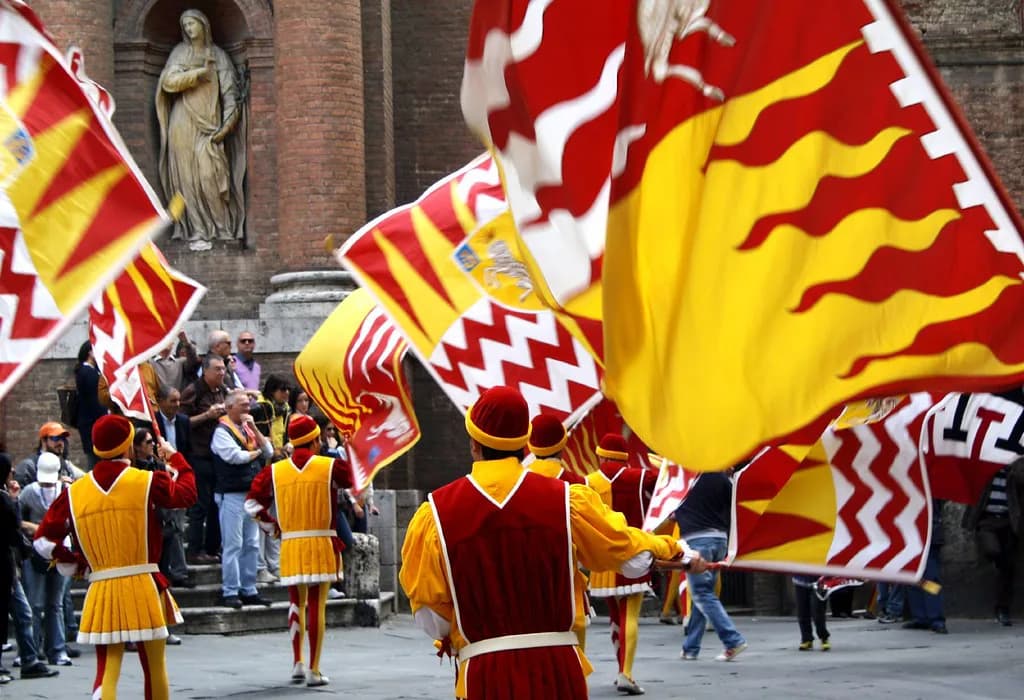
The contrade are a different system entirely. A travel feature on Siena's neighbourhood culture describes seventeen contrade named after animals and colours, with Panther, Lion, Turtle, Snail and Dragon among them, and their emblems visible on buildings as you walk. These are identity markers that residents carry for life, not bookable districts or hotel zones, so admire the symbols without treating them as a directory.
Keep the two layers separate in your planning: use the terzi to decide roughly which side of the centre suits your stay, and treat the contrade as culture you will notice once you arrive. If the horse race and its rituals interest you, the dedicated material on the Siena Contrade and the Palio is the better place to go deeper.
The Detail to Fix First: The Campo and the Ring Around It
Piazza del Campo is the reference point for everything else. It is shell-shaped and slopes down toward its lower edge, a design that, as one travel account explains, gives spectators a view of the races, and its nine segments are often read as a nod to the medieval government of the Nine. Once you picture that bowl, you can place most addresses as uphill, downhill, or off to one side of it.
The civic core sits directly on the square: Palazzo Pubblico, still the seat of city government since the thirteenth century, the Torre del Mangia rising above it, and the Fonte Gaia fountain at one side. Treat this cluster as your anchor and you will rarely be truly lost, even in the tangle of lanes behind it. For a broader inventory of what sits where, the Siena Attractions hub collects guides to individual sights.
Terzo di Città: The Duomo Side
For orientation purposes, think of the Terzo di Città as the third that holds the Duomo and the Santa Maria della Scala complex, the former hospital turned museum just across from the cathedral. If your priority is being on the doorstep of the city's headline monuments when they open, a base on this side saves you a climb each morning, though you should verify current entry arrangements on the official sites rather than relying on old guides. A detailed guide to Santa Maria della Scala is available if you plan to visit the complex itself.
A stay here suits travellers who plan around sights and early starts rather than long evenings out. The trade-off is that the area around the Duomo draws steady daytime foot traffic, so expect company rather than solitude, and budget separately for interiors: the square outside is public space, while the cathedral and museum complex are ticketed on their own terms.
Terzo di San Martino: Between the Campo and the South
The Terzo di San Martino occupies the part of the centre that includes the Campo and runs toward the southern edge of the historic core. Practically, this makes it a strong candidate if you want dinner and an evening stroll within a short walk of your bed, since the square's cafés and restaurants are right there. Confirm the exact position of any address on a map before booking, because the terzi labels are not signposted at street level.
The walking here is the classic Siena equation: short distances but constant gradients. A place that looks five minutes away on the map may involve a steep climb, so read reviews for mentions of stairs and check whether your luggage can be handled on foot, especially since vehicles are restricted in the centre.
If you want a structured route through this side of town, the Siena Self-Guided Walk Through the Old Town links the Campo with the streets behind it without claiming any official status.
Terzo di Camollia: The Northern Arrival Side
The Terzo di Camollia covers the northern part of the centre, the side you meet first when arriving from the station or the main bus hub at Piazza Gramsci. That makes it useful as an arrival base rather than a sightseeing one: you drop your bags quickly, then walk uphill into the monuments at your own pace. The bus hub, taxi rank and car parks around the Fortezza Medicea sit on this side of the city.
Choose this third if you value an easier exit on departure day, or if you are arriving late and want a short transfer. Accept the uphill walk to the Campo in exchange, and note that the station itself sits below the centre, so the final stretch into town is on foot or by bus or taxi rather than a stroll.
How to Identify a Contrada as You Walk
Contrada emblems appear on walls, fountains and doorways throughout the centre, and they are the quickest way to sense which part of town you are in. The animals and colours are not decorative flourishes but badges of belonging, and residents support their contrada the way others follow a football club. Reading them as neighbourhood identity rather than tourist theming is the respectful approach.
You will also see contrada names on plaques and banners, and some churches and chapels are associated with particular ones. Photograph the emblems freely, but do not wander into private contrada premises or treat rituals as photo opportunities. If you want the deeper history, the Siena contrade and Palio guide covers the institutions and their annual calendar.
The Palio in Practice: Culture, Not a Booking Category
The Palio is run twice a year in the Campo, on 2 July and 16 August, as the city's own site states. Those are the dates to check against your travel plans if you want to be in Siena for the race, or to avoid the crowds if you do not. Ticketing and spectator arrangements are a separate matter from the dates themselves, so verify them through official channels rather than assuming access.
Outside race days the square returns to being a public space, free to walk across and ringed by cafés. That distinction matters for budgeting: the Campo and its civic buildings are part of the everyday city, while the museums and towers you enter are ticketed individually. Check each official site for current prices and opening times instead of trusting older guidebooks.
Where to Stay: A Decision Framework by Walking Effort
Start with one question: how much hill do you want between your bed and the Campo? A base on the Duomo side suits sightseeing-first trips and early starts. A base near the Campo or slightly south suits evening meals and wandering. A base in the Camollia area suits easy arrivals and departures, accepting a climb whenever you head to the centre.
Next, weigh noise against convenience: rooms close to the Campo put you in the middle of everything, including late-night foot traffic and, on race days, crowds. Then confirm the practical details before booking: whether the property is inside the restricted centre, how you will move luggage, and whether stairs are involved. Hotels near the centre are also handy for a rainy day in Siena, when you want to duck in and out between showers.
If comparing Italian cities, the Bologna neighborhoods guide and the Turin neighborhoods guide apply the same logic elsewhere: pick the area by how you will spend your evenings and how much walking you accept, not by a single landmark on the map.
Getting In and Around With Luggage
Only buses, taxis and cars with permits can drive into the historic centre, and the main access point and bus hub is Piazza Gramsci, with taxis waiting nearby and car parks circling the Fortezza Medicea. Plan arrival day around that reality: you will likely finish the journey on foot, so pack for cobbles and stairs rather than assuming a door-to-door drop-off.
For getting around once you are settled, walking is the default in the centre, and the hills are the main cost. If you need a rest, the city's official site lists contacts and services, including the municipal URP number, which is the right place to check current local information rather than relying on outdated guide entries.
Anchor Sights by Area
On the Campo side, Palazzo Pubblico and the Torre del Mangia anchor the civic square, while the Duomo complex and Santa Maria della Scala anchor the cathedral side. Each is a distinct ticket, so plan a budget line per interior rather than assuming one pass covers the cluster. If you want alternatives beyond the headline sights, the hidden gems in Siena page widens the field.
For the churches away from the main squares, including the Basilica of San Domenico above the western edge of the centre, check current visiting arrangements on the spot or via official parish channels. A slow, food-focused afternoon is another way to reset after a monument-heavy morning, and the Siena local food guide covers the dishes worth seeking out.
Practical Mistakes to Avoid
The most common error is treating contrade as neighbourhoods you can book into. They are civic and social institutions, not districts with hotels, so search for accommodation by street and map position instead. The second mistake is under-packing for stairs: Siena's centre is stepped and steep, and a heavy suitcase on cobbles is the fastest way to sour an arrival.
A third is planning around the Palio as if it were a normal festival with predictable access. Outside the race days in July and August, the Campo is simply a public square, and your plans should hinge on the ordinary city first. Verify any special arrangements with the Comune before building a trip around them.
A Suggested Half-Day Shape: Campo to Duomo
Start on the Campo, circle the civic buildings and the Fonte Gaia, then climb the lanes toward the Duomo for the cathedral and Santa Maria della Scala. This is a suggestion rather than an official route, and it works because the two poles sit close together with plenty of lanes to explore between them. Build in a coffee stop so the gradient does not turn the morning into a march.
If you have a full day rather than half, extend the loop back down toward the southern side and pick up a slower activity such as a market or a long lunch. The self-guided walk can supply the connective tissue for either version.
Plan Your Siena Base
Choose your Siena base by the shape of your day: sightseeing-first near the Duomo, evening-first around the Campo, or arrival-first on the Camollia side. Use the terzi as a rough compass and the contrade as culture to notice, and verify the practical details before you commit.
Check current dates, opening arrangements and prices through the Comune and the individual sites rather than old guides, and pack for hills and stairs. Get those few decisions right and the city's labyrinth becomes a pleasure rather than a puzzle.
Frequently Asked Questions
What are Siena's three terzi and does it matter where I stay?
The terzi are the city's three historic thirds, commonly described as Città, San Martino and Camollia. They matter as rough orientation for choosing a base: the Città side wraps the Duomo, San Martino includes the Campo and the south, and Camollia covers the northern arrival area. Exact boundaries are not signposted clearly, so confirm the position of any specific address on a map.
How many contrade are there in Siena and what do their symbols mean?
Seventeen contrade are described in travel accounts of Siena, named after animals and colours such as the Panther, Lion, Turtle, Snail and Dragon. Their emblems appear on walls and buildings as identity markers for residents, not as tourist districts. Admire them respectfully and avoid entering private contrada premises.
Is it possible to walk everywhere in Siena's historic centre?
Yes, walking is the normal way to move around the centre, but the city is built on hills and steps, so short map distances can be steep in practice. Wear suitable shoes and allow extra time for climbs between the Campo and the Duomo. For longer trips to the station or the edge of town, use buses or taxis.
Can I drive or park in central Siena?
Only buses, taxis and cars with permits can drive into the historic centre. Most visitors arrive at the bus hub at Piazza Gramsci or the car parks around the Fortezza Medicea and continue on foot. If you need specific parking or access rules, check the Comune di Siena's site rather than relying on general guides.
When does the Palio take place in Siena?
According to the Comune di Siena, the Palio is run in the Campo on 2 July and 16 August each year. Spectator arrangements and ticketing are separate matters, so verify them through official channels before planning a trip around the race.
Which area of Siena is best for a first visit?
For a first visit, a base near the Campo suits many travellers because it puts the civic square, evening cafés and the route to the Duomo within walking distance. Choose the Camollia side if easy arrival and departure matter more, and the Duomo side if early sightseeing starts are the priority. Weigh hills, noise and luggage logistics before deciding.
Sources
Continue exploring
More guides you'll find useful