San Gimignano Viewpoints: Free Rocca, Wall Spots & Tower Climbs
A practical guide to San Gimignano viewpoints: the free Rocca di Montestaffoli, wall and street angles, and which tower climbs are worth the effort.
On this page
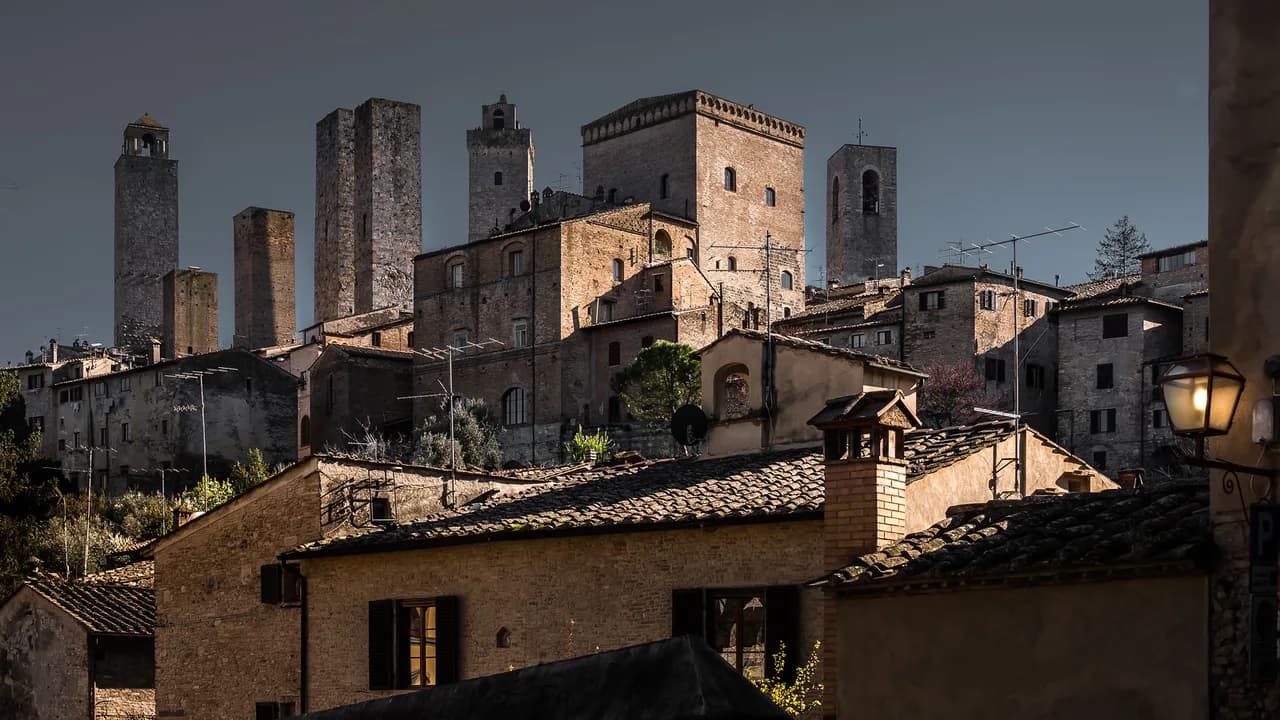
San Gimignano's skyline does most of the work before you even pay for a view. The town is built around a cluster of medieval towers that once numbered far more than the survivors you see today, and the historic centre holds UNESCO World Heritage status. That makes the simplest viewpoint strategy a matter of choosing elevation carefully rather than chasing one famous balcony.
The practical decision is this: use free high ground and street corners first, then decide whether a climb adds something the ground-level views do not. The Rocca di Montestaffoli and the streets around the two central piazzas give you the tower silhouette without a ticket. A tower ascent gives you the roofs, the surrounding hills and a different angle on the towers themselves.
Why San Gimignano's Skyline Is Worth Seeking Out
San Gimignano is known for its towers, and the comparison with other Tuscan hill towns is unavoidable once you reach the walls. The historic centre is UNESCO-listed, and the tower silhouette is the reason many travellers stop here rather than pass by on the road between Siena and Florence. The best viewpoints are not all about height: some of the strongest images come from looking along a street as the towers stack up behind the rooftops.
The town also has a deep practical layer that affects how you plan a viewpoint day. The Comune di San Gimignano publishes news and notices on its official site, including items on traffic, local works and the controlled-access zone in the historic centre. That matters if you arrive by car and intend to move between viewpoints outside the walls later in the day. Check the municipal notices before you commit to a parking and walking plan.
For a broader set of lower-key stops, the guide to hidden gems in San Gimignano is a useful companion to this one. It helps you see the town as more than a single tower climb and a gelato stop. Pair it with the viewpoint plan below so you are not criss-crossing the centre unnecessarily.
Quick Answer: Free Viewpoints First, Paid Climbs Second
Start with the free options. The Rocca di Montestaffoli and its park sit on high ground and are reached by a short staircase, which makes them the lowest-effort way to get above the rooftops. The streets around Piazza della Cisterna and Piazza del Duomo give you the towers from below, and the side streets on the edge of the centre open up views toward the surrounding countryside.
Then decide whether you want to pay for a climb. Torre Grossa is the tallest tower and the one most visitors target, but it is a real ascent rather than a lift ride. The shorter tower-house option at Torre Salvucci Maggiore is a different trade-off, and it may be closed to visitors when it is rented out. Choose one climb rather than both unless you have a full day and a strong interest in tower architecture.
Parco della Rocca and Rocca di Montestaffoli: The Free High Ground
Parco della Rocca is the simplest free viewpoint in San Gimignano. A short staircase leads up to the Rocca di Montestaffoli, where you get a raised look back at the towers and across the town's rooftops. It is a park rather than a monument, so you can linger without feeling rushed, and the climb is measured in steps rather than minutes of stair work.
This is also the spot to combine a view with a local drink. The park houses the Vernaccia di San Gimignano Wine Experience, where you can taste the white wine produced in the hills around town. If you are short on time or travelling without a car, this is a practical alternative to a winery visit in the countryside. The same source notes that a proper winery trip adds at least half a day and is best done by car.
If your priority is a low-cost day, this is the viewpoint to build around. The wider list of free things to do in San Gimignano covers other stops that pair well with the Rocca. Use the park as a first stop in the morning or a late-afternoon breather rather than a mid-day detour when the centre is busiest.
Where to Stand for the Tower Silhouette: Piazzas and Side Streets
Piazza della Cisterna and Piazza del Duomo are the two squares that frame the towers most clearly. Piazza della Cisterna takes its name from the well at its centre and is ringed by shops and cafes, while Piazza del Duomo puts you beside the collegiate church and the Palazzo Comunale. Neither is a quiet viewpoint, but both let you see the tower cluster without buying a ticket.
The side streets are where the town opens up. On the edge of the centre, streets such as Via Bonda give an unobstructed view of the Tuscan hills behind the rooftops, and it is the kind of corner you find by wandering rather than following a fixed route. Treat these lanes as residential space, keep your voice down and do not block doorways while you take photographs.
If you want a structured route through these streets rather than an aimless loop, a self-guided walk through San Gimignano can keep you moving in a sensible order. Build in a short pause at each square so you are not just passing through on the way to the next tower. The viewpoints work best when you give them a few minutes rather than a single glance.
The Wall Route Between Porta delle Fonti and Porta Quercecchio
A described route follows the outside of the medieval walls from Porta delle Fonti to Porta Quercecchio. You are not walking on top of the walls; you are circling their exterior, which gives a different perspective on the town's defences and the landscape beyond. Treat it as a walking suggestion rather than an official waymarked trail, and check the route on a map before setting out.
The walls are also useful for orientation. The main gates, including Porta San Giovanni at the southern end and Porta San Matteo to the northwest, help you link viewpoints to the streets that lead back into the centre. If you walk the wall route, plan where you will re-enter the town so you do not end up circling further than you intended.
Torre Grossa: What the Main Climb Actually Gives You
Torre Grossa rises about 54 metres above Piazza del Duomo, and the climb involves roughly 218 steps. The final section is closer to a ladder than a staircase, so it suits travellers who are comfortable with steep, enclosed spaces. The reward is a 360-degree view over the rooftops, the other towers and the hills beyond the walls.
The tower is reached through the Palazzo Comunale, which also houses the Civic Museum and the Pinacoteca art gallery. A source describes these as being included on a single ticket, but ticketing arrangements and opening hours can change, so confirm the current scope at the ticket desk or on the official site before you rely on it. Do not assume a museum ticket automatically covers every tower or church in town.
For a step-by-step look at the ascent, the guide to climbing the Torre Grossa in San Gimignano covers the route and the practical details. Read it before you decide, especially if you are travelling with children or anyone who dislikes heights. If the climb is the main reason for your visit, go early in the day and treat the museum as a bonus rather than a separate stop. For wider planning, see Climbing the Torre Grossa in San Gimignano.
Ticketing Reality Check: Museum, Gallery and Tower
San Gimignano's main civic sights are often presented as one combined visit, with the Civic Museum, the Pinacoteca and the Torre Grossa climb grouped together. That is a helpful starting assumption, but it is not a guarantee that the same arrangement applies on your date. Ask at the ticket desk exactly what is included before you pay, and check the official San Gimignano site for current opening times and any seasonal variations.
It is also worth separating the paid civic sights from the churches. The Duomo and the Church of Sant'Agostino have their own arrangements, and a tower ticket is not a church pass. Plan your paid stops as one group and your free stops as another so you are not buying overlapping tickets. For a wider set of visitor guides, the San Gimignano Attractions hub is the place to compare what each sight actually offers.
Torre Salvucci Maggiore: The Shorter Tower-House Climb
Torre Salvucci Maggiore is a medieval tower house rather than a civic monument. It has around 143 steps to the top, fewer than Torre Grossa, and the climb passes through the different levels of the house itself, including kitchens and living areas. That makes it a different experience: part ascent, part look at how a tower home was arranged.
The catch is availability. The tower house can be rented as accommodation, and when it is occupied it is closed to visitors. Do not plan your day around it without checking first; treat it as a bonus if it happens to be open. If it is available when you visit, it offers another angle on the town and the towers for a modest additional climb.
Duomo and Sant'Agostino: Keep Churches Separate from Viewpoints
The Duomo, also called the Collegiata di Santa Maria Assunta, stands on Piazza del Duomo and is known for its fresco cycles. The Church of Sant'Agostino, in the northwestern part of town, holds Benozzo Gozzoli's frescoes on the life of St Augustine. Both are worth a visit if you have time, but they are interiors rather than viewpoints, so do not count them as part of a tower climb.
Check entry arrangements at each church on the day rather than assuming one policy covers both. Some churches in Italy have free entry to the main nave and charge for separate areas, and others ask for a small contribution. If you are building a viewpoint route, place the churches as indoor pauses between outdoor stops rather than as the main event.
Timing Light and Crowds: Suggestions, Not Rules
The main streets of San Gimignano follow a predictable pattern, with most visitors arriving through Porta San Giovanni and walking up Via San Giovanni toward the piazzas. If you want a quieter experience, aim for the edges of the day and use the side streets rather than the main axis. These are suggestions based on how the town is laid out, not guarantees of empty squares at any particular hour.
Light matters more than crowds for photography. The towers read best when the sun is lower and the rooftops are not washed out, so an early or late visit tends to give more contrast. A general best time to visit San Gimignano guide can help you weigh season against light, but much of the decision comes down to how much heat and company you are willing to accept.
Getting In and Out: Gates as Orientation Points
The gates are the simplest way to orient yourself. Porta San Giovanni sits at the southern end of town, close to parking and the bus stop, while Porta San Matteo and Porta S. Jacopo anchor the northwest and northeast. If you arrive by bus or car, start at the gate nearest your transport and work inward rather than trying to cross the whole centre immediately.
Drivers should also be aware that the historic centre has a controlled-access zone with camera-controlled entrances. The municipality publishes the zone plan and the rules for permits on its site. Do not drive into the centre assuming you can park briefly; check the rules and use the car parks outside the walls instead.
Pairing Viewpoints with Food and Wine
Food is part of the viewpoint day rather than a separate activity. Wild boar, saffron and pici pasta are the dishes most associated with the town, and the local Vernaccia white wine is a natural match for them. A long lunch can eat into your walking time, so decide whether you want a sit-down meal or a picnic built from a local shop.
For a quick stop, the shops between Porta San Giovanni and Piazza della Cisterna sell local cheese, cured meats and other picnic supplies. Gelateria Dondoli on Piazza della Cisterna is a well-known stop, and the queue can be long at peak times. Build these stops around the viewpoints rather than between them, so your day does not become a series of detours.
A Half-Day Versus a Full-Day Viewpoint Route
For a half day, start at the Rocca di Montestaffoli for the free high view, then walk down through the piazzas for the ground-level tower shots. Add one paid climb, either Torre Grossa or the tower house if it is open, and finish with a short wander along a side street. That sequence gives you both the free and paid perspectives without covering the whole town twice.
A full day lets you add the wall route, a church interior and a longer lunch. It also gives you room to wait out a shower or revisit a square in better light. If you are staying overnight, split the viewpoints across two days so the morning and late afternoon light both work for you rather than cramming everything into one block.
Practical Etiquette: Stairs, Chapels and Residential Lanes
Tower stairs are narrow and often have only one route up and down, so let people pass rather than pushing through. The final stretch of Torre Grossa is closer to a ladder, and bags and tripods can make the climb harder for everyone. Churches are places of worship first, so keep your voice low and cover shoulders if you are unsure of the local expectation.
The side streets are home to residents, and a quiet lane can become someone's front door around the next corner. Avoid blocking entrances, do not sit on private steps and keep the noise down when you stop for a photograph. These small habits make the less-visited corners more pleasant for everyone, including the next traveller who finds them.
Plan Your Viewpoint Day
San Gimignano's best viewpoints do not all require a ticket. Start with the Rocca di Montestaffoli and the central piazzas, then decide whether a tower climb adds enough to your day to justify the stairs and the cost. Check the current ticketing, opening hours and tower availability before you go, because those details change with the season and with rental use of the tower house.
Build your route around one or two paid stops rather than trying to see everything in a single push. The San Gimignano Attractions hub helps you compare the sights, and the Torre Grossa guide gives you the detail you need before committing to the climb. With a little planning, the town's towers reward you whether you are standing in a square or looking down from above.
Frequently Asked Questions
What are the best free viewpoints in San Gimignano?
The Rocca di Montestaffoli and the surrounding park are the easiest free high viewpoint, reached by a short staircase. The central squares give you the towers from below, and the side streets on the edge of the centre open up views toward the countryside. None of these require a ticket.
Is climbing Torre Grossa worth it?
It is the main paid climb and gives a 360-degree view over the rooftops and hills, with around 218 steps and a ladder-like final section. It suits travellers who are comfortable with steep, enclosed stairs. If you want a shorter climb or a different perspective, the tower house is an alternative when it is open.
How many steps are there up Torre Grossa?
The climb involves roughly 218 steps, with the last stretch closer to a ladder than a staircase. Treat it as a real ascent rather than a lift ride and allow time to pause on the way up.
Can you walk on the walls of San Gimignano?
You do not walk on top of the walls. A described route follows the outside of the walls between Porta delle Fonti and Porta Quercecchio, giving a view of the defences and the landscape. Treat it as a walking suggestion and check the route on a map first.
Do you need tickets for the Duomo and Sant'Agostino?
The churches have their own entry arrangements, and a tower ticket is not a church pass. Check the current policy at each church on the day rather than assuming one rule covers both. If you are short on time, treat the interiors as optional indoor pauses between outdoor viewpoints.
How much time should you allow for the viewpoints?
A half day is enough for the Rocca, the central squares and one paid climb. A full day lets you add the wall route, a church interior and a relaxed lunch. If you are staying overnight, splitting the viewpoints across two days gives you better morning and late-afternoon light.
Sources
Continue exploring
More guides you'll find useful