San Gimignano Areas Guide: Piazzas, Lanes and Where to Stay
San Gimignano has no named quarters, but its piazzas and approach streets shape a visit. Compare Piazza del Duomo, Piazza della Cisterna and side lanes.
On this page
San Gimignano is a single walled hill town of a few thousand residents, not a city divided into officially named quarters. Searches for its neighbourhoods are really about something more practical: which piazza, street or edge of the historic centre suits your time and your base. Treat the areas below as ways of organising a visit rather than administrative districts.
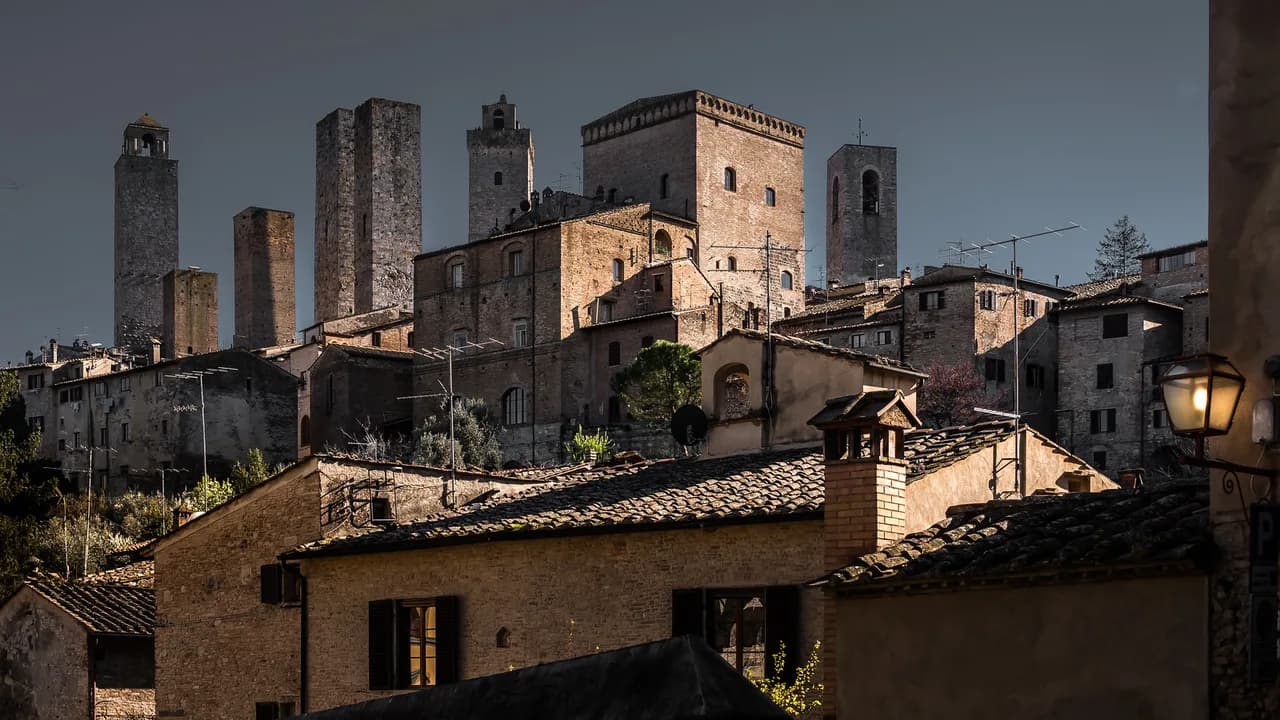
The organising geography is simple. The two main squares, Piazza del Duomo and Piazza della Cisterna, sit at the highest point of the hill, and the old Via Francigena route runs north to south through town from Porta San Matteo to Porta San Giovanni, as the Fondazione Musei Senesi describes. Everything else in this guide is a variation on those two facts.
One concrete detail worth knowing before you pick a base: the historic centre is closed to through traffic, so drivers leave cars outside the walls and walk in. The town's own municipal site publishes live parking numbers, tariffs and season tickets, which is the only reliable place to check current rates rather than trusting an old figure.
What Neighbourhoods Mean in a Town This Size
San Gimignano has been on the UNESCO World Heritage List since 1990 and preserves a compact medieval street plan inside its walls. Within that circuit you will not find signed districts or local quarter names in the way Florence has its sestieri. What you will find are distinct pockets with different jobs: civic, commercial, residential and panoramic.
That reframing matters when you choose a hotel or plan a day. A room on a piazza buys atmosphere and proximity but comes with evening noise, while a room outside the walls buys easier driving and parking at the cost of a climb at the end of the day. Neither is better in the abstract; they serve different trips.
If you want a broader set of overlooked corners before fixing an area, our guide to the hidden gems in San Gimignano pairs well with this one, since it covers the smaller sights that sit between the headline squares.
Piazza del Duomo: The Civic and Religious Core
Piazza del Duomo packs the town's two great institutions into one small space. The Palazzo Comunale, built in 1288 and home to the civic museums, faces the Collegiata di Santa Maria Assunta, the collegiate church commonly called the duomo. Both are worth time, and both charge separately for their interiors.
The square itself is free public ground, which is easy to forget when every doorway leads to a ticket desk. The Palazzo Comunale holds the Sala di Dante with Lippo Memmi's Maestà of 1317 and a picture gallery of Sienese and Florentine panels, and from that collection you reach the Torre Grossa, the city's tallest tower.
The Collegiata is ticketed separately from the civic museums, so do not assume one purchase covers both. Its interior is almost entirely frescoed, principally by Lippo Memmi and Bartolo di Fredi, with Ghirlandaio's Chapel of Santa Fina as the best-known set piece. Before you go, confirm the current seasonal hours on the church's own site, because opening times change between the summer and winter calendars.
If art is your priority, plan to spend your budget here first and treat other interiors as optional. For a fuller comparison of the ticketed sights across town, browse the San Gimignano Attractions hub before committing.
Piazza della Cisterna: Market Square and Social Crossroads
Piazza della Cisterna is triangular, slightly sloped, and ringed by towers and palazzi, including the Torre del Diavolo and the Ardinghelli towers. It was laid out in the thirteenth century as a marketplace and gathering point at the junction of the Via Francigena and the road linking Pisa and Siena, and its central well, built in 1273 and enlarged in 1346, gave the square its name.
In practice this is where a visit naturally pauses. Cafes and shops line the edges, the Arco dei Becci closes one corner, and the open space makes it the easiest place to sit with children or regroup after a museum. It is also the busiest, so treat it as a place to pass through slowly rather than a quiet retreat.
Because the square is free and open at all hours, it works well as an early-morning or evening anchor when interiors are shut. Pair it with the neighbouring lanes for a slow circuit rather than rushing from piazza to piazza.
The Via San Giovanni Approach
Most visitors enter the historic centre through Porta San Giovanni at the southern end, where Via San Giovanni runs uphill towards the two piazzas. That approach street is lined with restaurants, wine bars, craft and food shops, so it concentrates a large share of foot traffic. Arriving that way gives you the classic first view of the towers framed above the rooftops.
If you are staying inside the walls, a base near this street puts you close to the entrance with luggage and close to dinner options, at the price of more people outside your window. A base nearer Piazza del Duomo trades some of that convenience for quieter nights and closer access to the museums at opening time.
One resident writer estimates that the great majority of visitors stay on the main drag and the two main squares, and suggests leaving those areas to find calmer streets. Treat that as a sensible working assumption rather than a measured statistic, and test it yourself by turning off the main street for a block.
Side Lanes Off the Main Drag
The lanes that branch off Via San Giovanni and Via San Matteo change character quickly. Within a short turn you find shuttered facades, small workshops and stretches where you can hear your own footsteps. Use them to link the two piazzas rather than retracing the main street, and you will see more of the town's residential fabric with less jostling.
A structured route helps here. A San Gimignano self-guided walk lets you thread the side streets deliberately, hitting the smaller churches and viewpoints that get skipped on a quick pass between the squares.
Crowd levels also depend on timing more than on lanes. Our guide to the best time to visit San Gimignano explains how seasons and day-trip hours shift the pressure on the centre, which is more useful than memorising a list of streets.
The Northern and Western Edges: Churches, Rocca and Walls
The northern edge, around Piazza Sant'Agostino, is anchored by the Church of Sant'Agostino, whose interior carries fresco cycles behind the main altar. It is a working religious space rather than a museum, so check locally for visiting restrictions and treat it with appropriate quiet. From there, Via San Matteo leads back towards the centre and out through Porta San Matteo.
Above the town on the western side sits the Rocca di Montestaffoli, a former fortress with an open green space and wide views over the Valdelsa countryside and the towers. It is one of the best free vantage points in town and a natural destination for an evening loop. Approach it on foot from the centre and you get a genuine sense of the hill the town is built on.
The walls themselves make a walking frame for the whole visit. One guide gives the circuit as roughly 2,176 metres and notes several access points, though it is worth confirming that any section you want is open before planning a full lap. Walking part of the perimeter early or late in the day shows you the town's shape better than any single street.
Choosing Where to Stay: Inside the Walls or Outside
Staying inside the walls is the choice for atmosphere and short walks: you wake up in the medieval fabric and can reach the piazzas before the day-trippers arrive. The trade-offs are real, though. The centre is car-free, so you park outside and carry bags in, and ground-floor rooms on busy streets can be noisy until late.
Staying just outside the walls, near one of the gate car parks, suits drivers and anyone with limited mobility or heavy luggage. You sacrifice the evening atmosphere of an empty piazza but gain straightforward parking and often more space for the money. Which side of that ledger matters more is the single biggest decision in booking this town.
Wherever you pick, verify current parking arrangements on the municipal site rather than relying on rates quoted in old blog posts, since tariffs and access rules are set locally and change. The town also publishes a dedicated page on its video-controlled restricted traffic zone, which matters if you plan to drive to a hotel door with permission.
Where to Focus a Short Visit
With half a day, a piazza-first plan works best: enter through Porta San Giovanni, walk up to Piazza della Cisterna, then Piazza del Duomo, and climb the Torre Grossa for the overview. That gives you the town's silhouette, its civic heart and its best panorama in one compact circuit. Save the churches for a longer stay or a return trip.
With a full day and an art interest, reverse the logic. Start at the Collegiata when it opens, move to the Palazzo Comunale and its picture gallery, then spend the afternoon on Sant'Agostino and the Rocca. This art-first plan front-loads the ticketed interiors while you are fresh and leaves the piazzas for the softer light at the end of the day.
Food and wine belong in either plan. Vernaccia di San Gimignano is the local white and appears on nearly every wine list in town, so a tasting or a glass with lunch is an easy way to slow the pace between sights. Our San Gimignano food guide covers where that fits without turning the day into a crawl.
Practical Ticketing Logic
The most common planning error is assuming one ticket opens every door. It does not. The civic museums at the Palazzo Comunale, which include the picture gallery and the Torre Grossa, are ticketed through the San Gimignano Musei system, and the operator publishes current prices, reduced categories and validity on its own pages. The Collegiata complex is ticketed separately, as the church's own visitor information sets out.
A combined San Gimignano Pass bundles several sites across the civic museums and the collegiate complex, and the operator notes that the pass is not sold between 11 January and 28 February 2027. Check that window on the official site before you build a plan around the pass, and compare it with buying single entries if you only want two or three interiors.
Churches and public squares remain free to enter as public or religious spaces, even where a neighbouring museum charges. If your budget is tight, build the day around the piazzas, the walls and the Rocca, and choose one paid interior carefully. Our list of free things to do in San Gimignano helps with that version of the trip.
Stamina, Steps and Steep Lanes
San Gimignano is built on a hill, and every route between the gates and the piazzas involves a climb, often on stone paving that is slippery when wet. Wear shoes with grip and allow more time than a flat map suggests. Anyone with mobility limitations should plan the shortest gate-to-piazza route and consider staying close to it.
Tower climbs are the other stamina test. Figures vary between sources for the Torre Grossa ascent, and the open stairwell is not ideal for anyone uneasy with heights, so read the description before buying the combined museum ticket. If a climb is not for you, the Rocca and the walls give comparable views without the enclosed stairs. A suggested half-day is enough for the piazzas and one climb, but that is an editorial estimate rather than an official timing.
Finally, weather changes the plan quickly. The municipal site publishes civil protection alerts for the area, which is worth a glance the day before if you intend to walk the walls or the countryside paths.
Plan Your Visit
Think of San Gimignano as a handful of overlapping areas rather than a set of named quarters: the civic core at Piazza del Duomo, the social crossroads at Piazza della Cisterna, the busy approach along Via San Giovanni, the calmer side lanes, and the northern and western edges around Sant'Agostino, the Rocca and the walls. Choose your base according to whether driving, quiet or proximity to the museums matters most, and you will spend less time crossing town and more time looking up at the towers.
Before you travel, confirm the current opening hours, ticket scope and any combined pass conditions on the museum and church sites, and check parking and traffic-zone rules with the municipality. Those four checks remove almost all of the uncertainty from a short visit.
Frequently Asked Questions
Does San Gimignano have named neighbourhoods or quarters?
No. San Gimignano is a single walled hill town without officially named districts, so the useful way to divide it is by piazza, approach street and edge. The two main squares, Piazza del Duomo and Piazza della Cisterna, sit at the top of the hill, and the old Via Francigena route runs through town from Porta San Matteo to Porta San Giovanni.
Which piazza should I stay near in San Gimignano?
Stay near Piazza del Duomo if you want to reach the civic museums and the Collegiata at opening time, and accept some daytime bustle. Stay nearer Piazza della Cisterna or the Via San Giovanni approach if you want restaurants and shops on your doorstep. Both are inside the walls, so the difference is atmosphere and convenience rather than distance.
Should I stay inside the walls of San Gimignano or outside?
Inside the walls gives you medieval atmosphere and short walks but means leaving the car outside and carrying luggage in, since through traffic is restricted. Outside, near a gate car park, suits drivers and travellers with limited mobility. Check current parking and restricted-zone rules with the municipality before booking.
Is the centre of San Gimignano car-free?
Access to the historic centre is restricted, and the town operates a video-controlled restricted traffic zone, so ordinary through traffic is not permitted. Drivers park outside the walls and walk in. Confirm the current zone boundaries and any permit rules on the municipal website before you drive towards your accommodation.
Which San Gimignano sights are free to visit?
The piazzas, the street routes and the walkable stretches of the walls cost nothing, and the Rocca di Montestaffoli offers open ground and views without a ticket. Church interiors are generally free as places of worship but may have visiting restrictions, and the main museum collections and the Collegiata are separately ticketed.
How long does it take to walk across San Gimignano?
The walled centre is compact, so walking between the gates and the two main piazzas is a short stroll rather than a journey, though it is uphill much of the way. Rather than relying on a fixed figure, plan around the slopes and the time you want inside the museums, which is where a visit really lengthens.
Where do the crowds concentrate in San Gimignano?
Crowds gather along the Via San Giovanni approach, in Piazza della Cisterna and in Piazza del Duomo. One resident writer estimates that most visitors never leave those areas, which makes the side lanes a practical alternative. Timing matters too: early mornings and evenings are calmer than the middle of the day.
Sources
- Comune di San Gimignano
- Civic Museum and Town Hall - Fondazione Musei Senesi
- Home - Musei San Gimignano
- Palazzo Comunale - San Gimignano
- THINGS TO DO IN SAN GIMIGNANO – Tried & Tested! – The Tuscan Mom
- Insider's Guide to San Gimignano | Tuscany’s Medieval Manhattan
- Duomo di San Gimignano - cattedrale collegiata museo arte sacra san gimignano
- Piazza della Cisterna - San Gimignano
- CHIESA DI SANT'AGOSTINO | I Luoghi del Cuore - FAI
Continue exploring
More guides you'll find useful