Mantua's Historic Quarters: Tre Corone, San Leonardo and Lunetta
A practical orientation to Mantua's compact centre, from the linked piazzas to the southern streets and the Lunetta shore across the water.
On this page
Mantua rewards visitors who orient themselves before planning a route. The historic centre is a compact cluster of interlinked squares and arcaded lanes, so most of the confusion comes from not knowing which square you are standing on rather than from covering long distances. Thinking in three loose zones, the dense grid around Piazza delle Erbe, the southern edge toward Palazzo Te, and the shore across the water, gives you a mental map without pretending these are official wards.
The city and Sabbioneta together became a UNESCO World Heritage site in 2008, recognised for Renaissance town planning and the Gonzaga family's long patronage. That history is concentrated in a walkable core where the Ducal Palace, the Cathedral, the Rotonda di San Lorenzo and the Basilica di Sant'Andrea all sit within a few minutes of each other, as Italia.it sets out. Our Mantua Attractions hub collects individual guides to these sights, while this article explains how the zones relate.
Why Mantua's Core Works as Three Loose Zones
Tre Corone, San Leonardo and Lunetta are useful as geographic shorthand here, not as administrative districts with fixed boundaries. No source defines their edges, so treat them as directions: the medieval knot around Piazza delle Erbe, the southern side heading out toward Palazzo Te, and the far bank across the lakes. That framing helps you decide where to start and where to end, rather than sending you hunting for official place markers.
The compactness is the key fact. Guides describe a centre where the main squares sit close together and walking is the natural way to move between them, with the lakes acting as a boundary on part of the city. Because the distances are short, orientation matters more than an itinerary of kilometres: choose a zone, see what faces its squares, and let the lanes fill in the gaps.
Start With the Linked Squares
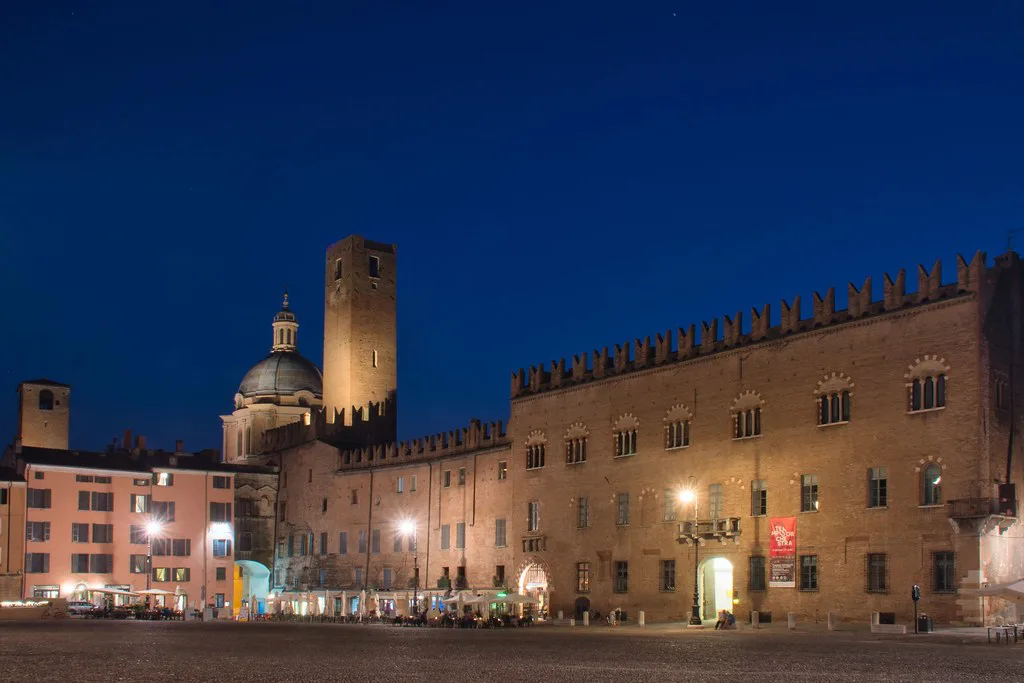
The heart of the centre is a chain of squares you can walk in sequence: Piazza Sordello, Piazza delle Erbe, Piazza Broletto and Piazza Andrea Mantegna. Italia.it describes Sordello as the square where the city's most important buildings face, with the Palazzo Ducale and the Cathedral on opposite sides, and notes the short hop from there to Piazza delle Erbe. Treat that chain as your spine and the rest of the centre becomes easier to read.
Piazza Sordello began as the seat of Gonzaga power, and the buildings around it span medieval, Renaissance and later styles. The square is free to walk through at any hour, which makes it a sensible first stop before any ticketed interior opens. From there you can drift toward the market square without needing a map, following the porticoes that line the old streets.
Tre Corone: The Medieval Grid Around Piazza delle Erbe
Piazza delle Erbe is the market square, framed by the Palazzo della Ragione, the Clock Tower and the small round church of the Rotonda di San Lorenzo. Italia.it notes the clock face with Roman numerals, zodiac signs and planetary hours, and mentions the Time Museum inside the tower. Walking the square and peering into the porticoes costs nothing; going up the tower or into a museum is a separate, ticketed decision.
This is the densest part of the old grid, where narrow lanes open unexpectedly onto the market and the surrounding arcades. The porticoes exist so people can walk and shop whatever the weather, and they still do that job today. Allow time to look up at the facades, since much of the interest sits above eye level on the upper storeys.
Piazza Broletto and Piazza Andrea Mantegna sit a short walk away and change the mood. Broletto carries the medieval civic buildings and a statue of Virgil, the Roman poet born near Mantua. Mantegna square is dominated by the facade of Alberti's Basilica di Sant'Andrea, which Italia.it lists among the city's essential stops. Moving between them is a matter of minutes.
What Faces the Squares: Palace, Cathedral and Basilica
The Palazzo Ducale is the city's defining monument, a palace-city of more than 500 rooms incorporating the Castle of San Giorgio. Inside the castle is Mantegna's Camera degli Sposi, the painted room whose ceiling illusion is among the most celebrated images of the Italian Renaissance. Italia.it places the fresco cycle between 1465 and 1474 and treats it as the palace's highlight. Access to the palace is ticketed and time-slotted, and opening days vary, so check the official museum website before fixing a date.
The Cathedral of San Pietro faces the palace across Piazza Sordello, rebuilt in the Middle Ages and enlarged in the early fifteenth century under Francesco I Gonzaga. Its mixture of Gothic, Baroque and later elements reflects centuries of reworking. Churches in Italy often have their own visiting rules and limited hours, so confirm before planning a visit around one.
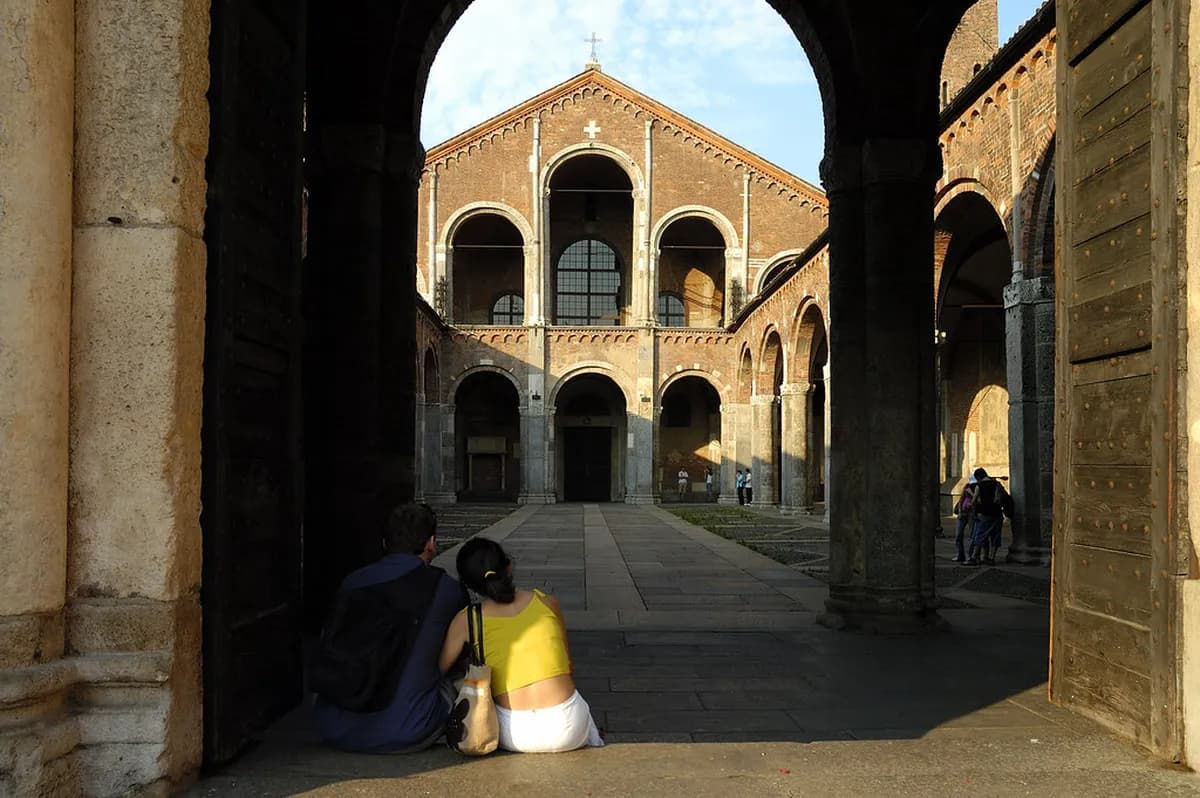
The Basilica di Sant'Andrea, designed by Leon Battista Alberti from 1472, holds the relic of the Holy Blood and the tomb of the painter Mantegna. Its facade combines a temple front with a triumphal arch and is one of the most influential experiments of Renaissance architecture. Italia.it lists it alongside the palace and Palazzo Te as the city's principal sights.
San Leonardo: The Southern Edge and the Walk Toward Palazzo Te
South of the main squares the streets loosen and the route bends toward Palazzo Te, the suburban villa Giulio Romano built for Federico II Gonzaga. Walking there takes you out of the tightest medieval grid into a calmer, more residential fringe. That makes the southern edge a natural place to pause between the palace complex and the villa rather than a sight in itself.
Palazzo Te is a separate ticket from the Palazzo Ducale, and it deserves its own slot. The Hall of the Giants covers walls and ceiling in a single collapsing mythological scene, and the Hall of Cupid and Psyche is the villa's most opulent room. Italia.it notes the palace was commissioned in 1525, and the frescoes were painted over the following decade. Confirm current opening days and ticket options on the museum's own pages before you set out.
If you take in both palaces, plan them on separate halves of a day rather than back to back. The distances are short, but the amount of fresco and sculpture to absorb is large, and fatigue flattens the experience. An explicitly editorial suggestion: start with the Ducal Palace in the morning, walk south for lunch, and leave Palazzo Te for the afternoon.
Lunetta: The Water, the Lakes and the Rio Canal
The three basins fed by the Mincio, the Lago Superiore, Lago di Mezzo and Lago Inferiore, wrap around part of the city and give it its island character. Italia.it describes Mantua standing on the banks of the three basins, and the lakes function as a natural boundary for walkers. Crossing to the far shore puts you in the Lunetta zone, looking back at the historic centre across the water, where the skyline of towers and domes reads as a single composition.
The Rio canal cuts through the centre itself, running from the upper lake toward the lower lake and passing near the old fish market of Giulio Romano. The arcades there frame a view over the water and onto the park that runs alongside it. This is one of the easiest places in the city to understand how water shaped Mantua's defences and trade.
For a wider sense of the water and the green edges of the city, our guide to the hidden gems in Mantua looks at overlooked corners beyond the obvious squares. Combining that with a lakeside walk gives a fuller picture than the piazzas alone. Keep the lakes in mind as a compass: if you can see water, you know roughly which side of the centre you are on.
Free Squares and Porticoes Versus Ticketed Interiors
One of Mantua's practical advantages is that the public spaces are free while the great collections are ticketed. Squares, porticoes, the lakeshore and church exteriors cost nothing to wander, so you can build a satisfying day around them if budget is tight. Palaces, museums and tower climbs are separate purchases, each with its own opening arrangements.
Do not assume one ticket covers everything. The Palazzo Ducale complex and Palazzo Te are distinct sites with distinct admission, and individual churches may have their own rules. The city's official site at the Comune di Mantova and the museum websites publish current notices, including temporary interruptions such as library service changes. Check those pages close to your visit rather than relying on older guides.
A Suggested Half-Day Orientation Route
This is an editorial suggestion, not an official route. Begin on Piazza Sordello to take in the palace exterior and the Cathedral, then walk the short distance to Piazza delle Erbe for the market square, the Clock Tower and the Rotonda di San Lorenzo. Continue through Piazza Broletto to Piazza Andrea Mantegna for the Basilica facade. That sequence covers the historic heart in a relaxed morning.
After lunch, head south toward Palazzo Te or turn toward the water for the Rio and the lakeshore, depending on whether you want art or air. Both are legitimate ways to spend an afternoon, and the choice depends on how much time you have inside buildings. With a full day, add one ticketed interior in the morning and one in the afternoon, leaving the squares for the in-between hours.
Practicalities: Walking, Water and Checking Access
Walking is the default in the centre, and the small scale means you rarely need transport between the main squares. Cobbles and arcades make sturdy shoes worthwhile, and the porticoes provide cover in wet weather. The lakes mark the edge of the old city, so a loop that follows the water will always bring you back toward the centre.
Before you travel, verify opening days and any ticketing requirements on the official museum and city sites, since arrangements change seasonally. Italia.it and the Comune di Mantova are the most reliable starting points, and the individual museum pages give the detail. Build in a little slack so a closure does not derail the day.
Plan Your Visit
Mantua's historic quarters are less about boundaries than about relationships: the squares connect, the palaces anchor them, and the water closes the frame. Tre Corone, San Leonardo and Lunetta work as a loose vocabulary for finding your way, not as official addresses. Once you know which square you are on, the rest of the city follows.
Start with the linked squares, choose one or two interiors to enter, and leave time for the porticoes and the lakeshore. Confirm current access on the official sites before you go, and let the compact scale do the rest. Our Mantua Attractions guides cover the individual sights in more detail when you are ready to plan specific visits.
Frequently Asked Questions
Why is Mantua famous?
Mantua is known for its Renaissance architecture and town planning, shaped by the Gonzaga family over centuries. Its historic centre, together with nearby Sabbioneta, is a UNESCO World Heritage site. The city is also associated with the Roman poet Virgil, who was born nearby, and with Shakespeare's Romeo and Juliet, in which Romeo is banished to Mantua.
Is Mantua the same as Mantova?
Yes. Mantua is the English name and Mantova is the Italian name for the same city in Lombardy. Signs, timetables and local websites will usually use Mantova, so search for both when planning.
Is Mantua worth visiting?
For travellers interested in Renaissance art and architecture, it is one of northern Italy's strongest destinations. The Ducal Palace, Palazzo Te, the Basilica di Sant'Andrea and the linked squares form a dense set of sights within a walkable centre. It also tends to feel less crowded than Florence or Venice, which makes slow exploration easier.
How long should I spend in Mantua?
One full day covers the main squares and one or two interiors. Two days allow both the Ducal Palace and Palazzo Te without rushing, plus a lakeside walk. Add a third day if you want to visit Sabbioneta or explore the wider Mincio park.
Is Mantua easy to explore on foot?
Yes. The historic centre is compact, and the main squares are close together along arcaded streets. Cobbles and porticoes are the norm, so comfortable shoes help, and the lakes act as a natural boundary that keeps you oriented.
Where is the quietest part of the historic centre?
The southern edge toward Palazzo Te and the lanes away from the main squares tend to feel calmer than the market area. The lakeshore beyond the centre is also quieter. These are general impressions rather than guarantees, and crowd levels vary by season and time of day.
Sources
Continue exploring
More guides you'll find useful