Free Things to Do in Mantua: What's Actually Free
A practical 2026 guide to Mantua's genuinely free squares, churches, lakeside views and courtyards, plus clear notes on which Gonzaga interiors need a ticket.
On this page
Mantua, Mantova in Italian, packs a Renaissance capital into a compact, largely pedestrian centre wrapped by three lakes of the Mincio. That geography makes it unusually easy to spend a day on foot and pay only for coffee and lunch. The historic centre and nearby Sabbioneta have been UNESCO World Heritage Sites since 2008, a status earned through Gonzaga patronage rather than through any single ticket booth.
The trick is to separate public space from museum space. Squares, church naves and the lakeshore are open to anyone, while the two Gonzaga showpieces, the Palazzo Ducale and Palazzo Te, are ticketed museums with their own booking rules. Read the two categories separately and a low-budget day becomes easy to plan.
How to Read 'Free' in Mantua
Mantua's centre is small and walkable, which is itself the main money-saver: no transport is needed to move between the old squares. Guide sources describe the whole historic core as something you can cover on foot, with the Palazzo Ducale on Piazza Sordello and the Basilica di Sant'Andrea only a few streets away. That layout means your day's cost is mostly what you choose to enter.
As a rule of thumb, expect the shell to be free and the frescoes to be paid. Piazza Sordello, Piazza Broletto, Piazza delle Erbe and Piazza Mantegna connect in a chain, and most of the churches that front them can be entered without a ticket. The interiors that hold Mantegna's Camera degli Sposi or Giulio Romano's giants sit behind museum turnstiles.
One honest caveat: church access can change with services, restoration work or seasonal arrangements, and small side chapels sometimes have their own arrangements. Check the notice board at the door rather than assuming yesterday's access still applies. For any time-sensitive detail, the city's own site is the place to start.
The Free Historic-Centre Walk: Sordello to Mantegna
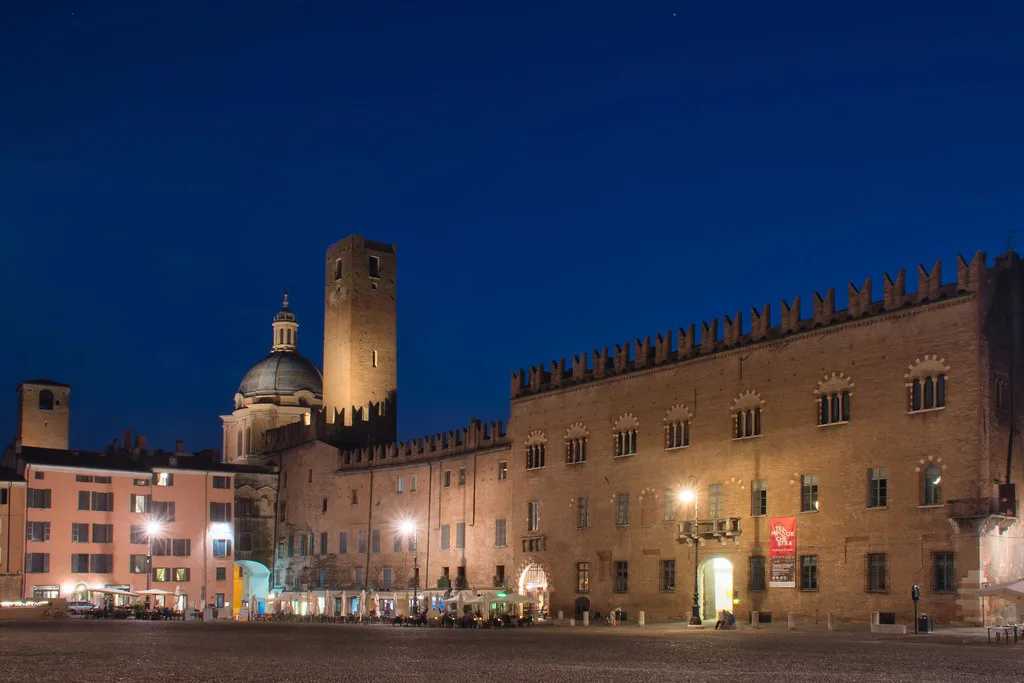
Begin on Piazza Sordello, Mantua's oldest square, framed by the cathedral and the long facade of the Palazzo Ducale. This is public ground, so you can study the Gonzaga power base from outside without buying anything. From there, slip toward Piazza Broletto, where the medieval Arengario arch still carries the iron rings once used to tether prisoners, a grim detail you can see at no cost.
Continue to Piazza delle Erbe, the market square, where the Palazzo della Ragione, the astronomical clock tower and the sunken Rotonda di San Lorenzo cluster together. Arcades frame three sides, so you can browse shop windows and watch the square without spending. Finish at Piazza Andrea Mantegna for the facade of Alberti's Basilica di Sant'Andrea.
Allow roughly half a day for this suggested route if you stop to look properly. The city is dense rather than sprawling, so most of your walking happens within a short radius and you can loop back for a second pass in different light.
Basilica di Sant'Andrea: The Free Nave, and What to Check
Leon Battista Alberti began the Basilica di Sant'Andrea in 1472, wrapping a Roman triumphal-arch facade around a single vast nave modelled on ancient Roman halls. Entry to the church interior has generally been free, which makes it one of the best value stops in the city for anyone interested in Renaissance architecture. The sheer scale of the coffered barrel vault is the attraction, not a display case.
The basilica's crypt holds reliquaries connected to the relic of Christ's Blood, venerated in Mantua since the Middle Ages and displayed in Good Friday processions. Access to that lower level, or to the chapel of the Sacred Vessels decorated by Giulio Romano, may follow separate arrangements. Ask at the church or check locally on the day rather than budgeting a fixed sum.
Because Sant'Andrea is an active parish rather than a museum, visiting around services is both politer and more rewarding. The church also contains Mantegna's own tomb, a quiet link back to the painter whose work dominates the paid interiors nearby.
Rotonda di San Lorenzo and the Cathedral: Verify Before You Go
The Rotonda di San Lorenzo, an eleventh-century round church sunk below the level of Piazza delle Erbe, is the oldest church in the city and was modelled on Jerusalem's Holy Sepulchre. Sources describe it as freely accessible, though it is small and can be closed for maintenance. Treat free entry as the working assumption and confirm at the door.
Mantua Cathedral, dedicated to Saint Peter, occupies one side of Piazza Sordello and has been free to enter in published accounts. Its facade mixes Gothic and Baroque layers, and the interior holds later artworks behind a sober exterior. Opening times vary and are exactly the kind of detail that changes, so check the parish or city information before travelling across town for it.
Pair the two churches rather than chasing every religious building. Together they give you a Romanesque round plan and a Renaissance basilica within a few minutes of each other, which is a better use of a short visit than a checklist.
Lakes, Bridges and the Skyline for Nothing
Mantua sits inside three artificial lakes, the Lago Superiore, Lago di Mezzo and Lago Inferiore, created to strengthen the city's defences long before the Gonzaga dynasty. The result is a ring of water that gives you a free skyline of domes, towers and spires. Walk the banks and you get the postcard view without entering a single monument.
Cross the bridge facing the Castello di San Giorgio and turn back to look at the city: the combination of water, fortress wall and dome is the shot most visitors remember. Sunset along the lakes is a common recommendation, and it costs nothing but timing. Bring a jacket in shoulder season, when the water makes the air cooler than the streets suggest.
Cycling is popular here because the terrain is flat and paths follow the water. If you rent a bike, budget for it, but the lakeside riding itself needs no ticket. For quieter corners beyond the obvious viewpoints, browse our guide to hidden gems in Mantua before you set out.
Palazzo Te Park and Mantegna's House Exterior
Palazzo Te, Giulio Romano's pleasure villa for Federico II Gonzaga, sits south of the centre in its own park. The park and the approach give you the building's low, square silhouette and the theatrical logic of a suburban retreat. The painted interiors, including the Hall of the Giants, are a separate ticketed visit, so decide in advance whether the frescoes are your priority.
Casa del Mantegna, the house the artist built for himself from 1476, is a square block with a circle inscribed inside it, a cylindrical courtyard open to the sky. Its interior decoration has largely been lost and the building now hosts exhibitions, but the geometry is legible from outside. Look through to the courtyard if access allows, and check what is on before assuming the rooms are open.
Both stops reward a slow approach on foot from the centre rather than a rushed taxi dash. The walk south also passes the Tempio di San Sebastiano and Palazzo San Sebastiano, so the neighbourhood holds more than one reason to head that way.
Markets and Porticoes in Piazza delle Erbe
Piazza delle Erbe has hosted Mantua's market since the medieval period, and browsing it remains a free way to see the city working rather than posing. Around the edges, porticoes shelter shops and cafes, which makes the square usable in light rain. You pay only for what you buy, and a coffee at a table is a legitimate way to watch the square for an hour.
Local food is part of the appeal even on a tight budget: pumpkin tortelli, sbrisolona almond cake and the boiled meats of the Mantuan table are the dishes to look for. A shop-bought slice of sbrisolona and a bench by the water make a cheap lunch. Cooking and produce quality here reflect a farming hinterland that has shaped the city's identity.
What Is Not Free: Budget These Separately
The Palazzo Ducale is the big one. A palace complex of more than 500 rooms, courtyards, gardens and the Castello di San Giorgio, it functions as a museum with timed access to Mantegna's Camera degli Sposi. The Bridal Chamber is the reason many people come, and it is the least likely thing in Mantua to be free.
Camera degli Sposi visits work on slots because the room is fragile, and published guides advise reserving a time when buying your palace ticket. That is a planning task, not a cost you can dodge, so check the museum's own site for current admission and booking rules rather than relying on older figures. Palazzo Te's painted rooms are a second ticketed interior and should be budgeted alongside, not instead of, the palace.
Performances at the Teatro Scientifico Bibiena, the eighteenth-century theatre where a young Mozart played, are also paid events, though stepping into the street outside is free. Many of Mantua's cultural draws, from concerts to temporary exhibitions, are programmed rather than permanently open. Check the city's events calendar before you build a day around one.
A Suggested Half-Day Free Route
This is an editorial suggestion, not an official itinerary. Start at Piazza Sordello and look at the cathedral and the Palazzo Ducale's exterior, then walk through Piazza Broletto to Piazza delle Erbe for the clock tower and the Rotonda. Continue to Piazza Mantegna for Sant'Andrea, and finish along the lakes with a bridge view.
That sequence keeps you inside the compact centre, which suits a low-budget day: every stop is public or free-entry, and you can abandon it at any point for a cafe. If you want a second half-day, spend it on a single paid interior rather than trying to see both palaces.
Plan Your Visit
Mantua's free pleasures are structural rather than incidental: four squares in a chain, a lake ring, a basilica nave, a round church and a courtyard house. Those give you a rich day at almost no entrance cost, and they let you judge whether the paid frescoes are worth the rest of your budget.
Decide before you arrive which ticketed interior matters most, whether that is the Camera degli Sposi or the Hall of the Giants, and confirm admission rules on the museum's own site close to your date. Then check the city page for any temporary restrictions, and build the rest of the day around walking. For related planning, see Santa Maria del Gradaro, Mantua: Visitor Guide.
Frequently Asked Questions
What can you do for free in Mantua?
The historic-centre squares, the lakeside and bridge views, the park around Palazzo Te and the interior of the Basilica di Sant'Andrea have generally been free to visit. The Rotonda di San Lorenzo and Mantua Cathedral have also been free to enter in published accounts. Opening arrangements can change, so confirm any church access at the door or through the parish.
Is Palazzo Te free to visit?
The park and exterior are open to walk through, but the painted interiors are a ticketed museum. Plan Palazzo Te as a paid stop and check the official site for current admission and any booking requirement before you go.
Can you see Mantua's lakes without paying?
Yes. The three lakes of the Mincio form a ring around the historic centre, and the banks, bridges and viewpoints are public space. Walking the shore and crossing toward the Castello di San Giorgio for the skyline view costs nothing.
Do you need tickets for the Camera degli Sposi?
Yes. Mantegna's Bridal Chamber sits inside the Palazzo Ducale museum complex and is accessed through the palace's ticketed route, with timed slots because the room is fragile. Book through the museum's own channels and check the current rules rather than relying on older guides.
Is Mantua walkable for a low-budget day?
The historic centre is compact and largely pedestrian, and the main squares sit within a few minutes of each other. Palazzo Te is the one significant detour south of the centre. Comfortable shoes matter more than transport, since the streets are cobbled.
Is Mantua worth visiting on a budget?
Yes, because the expensive parts are optional. The city's setting, squares and principal church nave deliver a full day for almost nothing, and you can add one paid palace interior if frescoes are your priority.
Sources
- Comune di Mantova
- What to do in Mantua Italy - the Italian Capital of Culture
- Welcome to my city, Mantua - Italia Slow Tour
- Marvelling at Mantua’s Palazzo Ducale : European Waterways Marvelling at Mantua’s Palazzo Ducale
- Palazzo Ducale and Palazzo Te in Mantua: why visit them | ItaloBlog
- Top Attractions In Mantua, A Renaissance Marvel In Northern Italy - The Geographical Cure
- Basilica of Sant'Andrea (Mantua)
- Visit Mantua Italy ⭐️ Best Things to Do and See in 2026
- Casa del Mantegna — Google Arts & Culture
- Mantova Guide | Martha's Italy
Continue exploring
More guides you'll find useful