Livorno Rainy Day Guide: Indoor Plans for When It Pours
Plan a wet day in Livorno with a free fortress park, frescoed churches in Venezia Nuova, a covered market and a flexible half-day route that stays dry.
On this page
Livorno is a compact port city where the canal quarter, the covered market and the historic centre sit close enough to link on foot, which makes a wet day a matter of sequencing rather than cancelling. The trick is to alternate short exposed stretches along the Fosso Reale with long, genuinely sheltered stops. This guide separates what is free from what needs checking, so you do not build a plan on stale assumptions.
Expect one honest trade-off up front: the city's most atmospheric rainy-day stop, the Fortezza Nuova, is an open-air walled park rather than a roofed museum. In steady rain its appeal drops sharply, so treat it as a dry-spell option and lean on churches and the market when the sky really opens.
Why Livorno Works in the Rain
The historic core is small enough that you are never far from a doorway, an arcade or a covered crossing. The canal district, known as Venezia Nuova, was laid out with waterways for commerce, and its quays and bridges give you a walkable loop even when the weather turns. The catch is that most of that loop is exposed, so plan it between two indoor stops rather than as the main event.
A useful rule for the day is to keep one anchor stop that is definitely covered and one that is definitely free, so a change of plan costs you nothing. Churches and the market supply the shelter; the fortress and the canals supply the atmosphere when the rain eases.
Start Under the Voltone at Piazza della Repubblica
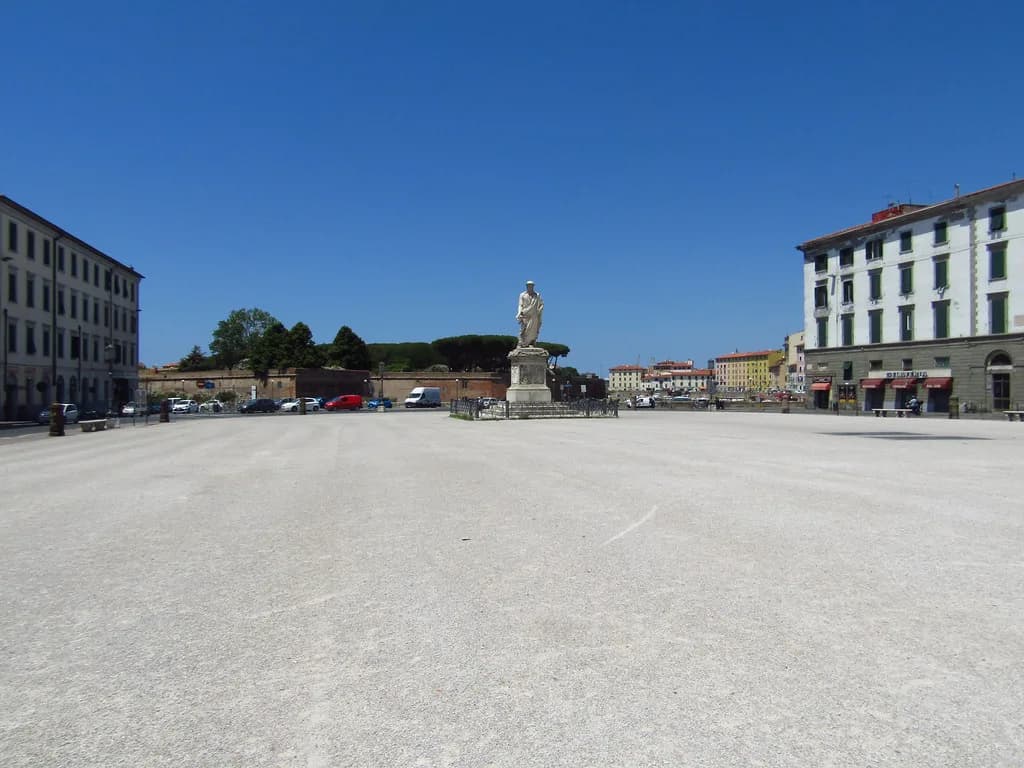
Piazza della Repubblica is not really a square: it is a large elliptical covered bridge carrying the city over the Fosso Reale, which is why Livornesi simply call it the Voltone after the vault beneath it. That makes it an ideal first shelter and orientation point, since Via Grande, the edge of the canal quarter and the way to the Fortezza Nuova all radiate from here.
Look up as you cross for the statues of Ferdinando III and Leopoldo II, and look down mentally: boat excursions pass through the tunnel under the vault, which is the one way to see the square from beneath in wet weather without getting soaked yourself.
Venezia Nuova in the Rain
From the Voltone, the canal quarter is a short walk into streets of faded façades, warehouses and small bridges. It reads as a quieter cousin of Venice, and on wet days the reflections on the water do much of the work. Keep the loop short and use the church as your turnaround point rather than trying to cover every quay.
The dome of Santa Caterina, rising about 63 metres, gives you a landmark to steer by when the skyline greys over. For a longer reading of the district, a self-guided loop through the canals and the two fortresses fills a wet morning without any booking.
Church of Santa Caterina: Frescoes and a Vasari Altarpiece
Santa Caterina is the best rainy-day interior in the canal quarter. Construction began in 1720 and dragged on for generations, which explains the unfinished marble façade and the octagonal tower wrapped around a dome that had stability problems. Step inside and the mood changes completely, with tall windows lighting an octagonal space ringed by side chapels.
On the main altar hangs Giorgio Vasari's Coronation of the Virgin, painted around 1571, and the dome above carries a fresco cycle by Cesare Maffei covering roughly 1,500 square metres, which the city tourism service describes as among the largest frescoed surfaces in Tuscany.
Entry to the church is listed as free, but that says nothing about when the doors are open, so confirm current visiting times with the parish or the city's tourism office before you build the day around it.
Fortezza Nuova: What Rain Changes
The Fortezza Nuova is a free public park enclosed by the surviving walls of a pentagonal Medici fort, reached by bridges from Piazza della Repubblica. The city tourism service presents it as an open-air green space used for exhibitions, concerts and performances, with views over the canals of the Venezia and Pontino neighbourhoods, and lists it as free, outdoors and requiring no reservation.
Its history explains the shape you see: a third-party guide reports that Bernardo Buontalenti designed it from 1590 for Grand Duke Ferdinando II, that around 60 percent was demolished in 1690 as the canal district expanded, and that the remainder became a public park in 1972. Treat those figures as reported history rather than municipal record.
In practice, rain strips away most of the reasons to go: there are no furnished interiors or museum collections, just walls, grass and water views. Save it for a break in the weather, and do not count on any guided access inside the walls, since organisers publish nothing reliable about current tours.
Mercato Centrale: The Midday Shelter
The Mercato Centrale is the natural place to sit out the worst of the weather. Housed in a large late nineteenth-century covered hall on Scali Aurelio Saffi beside the Fosso Reale, it packs stalls selling fish, meat, produce, bread and pasta into one bright, high-ceilinged pavilion. For wider planning, see Mercato Centrale di Livorno.
A US Army feature on the market records a long-standing schedule of mornings only, Monday to Saturday, but that description is from 2013 and should not be relied on now. Check the market's own channels or the city's restaurant portal on the day, and arrive earlier rather than later if you want the full stalls.
While you are there, look for cacciucco, the dense Livornese fish stew built from whatever the market did not sell, and the chickpea sandwich locals call cinque e cinque. Both are cheap, warm and suited to a grey afternoon.
A Suggested Half-Day Rain Route
An editorial suggestion rather than an official itinerary: begin at the Voltone, cross into the canal quarter, spend the wettest stretch inside Santa Caterina, then walk to the market for lunch. Shelter order matters more than distance here, because the exposed sections between them are short.
Leave the Fortezza Nuova and any canal-side wandering as optional extras for the first dry interval, and keep a buffer so a closed church door does not ruin the day. If the rain is set in for hours, drop the outdoor stops entirely and extend lunch.
Shoulder seasons are generally kinder for this kind of walking than high summer, when the same route is hot and exposed. For wider planning, see Best Time to Visit Livorno.
Backup Options When the Rain Settles In
If you want a genuinely indoor afternoon, head for Villa Mimbelli, a nineteenth-century villa that houses the Giovanni Fattori Civic Museum and its collection of Macchiaioli painting. Ticket prices and opening days vary, so check with the museum before travelling out; the villa sits away from the centre, so this is a taxi or bus decision, not a stroll.
The Sanctuary of Montenero sits on the hill above the city and is reached by a funicular, which makes it a poor choice in driving rain but a good one once the weather softens. Entry to the sanctuary is customarily free, though any museum or funicular charge should be confirmed locally.
The older Fortezza Vecchia near the port is another free outdoor option that works better in a lull than in a downpour.
Practical Rain-Day Notes
Canal edges, marble bridges and the paving under the Voltone turn slick quickly, so wear shoes with grip and expect to walk slower than a dry-day plan assumes. A light waterproof layer beats an umbrella in the narrow streets around the market.
Drivers should know that Livorno operates a ZTL, a limited-traffic zone covering much of the historic centre, so leave the car in a signed garage or paid bay outside the restricted area and finish on foot.
Finally, keep the whole plan loose: verify church and market hours the morning you go, since the city publishes events and notices but not a single consolidated rainy-day timetable. The official city website is the best place to check for any alerts before setting out.
Plan Your Rainy Day in Livorno
A wet day in Livorno works best as a short chain of covered stops with one open-air reward held in reserve. Lead with the Voltone, use Santa Caterina and the market as your shelter, and treat the Fortezza Nuova as a bonus for a dry window rather than a fixed appointment.
Check hours and any charges directly with each venue before you set out, and keep the plan flexible enough that a closed door simply means moving to the next arcade.
Frequently Asked Questions
Is Livorno worth visiting on a rainy day?
Yes, if you treat it as a compact city of covered stops rather than a beach or park day. The Voltone at Piazza della Repubblica, the church of Santa Caterina and the covered market give you a workable half-day without needing a car. Outdoor draws such as the Fortezza Nuova are best saved for a break in the weather.
What can you do for free in Livorno when it rains?
The city tourism service lists the Fortezza Nuova park and Piazza della Repubblica as free, and describes Santa Caterina as free to enter. The market is free to walk through, though you pay for whatever you buy. Always confirm current opening times before relying on any of these.
How long do you need for a rainy half-day in Livorno?
As an editorial suggestion, allow about three to four hours for the Voltone, a short canal-quarter loop, Santa Caterina and a market stop. That leaves slack for a closed door or a heavier shower. It is not an official figure, and the market's own hours will shape the timing.
Is the Fortezza Nuova a good rainy-day stop?
Only in light rain or a dry interval. It is a free walled park with canal views and almost no roofed interior, so heavy rain removes most of the point of going. Pair it with an indoor stop instead of making it the centrepiece.
What should you do in Livorno with children when it pours?
The covered market is the easiest bet, with food stalls to browse and a sheltered hall to move through. Villa Mimbelli and its Fattori museum offer a proper indoor alternative, but check opening days and ticket arrangements first, since they are not published consistently.
Do you need a car to get around Livorno in bad weather?
No. The historic centre and canal quarter are compact enough to link on foot, which is often quicker than moving a car through the restricted traffic zone. If you do drive in, park outside the ZTL and walk, and keep a backup indoor stop in case the rain lengthens the route.
Sources
- The Fortezza Nuova | Visit Livorno
- Fortezza Nuova, Livorno: Visitor Guide & Inside-the-Walls Tour 2026 — Castles & Palaces
- Piazza della Repubblica | Visit Livorno
- Sanctuary of Montenero, Livorno, Tuscany, Italy - Landmark Review | Condé Nast Traveler
- Old Fortress, Livorno, Livorno, Italy - Reviews, Ratings, Tips and Why You Should Go – Wanderlog
- Livorno: Insider's Guide to the Vibrant Port City in Tuscany
Continue exploring
More guides you'll find useful