A Realistic One-Day Livorno Itinerary: Canals, Seafront & Cacciucco
Plan one day in Livorno with a realistic walking loop through the centre, Venezia Nuova canals, Fortezza Nuova and the seafront, plus where to eat.
On this page
Most travellers meet Livorno from a cruise terminal or a train window and immediately treat it as a gateway to somewhere else. That is a reasonable choice, but it leaves a compact, watery, working port city unvisited, and a single unhurried day is enough to see why it deserves better. This plan keeps you inside Livorno from morning to evening and treats Florence and Pisa as a competing option rather than an automatic add-on.
The route below is an editorial suggestion, not an official schedule: a labelled morning block in the centre and canal district, a lunch decision, an afternoon on the seafront and one optional museum, then an evening back among the canals. It assumes you walk, because the historic core is small enough that the main risk is not distance but trying to fit too much into it.
Why a Slow Day in Livorno Beats a Florence-and-Pisa Dash
A Livorno day is realistic because the interesting parts sit close together: the bridge-square of Piazza della Repubblica opens onto the canal quarter, and the seafront is a straight walk from the centre. Sights such as the Fortezza Nuova park and the Piazza della Repubblica are open-air and free of ticketing, so the day's shape depends on your energy rather than on slots you must book. If you are choosing between this and a long excursion, remember that tours to Florence and Pisa often run through a tight timetable with limited free time in each city.
The honest trade-off is depth against breadth. A rushed three-city day gives you photographs of the Leaning Tower and the Duomo; a day in Livorno gives you canal reflections, a fortress wall above the water, a long sea terrace and a proper seafood lunch. Travellers with only a few hours in port should pick either the centre-and-canals loop or the seafront, not both at speed.
Morning Start: Piazza della Repubblica and the Voltone
Begin at Piazza della Repubblica, known locally as the Voltone, where a large vault carries the square over the Fosso Reale canal. Visit Livorno explains that the space is both a square and a bridge linking the historic centre to the rest of the city, and that Livornesi boast it is the widest bridge in Europe: treat that as a local claim rather than a fact to argue about. Look up for the statues of Ferdinando III and Leopoldo II before you descend to the water.
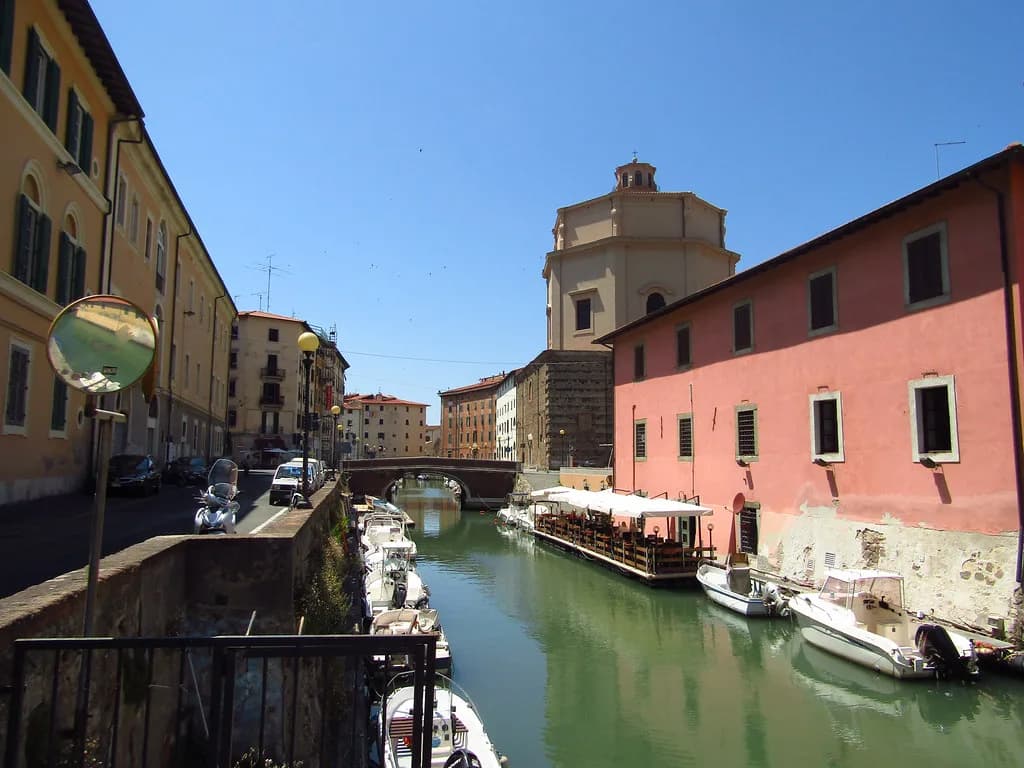
The square's real value for a one-day plan is orientation. From here you can see the edge of the Fortezza Nuova and the streets of the Venezia Nuova district, with the dome of Santa Caterina rising behind. Walking beneath the vault or taking a boat passage along the canal underneath gives you the city's water logic in a few minutes, which makes everything after it easier to read.
Venezia Nuova on Foot: Canals, Bridges and Santa Caterina
Cross into the Venezia Nuova, the canal quarter built for merchants, and follow the canal-side streets rather than a fixed checklist. The district is one of the hidden gems in Livorno precisely because it carries on everyday life while visitors photograph bridges and faded facades. Keep the water on one side, pause at small bridges for the long views, and let the loop bring you back toward the fortress.
The Church of Santa Caterina anchors the quarter with a dome that shapes the whole neighbourhood skyline. Visit Livorno records that construction began in 1720, that consecration came only in 1822, and that the unfinished marble facade was never completed as designed. Inside, the octagonal space holds a Vasari altarpiece, The Coronation of the Virgin, and a dome frescoed by Cesare Maffei covering about 1,500 square metres. Entry is described as free, which makes it the best cultural stop of the morning; check current opening times before you build the day around it.
Fortezza Nuova: The Free Island Park and the Optional Paid Tour
The Fortezza Nuova is a pentagonal Medici fort begun in 1590 to designs associated with Bernardo Buontalenti, and much of it was demolished in 1690 as the canal district expanded. What survives is a fragment of two bastions, curtain walls and the moat, converted into a public park in 1972. Visit Livorno frames it as a fortified island in the centre of the city, free to enter, with views over the canals of the Venezia and Pontino neighbourhoods and a green space behind the walls.
Separate the free park from the paid extra. An independent visitor guide describes a one-hour guided tour that goes inside the surviving walls with historical narration, priced separately from the park, which remains free. Decide before you arrive: the park alone suits a slow stroll and canal photographs, while the guided visit suits travellers who want the Medici story told properly. Confirm current tour availability and price with the operator on the day, since these change.
Lunch Decision: Market Seafood or a Fast Chickpea Sandwich
Lunch is the day's clearest fork. A sit-down plate of cacciucco, the Livornese seafood stew, at a trattoria near the centre or the market is the slower, more expensive option, and it is the right one if the day's purpose is food. The Mercato Centrale area gives you a sense of what the city cooks with, and a market lunch lets you eat well without committing to a long afternoon at the table.
The fast alternative is the 5e5, a chickpea pancake stuffed into bread, which several local food writers treat as the city's signature quick bite. It costs little, takes minutes and leaves the afternoon free, but it is a snack rather than a meal. If you are travelling with children, on a tight budget or short on daylight, take the sandwich; if the weather is poor and you want to sit, take the trattoria.
Whichever you choose, avoid booking the whole afternoon around a single restaurant. Livorno's centre is walkable, so pick a place near your next stop rather than crossing the city for a name you read online, and check opening days directly, because market and kitchen hours shift with the season.
Afternoon: Terrazza Mascagni and the Seafront
Walk or ride toward Terrazza Mascagni, the checkerboard terrace on the Tyrrhenian seafront, and give it more time than you think you need. The terrace is a public promenade, so there is nothing to book and nothing to queue for: arrive, walk the edge, watch the light change and let the sea air slow you down. Early morning is quietest for photographs, while late afternoon brings the passeggiata and warmer tones on the tiles.
The Acquario di Livorno near the seafront is the obvious add-on for families, and it is genuinely optional; it is an indoor ticketed attraction, so check its current hours and admission on the day rather than assuming it fits. If the weather turns, the aquarium or a museum is the sensible swap, and the seafront can wait for another visit. Continue the coastal walk at an easy pace and turn back when you are ready, not when a schedule says so.
Drivers should plan for the restricted traffic zone in the historic centre and for paid parking, which is a real constraint rather than a footnote. Leave the car outside the centre and walk in, and if you are arriving by ferry or cruise ship, use the port shuttle or a local bus toward the centre and keep buffer time for the return. Our guide to getting around and arriving in Livorno: trains, ferries and local transport sets out the options in more detail.
One Optional Museum: Fattori's Macchiaioli or the Jewish Story
Choose one museum, not three. Villa Mimbelli houses the Giovanni Fattori Civic Museum and its collection of Macchiaioli painting, the Tuscan movement that painted outdoors with bold patches of colour before the French Impressionists. It suits travellers who want a calm, indoor hour with art and a garden setting away from the waterfront. The Jewish Museum tells the other half of Livorno's story, the Livornine laws that opened the port to settlers of many faiths and the community that grew around them; visits have been described as arranged by appointment, so contact the museum before relying on it.
If both appeal, decide by weather and by mood: art in a villa for a hot or rainy afternoon, the Jewish Museum for a shorter, denser history stop near the centre. Do not attempt the Sanctuary of Montenero as well unless the day is going unusually well, because the hilltop church and its views deserve their own half-day rather than a rushed detour.
Evening: Aperitivo, Dinner and a Night Stroll
Return to the canal district for the evening, when the water catches the streetlights and the quarter feels calmer than the seafront. An aperitivo in a neighbourhood bar, followed by a seafood dinner, is the natural end to this itinerary, with cacciucco as the dish to order if you skipped it at lunch. Choose a table on a side street rather than the busiest terrace, and check whether the kitchen takes bookings in high season.
Finish with a short walk through Venezia Nuova and across the Voltone, which costs nothing and shows the city in its best light. If you have an early departure the next morning, keep this stroll short and confirm your route back to the station or the port before the evening begins, since late buses and shuttles run less often.
Realistic Pitfalls and What to Cut When Time Runs Short
Heat is the main enemy of this plan. In midsummer, shift the walking to morning and evening, use the churches and museums as shade, and carry water; in spring and autumn the same route is far more comfortable and the canal light is better for photographs. Rain changes the order rather than the day: put the museum and Santa Caterina first, and take the seafront only if it clears.
If you have half a day, cut the museums and the Montenero extension, keep the Voltone, the canal quarter and the fortress park, and eat quickly. If you have only a couple of hours, choose either the canals or the seafront, not both, and check the tide of your own energy rather than the map. Those with a full day can add one museum and a proper lunch; those with a port call of a few hours should not attempt more.
It is also worth being honest about the comparison with Pisa and Florence. Those cities are impressive and crowded; Livorno is quieter, less polished and easier to cross on foot, and a single day here is a complete visit rather than a substitute. If you want the Leaning Tower and the Uffizi, take a separate day trip and give Livorno its own unhurried hours instead of squeezing it between train stations.
Plan Your Visit
Build the day around three fixed points, the Voltone, the canal quarter and the seafront, and treat everything else as optional. Check current opening times for Santa Caterina and any museum before you travel, and confirm guided fortress tours and aquarium admission with the operators, because those details change with the season.
Keep the walking pace gentle, leave buffer time for the return to your ship or train, and let lunch be a decision rather than a destination. The result is a realistic day in Livorno that feels like a city visited rather than a gateway skipped.
Frequently Asked Questions
Can you realistically see Livorno's centre, canals and seafront in one day?
Yes, if you keep it to three areas and walk. The Voltone, the Venezia Nuova canal quarter and the Terrazza Mascagni seafront form a loose loop through the centre, with the free Fortezza Nuova park in the middle. Add one museum at most, and treat the Sanctuary of Montenero as a separate half-day rather than an extra stop.
Is Fortezza Nuova free to visit, and what does a guided tour add?
Visit Livorno describes the surviving fortress as a public park that is free to enter, and that is what most visitors see: walls, water views and a green space inside the bastions. A separate paid guided visit, described by an independent guide, goes inside the walls with historical narration. Book or verify it with the operator, since tours and prices change.
Is Livorno worth a day instead of a day trip to Pisa or Florence?
They answer different wishes. Pisa and Florence deliver famous monuments in crowded conditions, while a Livorno day delivers canals, a Medici fortress park, a long sea terrace and seafood without the same crush. If you have only one free day and have never seen the Leaning Tower or the Duomo, go there; if you want a slower, walkable port city, stay in Livorno.
Where should you eat cacciucco in Livorno on a short visit?
Look for trattorias near the centre or around the Mercato Centrale rather than crossing the city for a specific name. Cacciucco is a slow, sit-down dish, so it suits a full day better than a short port call; on a tight schedule, take the fast 5e5 chickpea sandwich instead. Check opening days directly, as restaurant and market hours vary by season.
Do you need a car for a one-day Livorno itinerary?
No. The centre, canal district and seafront are close enough to walk, and a car brings restricted traffic zone rules and paid parking in the historic centre. Arrive by train, ferry or cruise shuttle, use local buses toward the centre if needed, and keep buffer time for the return. Reserve a car for countryside excursions rather than this city day.
What is the Church of Santa Caterina known for?
Visit Livorno describes an unfinished marble facade hiding an octagonal interior with a Vasari altarpiece and a dome frescoed by Cesare Maffei across roughly 1,500 square metres. Construction began in 1720 and consecration came in 1822. Entry is described as free, but check current opening times before planning your morning around it.
Sources
Continue exploring
More guides you'll find useful