Livorno Neighbourhoods: Where to Stay and What Each Quarter Is Like
Compare Livorno's centre, Venezia Nuova and seafront for a stay: what each quarter is like, free outdoor sights, and honest trade-offs to weigh before booking.
On this page
Livorno is a working port whose centre was extensively rebuilt after wartime bombing, so you will not find the intact medieval lanes that many travellers expect from a Tuscan city. That makes the choice of quarter unusually consequential: the civic heart, the canals and the sea each offer a different stay. One immediate example: the Fortezza Nuova, the pentagonal Medici fort begun in 1590 to a design by Bernardo Buontalenti, now encloses a public park on an island in the canal network, and the city's tourism board lists it as free, outdoors and reachable by public transport.
How to Read Livorno's Map: Three Anchors
Almost every visitor decision in Livorno hangs off three anchors. The first is Piazza della Repubblica, the elliptical bridge-square that carries the main street across the Fosso Reale canal. Locals call it the Voltone, and the tourism board describes it as the widest bridge in Europe. Below the roadway runs a water tunnel you can see from a boat, which connects the centre to the canal neighbourhood beyond and makes the square a place to look at from two levels.
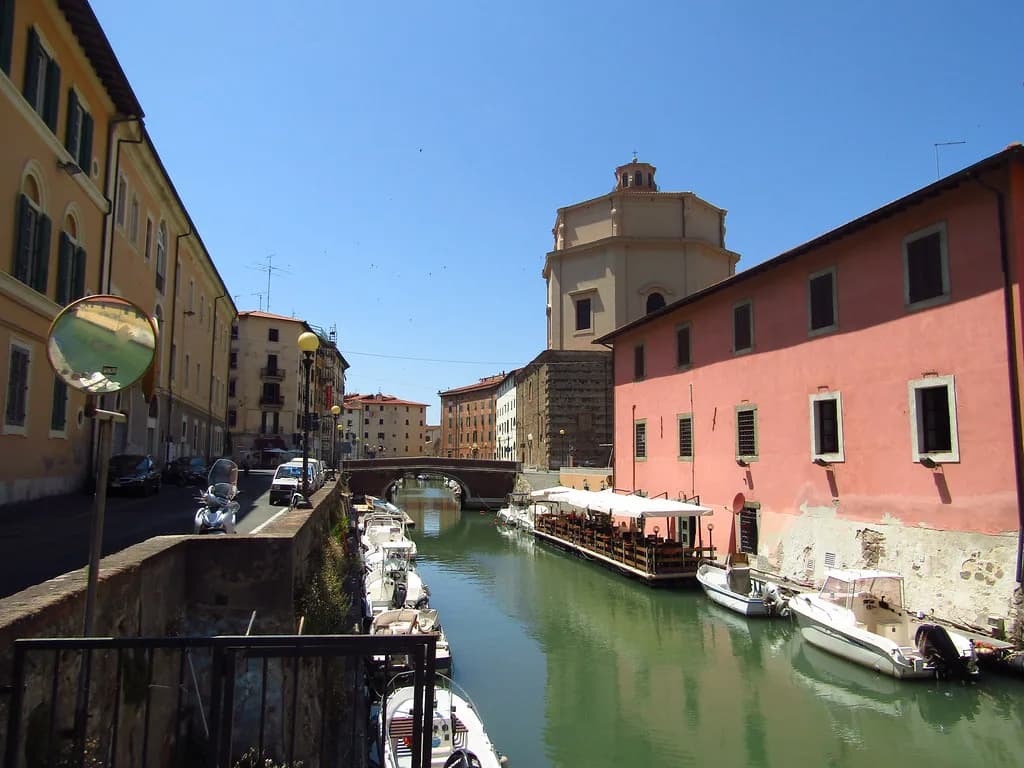
The second anchor is the Venezia Nuova canal grid, a district of waterways, bridges and old warehouses laid out for commerce. The third is the seafront, a long promenade running south toward Ardenza and ending in the checkerboard expanse of Terrazza Mascagni. Frame your accommodation choice around which of these three you want on your doorstep, because the city is compact enough that you will reach the others on foot or with a short ride.
Orientation is easiest once you accept the city's logic: water first, streets second. Livorno grew around its port, and the canals determined where goods, warehouses and merchants settled. Walking the scali, the canal-side streets, gives a faster mental map than any list of monuments. For arrival logistics, see this guide to getting around and arriving in Livorno: trains, ferries and local transport, which explains how the port, station and centre relate. For wider planning, see Getting Around and Arriving in Livorno.
The Centre: Via Grande and the Bridge-Square
The centre, threaded by Via Grande and the bridge-square, is the practical choice for a first visit. The square, the canal edge, the reconstructed shopping street and the waterfront sit within easy walking distance of one another. Because the historic fabric was largely rebuilt after wartime bombing, expect a city that feels honest and workaday rather than precious, with newer façades alongside surviving monuments.
By day, the centre behaves like a functioning Italian city: errands, buses, cafés and offices rather than a tourist theatre. The bridge-square is a transit space as much as a destination, and the experience worth planning for is the view of it from below, on a boat excursion along the tunnel. The tourism board marks the square as free, outdoors, reachable by public transport and requiring no reservation, which makes it a reliable stop when plans change.
The centre is also the most convenient base if you plan to combine city time with trips elsewhere in Tuscany, because everyday services and transport remain closest at hand. It is the least romantic of the three quarters and the most useful. This guide to a Livorno self-guided walk through the old canal district, fortresses and old harbour shows how the centre connects to the water on foot.
Venezia Nuova: The Canal Quarter
Venezia Nuova is the quarter most visitors remember. Its waterways were cut for trade, and the surviving geometry of bridges, warehouse walls and reflections now gives the district a calmer, more intimate character than its Venetian namesake. The city's tourism office lists the Fortezza Nuova inside this area as a public park where art exhibitions, concerts and performances are held, so the fortress works as both monument and venue.
Architecture here rewards a slow loop rather than a checklist. The Church of Santa Caterina, begun in 1720 and consecrated only in 1822, dominates the neighbourhood with a dome that had to be wrapped in an octagonal tower to solve stability problems. Inside, the frescoed dome covers a vast surface, and the main altar holds Vasari's Coronation of the Virgin, whose preparatory sketch is in the Louvre. The tourism board lists the church as free, outdoors and reachable by public transport, but interior access should be checked locally before you build a visit around it.
The trade-off is straightforward. Canals make for beautiful mornings and unhurried walks, but this is a low-rise, partly lived-in district where some façades are faded and the commercial bustle belongs to the centre. If you want shops and services on your doorstep, you will walk a few minutes for them. If you want canal light outside your window, this is the quarter to choose. The guide to the best time to visit Livorno and how to avoid the crowds explains how the seasons change the feel of these streets.
The Seafront and Ardenza Side
South of the centre, the city opens onto the sea. Terrazza Mascagni, a vast black-and-white tiled terrace named after the Livorno-born composer Pietro Mascagni, is the emblem of this side: a place for walking, cycling and watching the light change over the water. Stays here suit travellers who value air, space and a promenade over convenience to the station, and they work well for anyone blending city sightseeing with beach time along the coast. For wider planning, see Livorno Attractions: Visitor Guides to 10 Sights.
Piazza San Jacopo in Acquaviva, in the shadow of its church and near the Naval Academy, is where the seafront routine becomes visible: swimming, sunbathing and conversation at the water's edge. Further south, the shoreline continues toward Ardenza and beyond, with beach clubs and public access mixed along the coast. Expect a slower rhythm than the centre, and plan on a bus, a bicycle or a longer walk to reach the canal district.
For an elevated contrast, the Sanctuary of Montenero sits on the hill above the city, a church dating to 1345 with sweeping views over the port and the sea and a collection of ex-voto offerings left by generations of grateful pilgrims. It is a half-day excursion rather than a neighbourhood, but it reframes the whole city below. A realistic one-day Livorno itinerary shows how to slot the seafront and the hill into a short stay.
Day Versus Night: Keeping Expectations Honest
Daytime differences between the quarters are easy to describe and verify. The centre is busy with errands and transit, the canal district is calm enough for photography and unhurried walks, and the seafront fills with swimmers, cyclists and strollers when the weather cooperates. Free outdoor space is abundant: the bridge-square, the Fortezza Nuova park, the promenade and the terrace all cost nothing to enjoy, which makes Livorno a forgiving city for a low-budget day.
Evening character is harder to pin down from published sources, and this guide will not pretend otherwise. Rather than promising specific nightlife, check what is actually scheduled during your dates on the city's events calendar, which lists exhibitions, concerts, theatre and festivals with dates and venues.
The same caution applies to individual sites. Opening arrangements for churches, fortress interiors and museums change, and guided visits inside the Fortezza Nuova walls are sold separately from the free park. Confirm current times and whether a ticket is needed directly with the operator or the tourist office before building a day around a specific interior.
Choosing by Trip Type
Cruise passengers with a single day should gravitate to the centre and canal district, where the bridge-square, the waterways and the fortress park sit close together, and the boat view under the Voltone adds a distinctive half hour. Families often prefer the seafront side, where the terrace, the beaches and open space absorb energy, while couples may favour Venezia Nuova for its evening reflections and quieter streets. The Livorno with kids guide covers family logistics in more detail.
Slow travellers and anyone working remotely should weigh practicalities over atmosphere: the centre offers the easiest access to services and transport, while the canal quarter offers calm. The Fortezza Vecchia, the older Medici stronghold by the port where Livorno's city status was proclaimed in 1606, anchors the historic waterfront and is described in visitor listings as free to enter, though events held there can change access. A dedicated Fortezza Vecchia guide covers what to expect.
Practical Planning: Free Stops, Paid Interiors and Walking
Build your plan around what is free and what is not. The Fortezza Nuova park, Piazza della Repubblica and the Terrazza Mascagni are outdoor public spaces; the fortress's inner spaces on a guided tour, museum collections and any boat excursions are separate purchases. The tourism board marks the fortress and the bridge-square as free, outdoors, reachable by public transport and requiring no reservation, which makes them reliable fallbacks when plans change. For wider planning, see Piazza della Repubblica Livorno: the bridge-square and its two monuments.
Walking is the right way to connect the quarters, but distances add up if you base yourself at the seafront and plan repeated trips into the centre. A bicycle or a bus ride solves that, and the compact canal grid means you rarely need transport once you are inside it. Carry small change for cafés, and check whether your accommodation sits inside a restricted-traffic zone before arriving by car.
Use the city's tourism portal to confirm what is running during your stay, and treat any fixed opening hours you find online as needing verification rather than gospel. Rental listings and review platforms can help you compare areas for accommodation, but they are commercial and should inform rather than decide your choice.
A Suggested Two-Day Shape Across All Three Quarters
Day one: start at the bridge-square, cross into Venezia Nuova and walk the canal streets toward the Fortezza Nuova park, then take a boat through the tunnel beneath the Voltone for the view from below. Finish with Santa Caterina's exterior and the canal light in the late afternoon. This is a suggested route, not an official one, and it deliberately leaves interiors optional so you can adapt to what is open.
Day two: follow the seafront south from Piazza San Jacopo in Acquaviva to Terrazza Mascagni, allowing time for a swim or a coffee, then climb to Montenero for the view if transport and time allow. If you only have one day in the city, compress this into an afternoon after the canals. The one-day plan linked above shows the shorter version.
Plan Your Visit
Choose the centre if you want convenience and transport, Venezia Nuova if canal atmosphere matters more than services, and the seafront if sea air and space are the point of the trip. Livorno rewards that clarity because its three anchors are distinct and close enough to visit from any base.
Before you go, confirm current opening arrangements and event dates with the city and the tourism office, since schedules shift by season. For a deeper look at the corners most visitors skip, browse the hidden gems in Livorno, and pair this guide with a realistic one-day plan for the city.
Frequently Asked Questions
Which neighbourhood in Livorno is best for a first visit?
The centre around Via Grande and Piazza della Repubblica is the easiest base for a first visit, because landmarks, transport and services sit close together. From there you can walk into the Venezia Nuova canal district in minutes, which means you get canal atmosphere without giving up convenience.
Is Venezia Nuova a good area to stay in Livorno?
It suits travellers who prioritise canal views, quiet streets and the Fortezza Nuova park over having shops and cafés immediately outside. Expect a partly lived-in district with faded façades, and plan a short walk to the centre for services and transport.
How walkable is central Livorno between quarters?
The centre and Venezia Nuova are comfortably walkable and connect through the bridge-square, with the boat tunnel beneath it offering a different perspective. The seafront toward Ardenza is a longer walk, so a bicycle or bus helps if you plan to move repeatedly between the sea and the canals.
What can you see for free in Livorno's canal district?
The Fortezza Nuova park, the canal streets and bridges, and the exterior of Santa Caterina are free to explore, and the tourism board lists the fortress park as outdoors and requiring no reservation. Guided visits inside the fortress walls and museum interiors are separate and should be confirmed before you go.
Should you stay near Terrazza Mascagni or in the centre?
Stay near Terrazza Mascagni if sea air, swimming and a promenade matter most, accepting a longer trip into the centre. Stay in the centre if you want transport links, everyday services and quicker access to the canal district, and visit the seafront as a half-day outing.
How many days do you need to get a feel for Livorno's quarters?
Two days is enough to walk the centre, explore the canals and spend an afternoon on the seafront, with an optional climb to Montenero. A single day works if you concentrate on the centre and Venezia Nuova and treat the coast as a bonus.
Sources
- The Fortezza Nuova | Visit Livorno
- Piazza della Repubblica | Visit Livorno
- The church of Santa Caterina | Visit Livorno
- Sanctuary of Montenero, Livorno, Tuscany, Italy - Landmark Review | Condé Nast Traveler
- Old Fortress, Livorno, Livorno, Italy - Reviews, Ratings, Tips and Why You Should Go – Wanderlog
Continue exploring
More guides you'll find useful