Two Days in Arezzo: Piazza Grande, Piero della Francesca and a Slower Second Day
Plan two days in Arezzo: one day for Piazza Grande, the Duomo and Piero della Francesca, one for Vasari, Etruscan finds and the Medici fortress.
On this page
Arezzo sits on a hill above the Arno floodplain, and its upper town is a compact but steep knot of medieval streets. That geography is the most useful thing to know before planning two days here. As an editorial suggestion rather than an official timing, allow a full day for the headline sights and a second, lighter day for museums and fortifications, so that the climbing is spread out and day two does not simply repeat day one. For wider planning, see Arezzo Attractions: Visitor Guides to 10 Sights.
The first day belongs to the places that draw people to Arezzo: the sloping Piazza Grande, the Duomo San Donato and the Basilica of San Francesco with Piero della Francesca's Legend of the True Cross. The second day trades the big names for Casa Vasari, the Archaeological Museum, the Roman Amphitheatre, the Medici Fortress and Palazzo Bruni Ciocchi. Together the two days cover the city's Etruscan, medieval and Renaissance layers without turning the trip into a checklist sprint.
Why Arezzo Rewards Two Days Instead of a Rushed Stop
Arezzo is often treated as a half-day add-on between Florence and Rome, which is a shame because its main sights sit in different pockets of the upper town. A single rushed loop tends to produce a blur of churches and a quick photo on the square. Two days let you give Piero della Francesca's frescoes unhurried attention and still have energy for the Etruscan collection on the following morning.
The city's fame rests largely on those frescoes, and one travel guide notes that Arezzo has grown more popular in recent years for its atmosphere, art and architecture. That popularity is a reason to build slack into the plan rather than dash between sites. If you want a compressed version instead, keep the first day of this plan and drop the second; the One Day in Arezzo plan covers that shape in more detail.
A useful way to think about the split is by type of attention. Day one asks for standing and looking inside two major churches plus a square. Day two asks for reading labels, climbing to viewpoints and wandering a park. Alternating those rhythms is easier on the legs than stacking every church on one afternoon, and it leaves room for the hidden gems in Arezzo that sit between the headline stops.
Before You Go: How Steep the Historic Centre Is and How to Pace the Walking
The upper part of Arezzo is described as an excellent example of medieval architecture and home to the city's landmarks, with terrain that is genuinely steep. The same guide suggests that a couple of hours can cover the top attractions, but that assumes a brisk pace and little lingering. For two days, plan fewer stops per half-day and accept that you will climb the same hill more than once.
A practical trick is to group each day's stops by elevation rather than by fame. Start high in the morning when legs are fresh, and save flatter piazza time for the afternoon lull. Comfortable shoes matter more here than in cities built on level ground, and a light layer helps inside churches where the stone keeps the air cool.
Before leaving your accommodation, check official websites or phone the tourist information office for each museum you plan to enter that day. The city's tourism foundation publishes visitor news and information about the state museum circuit, while the cathedral and basilica are separate institutions with their own arrangements. Treat any opening hours or ticket scope you read in an older guide as unconfirmed until you match them against a current official page. Further visitor details appear in FONDAZIONE AREZZO INTOUR - AREZZO DMO TUSCANY » Fondazione Arezzo Intour - DMO Arezzo ( Tuscany ).
Day One, Morning: Piazza Grande and What Its Slope Tells You
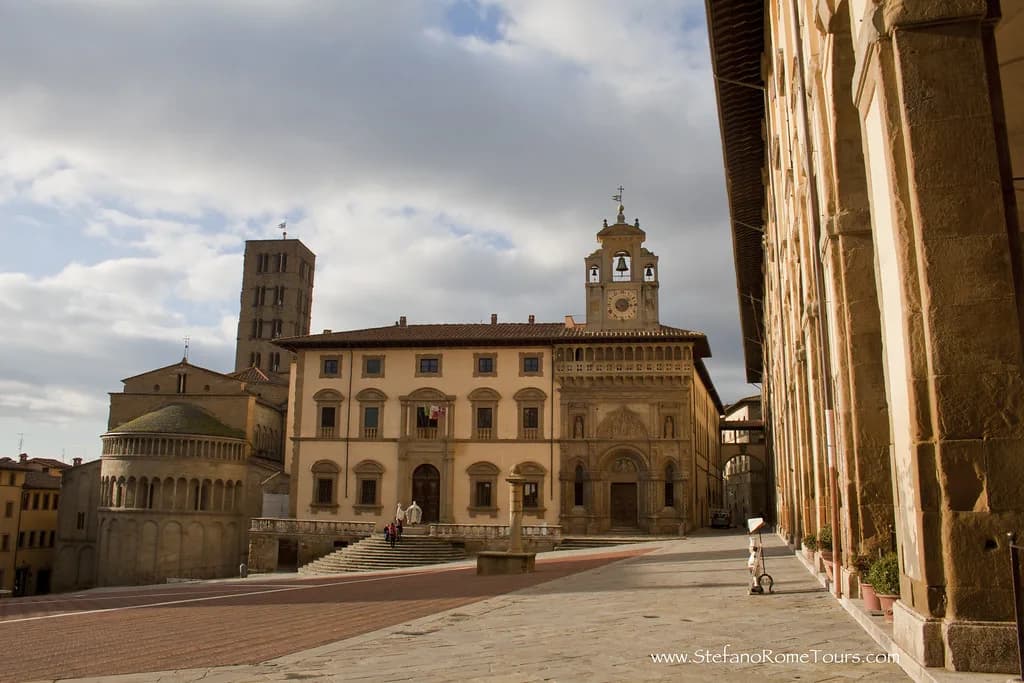
Begin on Piazza Grande, the sloping rectangular square that one travel guide calls the heart of Arezzo and arguably the most beautiful piazza in Tuscany. Its incline is not decorative: it channels rainwater downhill in a hill town that gets proper storms, and it tells you immediately how much vertical ground the old centre covers. Stand at the upper edge first to read the square as a whole before dropping down to its cafés.
The architecture around the square rewards a slow circuit. The Palazzo delle Logge, designed by Giorgio Vasari, anchors one side, while the Church of Santa Maria della Pieve and the thirteenth-century Torre Faggiolana sit within the same view. The Palazzo della Confraternita dei Laici is an odd pleasure: Gothic on the lower level and Renaissance above, a visible seam in the city's building history. For wider planning, see Hidden Gems in Arezzo.
Film lovers can add a light layer of orientation here, since several scenes from Roberto Benigni's La Vita è Bella were filmed in Arezzo. The same source notes the Caffè dei Costanti and the school at Porta Buia among the film's locations. Treat this as a pleasant thread to follow rather than a formal marked trail.
Day One, Midday: A Tuscan Lunch and the Local Dishes Worth Ordering
Lunch in Arezzo is a planning decision, not an afterthought, because the hill will slow you down after a heavy meal. Local cooking leans on pasta, cheese and Tuscan wine, and the dish most associated with the city is pappardelle all'aretina, broad flat noodles under a hare sauce. Pici, the thick hand-rolled pasta, and gnocchi with spinach and cheese also appear on local menus as regional staples.
Keep the midday meal moderate if you plan two churches in the afternoon, and choose a table near the square or slightly off it depending on whether you value the view or the quiet. Menus and prices vary by season and by restaurant, so read the posted board before sitting down rather than budgeting from an old article.
Wine tours, cooking classes and day trips into the surrounding countryside are also promoted for the area, including excursions toward Cortona, Pienza and the hilltop villages of Chianti. These are better treated as a third-day option than squeezed into a two-day city plan. If you add one, book it for the day you leave rather than sacrificing the slower second day in Arezzo itself.
Day One, Afternoon: the Duomo and Piero della Francesca's Frescoes
The Duomo San Donato crowns the upper town, and its construction began in 1278 before completion in 1511, which helps explain the mix of styles you see outside and in. Inside, the ceiling frescoes by Guillaume de Marcillat and Salvi Castellucci draw the eye upward, while Piero della Francesca's Mary Magdalene from the mid-fifteenth century sits lower in the visual hierarchy. Give the cathedral focused time and check current visiting arrangements before you go.
The afternoon's real centrepiece is the Basilica of San Francesco, where Piero della Francesca's Legend of the True Cross fills the chancel walls. The cycle is not arranged chronologically, so a short orientation read before entering helps: look for the Burial of the Holy Cross, the Annunciation and Constantine's Dream. Understanding the panels, rather than chasing a chronological order, is what makes the visit memorable and why this stop deserves unhurried time. For wider planning, see One Day in Arezzo.
Lighting and conservation work can affect what is visible in a fresco cycle at any given time, so ask at the entrance about current viewing conditions rather than assuming the whole chapel is equally readable. If photography is restricted, respect the signs. Plan this as your last major stop of the day so the images stay with you over dinner.
Day One, Evening: Stay Overnight and See Arezzo After the Day Trippers Leave
Staying at least one night changes the trip more than any single sight. The travel guide is blunt about it: a slower evening reveals a different Arezzo once the day visitors have gone, and the city works well as a base for a wider Tuscan road trip because of its position roughly between Florence and Rome. Book directly with the property or a reputable booking site and confirm the room details rather than relying on an old listing.
For the evening, walk back through the upper town without a checklist. A second pass over Piazza Grande after dark, or a drink in the streets below it, gives you a sense of the city's daily rhythm that a daytime circuit cannot. Arezzo has a modest but real evening scene, and picking one neighbourhood to settle into beats racing between bars; the Arezzo nightlife guide covers the options in more detail.
Day Two, Morning: Casa Vasari and the Etruscan Collection
Day two starts with Giorgio Vasari, the painter, architect and writer whose house at Via XX Settembre 55 is now a museum. The building holds more than fifty paintings and frescoes and preserves one of the few surviving Renaissance artist's studios. It is a compact, domestic visit, best appreciated before the day's larger sites and before your concentration fades.
The Archaeological Museum then shifts the story back centuries, to Gaio Cilnio Mecenate and the Etruscan past that shaped the city. Its collections span Etruscan and Roman material, and the bronze Chimera of Arezzo belongs to that heritage. The travel blog points readers to the museum's own page for opening times rather than stating them, and the same caution applies to entry conditions: confirm current days before building the morning around it. For wider planning, see One Day in Arezzo.
Arezzo's craft identity is another thread worth noticing while you walk between these stops. The city is known for goldsmithing and artisan workshops, and a short detour to a working atelier pairs naturally with a morning that already mixes art and archaeology. For wider planning, see Arezzo Goldsmiths and Artisan Workshops.
Day Two, Midday: the Roman Amphitheatre and a Quieter Pause
The Roman Amphitheatre is described as the most extensive archaeological site in Arezzo, founded between 117 and 138 AD and once able to hold more than eight thousand spectators. Twentieth-century restoration opened it to visitors, and the surviving curve of the seating gives a clearer sense of Roman scale than any museum label. Come around midday, when the light on the stone is strong.
Nearby, the Church of Santa Maria della Pieve is worth a short stop if you did not look inside on day one. Keep the pause genuinely quiet: sit in the square, buy a coffee and let the morning's museum reading settle. Two days in Arezzo only feels slow if you actually stop, and this is the place in the plan to do it. For wider planning, see Fortezza Medicea Arezzo visitor guide.
Day Two, Afternoon: the Medici Fortress Park and Palazzo Bruni Ciocchi
The Medici Fortress, built more than five hundred years ago, sits on the city's hilltop with a pentagonal plan and wide views across the region. The ground around it functions as a park, which makes it the best place in this itinerary to breathe after a morning indoors. Check locally for any temporary restrictions on the grounds before making the climb.
Finish with Palazzo Bruni Ciocchi, also called the Dogana, which houses the Museum of Medieval and Modern Art and includes paintings by Vasari. The building itself is part of the attraction, so budget time for the architecture as well as the collection, and note that this is a separate museum from the cathedral and basilica rather than part of one shared ticket. Further visitor details appear in 10 things to do in Arezzo, Italy & the best hotels in the city.
If the palace is closed on the day you visit, the fortress park and the amphitheatre already give the second day a distinct character. A plan that can lose one stop without collapsing is a realistic plan for a small Italian city with shifting museum hours.
Day Two, Evening: a Slower Wander and Where to Leave Slack
Keep the final evening loose. Revisit whichever square or viewpoint you liked most, and leave the rest of the time for an unhurried dinner and a walk back through the medieval streets. Leave the last half-day without a fixed ticket so you can follow a recommendation from a bookseller or a café owner without rearranging the whole trip. If you have only one day, the one day in itinerary concentrates the essentials and leaves this slower evening aside.
If you are travelling on for longer, Arezzo's position makes it a sensible base for further Tuscan stops, and the travel guide describes it as more affordable than some better-known neighbours. Use the leftover evening to check onward transport for the following morning rather than assuming timetables from a website you read weeks ago.
Timing Your Trip Around Recurring Events
Two recurring events can reshape a stay. Piazza Grande hosts an antique fair on the first weekend of each month, described by one travel guide as among the best in Italy, and the Saracen joust, the Giostra del Saracino, is staged twice a year in June and September with costumes and galloping horses. Both are worth planning around or deliberately avoiding depending on whether you want crowds.
Because the fair and the joust recur rather than sit on one fixed date, confirm the specific weekend or joust day with the city's tourism foundation before booking. The Arezzo antiques fair and markets guide covers the market in more depth, including how the monthly rhythm works. Exact dates for a given year should always come from an official listing rather than an older travel article.
Fondazione Arezzo Intour publishes notices about the city's Christmas season, the state museum circuit and event opportunities, which makes it the first place to check once your dates are set. Its pages also carry contact details for the tourist office if you need to ask a specific question about what is running during your stay.
Practical Pitfalls: What to Verify Before Each Site
The biggest planning error in Arezzo is assuming that everything in the old town shares one ticket or one timetable. The cathedral, the basilica, the archaeological museum and the palace museum are distinct places with separate arrangements. Confirm the scope of any ticket you buy and check whether an interior you want to see is free, ticketed or subject to conservation restrictions.
Do not quote or budget from memory either. Admission charges, opening days and tour availability change, so check current information on official pages or at the tourist office the day before. If you have booked a guided tour, confirm the meeting point and what it covers; the city's official tourism body is the safest source for anything that affects your itinerary.
Finally, treat any fixed list of closed days or seasonal hours in a guide, including this one, as a prompt to verify rather than a promise. Small museums in Italian hill towns adjust schedules for holidays and restoration work. A quick call or an official website check on the morning of your visit saves an unnecessary climb.
Plan Your Visit
Two days in Arezzo work best as a rhythm rather than a checklist: one day for the square, the cathedral and Piero della Francesca's frescoes, and one for Vasari's house, Etruscan finds, the amphitheatre and the fortress park. The steep upper town sets the pace, so group each half-day by elevation and leave room for a long lunch and an unplanned coffee.
Before you travel, confirm museum days, ticket scope and any recurring events with the city's official tourism body, and book accommodation directly rather than relying on old listings. With those checked, Arezzo rewards the second day as much as the first, and the slower evening is often the part travelers remember.
Frequently Asked Questions
Is Arezzo worth two days?
Yes, if you want to see both the headline churches and the city's museums without rushing. Day one covers Piazza Grande, the Duomo San Donato and the Basilica of San Francesco with Piero della Francesca's frescoes. Day two adds Casa Vasari, the Archaeological Museum, the Roman Amphitheatre, the Medici Fortress and Palazzo Bruni Ciocchi, which is difficult to fit into a half-day stop.
Can you see Arezzo's highlights in one day and use day two differently?
You can compress the main sights into one full day and use a second day for a countryside excursion, a cooking class or a slower wander through the upper town. If you keep only one day in the city, concentrate on Piazza Grande, the cathedral and the basilica, and treat the museums as optional extras.
When is the antique fair in Piazza Grande and when is the Giostra del Saracino?
The antique fair is held on the first weekend of each month, and the Giostra del Saracino takes place twice a year in June and September. Because these recur rather than falling on fixed dates, confirm the exact weekend or joust day with the city's tourism foundation before booking travel.
What should I check before visiting Arezzo's churches and museums?
Check opening days, ticket scope and any conservation restrictions for each site individually. The cathedral, the basilica, the archaeological museum and the palace museum have separate arrangements, and small museums adjust hours for holidays and restoration work. Official tourism pages or a call to the tourist office the day before your visit are the safest sources.
Is Arezzo a good base for exploring Tuscany?
It works well as a base because of its position on the route between Florence and Rome, its compact historic centre and, according to one travel guide, generally lower prices than better-known Tuscan towns. From Arezzo you can add day trips toward Cortona, Pienza and the Chianti villages, or use the city as a calm base for a longer road trip.
Sources
Continue exploring
More guides you'll find useful