Battistero di San Giovanni Siena: Visitor Guide
Plan a visit to Siena's Baptistery of San Giovanni, from Vecchietta's frescoed vaults to the bronze font shaped by Donatello and Ghiberti beneath the Duomo.
On this page
The Baptistery of San Giovanni sits on Piazza San Giovanni, tucked beneath the apse of Siena's cathedral, and you enter from that square rather than from the Duomo itself. It is a small space, so a suggested 20 to 30 minutes is enough for most visitors: that is a planning suggestion, not an official duration. In that time you can read the vault frescoes, find the panels on the font and notice the half-finished facade on the way out.
The baptistery belongs to the monumental complex of the Duomo, but it is a distinct room with its own decoration and its own place in the ticket system. The operator lists the cathedral, Piccolomini Library, museum, Facciatone panorama, crypt, baptistery and Porta del Cielo as separate sites within the complex, which is why a combined pass and a single-site ticket are not the same purchase. Anyone building a day around the Siena Attractions hub should treat the baptistery as a short, dense stop rather than a museum-sized visit.
Where the Baptistery Fits in the Duomo Complex
The baptistery occupies the space under the last bays of the cathedral choir, reached down steps from Piazza San Giovanni. Its position explains the unusual interior: a rectangular hall with three aisles and cross-vaults, fitted under the church above rather than built as a free-standing baptistery. Look up as you descend and you are already seeing how the building was squeezed into the cathedral's footprint.
Treat the complex as a set of connected but separately ticketed spaces. The Opera della Metropolitana lists the cathedral, the Piccolomini Library, the museum, the Facciatone panorama, the crypt and the baptistery among its sites, and describes a single OPA SI PASS as covering access to all the complex's museum venues. That does not mean every entry point or every kind of visit works the same way, so read the ticket terms before you choose.
If you only have time for one paid interior beyond the cathedral, the baptistery is a strong candidate because so much sculpture and painting is concentrated in a small room. If you plan to add the museum and the Facciatone climb, a combined pass usually makes more sense than buying each site separately, though you should compare current terms yourself. The Santa Maria della Scala in Siena covers the former hospital across Piazza del Duomo, which is a separate museum and belongs on a different day or a longer one.
Getting There and What You See First
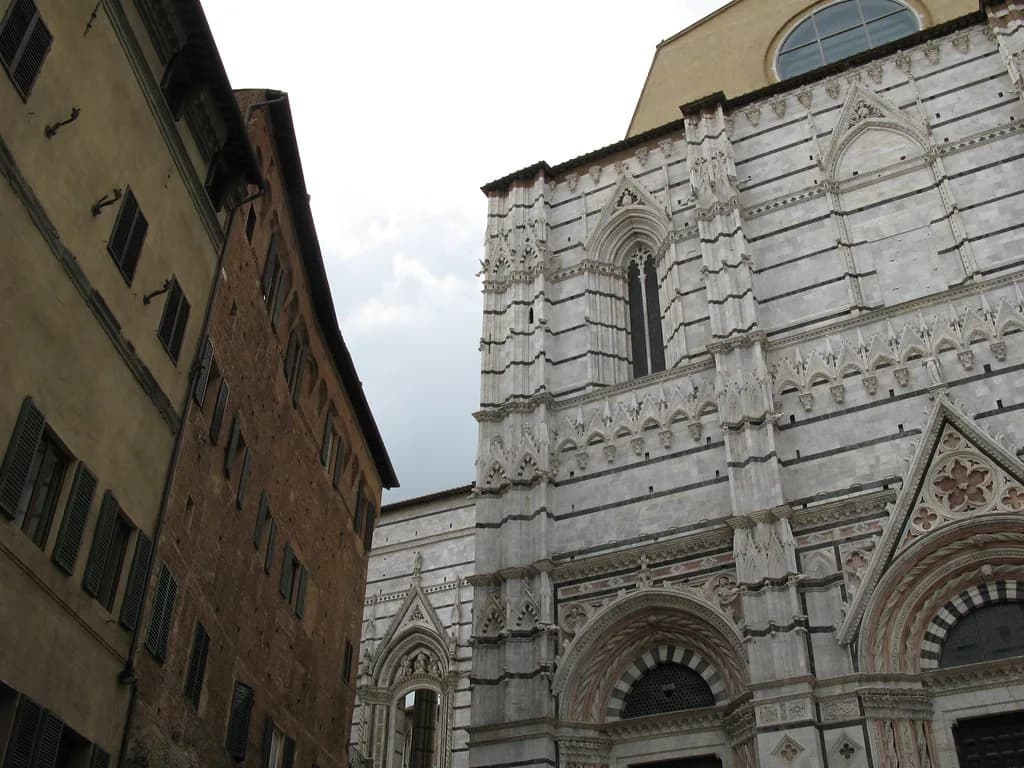
Approach from Piazza del Duomo and walk around the cathedral's left flank to Piazza San Giovanni, where the baptistery facade faces you at the bottom of the steps. The lower facade is clad in white marble with three recessed portals, while the upper section was never finished and remains bare brick. Notice the contrast before you go in: it is one of the most legible stories in Siena of ambition outrunning money and politics.
Construction is dated to between 1316 and 1325, probably to a design by the master builder Camaino di Crescentino, with the facade begun later in the fourteenth century. The building was part of the cathedral's large expansion programme, and the unfinished upper storey is often read as a comment on the limits of that project. Knowing the dates helps you place the interior decoration, which belongs to the following century.
The square in front is public ground, so you can see the facade and the exterior without a ticket. Only the interior is ticketed, which matters if you are passing through with limited time or visiting on a day when the complex is busy. The Siena self-guided walk old town route is a sensible way to arrive on foot while folding the baptistery into a larger circuit of the centre.
Inside: A Vaulted Hall Beneath the Cathedral
Inside, the rectangular hall is divided into three aisles by columns and covered with cross-vaults, all of them painted. Because the room sits under the choir, it feels compressed and dim in a way that makes the frescoes read as a single continuous surface overhead. Give your eyes a minute to adjust, then start with the vaults before moving to the floor and the font.
The decorative programme was designed to teach as much as to impress. The vault cycle sets scenes from the Creed among prophets and apostles, while the side walls carry further narrative frescoes and statues. This is not a space to hurry through with a camera; the sequence is the point.
Vecchietta's Creed Cycle and the Other Frescoes
Between 1447 and 1450 the painter Lorenzo di Pietro, known as Vecchietta, and his assistants covered the vaults with a cycle illustrating the Articles of the Creed. The twelve triangular vaults carry scenes such as the Creation, the Annunciation and Pentecost, framed by prophets and apostles. In the apse, larger scenes including the Assumption, Annunciation, Flagellation and Way to Calvary are attributed to Vecchietta with contributions from Matteo di Giovanni.
Elsewhere in the room, the lunettes hold a cycle of the Miracles of St Anthony by Benvenuto di Giovanni from around 1460, and a Foot-washing scene by Pietro degli Orioli dated 1489. An altarpiece with the Madonna, saints and stories of St Stephen is associated with Andrea Vanni and Giovanni di Paolo, and fourteenth-century wooden and marble statues from the school of Giovanni Pisano are also displayed. If you only have ten minutes indoors, spend them on the vaults and the font, which carry the strongest artistic names.
The painter's full name, Lorenzo di Pietro, is worth remembering because he appears in other Sienese collections. The Basilica of San Domenico is one of the city's free churches and makes a natural pairing with a paid Duomo-complex visit later the same day, since it costs nothing to enter and shifts the mood entirely.
The Floor: A Baptism in Marble and Mosaic
Before the three portals, the pavement carries a mosaic and inlaid marble composition depicting the Baptism, made in 1450 and 1451. It is easy to walk over without looking, so step to the side as you enter and check the floor after your eyes have adjusted. The technique is the same commesso marble work that makes the cathedral's own floor famous, though here it is on a much smaller scale.
Pairing the two floors makes sense: the cathedral's inlaid pavement is the grand statement, and the baptistery's is the intimate preview. The cathedral floor is only fully uncovered in certain periods, so if that is a priority, check the operator's published dates before you build your trip around it.
The Hexagonal Font and the Artists Who Made It
The hexagonal baptismal font, made between 1417 and 1431, is the reason many visitors come. Jacopo della Quercia provided the general design and some panels, while Lorenzo Ghiberti, Donatello, Giovanni di Turino and Goro di Neroccio contributed others. The reliefs follow the life of St John the Baptist and the New Testament, including the Baptism of Christ, the Birth of the Baptist, the Preaching of John and the Feast of Herod.
Donatello's Herod panel is carved in very shallow relief, and his bronze Virtues of Faith and Hope stand around the base alongside Justice, Charity, Prudence and Fortitude by other hands. Jacopo della Quercia's statue of St John crowns the canopy above slender columns. Walking slowly around the hexagon once, then again in the opposite direction, is the best way to compare each sculptor's handling of the same story.
The font is also a civic object. It was a collaborative commission that gathered Sienese and Florentine sculptors in one place, and it advertised the city's ambition alongside its piety. Seen that way, the unfinished brick facade outside and the crowded bronze inside tell the same story about a republic spending beyond its means for the sake of beauty.
Tickets and Combinations: What to Decide
The main decision is whether to buy a combined pass, which the operator markets as covering the complex's museum venues, or to pay for a single site. Single-site entry is cheapest on paper if you only want the baptistery; the pass pays off when you add the cathedral interior, the Piccolomini Library, the museum, the crypt and the Facciatone. The operator publishes the current prices and the ticket options, and those figures are the ones to trust.
Published figures elsewhere can drift out of date quickly. A hotel blog has reported an OPA SI Pass at about twenty euros full price and five reduced, with a single baptistery ticket around eight euros, but those numbers are third-party and approximate and should not be planned around. Check the operator's own price page and ticket categories, including any reductions you might qualify for, before you commit.
Tickets can be bought online, through the call centre, or at the ticket offices at Piazza Duomo 7 and the Dear Guests visitor centre on via di Città, according to the operator. Whether you need to book ahead for the baptistery specifically is not something the operator states plainly, so ask when you buy. Print or download your ticket before arriving, because mobile signal in the dense streets around the cathedral is not reliable.
Hours, Season and Timing Your Visit
The operator publishes seasonal opening hours for the whole complex rather than a separate timetable for the baptistery, and the last entry is generally thirty minutes before closing. Broadly, the complex runs shorter hours in winter and longer hours from April through October, with reduced hours on religious holidays for the cathedral alone while the rest of the complex keeps weekday times. Always check the current schedule on the official site for your dates, because celebrations can change it.
Third-party pages describe similar seasonal patterns, with roughly 10:30 to 17:30 in the low season and 10:00 to 19:00 in high season, but treat those as indicative only. The baptistery is small, and a mid-morning or late-afternoon slot usually fits more comfortably around the cathedral's service times. If you want the cathedral floor uncovered as well, check the operator's published dates for that period before fixing your day.
Several events can affect access, including concerts and liturgical celebrations. Build some slack into your plan rather than scheduling the baptistery as the last thing before a train. The broader hidden gems in Siena guide helps you fill the rest of the day with free churches and squares if a ticketed slot falls through.
Practical Notes on Access and Etiquette
The baptistery is reached via steps from Piazza San Giovanni and sits below the cathedral floor. The operator states that the cathedral is accessible by means of a dedicated ramp on the left side of the building, while the museum, crypt and baptistery do not currently have tools permitting access for visitors with disabilities. A hotel blog describes the baptistery as not wheelchair accessible, which is consistent with the operator's wording but is not an official statement in itself.
Inside, dress and behaviour should match a working religious building: cover shoulders and knees, keep voices low and put phones on silent. Flash photography is best avoided in a painted interior. If a baptism or mass is under way, wait or come back rather than walking through, since the room is still in liturgical use.
Bags and large umbrellas are awkward in the narrow aisles, so leave them at your hotel if you can. Water fountains near the portals are decorative rather than drinking fountains, so carry your own bottle. Comfortable shoes matter more than usual because the streets around the Duomo are steep and uneven.
Pairing the Baptistery With the Rest of Siena
A sensible half-day starts with the cathedral interior and the Piccolomini Library, drops down to the baptistery, then climbs to the museum and the Facciatone for the view. That order keeps you moving downhill and back up once rather than repeatedly. The Palazzo Chigi-Saracini Siena visitor guide covers a quieter musical palace on the other side of the centre if you want to extend the walk after lunch.
For a slower day, pair the baptistery with the free churches and the steep lanes behind the cathedral instead of adding more paid sites. The Siena Self-Guided Walk Through the Old Town gives a route that threads these together without needing a guide. Reserve the longest block of time for whichever interior matters most to you, and accept that the rest of the complex will be a shorter stop.
Plan Your Visit
The Baptistery of San Giovanni rewards a short, focused visit: descend from the square, read the vaults, find Donatello and Ghiberti on the font and look back at the unfinished brick above the marble portals. Allow 20 to 30 minutes as a suggestion, and leave room to sit in the square afterwards. Confirm current hours and ticket scope with the Opera della Metropolitana before you travel, since the complex's schedule changes with the season and the liturgy.
If your time in Siena is short, choose between the baptistery and the cathedral interior rather than trying to do everything at speed. If you have a full day, buy the combination that matches how many sites you will actually enter and spend the saved time on the walk between them.
Frequently Asked Questions
Is the Baptistery of San Giovanni included in the OPA SI Pass?
The Opera della Metropolitana describes the OPA SI PASS as covering access to the complex's museum venues, and the baptistery is listed as one of the sites in the monumental complex. Whether a particular pass version includes a specific entry or experience should be confirmed on the operator's ticket page before you buy. Do not assume that a single ticket covers every site in the complex.
How long should I spend in the baptistery?
A suggested 20 to 30 minutes is realistic for most visitors. That is not an official duration; the room is small but dense, so the time depends on how closely you read the frescoes and compare the font panels. If you are also visiting the cathedral, museum and Facciatone, budget the longest block for whichever interior matters most to you.
Was St Catherine of Siena baptised in this baptistery?
Tradition holds that St Catherine of Siena was baptised in this baptistery, which served generations of Sienese residents. Treat that as tradition rather than a documented fact. The Basilica of San Domenico and her family sanctuary elsewhere in the city fill in the rest of the story.
Who contributed to the baptismal font?
The hexagonal font, made between 1417 and 1431, was designed by Jacopo della Quercia, with panels by Donatello, Lorenzo Ghiberti, Giovanni di Turino and Goro di Neroccio. Donatello also carved the bronze Virtues of Faith and Hope, and Jacopo della Quercia's St John crowns the canopy. Walk around the font at least twice to compare their handling of the same narrative.
Why is the baptistery facade unfinished?
The lower facade is white marble with recessed portals, while the upper section remains bare brick because construction was never completed. The building was part of the cathedral's fourteenth-century expansion, and the unfinished top is a visible reminder of how far that programme outstripped the resources behind it. The contrast is worth a moment before you go inside.
Is the baptistery wheelchair accessible?
The Opera della Metropolitana states that the cathedral can be reached by a dedicated ramp on the left side of the building, while the museum, crypt and baptistery do not currently have tools permitting access for visitors with disabilities. Because the baptistery is below the cathedral floor and approached by steps, plan accordingly. Ask the operator directly if you need details for a specific need.
What are the baptistery's opening hours?
The operator publishes seasonal hours for the Duomo complex as a whole rather than a separate timetable for the baptistery, with last entry generally thirty minutes before closing. Hours shorten in winter and lengthen from April through October, and celebrations can change them. Check the official site for your dates rather than relying on third-party summaries.
Can I visit the baptistery without entering the cathedral?
Yes. The baptistery has its own entrance from Piazza San Giovanni, and the facade and square can be seen without a ticket. Only the interior requires one. Whether a single-site ticket or a combined pass suits you depends on how many other parts of the complex you plan to enter, so compare the operator's options before deciding.
Sources
Continue exploring
More guides you'll find useful