
Santa Maria dei Servi Siena: A Visitor Guide
A focused guide to Siena's Basilica di Santa Maria dei Servi, covering its Servite history, the 1261 Madonna del Bordone and a slow approach from the centre.
On this page
Most Siena itineraries run between Piazza del Campo and the Duomo, while the Basilica di Santa Maria dei Servi sits outside that loop on high ground above the Valdimontone valley. It is a working church, not a museum, and the reward for the climb is a layered interior rather than a single blockbuster room. A suggested allowance is around 45 to 60 minutes inside, plus the uphill walk; that is editorial advice, not an official timing.
The church carries two names, which confuses first-time visitors scanning maps. Both refer to the same building, and knowing why saves a wrong turn or a duplicated search.
What the Basilica Is, and Where It Sits
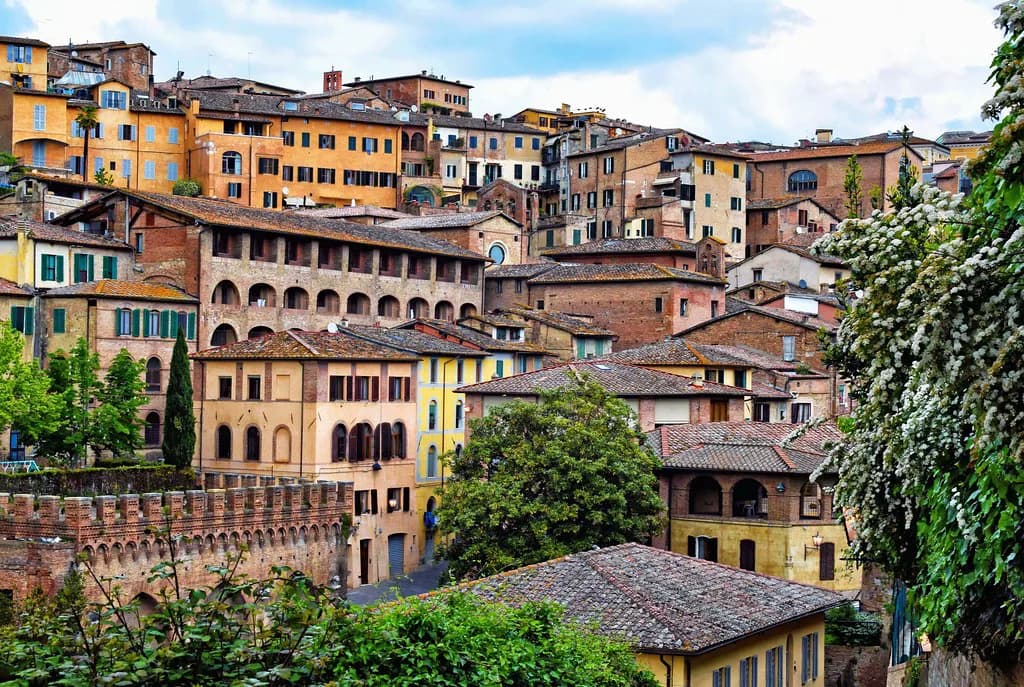
The basilica stands on a hill overlooking the Valdimontone area of Siena, a position that shapes the visit as much as the art does. Because it sits away from the flat spine of the historic centre, the approach involves a climb through ordinary residential streets. Treat the building as one deliberate stop on a walk rather than a detour squeezed between two piazza sights.
Siena's wider attraction map rewards this kind of patience. The city's official pages direct travellers toward the centre's main monuments alongside the Palio tradition, and the Opera del Duomo site details the cathedral complex as a separate ticketed visit. Seeing where the Servite basilica fits against those better-known stops helps you plan a day that is not all queues. Further visitor details appear in Opera Duomo Siena – Siena Opera della Metropolitana.
The Name Explained: San Clemente in Santa Maria dei Servi
The full dedication is Basilica di San Clemente in Santa Maria dei Servi, a double name that records the merger of two religious sites. When the Servite order arrived in Siena in the mid-thirteenth century it initially settled outside the city walls, then moved in 1263 to the present location and absorbed the existing church of San Clemente into its new convent. That is why guidebooks, maps and signage alternate between the two names for one building.
For practical purposes, searching either name on a map will land you in the same place, but the San Clemente form distinguishes this church from the many Italian churches dedicated to Santa Maria dei Servi. If you are comparing notes with an older printed guide, expect the older dedication to appear first.
Three Centuries of Construction
Construction was slow and cumulative rather than conceived as a single design. The Gothic transept and the end chapels were complete by the middle of the fifteenth century, and the Renaissance portion followed between 1471 and 1528, a phase attributed to Ventura Turapilli and possibly influenced by Baldassarre Peruzzi. Walking the nave, you are reading two architectural languages stitched together across roughly three hundred years of work.
That long build explains the interior's mixture of vault shapes: the central nave carries transverse arches while the side aisles use pointed arches, a deliberate nod back to Gothic conventions. It is worth pausing under both to notice the change in rhythm, because the difference is easy to miss when you are moving toward the altars.
Coppo di Marcovaldo's Madonna del Bordone
The anchor of any visit is the Madonna del Bordone, a panel painted by Coppo di Marcovaldo in 1261. It is one of the earliest and most important works in the church, and its date places it before much of the building around it was finished. Seeing a thirteenth-century panel in the setting it was made for, rather than in a museum vitrine, is the reason this church repays a detour.
Allow real time in front of it rather than photographing and moving on. The painting's scale and its position relative to the later chapels make more sense if you look at the altarpiece first and then read the rest of the interior as later additions layered around it.
Other Works to Look For
Beyond the Coppo panel, the church holds a Rutilio Manetti Natività di Maria and a painted cross attributed to Ugolino di Nerio and Niccolò di Segna, both of which reward a slow circuit of the chapels. In the central chapel you can find Bernardino Fungai's Coronation of the Virgin with saints, a strong example of late Gothic painting in Siena. Together these works span several centuries, which is precisely the point of visiting a building that grew over that same span.
The transept chapels themselves mix Gothic and neo-Gothic elements, with fourteenth-century treasures and later reworkings sitting side by side. Some of the most affecting details are small: a painted cross, a panel above a side altar, a fragment of fresco. Patient looking matters more than equipment.
Chapels, the Blesseds and the Madonna della Misericordia
The chapel at the head of the right transept holds the preserved body of the Blessed Francesco Patrizi, which gives that corner of the church a devotional intensity distinct from the artistic circuit. The left transept chapel contains Giovanni di Paolo's Madonna della Misericordia and relics of the Blessed Gioacchino Piccolomini, adding a further layer of local religious history. These are active devotional spaces, so check whether a service or private prayer is underway before stepping close.
Reading the chapels as a sequence rather than a checklist helps: each one carries its own saint, patron and story, and the works were commissioned to serve those functions. That context makes the art legible in a way that labels alone cannot.
The Campanile and the Neo-Gothic Reworking
The Romanesque campanile was built between the fourteenth and fifteenth centuries and underwent a significant restoration in 1926, when central and corner spires were added in a style echoing the Duomo. Look up before entering, because the tower is easy to walk past at street level. The neo-Gothic reworking of the apse chapels in the nineteenth and twentieth centuries, with work by artists including Alessandro Franchi and Giovanni Brunacci, kept the church a living part of the city's cultural landscape rather than a frozen medieval shell.
A modern curiosity inside is the Mascioni pipe organ, installed in 1925 and later restored and extended in 2008. If you visit during a service, the instrument's placement and acoustics in the vaulted space become part of the experience rather than a footnote.
How to Read the Interior
The interior's most striking visual effect is the contrast between white plaster and grey pietra serena stone, a Renaissance pairing that gives the space an elegant, slightly austere calm. Set against the darker Gothic chapels, this tonal shift is the clearest way to feel where one building phase ends and another begins. Walk the nave slowly, then return along a side aisle, and the sequencing becomes obvious.
The church's plan is a classic Latin cross with an elongated three-aisle body and a projecting transept. Rather than trying to see everything from the entrance, pick one chapel, one altarpiece and one architectural detail, and let the rest of the building be background. A focused visit of this kind tends to stay with you longer than a rushed circuit.
What Remains Unconfirmed Before You Go
The church's history is well documented, but practical visitor information is not published in the sources reviewed here. Entry arrangements, opening hours, whether the building closes during midday, and whether any part of the complex charges admission are details you should confirm locally rather than assume. The Siena municipality's site carries city-wide notices and event listings, which can help you spot closures affecting the centre, but it is not a parish timetable.
Accessibility is a particular unknown: the hillside setting and the historic fabric mean step-free routes and lift access should not be taken for granted. If mobility is a concern, contact the parish or the Archdiocese of Siena before travelling. The same applies to any terrace or panorama: the elevated position above Valdimontone is documented, but a purpose-built visitor terrace is not, so plan around the streets and viewpoints you can verify. The city's own viewpoints guide covers the documented panoramas, including the basilica's hill, without promising a platform that isn't there. For wider planning, see Viewpoints in Siena.
Pairing the Basilica With Siena's Water History
Down in Piazza del Campo, the Fonte Gaia you see today is not the original: it is Tito Sarrocchi's 1858 replica after Jacopo della Quercia's 1419 fountain, and the original marbles are kept indoors at Santa Maria della Scala. The Santa Maria della Scala publishes dated visitor notices rather than a permanent schedule, so check current hours on its site before you build a day around it. For the piazza fountain, the same source notes the water is recirculated for decoration rather than drinking, so carry a bottle instead.
Putting these stops together creates a walk about how Siena managed water, from the civic showpiece in the square to the working fountain below the basilica's hill and the museum that preserves the original sculpture. Fontebranda, documented as the oldest of Siena's surviving fountains, fed by the bottini aqueducts, is a worthwhile southern anchor for that same theme. It is a more satisfying frame than ticking off churches in isolation.
A Slow Half-Day Frame
A practical shape for the day is to start at Piazza del Campo, climb toward the basilica, spend focused time inside, then descend toward Fontebranda and finish at Santa Maria della Scala. Keep the frame loose: the value here is unhurried attention, not distance covered. If the church is closed when you arrive, the walk itself and the Valdimontone setting still justify the climb.
For orientation and route ideas across the historic centre, follow the Siena Self-Guided Walk Through the Old Town, which groups the main squares and streets in a logical order. The key is to cluster the basilica with the eastern and southern sights so that the ascent happens once.
A Different Church of the Same Name
Several Italian cities have a Santa Maria dei Servi, and the one in Bologna is a separate building with its own artworks and history. Nothing about the Bolognese church applies to Siena, so check the city name on any map result or ticket page before committing. Confusing the two is the most common practical error with this dedication.
Plan Your Visit
The Basilica di Santa Maria dei Servi rewards travellers who accept a small amount of uncertainty. Its documented history is rich: a Servite arrival in 1263, a Renaissance phase running to 1528, a 1261 altarpiece by Coppo di Marcovaldo, and a campanile restored in 1926. Its visitor logistics are less published, so confirm entry arrangements and hours locally and treat the climb as part of the experience.
Build the visit into a slow walk rather than a dash, pair it with Siena's water history at Fontebranda and Fonte Gaia, and save the original fountain marbles for Santa Maria della Scala. Dress and behave as you would in any active place of worship, keep voices low during prayer, and let the quiet of the hillside church be the point rather than a compromise. For related planning, see Hidden Gems in Siena.
Frequently Asked Questions
Is the Basilica di Santa Maria dei Servi in Siena free to visit?
The sources reviewed do not confirm an entry fee or donation policy for this church, so treat any figure you see online with caution. Check with the parish or the Archdiocese of Siena before you travel, and carry some cash in case a donation is invited at the door.
What is the Madonna del Bordone and where can I see it?
It is a panel painted by Coppo di Marcovaldo in 1261, and it remains in the church rather than in a museum collection. Look for it as the artistic anchor of the interior, then read the surrounding chapels as later layers built around it.
Why is the church also called San Clemente?
When the Servite order moved to this site in 1263, it absorbed the existing church of San Clemente into its convent, producing the double dedication. Maps and guidebooks use either name for the same building, so search both when planning your route.
How long should I allow for a visit?
There is no official recommended duration, but a focused visit covering the main altarpiece, two or three chapels and the nave typically suits a half-hour to an hour inside. Add the climb from the centre and the descent, and the church becomes a half-day anchor rather than a quick stop.
Is there a terrace or viewpoint at the basilica?
The church occupies an elevated position above Valdimontone, which is documented, but a purpose-built visitor terrace or panorama platform is not confirmed. Plan to enjoy the surrounding streets on the approach and check locally if a specific view is your main reason for visiting.
How do I walk there from Piazza del Campo?
No specific route or walking time is documented here, but the church sits on high ground away from the flat centre, so expect an uphill approach through residential streets. Use Piazza del Campo as your starting reference and follow signage toward the Valdimontone area.
Where is the original Fonte Gaia sculpture?
The fountain in Piazza del Campo is Tito Sarrocchi's 1858 replica; Jacopo della Quercia's original 1419 marbles are preserved at Santa Maria della Scala. Check that museum's published notices for current opening arrangements before planning a visit.
Is the Bologna Santa Maria dei Servi the same church?
No. Bologna has its own church of the same dedication with different artworks and history, so confirm the city name on any listing before relying on it. The Siena building is the one connected to the 1261 Madonna del Bordone.
Sources
Continue exploring
More guides you'll find useful





