Palazzo della Ragione Padua: Frescoes, History & Visit Tips
Plan a visit to Palazzo della Ragione in Padua: the vast frescoed hall, its medieval law-court history, and which details to confirm with the city before you go.
On this page
The Palazzo della Ragione sits between Padua's two market squares, and that position is the first thing to understand about it. It has separated Piazza delle Erbe and Piazza della Frutta since the Middle Ages, and it has served as a law court, a market backdrop and now a monument in the city's civic heart. A visit takes you above the market bustle into a single enormous hall, so the building rewards travellers who want to read a city through its architecture as much as those chasing frescoes.
This guide covers what is inside the Salone, the history behind its rebuilds and frescoes, and the practical points to verify before you go. It avoids quoting ticket prices or exact hours, because those belong on the city's own pages. Use it to plan what you will look at, then confirm the day's details with the operator.
Quick Orientation: The Palace Between Padua's Twin Squares
The building divides Piazza della Frutta and Piazza delle Erbe, and the market still runs beneath and around it as it did in the Middle Ages. Your approach is part of the visit: you arrive through produce stalls and café tables before you reach the entrance. The palace belongs to the Comune di Padova, and the city is the authority to consult for current visitor information.
Look up before you go in. The palace's long brick flanks and roof shape give you a sense of the hall's scale, and the ground-level arcades frame the squares nicely. If you are building a walking route, this is a natural midpoint rather than a detour.
History in Brief: Law Courts, Rebuilding and a Fire
Construction started in 1218, and the building was later enlarged through the work of Fra' Giovanni degli Eremitani between 1306 and 1309. A fire in 1420 destroyed most of the first fresco cycle, which is why what you see today is a later scheme. Knowing this helps you read the hall as a building remade more than once. Further visitor details appear in Guide Turistiche Padova:: The Palazzo della Ragione.
Those dates also explain the building's role. It was where justice was administered in the medieval city, sitting in the commercial and social hub. That combination of law, trade and public life is what makes the palace more than a painted room.
What You Actually See Inside: The Salone and Its Frescoes
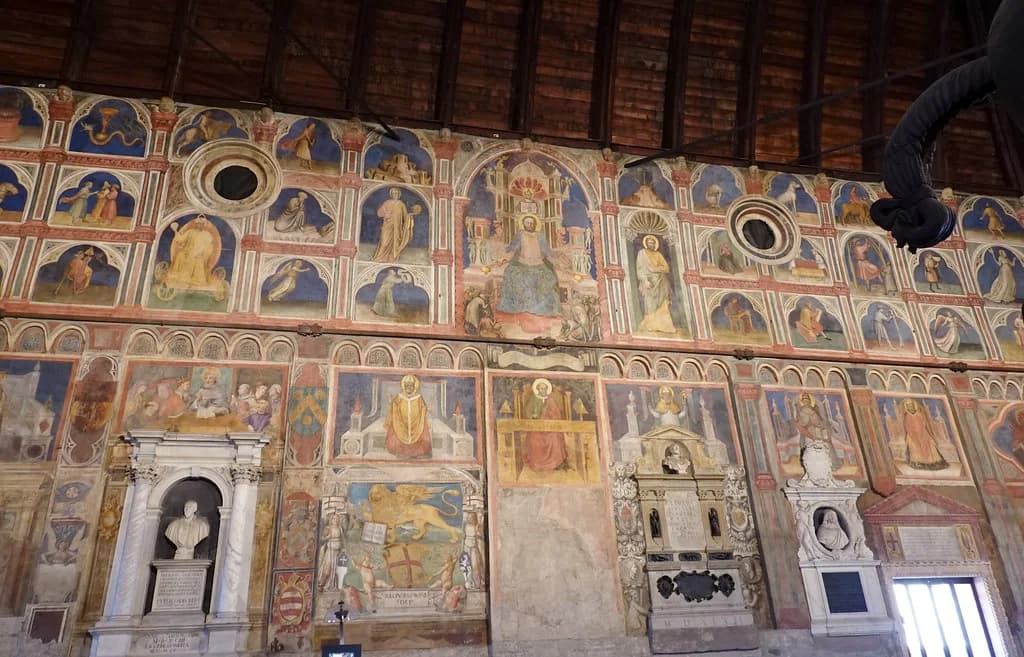
The main event is the vast medieval Salone, a single upper hall whose size is hard to judge from outside. Its fresco cycle draws on the writings of Pietro d'Abano, an astrologer and physician, which is why the imagery runs to planets, zodiac signs and astrological themes rather than a conventional saintly narrative.
Because the hall is so large and open, it rewards a slow lap rather than a quick photo stop. Pick out a few panels that catch your eye and work out what the figures are doing before moving on. If you are travelling with children, turning the astrological figures into a spotting game often works better than reading every label. Further visitor details appear in Palazzo della Ragione: monument, Padua.
Small Details Worth Hunting: The Wooden Horse and the Pietra del Vituperio
Beyond the frescoes, two objects are worth seeking out: a wooden horse and the pietra del vituperio, the stone associated with public shaming of debtors. They are easy to miss in such a large space, so note them before you enter rather than trying to remember afterwards. They also keep the civic story concrete: this was a working court and a place of public punishment as well as a painted hall.
Treat these as highlights to look for rather than a checklist to race through. The hall's scale means that a focused look at a few objects and a few fresco panels usually feels more satisfying than trying to cover everything.
Reading the Hall as Civic Life, Not Just a Painted Room
The palace makes most sense when you connect it to the squares below. The market, the law courts and the public hall all sat in the same spot, which is why the building's position between Piazza delle Erbe and Piazza della Frutta matters so much. Go down after your visit and look back at the arcades with the hall's function in mind.
This is also why the palace fits comfortably into a day of fresco-hunting in Padua. The city's painted heritage extends well beyond this one building, and pairing the Salone with another fresco site gives you a fuller picture of how Padua used art in public and private spaces. If you want to add the city's best-known cycle, plan that separately rather than assuming one ticket covers both.
Practical Planning: Opening Pattern and What to Verify
The palace follows a seasonal pattern rather than fixed year-round hours. Guide sources describe opening Tuesday to Sunday, with different spring/summer and autumn/winter closing times and closure on Mondays, but those times may already be out of date. Check the city's official pages for the day you plan to visit instead of relying on a printed guide or an old listing.
Ticket prices and any booking arrangements are also best confirmed directly. The city's tourism portal and the Comune di Padova publish visitor information, and the official site is the final reference if a third-party listing disagrees. Do not assume that a market visit or a square-level stroll includes entry to the Salone: they are separate experiences.
How Long to Allow: A Labelled Estimate
As a rough editorial suggestion rather than an official figure, allow around 45 minutes to an hour inside the Salone. That is enough for a slow walk, a look at the astrological programme and a stop at the wooden horse and the pietra del vituperio. Add more time if you like reading every fresco panel or are visiting with an audio guide.
The estimate excludes time in the squares below, which can easily absorb another half hour if the market is busy. A sensible plan is to visit the hall first and then wander the market, rather than trying to do both in a rush before a timed entry elsewhere.
Accessibility and Inclusive Resources: The CAA Easy-Read Guide
The Veneto region has produced a CAA (Augmentative and Alternative Communication) guide to the Palazzo della Ragione, using photos, easy-read text and Widgit symbols to make the building's story accessible. It is designed for children with specific learning difficulties, people with cognitive disabilities or autism, older readers and visitors who do not read Italian fluently. The guide is available as a PDF, which makes it a practical thing to download before you travel. Further visitor details appear in Guida del Palazzo della Ragione a Padova.
That guide is an easy-read resource, not proof of step-free access or of any particular facility inside the building. If you have mobility needs, contact the city's museums service or check the official visitor pages directly before you go. It is also worth asking on arrival about the route through the palace, since historic buildings often have uneven floors and stairs.
Combining the Palace With Nearby Sights
The palace sits within easy walking distance of several of Padua's other highlights, which makes it a good anchor for a half-day rather than a standalone stop. Palazzo Bo, the historic seat of the university, offers guided tours of its courtyards and the Anatomical Theatre, and it is a natural companion for anyone interested in the city's intellectual history. Check tour times and availability with the university before you go.
If the weather turns, the palace works well as an indoor stop, and there are other covered options nearby. A wet afternoon is a good excuse to slow down and look at the frescoes properly rather than treating the hall as a box to tick.
For travellers who want to go beyond the headline sights, Padua has quieter corners that reward a longer stay. The Abbey of Santa Giustina, near Prato della Valle, is a large Benedictine complex with free entry and a long history, and it pairs well with a broader day of exploration. You can read more about it in our guide to hidden gems in Padua.
Common Mistakes First-Time Visitors Make
The most common mistake is to arrive without checking the day's opening arrangements, only to find the palace closed on a Monday or on a seasonal schedule. A second is to treat the visit as a quick photo stop and miss the astrological programme and the smaller objects entirely. A third is to assume that the market below and the hall above share a ticket or a single entrance, which they do not.
Finally, do not rely on a single outdated web listing for prices or hours. Cross-check with the city's official pages, and if a detail matters to your plans, call or email the museums service ahead of time. A few minutes of checking saves a wasted trip.
Plan Your Visit
The Palazzo della Ragione is one of Padua's most distinctive buildings precisely because it combines law, trade and art in one place. Plan to spend around 45 minutes to an hour inside, longer if you like to read every fresco, and leave time for the squares below. Confirm the day's opening arrangements and ticket details with the city before you travel, and download the CAA guide if an easy-read resource would help someone in your group.
If you are building a wider itinerary, the palace works well as a midpoint between the market squares and the university quarter. Pair it with Palazzo Bo, the Scrovegni Chapel or the Padua Historic Center Self-Guided Walk to get a fuller sense of the city's painted heritage.
Frequently Asked Questions
What can you see inside the Palazzo della Ragione in Padua?
Inside, the main sight is the vast medieval Salone with its astrological fresco cycle, inspired by the writings of Pietro d'Abano. Look also for the wooden horse and the pietra del vituperio, two smaller objects that connect the hall to its past as a court. The building's scale makes it worth walking slowly rather than trying to see everything at once.
Is the Palazzo della Ragione worth visiting?
If you are interested in medieval civic architecture or fresco cycles, yes. The hall is unusually large and the astrological programme is distinctive, and the building's position between Padua's two market squares gives it a context you will not find in a standalone museum. It is also a convenient stop while exploring the historic centre.
Do you need to book tickets for the Palazzo della Ragione in advance?
The available sources do not confirm whether advance booking is required or available, so check with the city's official visitor pages before you travel. If you are visiting in a busy period or with a group, it is worth asking directly rather than assuming you can walk in.
How long does a visit to the Palazzo della Ragione take?
As a rough suggestion, allow around 45 minutes to an hour inside the hall. This is an editorial estimate, not an official figure, and it excludes time in the market squares below. Add more time if you plan to read the frescoes in detail.
Why are the frescoes linked to Pietro d'Abano?
The fresco cycle is described as being inspired by the writings of Pietro d'Abano, a physician and astrologer. That explains the strong astrological content, including planets and zodiac imagery, rather than a purely religious narrative. Knowing this helps you interpret the programme as you walk around the hall.
Is the Palazzo della Ragione open on Mondays?
Guide sources describe a Tuesday to Sunday opening pattern with Monday closure, but hours can change seasonally. Confirm the day you plan to visit on the city's official pages rather than relying on an old listing.
Is there an accessible guide for the Palazzo della Ragione?
Yes, the Veneto region has produced a CAA (Augmentative and Alternative Communication) guide using photos, easy-read text and symbols. It is designed for visitors with cognitive disabilities, children with learning difficulties and readers who need simpler language. It is not proof of step-free access, so check physical accessibility with the city separately.
Sources
Continue exploring
More guides you'll find useful