Prato della Valle Guide: Statues, Canal & Market Tips
Plan a visit to Padua's Prato della Valle: how the elliptical square and its statue-lined canal came about, what to see nearby, and when to go for the market.
On this page
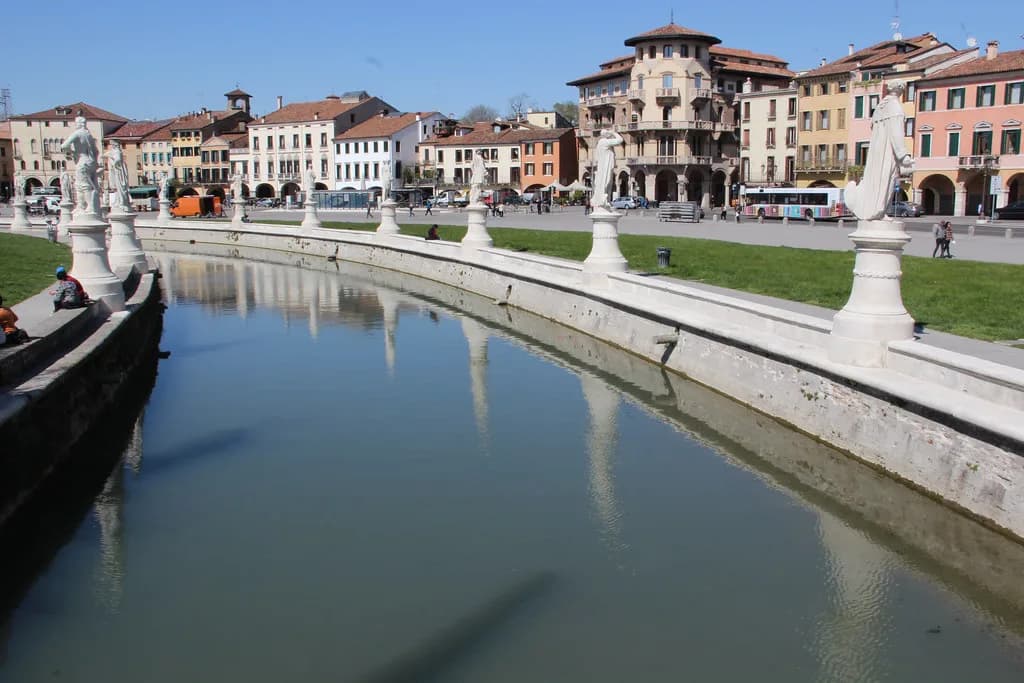
Prato della Valle does not read like a normal Italian piazza. Its centre is a green island, the Isola Memmia, wrapped by a canal and crossed by bridges, with rows of statues standing along the water's edge. The ground itself is free public space, so you can walk in without a ticket, which makes it one of the easiest big sights in Padua to fit into a day.
This guide explains how the square took its unusual shape, who the statues commemorate, and how to read the layout on foot. It also covers the Saturday market, the sights on and near its edge, and how much time to budget. For the wider city, start with the Padua Attractions hub and then come back here for the square itself.
What Prato della Valle Is and Where It Sits
Prato della Valle lies just outside Padua's tight historic core, within walking distance of the Basilica of Saint Anthony and the Abbey of Santa Giustina. It functions as a working public space rather than a museum enclosure: people cross it on foot, gather on the grass of the central island, and events and markets take over parts of it at different times. Map listings give the address simply as Prato della Valle, Padua, which is enough for any map app to find it.
The most useful fact for planning is access. Travel listings describe the square as open year-round, around the clock, with no entry fee for the open ground; one source suggests allowing roughly one to two hours there, which is a reasonable estimate rather than an official figure. That framing helps you decide: treat it as a slow stop with statues, canal views and a coffee nearby, not as a timed attraction. Note that any ticketed interiors in the surrounding religious complexes are separate from the square itself.
How the Square Took Its Shape
The ground beneath Prato della Valle has a long history of use. Before the elegant layout existed, the area served Roman-era purposes and later lay as marshy, neglected land, far from the formal civic space you see now. That background explains why the square sits slightly apart from the dense medieval centre: it was open ground on the edge of the city, not a courtyard carved out of it.
The transformation came through Andrea Memmo, a Venetian urban planner who launched a reclamation project in 1775. His design drained the wet ground, created the central Isola Memmia as a green island, and cut the canal that surrounds it, with bridges linking island to edge. Reading the square today is easier once you know this: the water is not decorative leftover but part of the engineering that made the space usable.
The Statues Explained
Two arcs of statues line the canal, and the sources consulted give the count as 78. They honour figures connected to Padua rather than generic allegories, and among the names is Galileo Galilei, who is associated with the city through its university. Most are carved from Vicenza stone, a pale local limestone that gives the rows their uniform, slightly chalky look against the water.
The arrangement is not decorative symmetry for its own sake. The statues form a double ring that frames the island and canal, so wherever you stand on the outer edge you look across water toward green, and the figures act as a processional border. The original scheme was more ambitious than what survives, so the ensemble reads as a designed landscape rather than a completed set of 78 planned figures.
Reading the Name and the Layout on Foot
The name translates roughly as Meadow of the Valley, a reminder that this was low, damp ground before it was a square; the word for meadow also carried the sense of an open commercial or gathering space. In practice the layout is simple once you are there: an outer ring road, a canal, the island at the centre, and bridges at intervals. Walk the outer perimeter first for the long view, then cross a bridge and loop the island for the close-up of statue bases and inscriptions.
Pay attention to the bases rather than just the faces. Many carry names and identifying inscriptions, which turns a stroll into a roll call of Paduan scholarship, medicine and civic life. If you want structured context while you walk, a self-guided audio route or a small-group walking tour can do the explaining for you; otherwise a short read beforehand is enough to make the rows legible.
Walking the Square: A Suggested Loop and Timing
Start at the edge nearest the abbey, follow the canal along the outer pavement, and cross to the island about a third of the way round; finish with the stretch that faces the basilica. The whole loop is flat and short, so the real variable is how long you linger. As a suggestion rather than an official schedule, early morning and late afternoon are the most comfortable times to be out on the open stone.
Midday in summer can be harsh here, because the open expanse offers little shade along the canal edges; plan a shorter stop or a shaded bench rather than a long circuit. After big events the ground may hold some litter, and sections of the canal can look murky, so set expectations for a working public space rather than a manicured garden. Weekday mornings are generally quieter, while the weekend market brings a different, busier rhythm.
Market Day and the Square's Daily Life
The Saturday market is the big recurring event, filling the square with produce, clothing and household stalls and drawing a steady local crowd. It is a market people actually shop at, so expect practical goods and food rather than souvenir displays aimed only at visitors. Arrive earlier if you want room to move and a calmer look at the stalls; by late morning the aisles tighten up.
Beyond market day, the square is used for events, jogging, picnics and simple crossing from one part of the city to another. For current event programming, check the city's own pages rather than relying on travel articles, since schedules change and listings go stale. If a large event is scheduled, expect parts of the space to be occupied and adjust your loop accordingly.
Beyond the Square: Nearby Sights
The Abbey of Santa Giustina sits directly on the edge of the square, an imposing brick complex with a dome-topped profile that anchors the view from the island. It is one of the more rewarding stops in this part of Padua and pairs naturally with a circuit of the square. Our guide to the Abbey of Santa Giustina in Padua covers its history and what to look for inside.
A short walk away stands the Basilica di Sant'Antonio in Padua, the city's major pilgrimage church and the natural second stop after the square. It is a separate site with its own visiting arrangements, so plan it as its own visit rather than an extension of the piazza. The Basilica di Sant'Antonio Visitor Guide: Tickets, Hours & What to See covers what to expect inside.
Practical Planning: Time, Money and Combining Sights
Because the square itself is free open ground, your budget goes to what surrounds it: church interiors, museums and guided tours. Allow roughly an hour for the square alone, or two if you add the abbey and sit for a coffee; add more for the basilica. Confirm any opening times or ticket conditions directly with each site, as these change with season and liturgy.
For a fuller day, link the square to the city centre on foot; the route is compact and passes markets, arcades and university buildings. A structured option is the Padua Historic Center Self-Guided Walk: 2-Hour Route, which you can trim or extend depending on how long you spend at the statues. Keep the square as an early or late stop so the light and crowds work in your favour.
What to Buy and Eat Around the Market
If you visit on market day, buy what travels well and eat what does not. Veneto specialities worth seeking out in Padua include baccalà prepared in the regional style, bigoli pasta, and radicchio from the surrounding area. The Padua Local Food Guide: What to Eat and Where is a sensible companion for turning a market browse into a meal plan.
A scoop of gelato is the obvious square-side treat, and the area around Prato della Valle has options within a short walk. Use the market for picnic supplies, then eat on the island grass if the weather is kind. Beyond the obvious, the city rewards wandering: our list of hidden gems in Padua points to quieter corners worth adding to the same afternoon.
Plan Your Visit
Prato della Valle works best when you treat it as a place to spend time rather than a box to tick. Walk the perimeter, cross to the island, read a few statue inscriptions, and let the market or the evening light set the pace. It costs nothing to enter, which makes it easy to return later in the day if your first pass feels crowded.
Build the rest of the day around it: the abbey on the edge, the basilica a short walk away, and the centre's arcaded streets beyond. Check the city's own pages for events before you go, and confirm any interior hours at the door or on official sites. For more Padua planning, browse the Padua attractions collection and pick the sights that match your available hours.
Frequently Asked Questions
Is Prato della Valle free to visit?
Yes. The square is open public ground rather than a ticketed attraction, so there is no entry charge to walk the perimeter, cross the bridges or sit on the island. Nearby churches and museums set their own arrangements, so check those separately before you plan your time and budget.
How long should I allow at Prato della Valle?
Allow about an hour for a slow loop of the canal and island, or up to two hours if you add the Abbey of Santa Giustina and a coffee. Travellers who combine it with the Basilica of Saint Anthony usually give the square a shorter pass and save time for the church.
What happens at Prato della Valle on Saturdays?
A large market fills the square with food, clothing and household stalls, and the atmosphere is busy and local rather than purely touristic. Come earlier for space to move, and expect tighter aisles and slower walking by late morning. Check the city's pages for any event that may alter the layout.
How many statues are in Prato della Valle?
There are 78 statues arranged in two rows along the canal that rings the central island. They commemorate figures linked to Padua, including Galileo Galilei, and most are carved from Vicenza stone. The original plan was more ambitious, so the present set does not match everything once envisaged.
Why is the square shaped like an ellipse with a canal?
The layout comes from Andrea Memmo's reclamation project of 1775, which drained marshy ground and created a central island with a canal around it. The water and bridges gave the statues a defined edge to line. Reading it this way explains why the square feels designed rather than simply open.
What else can I see near Prato della Valle?
The Abbey of Santa Giustina sits on the edge of the square, and the Basilica of Saint Anthony is a short walk away. Padua's compact centre, with its arcades, markets and university buildings, is also reachable on foot, so the square fits easily into a half-day route.
Sources
Continue exploring
More guides you'll find useful