
Abbazia di Santa Giustina, Padua: History & Art Visitor Guide
A visitor guide to the Abbey of Santa Giustina in Padua: Benedictine history, Veronese's altarpiece, St. Luke's tomb, free entry and the areas needing a guide.
On this page
The Abbey of Santa Giustina stands at the edge of Prato della Valle, a short walk from the heart of Padua and a world away from the queue outside the Basilica of Saint Anthony. Where the Antonian church draws pilgrims in crowds, this Benedictine complex offers a long nave, a celebrated Veronese altarpiece and a history reaching back to a martyr's burial site. It rewards an hour of unhurried attention rather than a quick photo stop, and its position beside the square makes it easy to combine with a walk across the city's southern edge.
This guide follows the layers of the complex as you will meet them: the early Christian burial ground, the arrival of the Benedictines, the sixteenth-century rebuilding, and the suppression and return that shaped the monastery you see today. It also separates the parts of the church open to anyone from the spaces that require an authorised guide, so you can decide how much time to set aside before you arrive.
Orientation: Where the Abbey Sits and How to Check Access
The abbey faces Prato della Valle, the vast square that anchors the city's southern edge. Padua's tourism office lists the entrance on the Sagrato di Santa Giustina, making the complex easy to fold into a walk across the square rather than a separate excursion. Because openings can change for liturgical reasons, check the abbey's own website and the city tourism listing in the days before you go.
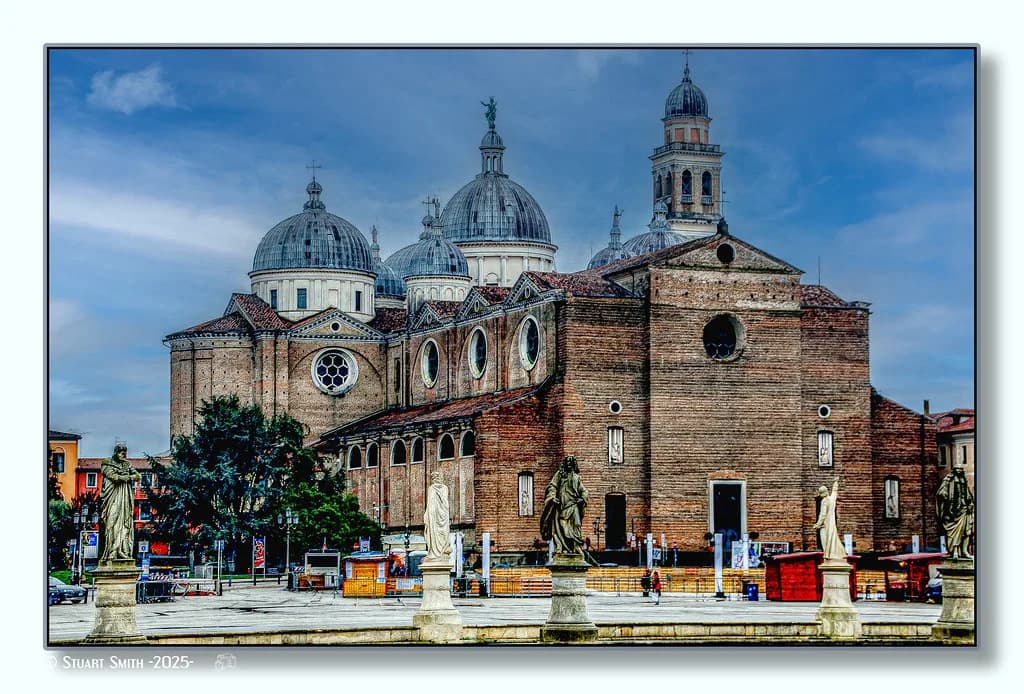
Arriving on foot from the historic centre, you pass through arcaded streets before the square opens out in front of you. The church's unfinished brick facade and its dome give it a different silhouette from the polished Antonian basilica across town. If you are building a walking route, our Padua historic centre walk sets out a full day through the arcaded streets, and you can finish at the square and the abbey. For wider planning, see Padua Historic Center Self-Guided Walk.
History Layer by Layer: From Martyr's Grave to Benedictine Abbey
The story begins well before the present building. Padua's tourism office records that the first basilica here was built in the sixth century, when the area around Prato della Valle was a cemetery, on the site of the burial in 304 AD of Giustina, a young martyr. That early origin explains why the site carries the name of a local martyr rather than a founder or noble family.
The Benedictines reached Padua in the tenth century and settled here, gradually building one of northern Italy's most influential religious communities. Their presence turned the site into a monastery as well as a shrine, and the community's prestige shaped the scale of what was eventually rebuilt. It is worth keeping this sequence clear: the monks did not found the abbey from nothing; they inherited an older sacred site and enlarged its role.
As the community grew, the relics of saints hidden during earlier invasions were gradually brought to light again, including those of Giustina and of Luke the Evangelist. Luke's remains were said to have travelled from Thebes to Constantinople before reaching Padua. These translations gave the abbey a standing that drew pilgrims and benefactors over the centuries, and they explain why two evangelists' tombs still frame the transepts.
The Building You See: A Sixteenth-Century Basilica
The present basilica dates from the sixteenth century and is 122 metres long, on a Latin-cross plan with a central nave and two side aisles. Padua's tourism office gives those measurements and the plan. That length is the first thing you notice inside: the nave keeps going, and the proportions make the church feel more like a hall than a parish chapel. Further visitor details appear in Abbazia Benedettina of Santa Giustina.
The apse holds a remarkable carved wooden choir from the fifteenth century, which survived the later rebuilding and gives the east end a warmer, older texture than the stone around it. Above it hangs Veronese's altarpiece. Look for the contrast between the choir's dark wood and the painting's Renaissance colour; together they are the visual climax of the interior.
The side aisles reward a slow pass rather than a single sweep toward the altar. Chapels and altars along the way hold smaller works that rarely feature in short itineraries, and the scale of the building means you can often find a quiet corner even when the square outside is busy.
Art and Relics to Look For
The most celebrated painting is Paolo Veronese's The Martyrdom of St. Giustina, painted in 1575 for the apse. It depicts the martyrdom of the saint to whom the abbey is dedicated, tying the artwork directly to the site's founding story. Give it a few minutes rather than a passing glance, since its position above the choir means it is usually seen from a distance.
In the north transept is the Tomb of St. Luke, a monumental marble sarcophagus that has drawn pilgrims for centuries. The south transept holds the tomb of St. Matthew the Apostle. The pairing of two evangelists' tombs in one church is unusual enough to justify a walk from one transept to the other before you leave.
From the transepts, the Corridor of the Martyrs leads to the chapel of St. Prosdocimus, the first bishop of Padua, built at the end of the sixth century on a Greek-cross plan over his tomb. This is among the oldest surviving fabric in the complex and gives a sense of what the site looked like before the sixteenth-century rebuild. For wider planning, see Hidden Gems in Padua.
One further burial is easy to miss: the fourteenth-century Chapel of St. Luke holds the tomb of Elena Lucrezia Cornaro Piscopia, who in 1678 became the first woman in the world to gain a university degree. It sits among the spaces that require an authorised guide, so plan accordingly if this is on your list. Padua's tourism office sets out which spaces these are.
Suppression, Barracks and the Return of the Monks
The monastery's fortunes reversed sharply under Napoleonic rule. Padua's tourism office records that the entire monastery was suppressed in 1810 and served as a military barracks until 1919, when the Benedictines finally returned. The community you encounter today is therefore a modern continuation of an interrupted tradition rather than an unbroken medieval one.
Knowing this history changes how the interior reads. Much of what survived did so despite requisition, and the return of the monks in the twentieth century restored the church to liturgical use. The abbey is described by the city tourist office as a religious building of long importance, which explains why some areas remain reserved for the community and its authorised guides rather than open to all visitors.
What Requires an Authorised Guide
Not everything in the complex is open on a walk-in basis. According to Padua's tourism office, the fourteenth-century Chapel of St. Luke, the fifteenth-century wooden choir and the Antesacristy can only be visited with an authorised guide. That distinction matters when you plan: the main church is one experience, and these reserved spaces are another.
The practical step is to ask the abbey directly about guided access before you travel, since arrangements are not published as a fixed public schedule. The abbey's secretariat can be reached through the contact details on its own site and on the city tourism listing. Do not assume a guide is available on the day you happen to arrive.
If your time in Padua is short, treat the reserved spaces as a bonus rather than the basis of your visit. The nave, the transepts with their two tombs and the apse with the choir and Veronese altarpiece are the core of the experience, and they do not depend on a guide. If the reserved three spaces are essential to you, build your day around a confirmed booking.
Some visitor accounts describe a wider complex of domes and a slender bell tower, but published information does not confirm general access to cloisters or monastic buildings. Plan on the basilica and the reserved chapels, and ask on site about anything further. A recent Trip.com moment on the abbey gives a traveller's impression of the exterior and the interior atmosphere.
Practical Visit Notes: Entry, Hours and the Midday Break
Entry to the basilica is free, according to Padua's tourism office, which lists opening hours of 7.30 am to 12 pm and 3 pm to 7 pm daily. Treat both as stated and time-sensitive: church hours can shift for feast days, funerals and Mass, so confirm with the abbey before a long journey. The same source gives the abbey's phone number and email for enquiries.
The long midday closure is the single most useful fact for planning. A morning visit should start early enough to finish before noon, and an afternoon visit cannot begin until three. A traveller's account of the abbey gives slightly different times, which is exactly why the closing hours are worth verifying rather than copying from any single page.
For a suggested duration, allow about 45 to 60 minutes for the freely accessible church at an unhurried pace; that is an editorial estimate, not an official figure. Add more time if you have arranged access to the reserved chapels. A visit slots neatly into a morning before the square fills and before the doors close for the midday break.
Because hours vary by day and by season in many Italian churches, the safest approach is to check two sources close to your date: the abbey's own website and the city tourism listing. Neither source suggests that booking is required for ordinary entry, but neither should be read as a guarantee on a feast day. For more context on timing across the year, our guide to the best time to visit Padua covers the seasonal rhythm of the city.
Manners, Timing and Avoiding the Busiest Moments
This is an active place of worship, so dress and behaviour should follow the standards you would apply in any Italian basilica: covered shoulders, quiet voices and no photography during services. If a Mass is starting, wait outside or visit another part of the church rather than walking through the congregation.
Timing your arrival just after the doors reopen in the afternoon tends to be calmer than the late morning, when groups pass through. A visitor account describes the abbey as a chill spot compared with the Basilica of Saint Anthony, but that is one traveller's relative comparison, not a promise of emptiness. Feast days and religious holidays will still draw local worshippers.
If you want to hear the space rather than just see it, check whether an organ recital or liturgical celebration coincides with your dates. Details are published by the abbey and local listings rather than in fixed annual schedules, so confirm before adjusting your plans around one.
Pairing the Abbey With the Rest of Padua
The most natural pairing is the square itself. Prato della Valle is one of Europe's largest public squares, ringed by a canal and statues, and a slow circuit makes a good counterpoint to the interior. Our Prato della Valle Guide: History, Markets & What to See covers the layout, the market days and what the statues represent.
Padua's better-known religious site is a short walk or bus ride north. The Basilica di Sant'Antonio in Padua draws pilgrims to the saint's tomb and to Donatello's altarpieces, and its Visitor Guide: Tickets, Hours & What to See explains the separate ticketed areas so you do not assume one ticket covers everything.
For fresco lovers, the Baptistery in Padua holds a cycle that forms part of the city's UNESCO-listed painted interiors, a useful contrast to the Renaissance canvas here. The baptistery is a small, timed space, so check access before turning up, and see our Padua Attractions for the full set of visitor guides.
Do not confuse this abbey with the former Church of Santa Giustina in Venice, a deconsecrated building in the Castello district that now houses a school. It shares a name but has no connection to the Padua monastery, and its history is Venetian, not Paduan.
Plan Your Visit
The Abbey of Santa Giustina rewards travellers who treat it as a destination in its own right rather than a footnote to the square outside. Its appeal lies in the combination of a martyr's early cult, a Benedictine community's ambition, Veronese's altarpiece and the quiet of a long nave. Build in time to sit, not just to walk through.
Before you go, confirm the day's opening times with the abbey or Padua's tourism office, ask whether guided access to the reserved chapels is possible during your dates, and plan around the midday closure. With those details settled, the visit itself needs nothing more than an hour and some attention.
Frequently Asked Questions
Is entry to the Abbey of Santa Giustina in Padua free?
Padua's tourism office lists free entry to the basilica, and ordinary visits do not require a ticket. The spaces that need an authorised guide are a separate matter, so ask the abbey about those directly. Hours and access conditions can change, so confirm shortly before you travel.
What are the opening hours, and is there a midday break?
Padua's tourism office states daily hours of 7.30 am to 12 pm and 3 pm to 7 pm, with a long midday closure. Other accounts give slightly different times, and church hours shift for feast days and services. Check the abbey's own site or the city tourism listing on the day you plan to visit.
Do I need a guide to see the Chapel of St. Luke or the wooden choir?
Yes. The fourteenth-century Chapel of St. Luke, the fifteenth-century wooden choir and the Antesacristy can only be visited with an authorised guide. Contact the abbey's secretariat in advance to ask what is possible during your dates rather than assuming access on arrival.
Who painted the altarpiece in the apse?
Paolo Veronese painted The Martyrdom of St. Giustina in 1575, and it hangs in the apse above the fifteenth-century carved wooden choir. It depicts the martyrdom of the saint to whom the abbey is dedicated, tying the painting to the site's origins.
How do I get to the abbey from Prato della Valle?
The abbey sits directly on the edge of Prato della Valle, with its entrance at the Sagrato di Santa Giustina, so it is a short walk across or around the square. From the historic centre, the square is reached on foot through the arcaded streets; check local transport options for the exact route from your accommodation.
Is Santa Giustina a good alternative to the Basilica of Saint Anthony?
It can be, especially if you want a calmer interior and are interested in Renaissance painting and early Christian history. One visitor account describes it as less crowded than the Antonian basilica, but that is a relative comparison rather than a promise. The two churches are close enough to visit on the same day if you plan around the midday closure.
What should I not miss inside?
Prioritise Veronese's Martyrdom of St. Giustina above the wooden choir, the Tomb of St. Luke in the north transept and the Tomb of St. Matthew in the south transept. If you have arranged a guide, add the Corridor of the Martyrs and the sixth-century chapel of St. Prosdocimus.
Sources
Continue exploring
More guides you'll find useful





