Casa del Mantegna, Mantua: Visitor Guide to Mantegna's House
Plan a visit to Casa del Mantegna in Mantua: what survives of the painter's remarkable courtyard house, where it stands near Palazzo Te, and what to check first.
On this page
Most Mantua itineraries circle the Ducal Palace and its Camera degli Sposi, where Andrea Mantegna painted for the Gonzaga court. Casa del Mantegna offers the reverse perspective: the house the artist built for himself, on land granted by Prince Ludovico, with a geometry that is easier to read in stone than in paint. It rewards a short, attentive stop rather than a full morning.
This guide sticks to what the published record supports and flags the practical details, such as opening hours and access to interiors, that you must confirm with the building's managers before setting out. The historical material here draws mainly on the Mantova Museo Urbano Diffuso feature on the house and on city-level orientation pages.
Why Mantegna's Own House Is a Separate Stop
Mantegna arrived in Mantua in 1460 and died there in 1506, and for much of that period he was the favourite artist of Ludovico II Gonzaga. His house is therefore not a generic Renaissance palazzo but a building tied to a specific patron-artist relationship, documented by an inscription on its exterior corner. That makes it a useful counterpoint to the fresco cycles you see elsewhere in the city.
Treat the visit as an architectural one. The reason to come is the plan and the surviving fabric, not a room full of intact paintings, because the interior decoration has largely disappeared over five centuries of changes in ownership and use. If you arrive expecting a second Camera degli Sposi, you will misread the building.
Where the House Stands in Mantua
Casa del Mantegna sits in an area dense with Gonzaga-era architecture, close to Palazzo Te and to the Palazzo di San Sebastiano, with Leon Battista Alberti's Tempio di San Sebastiano standing almost opposite. That clustering is the practical argument for combining the house with Palazzo Te rather than crossing the city twice.
The historic centre itself is compact, ringed by lakes on three sides, which makes walking or cycling between the centre and this outer cluster feasible for many visitors. Mantua's Renaissance architecture and town planning are the basis of its UNESCO World Heritage listing.
For orientation, the city's three linked squares, Piazza Sordello, Piazza Broletto and Piazza delle Erbe, form the heart of the old centre and sit on the far side of the historic core from Palazzo Te. Plan your walking order so that the house and Palazzo Te fall in the same block of time.
The Commission and the 1476 Foundation
According to the Mantova Museo Urbano Diffuso account, the house was begun on land given by Prince Ludovico, and a Latin inscription on the marble reinforcement at the external corner records that Mantegna laid the foundations on 18 November 1476. The building rose slowly, and the artist is documented as living there by 1496.
The same source notes that Mantegna was also active as an architect and supervised decorations in several Mantuan palaces that no longer survive, which is part of why the house is attributed to his own design or direction rather than to a firmly named architect. Vasari, in his Lives, described Mantegna as having built and painted a beautiful house for himself.
His tenure was shorter than the construction suggests. A Gonzaga order dated 16 January 1502 made the building property of the family, and Mantegna received a different building near what is now Piazza Marconi in exchange, a few metres from the Cathedral of St Andrew. The private house-workshop he had planned did not last into his final years.
Reading the Square and the Circle
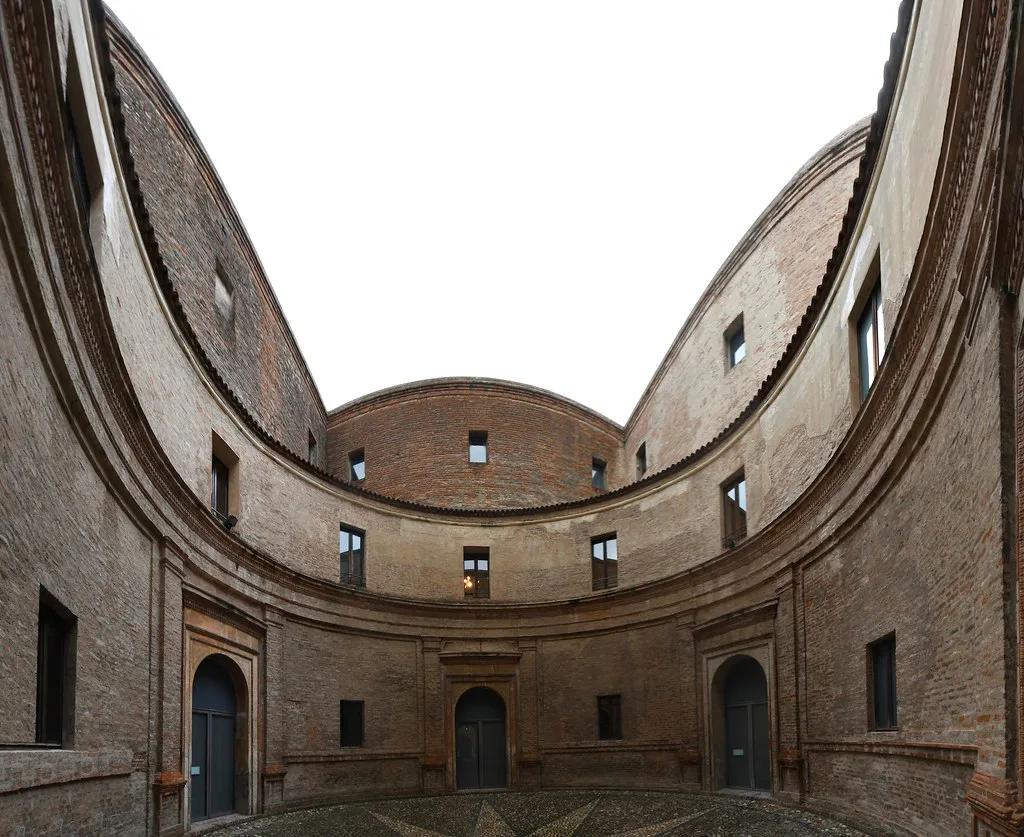
The building's defining trait is a square plan with a circle inscribed inside it, forming a cylindrical courtyard open to the sky. The circular opening frames a slice of sky and echoes, on a domestic scale, the oculus of the Camera degli Sposi in the Ducal Palace, which is Mantegna's best-known painted ceiling.
The geometry produces real spatial effects worth looking for. From the entrance to the circular court, aligned with the house's own entrance, you can see the three French windows at ground level and a double section above, with windows in the curved wall on the upper floor and smaller openings set back on the flat wall. The arrangement balances solids and voids rather than simply decorating a facade.
The identity of the designer remains uncertain in the published account, which names Mantegna himself or an architect following his instructions. That uncertainty is worth holding onto as you look: the house is a document of Renaissance design thinking as much as a signed work.
Ab Olympo and the Gonzaga Arms
Over the entrance, seen when entering the inner courtyard, runs the motto AB OLYMPO. Its meaning is not settled: it points to a link between human art and the world of the gods, and Mount Olympus was a theme the Gonzaga favoured, but whether the house is presented as a home of the gods or as blessed by a presence descending from above remains open.
The fragmentary interior frescoes include two coats of arms linked to Mantegna, comparable to the one in his funerary chapel in the Cathedral of St Andrew. On the right is a sun, the symbol of the Marquis Ludovico granted to the painter in 1459; on the left a crown surrounded by myrtle, below which two decorated strips on a black background recall the earliest Gonzaga arms.
Elsewhere in the house the most prestigious surviving fresco is a sun shining over a grid of coloured rings in azure and yellow, with a scroll bearing the words Par un desir. The motif deliberately parallels the ringed ceiling of the Camera degli Sposi; look for it as evidence of how Mantegna carried court imagery into his own home.
What Remains and What Is Lost
Almost all of the interior decoration is gone, and what you encounter are fragments rather than a program. A surviving patch of late fifteenth-century fresco, prized for its blue ground, and a coffered ceiling that probably postdates Mantegna are the kind of detail the house now offers. The loss is not incidental: it is the result of centuries of remodelling.
Later works altered the structure while also saving it. After passing through Gonzaga hands, the building was sold in 1607 to Pirro Maria Gonzaga of the Vescovato branch, changed owners again, and in 1728 became property of the marquises Paleotti Lanzoni, whose extensive modifications helped preserve it from ruin. In the nineteenth century it served as a school run by the City of Mantua, and the provincial administration later restored it in phases.
The House Today: Exhibitions, Not a House Museum
The restored building now functions as a venue for exhibitions and as an information point on Mantegna's life and work, according to the Museo Urbano Diffuso feature. That means what you find inside may be a temporary display rather than a fixed sequence of rooms, so the reason for your visit could be the architecture plus whatever is showing.
The published sources do not give current opening hours, closing days, ticket prices, or whether the courtyard and interiors are accessible on a given day, and none of them confirms a combined ticket with Palazzo Ducale, Palazzo Te, or Mantova Card. Check the Comune di Mantova site and the venue's own listings before travelling, and treat any figure quoted on a third-party page as unverified.
Pairing the House with Palazzo Te and San Sebastiano
The strongest short itinerary keeps you in this quarter: Casa del Mantegna, then Palazzo Te with its park and frescoed interiors, then the Tempio di San Sebastiano opposite. Palazzo Te was built as a Gonzaga pleasure palace in 1524 and now contains an art museum, so it is a substantial stop in its own right and needs time set aside.
A useful half-day version adds the Palazzo Ducale in the centre, but be aware that the Ducale is a vast complex of palaces, apartments and churches, and a couple of hours is a realistic minimum rather than a generous allowance. Third-party guides list closure days for the Ducale, but those details change; confirm them on the official site rather than relying on an older article.
If you are travelling without a car, the city's compact core and lakeside paths make bicycles a practical way to link the centre, Palazzo Te and the house, and the tourist information office in Piazza Mantegna is the place to ask about rentals and routes. Regional trains connect Mantua with Verona and Modena, with the station a short walk from the centre.
A Short Visit Versus a Half Day
If your priority is the courtyard and the exterior inscription, a focused stop of well under an hour can work, though no source confirms an official visiting time and you should not plan around one. Read the Ab Olympo motto, walk into the circular court, and look back at the entrance axis before moving on.
For a fuller picture, give the cluster half a day: Palazzo Te's interiors and park take the largest share, San Sebastiano adds Alberti's architecture almost opposite, and the house supplies the human-scale epilogue. That ordering also keeps you close to the Mincio River and the lake margins for an evening walk back.
Whatever you choose, verify access on the day you plan to go. The Comune's events and notices pages are the most reliable public starting point for what is open and what is programmed, including temporary disruptions affecting city cultural services, and they will tell you more than any static guidebook entry.
Plan Your Visit
Casa del Mantegna is best approached as a piece of architecture with a documented history and a partly lost interior, not as a painted treasure house. The square plan with its inscribed circle, the 1476 foundation inscription and the Ab Olympo motto are the concrete things to seek out, and they sit conveniently beside Palazzo Te and San Sebastiano.
Before you go, confirm current opening arrangements and any exhibition programme through the Comune di Mantova and the venue itself, since hours, access and ticketing are not fixed in the published record. Broader options across the city are collected in our Mantua Attractions section if you want to build the rest of the day around this quarter.
Frequently Asked Questions
Where is Casa del Mantegna located in Mantua?
It stands in the part of Mantua associated with the Gonzaga, close to Palazzo Te and the Palazzo di San Sebastiano, with Alberti's Tempio di San Sebastiano almost opposite. That places it outside the tight historic core of Piazza Sordello, Piazza Broletto and Piazza delle Erbe, so plan it as a separate cluster rather than a stop between the squares.
Is Casa del Mantegna the same as Palazzo Ducale?
No. Palazzo Ducale is the vast Gonzaga palace complex on Piazza Sordello containing the Camera degli Sposi. Casa del Mantegna is the house Andrea Mantegna built for himself on land granted by Prince Ludovico, begun according to its inscription in 1476. They are different buildings in different parts of the city and should be planned as separate visits.
Can you see original Mantegna frescoes inside the house?
Only traces. The published account states that nearly all the interior decorations have been lost and that what survives are fragments, including two coats of arms and a sun motif over a grid of coloured rings, plus a coffered ceiling that probably postdates the artist. Do not expect intact painted rooms, and check what is currently on view before travelling.
Who commissioned Casa del Mantegna and when was it begun?
Mantegna built it on land given by Prince Ludovico, and a Latin inscription on the external corner records the laying of foundations on 18 November 1476. Construction proceeded slowly and he is documented living there by 1496, but a Gonzaga order of 16 January 1502 transferred the property to the family in exchange for another building near today's Piazza Marconi.
What does Ab Olympo mean on the courtyard entrance?
The motto is inscribed over the entrance visible when entering the inner courtyard, and its meaning is not settled. It links human art to the world of the gods, and Mount Olympus was a Gonzaga theme, but interpreters differ over whether the house is presented as a home of the gods or as blessed by a presence descending from above.
Do you need to book, and what are the current opening hours?
The available sources do not publish current opening hours, closing days, prices, booking rules or accessibility details for the house, and they do not confirm any combined ticket with Palazzo Ducale, Palazzo Te or Mantova Card. Since the building operates as an exhibition and information venue, check the Comune di Mantova site and the venue's own notices shortly before your visit.
What else is there to see near Casa del Mantegna?
Palazzo Te, with its park, frescoed interiors and art museum, is the natural companion, and the Tempio di San Sebastiano stands almost opposite. Allow a couple of hours for the Palazzo Ducale if you add the centre, and confirm its closure days on the official site rather than relying on older travel articles.
Sources
Continue exploring
More guides you'll find useful