Vucciria Market Palermo: Day Versus Night Visit Guide
Plan a visit to Palermo's Vucciria market: daytime stalls, evening street food and bars, plus practical safety and etiquette tips from traveller sources.
On this page
La Vucciria is one of Palermo's oldest market names, but what visitors find today changes character completely between morning and night. Treat the day-night split as your main planning decision: come early for produce and a quiet lane, or come after dark for street food, drinks and crowds. Allow roughly an hour on a daytime wander and a whole evening if you come for the nightlife; those are editorial suggestions, not official timings. If you expect a bustling covered food market at noon, you will probably leave puzzled.
The official Italia.it listing describes the market around Piazza Caracciolo as Palermo's oldest local market, active by day with fruit, vegetables, fish and meat, and transformed in the evening into a nightlife meeting place with music and local food. That dual identity is the key to enjoying it. Decide which version you want before you set out, because the two experiences barely overlap.
Where Vucciria Sits in Palermo
Vucciria sits in the heart of the historic centre, close to Piazza San Domenico and its church, and within easy walking distance of Via Roma. The market threads through narrow lanes such as Via Maccheronai, with Piazza Caracciolo acting as its main square. Because it is embedded in the old street grid, you will pass through it rather than arrive at a single gate.
That central position makes Vucciria easy to combine with other sights on a walking day in Palermo. If you want a broader plan for the centre, the Palermo Attractions hub collects guides to the city's main sights so you can slot the market into a route. A morning market stop pairs naturally with a later visit to the Palermo Cathedral visitor guide, since both are in the compact historic core.
The Name and Its Butcher's-Shop Roots
Italia.it explains that the market was once called la Bucceria, from the French boucherie, or butcher's shop, because it was originally intended for selling meat. Over time the loud cries of traders made the name a byword for noise and confusion. Knowing that history helps explain why the Sicilian name still suggests chaos rather than orderly aisles.
A traveller account on Travelling Jezebel dates the market back more than a thousand years, to a period of North African presence in Sicily. Treat such long-range history as context rather than a precise founding date. What matters for a visitor is the continuity: this has been a trading corner of the city for centuries, even as its daily function has shifted.
What Vucciria Is Not: A Working Food Market Like Ballarò
The most useful expectation to set is that Vucciria is not the hectic, bargain-hunting street market that many online descriptions imply. The Travelling Jezebel guide argues that much of that image is outdated and sends readers who want a classic Sicilian market experience to Ballarò or Il Capo instead. Both are described as still functioning in the traditional way, with vendors calling over one another and produce to haggle over.
So choose your market by purpose. For photographing fish stalls, comparing tomatoes and haggling over spices, head to Ballarò or Il Capo. For a low-key daytime lane of small stalls that turns into a nightlife square after dark, Vucciria is the right stop. Mixing up the two is the single most common reason visitors feel disappointed.
Daytime in Vucciria: What the Stalls Actually Sell
By day, the stalls along Via Maccheronai are a modest mix rather than a grand market. Expect fruit and vegetables alongside bric-a-brac, old newspapers, photographs, coins and assorted curiosities. A few souvenir stalls have appeared in recent years, selling inexpensive toys and fridge magnets. The scene is quiet enough that you can look without being pressed to buy.
Italia.it confirms the daytime market role, describing Vucciria as a place where you can buy everything and anything, especially fruit, vegetables, fish and meat. The listing places the market at Piazza Caracciolo in the historic centre. Come with modest expectations and you will find a pleasant, lived-in corner of the city rather than a spectacle.
Daytime is also when the lanes are easiest to walk and photograph. The trade-off is that many food and drink places are shut or quiet, so do not plan a long lunch here on the strength of the daytime market alone. If street food is your goal, come later.
Evening in Piazza Caracciolo: Street Food, Bars and Music
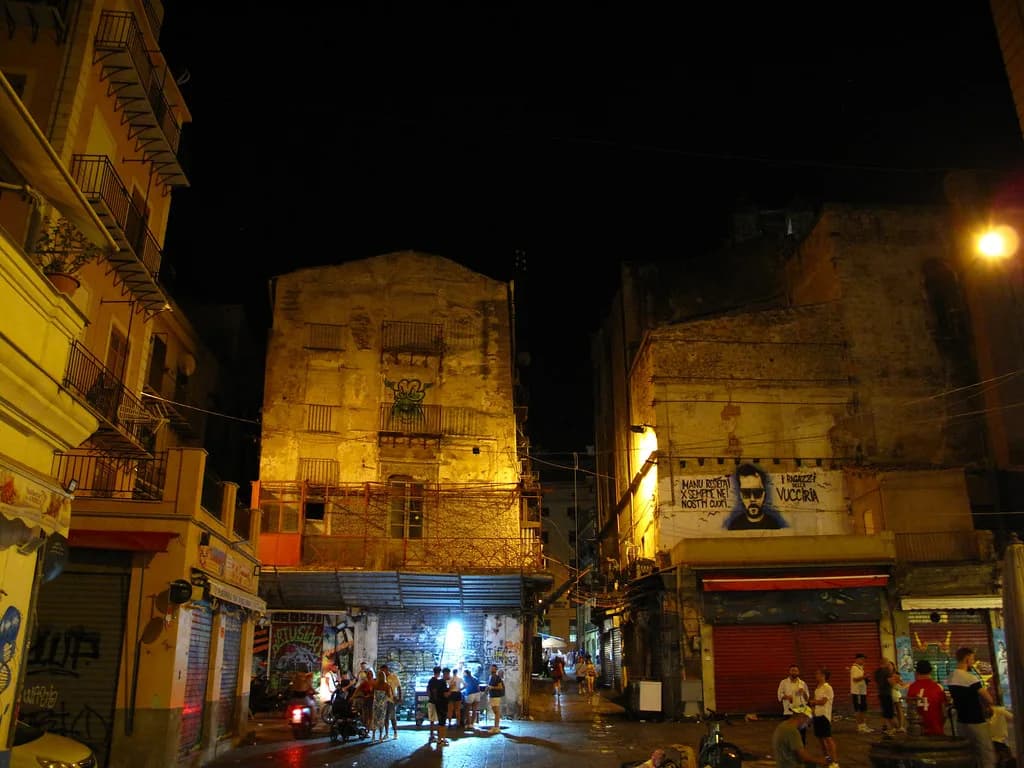
After dark, Piazza Caracciolo becomes the focus. Italia.it describes the evening transformation into Palermo's nightlife meeting place, always lively, with music echoing late and local delicacies served outdoors. The Travelling Jezebel account adds detail: street food vendors grilling meat, makeshift bars appearing in the square and a crowd that grows louder and denser as the night goes on.
The evening is street-first rather than table-first. People buy a drink and stand outside, and the party happens in the lane rather than inside any particular bar. That means you do not need to choose the perfect venue in advance; you need to be comfortable standing, walking and being part of a crowd.
Food to Look For in Vucciria
Palermo's signature street foods are the reason many visitors come. Pani ca meusa, the spleen sandwich, is sold from small stalls, and the Travelling Jezebel guide singles out one vendor, Rocky Basile, as a well-known source near Piazza Caracciolo or the Via Roma entrance. Arancine, sfincione and pane e panelle also appear around the market, and Tripadvisor's attraction page lists these among the specialties to eat on the spot.
Seafood and grilled meat are the other mainstays. The Travelling Jezebel account describes seafood laid out on ice, fritto misto, grilled octopus and oysters at one square-side spot, and a simple barbecue grill sending meat smoke across Via Roma. For a wider survey of local dishes and where they fit in the city's food culture, see Sicilian Food in Palermo, which sets dishes like pasta con le sarde in context.
Do not expect fixed menus or reliable online listings. The same traveller account notes that mapping apps are often inaccurate or out of date for Vucciria's small establishments, many of which have no name at all. Walk the lanes, look at what is being cooked, and ask what is available that evening.
Drinking in Vucciria: Street-First Bar Culture
Bar culture here is about buying a drink and taking it outside. The Travelling Jezebel guide notes that Taverna Azzurra is the oldest and most storied bar on the street and that, because locals cluster there, the bars opposite often serve faster. It also describes pop-up shot bars in Piazza Caracciolo as cheap and lively. Use these as examples of the scene rather than a guaranteed current list.
If you dislike crowds or noise, arrive early in the evening and leave before the square fills. If you want the full atmosphere, accept that the lanes become tight and loud. Either way, keep your group together and agree on a meeting point before the crowd thickens.
Etiquette and Expectations: Sunday, Cash and No-Frills Seating
One practical point comes from the traveller account: much of Vucciria is described as closed on Sundays, which is why a nearby African restaurant's music and dance afternoons used to draw a crowd then. Treat that as one writer's observation rather than an official timetable, and check locally before making a Sunday trip. On other days, assume some places open late and some close early.
Cash and informal service are the norm in this kind of street market. Carry small notes, do not rely on card readers, and expect plastic chairs, paper plates and handwritten menus rather than polished hospitality. Bring a little patience: service moves at the pace of the crowd.
Staying Safe and Comfortable
Palermo is generally described as safe, but crowded nightlife areas attract pickpockets. The Travelling Jezebel guide advises keeping belongings close, leaving the bank card at home and not carrying your wallet in a back pocket. This is sensible traveller caution rather than an official security notice. Keep your phone and cash in a zipped bag and avoid carrying a laptop.
Footwear matters more than you might expect. The same account warns that the streets can be dirty and smelly, so closed shoes are a better choice than open sandals. Pace yourself across a long evening: eat something before drinking, keep water to hand, and know your route back to your accommodation.
Who Will Love Vucciria and Who Should Skip It
Vucciria divides opinion. The Travelling Jezebel writer describes it as a love-it-or-hate-it place, adored for its unpretentious, shabby character and disliked for its grime and smells. If you enjoy street food, standing-room bars and a bit of grit, it will likely appeal. If you want quiet, polished dining or a classic produce market, choose elsewhere.
If you like atmosphere but not crowds, the daytime version may suit you better. If you want more of Palermo's quieter corners after the market, the hidden gems in Palermo guide points to less obvious places across the city. And if you are planning a broader visit, the Norman Palace and Palatine Chapel visitor guide offers a more structured, ticketed sight to balance a scruffy, freewheeling market evening.
Plan Your Visit
The simplest way to enjoy Vucciria is to choose your time deliberately. Come in the morning for a quiet walk through the produce and bric-a-brac stalls, or come after dark for street food, outdoor bars and music in Piazza Caracciolo. Trying to do both in one short stop usually means seeing neither version properly.
Set expectations before you go: this is not Ballarò, the listings are unreliable, and the experience depends on the crowd. Carry small cash, wear closed shoes, keep your belongings secure and check locally before a Sunday trip. If you want a calmer side of Palermo afterwards, the Catacombs of Porta d'Ossuna visitor guide is a good contrast.
Frequently Asked Questions
What is the best time to visit Vucciria?
It depends on what you want. Daytime is quietest and best for seeing the produce and bric-a-brac stalls along Via Maccheronai. Evening, especially in Piazza Caracciolo, is when street food, bars and music take over. If you dislike crowds, arrive early in the evening and leave before the square fills.
Is Vucciria still a working market?
Partly. Italia.it describes it as Palermo's oldest local market, with daytime produce, fish and meat stalls. The Travelling Jezebel account warns that it is no longer the hectic bargaining market many older guides describe, and suggests Ballarò or Il Capo for that experience. Go expecting a modest street market that becomes a nightlife square.
How does Vucciria compare with Ballarò and Il Capo?
Vucciria is smaller and more oriented toward evening street food and bars. Ballarò and Il Capo are described by the Travelling Jezebel guide as still functioning in the traditional way, with vendors calling out and produce to haggle over. Choose those for a classic market morning and Vucciria for a night out.
What street food should I try in Vucciria?
Look for pani ca meusa, arancine, sfincione and pane e panelle, plus seafood such as fritto misto and grilled octopus, and simple grilled meats. Tripadvisor's attraction page lists the first group among the specialties to eat on the spot. Availability varies by vendor and evening, so ask what is being cooked.
Is Vucciria open on Sundays?
The Travelling Jezebel account reports that much of Vucciria is closed on Sundays, but treats this as an observation rather than an official timetable. Check with your accommodation or a local contact before planning a Sunday visit, since individual bars and stalls may vary.
How do I stay safe in Vucciria at night?
The Travelling Jezebel guide advises keeping belongings close, leaving bank cards at home and avoiding back pockets in the crowded lanes. Wear closed shoes, eat before drinking and know your way back. These are traveller tips rather than official security rules.
Sources
Continue exploring
More guides you'll find useful