
Padua Cathedral Visitor Guide: History and Practical Tips
Plan a visit to Padua Cathedral with its Renaissance history, unfinished facade and Michelangelo-linked presbytery, plus tips for the adjoining Baptistery.
On this page
Padua Cathedral, known locally as the Duomo di Padova, is easy to walk past. Its brick front was never finished, and it sits a few minutes from the busier squares rather than on the main tourist circuit. That unfinished look is exactly why the building repays twenty focused minutes: it is a record of centuries of changing plans rather than one architect's finished statement.
The cathedral stands on Piazza Duomo in the walkable core of Padua, with the Baptistery immediately beside it. The two are distinct monuments with separate entrances and, in practice, separate ways of visiting. Treating them as one stop is the most common mistake, and it usually means rushing the frescoes that many visitors remember longest.
Finding Padua Cathedral in the Historic Centre
The cathedral sits on Piazza Duomo, a short walk from the university quarter and the twin market squares. Because its facade is plain and incomplete, first-time visitors occasionally mistake the building for a minor church. Look for the dome rising over the crossing and the bell tower beside it, which together identify the site from a distance.
Padua is compact enough that most of the centre can be covered on foot, which makes the cathedral an easy addition to a route between the station and Prato della Valle. Allow a few extra minutes for the lanes around Piazza Duomo, where the approach is quieter than around the Basilica of Sant'Antonio. For an overview of how this stop fits with other monuments, see our Padua Attractions guides.
One practical note: religious buildings in Italy keep liturgical life running alongside tourism. If a service is in progress when you arrive, wait outside or return later rather than walking through the nave. The Diocese of Padova publishes news and diocesan appointments online, which is also where local context for cathedral events appears.
A Short History: From Early Christian Origins to the 1117 Earthquake
The site's history reaches back to the early Christian era, when the first cathedral was built in what is now marked by a column topped with a cross. It was initially dedicated to Saint Justina before taking the title of Santa Maria. The dedication to the Assumption of the Virgin Mary is the one the cathedral carries today.
The medieval building had a hard run. It was damaged during Hungarian incursions and then struck by the catastrophic earthquake of 1117, which levelled much of the city. A Romanesque reconstruction followed in the twelfth century under the architect Macillo, and the rebuilt cathedral was consecrated in 1180. That date marks the end of one chapter, not the building you see now.
If you want to understand Padua's medieval layers before visiting, our guide to the hidden gems in Padua covers quieter corners of the centre that survived or were rebuilt in the same centuries.
The 1551 Reconstruction and the Renaissance Transformation
The present cathedral began with a reconstruction started in 1551, which gives the building its three-aisled, Latin-cross form. Bishop Pietro Barozzi had earlier set the process in motion by commissioning a new presbytery inspired by the scale of St Peter's in Rome. The ambition was Roman, but the execution stretched over more than two centuries.
That long timeline explains much of what you see. The right transept was completed in 1635 and the left in 1693, and embellishments continued into the eighteenth century. Reading the cathedral, then, is less about a single moment of design than about a sequence of campaigns, each stopping and starting for reasons of money, politics or war.
The most visible consequence is the facade, which was never completed. Rather than a flaw, it is useful evidence: it shows what a large Renaissance church project in a mid-sized Italian city actually looked like when funds ran dry. Measure your expectations against that story and the visit becomes considerably more interesting.
Michelangelo, the Presbytery and What "Linked to the Design" Means
Michelangelo Buonarroti is associated with the cathedral through the design of its presbytery, the raised eastern end around the high altar. His involvement gave the project a monumental model, and the presbytery was completed in 1582. The plans were altered along the way, so his contribution is best understood as a starting point rather than a final blueprint.
This matters for visitors because the cathedral is sometimes described as a Michelangelo building, which overstates things. It is not his church in the way that St Peter's is associated with him. Look instead at the presbytery and the way the eastern end anchors the interior, then compare it with the unfinished exterior.
If you enjoy tracing how great names attach to buildings, pad this stop with scholarly context rather than plaques alone. The city's tourism office maintains pages on major monuments that help separate documented involvement from later legend, and a short read before arrival makes the interior far easier to parse.
Reading the Building: Three Aisles, a Dome and an Unfinished Facade
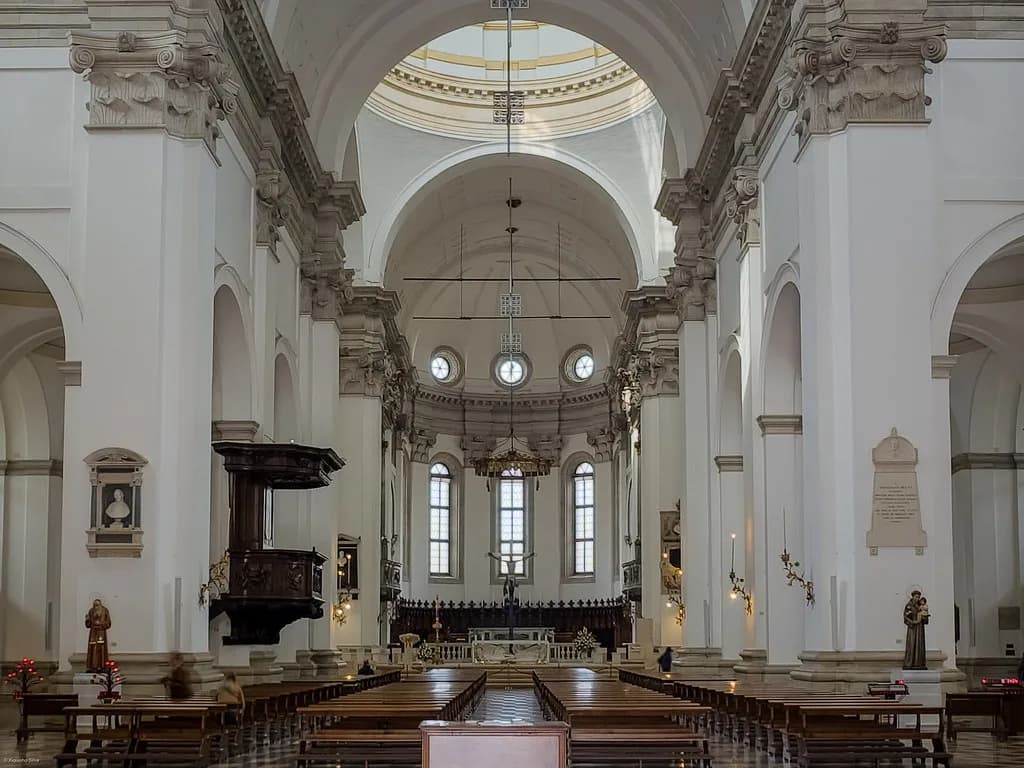
Inside, the cathedral is a three-aisled basilica on a Latin cross plan with a bright, barrel-vaulted nave. The effect is calmer and more austere than the lavish Basilica di Sant'Antonio on the other side of the centre. Architecture enthusiasts will notice how the nave's proportions pull the eye toward the crossing and the presbytery beyond.
A lantern-crowned dome rises above the crossing. The dome project began in 1756 and is attributed to Giovanni Gloria and Giorgio Massari, so credit belongs to both figures rather than to one. A lightning strike damaged the dome in 1822, and it was subsequently restored. When you look up, you are seeing eighteenth-century engineering that has already survived at least one serious scare.
The bell tower has its own history: originally part of the medieval structure, it was rebuilt in the sixteenth century under Cardinal Francesco Pisani. It remains one of the landmarks of the skyline around Piazza Duomo. Together with the dome, it gives the otherwise reticent exterior its profile.
What to See Inside: Petrarch's Cenotaph and the Byzantine Icon
Among the works inside, two stand out for most visitors. The first is the cenotaph of Petrarch, a memorial monument rather than the poet's burial place; Petrarch's actual tomb is elsewhere in the region. The distinction saves a common misunderstanding, so read the inscription carefully before assuming this is his grave.
The second is a thirteenth-century Byzantine icon of the Virgin Mary, a devotional image that predates much of the current building's decoration. Its presence is a reminder that the cathedral's treasury of objects accumulated across centuries rather than arriving as a single commission. Both are easy to miss if you walk straight down the nave and out again.
The cathedral also holds relics associated with Saint Daniel, Saint Leonine and Saint Gregory Barbarigo, which underline its role as a working place of worship. Be discreet around chapels where people are praying, and keep voices low. Photography rules can vary by area, so follow any signage rather than assuming.
The Baptistery Next Door Is a Separate Visit
The Baptistery of Padua adjoins the cathedral, but it should be treated as its own monument. Inside, Giusto de' Menabuoi painted a fresco cycle that covers the walls and culminates in a dome dominated by Christ Pantocrator. The colour and preservation make it one of the outstanding fourteenth-century interiors in northern Italy.
The cathedral and the Baptistery do not share a single, simple entry arrangement. Access to the Baptistery has been managed through timed or guided entry at various points, and published prices and opening times have differed between sources. Our Baptistery of Padua Visitor Guide: Frescoes & Tickets explains what the frescoes show and how to plan the visit; confirm current conditions with the Diocese of Padova or the city tourism office before you travel.
Useful practical context on visiting the Baptistery appears in general Padua guides, which note the separate, structured nature of entry compared with the free-flowing cathedral. Wanderlog lists the site on Piazza Duomo with published opening periods, but these change seasonally.
Practical Tips: Dress, Timing and Verifying Hours
Padua Cathedral's opening times are not fixed in any way you should trust from a secondary source. Tourist listings online, including a Padua attractions guide that gives a daytime and afternoon window, disagree with other pages and are not the operator. Before you go, check the Diocese of Padova website or the city tourism office for current hours, and plan around services rather than against them.
Dress code is the other thing to get right. In Padua's major churches, covered shoulders and knees are expected, and the same standard is sensible at the cathedral even where no sign spells it out. Carry a light scarf in summer. Entry policies, including whether a modest contribution is requested, are best confirmed on site rather than assumed.
Mornings tend to be quieter in this part of the centre, since the market crowds gather around Piazza delle Erbe rather than Piazza Duomo. If you plan to combine the cathedral with the Baptistery, leave a clear hour and do the Baptistery first if your schedule allows, since its entry is the more tightly regulated of the two.
Pairing the Cathedral With Nearby Sights
The cathedral is a natural stop on a walk that continues to Prato della Valle, one of the largest squares in Italy and home to the Basilica of Santa Giustina. Our guide to the Abbey of Santa Giustina explains its scale and the tomb of Saint Luke, which sits in the north transept. Check the abbey's own published opening periods, since access to inner chapels requires an authorised guide.
In the other direction, the Basilica di Sant'Antonio draws far larger crowds and holds Donatello's bronze works on the high altar. Italo's Padua guide notes that the city's monuments are close enough to combine, with the station a short walk from the historic centre. Our Basilica di Sant'Antonio in Padua guide helps you decide whether to add it to the same day or save it.
For university history, Palazzo Bo offers guided visits that include the anatomical theatre and the hall where Galileo taught. Prices and tour days are published by the university and by the tourism office, and bookings are handled through the university rather than the cathedral.
Suggested Time Split for a Cathedral Stop
If you have only an hour in this corner of Padua, spend roughly twenty to thirty minutes in the cathedral and the rest at the Baptistery. The cathedral is small enough to absorb quickly, and its main points of interest, the presbytery, the cenotaph and the icon, cluster in predictable places. The Baptistery rewards a slower read of its painted scenes.
With two or three hours, add Prato della Valle and the Basilica of Santa Giustina, which are a short walk south. Save the Scrovegni Chapel for a separate slot: it requires advance booking for timed entry, and online travel guides stress that same-day walk-in visits are unreliable in high season. Fulltravel's ticketing guide explains the booking options.
If your time is very short, prioritise the Baptistery and skip the cathedral interior. It is a decision most guides do not phrase so bluntly, but the fresco cycle is the rarer experience, and the cathedral can be appreciated from Piazza Duomo later. Storyhunt's Padua guide likewise treats the Duomo and Baptistery as one location with the Baptistery as the artistic highlight.
Where the Cathedral Fits in a Wider Padua Itinerary
Padua rewards a slow approach. The cathedral and Baptistery occupy a quiet pocket of the centre that contrasts with the market bustle of Piazza delle Erbe, where stalls have traded since the Middle Ages. If you are building a full day, link the cathedral with a market breakfast and a late-afternoon walk to Prato della Valle rather than trying to see everything before lunch.
The city's attractions reward different lengths of stay. MyCityHunt notes the cathedral's unfinished facade and its location near other major sights, which makes it an easy add-on rather than a destination in itself. Plan for one focused stop here and give the Scrovegni Chapel and the basilicas their own time.
Finally, if you want a self-guided structure rather than a checklist, our Padua Historic Center Self-Guided Walk offers a two-hour route through the core. Treat it as a suggested order of stops, not a fixed schedule, and adjust it around whatever service times you find on the day.
Plan Your Visit
Padua Cathedral is worth a deliberate twenty-minute stop, not a detour. Its unfinished facade, Renaissance presbytery, baroque dome and quiet interior tell a story of interrupted ambition, and the cenotaph of Petrarch is a memorial rather than a tomb. Taken with the Baptistery next door, it makes one of the most rewarding short visits in the Veneto.
Before travelling, verify current opening hours and entry arrangements for both the cathedral and the Baptistery with the Diocese of Padova or the city tourism office, since published third-party times vary. Allow extra time if you want the Baptistery's frescoes, and dress for a working church. For more stops in the city, browse Padua Attractions and the rest of our Italian guides.
Frequently Asked Questions
Is Padua Cathedral free to enter?
Entry conditions are not published consistently by third-party sources, so do not rely on a blog or listing to tell you whether a contribution is expected. Check with the Diocese of Padova or the city tourism office before you go, and be prepared for a donation box at the door.
Do I need a separate ticket for the Baptistery?
Yes, the Baptistery is a distinct monument next to the cathedral, not an extension covered by a cathedral entry. Its access has been managed through timed or guided entry at various points, and published details differ between sources. Confirm the current arrangement with the Diocese of Padova or the tourism office.
How long does a visit to Padua Cathedral take?
Twenty to thirty minutes is enough to see the nave, the presbytery, Petrarch's cenotaph and the Byzantine icon at an unhurried pace. That is a suggested duration, not an official figure. Add a separate slot of around an hour if you want to see the Baptistery's frescoes properly.
Did Michelangelo design Padua Cathedral?
No. Michelangelo is linked to the design of the presbytery, which was completed in 1582 after modifications to his plans. He was not the cathedral's overall architect, and the building's present form results from a reconstruction begun in 1551 and campaigns continuing into the eighteenth century.
What can I see inside Padua Cathedral?
Highlights include the barrel-vaulted, three-aisled interior, the Renaissance presbytery linked to Michelangelo's designs, the cenotaph of Petrarch and a thirteenth-century Byzantine icon of the Virgin Mary. Relics of several saints are also venerated here. Photography rules vary, so follow signage.
Is Petrarch buried in Padua Cathedral?
No. The monument inside the cathedral is a cenotaph, a memorial rather than a tomb. Petrarch's actual burial place is elsewhere in the region, so read the inscription with that in mind and avoid repeating the common assumption that this is his grave.
What should I wear when visiting Padua Cathedral?
Cover your shoulders and knees, as you would at Padua's other major churches. Carry a light scarf in summer for that purpose. The cathedral is a working place of worship, so dress and behaviour should reflect that even when no sign states a rule explicitly.
Is Padua Cathedral worth visiting if I only have a day in Padua?
It is worth a short stop, especially if you pair it with the Baptistery, where Giusto de' Menabuoi's fresco cycle is the stronger artistic draw. If your day is very tight, prioritise the Baptistery and the Scrovegni Chapel, which requires advance booking for timed entry in high season.
Sources
- Padua Cathedral
- Home - Chiesa di Padova
- What to see in Padua: a complete guide to visiting the city of Saint Anthony - Italo Blog
- Top 9 Attractions in Padua (2026 Guide) and a Free Interactive Map
- Tickets for the Scrovegni Chapel: Which One to Choose and How to Book
- Battistero di San Giovanni Battista, Padua, Italy - Reviews, Ratings, Tips and Why You Should Go – Wanderlog
- 13 Best Things to Do in Padua: Art, History & Attractions - The Weather Guide
- Palazzo Bo and Anatomical Theatre
Continue exploring
More guides you'll find useful





