Castello di Carlo V Lecce: Visitor Guide
Plan a visit to Castello di Carlo V in Lecce: bastions, courtyard, the two internal displays, ticket-scope checks and a realistic suggested visit length.
On this page
Castello di Carlo V is the odd one out in a city of lace-cut baroque facades: a squat military block with lance-shaped bastions, covering roughly 13,000 square metres and described by the city tourism portal as the largest castle in Puglia. That scale is exactly why first-time visitors pause at the gate, unsure whether there is enough inside to justify the stop. This guide separates what you can read from the street, what sits in the courtyard, and what the interior displays add.
One practical point shapes every plan: the castle is managed by the regional museum directorate for Puglia, a transfer reported by both the castle's own site and the city tourism page as taking effect in 2023. Current opening days, ticket scope and any guided-route availability are published on the castle site rather than fixed here, because they change with exhibitions and events. Treat the castle as a one-hour anchor in a longer walking day rather than a half-day destination.
Where the Castle Sits in Lecce
The fortress occupies the eastern edge of the historic centre, a short walk from Piazza Sant'Oronzo and the Roman amphitheatre. It has two entrances, one from Via XXV Luglio and another from Piazza Libertini, so you can enter from the shopping street and leave towards the quieter lanes behind. Because the old moats were filled in 1872, the castle now stands isolated on three sides, which makes it far easier to read as a shape than most monuments in the city.
That position suits a simple loop: castle first, then the baroque heart around Piazza del Duomo and Santa Croce. If you are building a wider sightseeing list, the Lecce Attractions hub groups the city's main monuments so you can decide what deserves time before you start walking.
A Short History: Normans, Carlo V and the Barracks Years
The name is slightly misleading. A castle already existed here in the Norman-Swabian period, when it served as the seat of the counts of Lecce, and archaeology on the site has traced earlier phases beneath the sixteenth-century work. What you see today is largely the result of a defensive rebuild ordered in 1539 by Emperor Carlo V, who needed protection against Turkish raids in the Mediterranean, with the design entrusted to the royal engineer Giangiacomo dell'Acaya.
Dell'Acaya wrapped the medieval core in a quadrilateral curtain with four pointed bastions, two facing the city and two facing the countryside, and demolished the Celestine convent of Santa Croce to make room; two bastions still carry those religious names. The castle later lost its residential and military purpose and spent decades as a barracks and garrison before restoration from 1994 reopened it to the public. The castle's own site frames that long arc from Norman residence to late nineteenth-century barracks as the key to reading the building.
Outside First: Walls, Bastions and the Filled Moat
Start outside before buying anything. Walk the length of Via XXV Luglio, then turn onto Piazza Libertini, and look for the giant Habsburg eagle carved in local stone above the portal, its shield framed by the collar of the Golden Fleece. The same emblem appears on the inner facade facing the piazza d'Armi, and spotting both is a small reward for circling the building rather than entering straight away.
The bastions are the clearest evidence of how warfare changed: angled points designed for artillery replaced the merlons and towers of the medieval wall circuit. Because the moat was filled in the nineteenth century, the castle looks shorter than it once did, and the drawbridges are gone, though the slots that held the chains and operating beams are still visible at the gates. The street-level exterior is part of the public cityscape, but published sources do not confirm access rules for the moat or grounds at all hours, so check locally rather than assume.
Courtyard and Interior: What the Walk Feels Like
Inside, the castle is deliberately austere, and that is part of the experience. The quadrilateral curtain encloses a central piazza d'Armi dominated by the surviving medieval towers, the Torre Magistra and the Torre Matta, so you move from open military space into the older residential core. Expect bare stone, sudden shade and a strong sense of how defensive architecture works, rather than the gilded interiors you find in Lecce's churches.
The city tourism page describes guided and multimedia routes that include hidden and below-ground spaces such as the prisons and cellars. Those areas are presented as part of organised routes, not as open rooms you can wander into, so do not plan around seeing the dungeons unless the operator confirms access for your date.
The Two Internal Displays: Papier-Mâché and Roman Lecce
Two permanent installations give the interior its substance. In the former stables, the Museo della Cartapesta uses historic works to tell the story of Lecce's papier-mâché craft, a tradition better known from festival figures than from museum cases. In the spaces that once served as the castle kitchens, scale models reconstruct the Roman theatre and amphitheatre of Lupiae, the ancient city beneath modern Lecce, and they are useful preparation before you see the excavated amphitheatre in the piazza.
These displays are separate in character from the historic rooms, and the sources do not describe one all-inclusive ticket covering every internal area and guided route. Check the ticket page for exactly what is included on the day you go, especially if a temporary exhibition is running, because the castle is also used for shows and events.
The Maria d'Enghien Room and Medieval Memory
On the first floor, in the part of the complex called the quarto nobile, the medieval rooms that once housed the princely residence of the county of Lecce survive inside the sixteenth-century shell. The most celebrated is the hall of Maria d'Enghien, covered by a lunetted barrel vault resting on carved corbels, with the coat of arms of the viceroy Pedro de Toledo at the centre of the ceiling. It is the moment where the castle stops being a fortress and becomes a residence.
A good anecdote to carry out with you: dell'Acaya, the engineer who designed the fortifications, reportedly ended his life imprisoned in the castle's own damp cells as an insolvent debtor, a story recorded by the city tourism portal. Whether the cells themselves are on view depends on the guided routes of the day.
Practical Planning: Tickets, Hours and Confirmation
Do not rely on third-party listings for opening times. One travel aggregator still displays daily hours for the castle, but such listings can lag behind seasonal changes, exhibitions and event closures, so the castle's own site and its hours and tickets page are the places to confirm before travelling. The castle is run by the Direzione regionale Musei nazionali Puglia, which is the authority behind the published schedule.
Fees, reduced rates and combination tickets change with the exhibition programme, so this guide does not quote figures. Check the official pages in the week before your visit, note whether the papier-mâché museum and model displays are included in the day's ticket, and ask about guided routes at the ticket desk if the underground spaces matter to you.
How Long to Allow
As an editorial suggestion rather than an official duration, plan around an hour to ninety minutes for the exterior circuit, courtyard, historic rooms and the two displays. Add time if you join a guided or multimedia route, because those extend into hidden areas and move at group pace. If you only have twenty minutes, the bastions, gates and courtyard still give a coherent impression of the fortress without entering the museum spaces.
Families often find the papier-mâché figures and the Roman city models the easiest points of engagement, while travellers short on time may prefer to spend their indoor hours in the churches. The castle rewards curiosity about how cities defend themselves more than it rewards a checklist visit.
Pairing the Castle With Nearby Lecce Sights
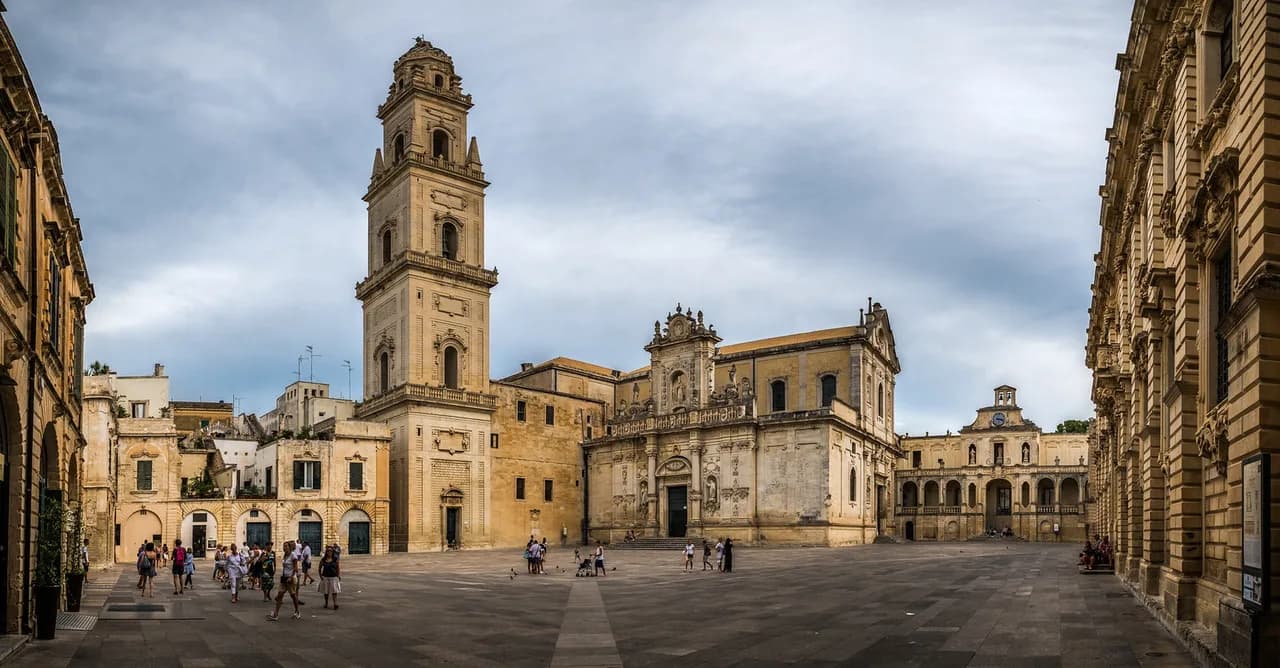
From the castle it is a short walk to Piazza del Duomo, where the cathedral, bell tower, seminary and museum complex cluster on one enclosed square; that setting makes it the natural next stop for anyone continuing a baroque day. The Piazza del Duomo Lecce visitor guide explains the individual buildings and current access arrangements.
Santa Croce is the other obvious partner, and there is a neat historical thread: the Celestine convent demolished to enlarge the castle was rebuilt elsewhere in the city, and the basilica's facade is the high point of Leccese baroque. Visiting the Basilica di Santa Croce in Lecce covers how the church is currently ticketed and visited.
If you want to go beyond the headline monuments, the hidden gems in Lecce article covers less-obvious corners of the old town, including the Museo Faggiano and its excavated layers, which make an interesting counterpoint to the castle's archaeology.
For a market-and-street contrast, walk up towards Porta Rudiae, where a small historic market operates just outside the gate with produce, roasted chicken and pastries, according to listings that also give trading hours. Those hours are third-party information, so confirm on the day if the market is your reason for the detour.
Who Should Prioritise the Castle and Who Can Skip It
Prioritise the castle if you are interested in military architecture, in the medieval layers hidden under baroque Lecce, or in the papier-mâché craft that shapes the city's festivals. It is also a sensible rainy-day stop, since much of the visit is indoors.
Skip or shorten it if your time in Lecce is one afternoon and your priority is carved stone facades, or if you need confirmed step-free access, since published sources do not detail accessibility for the courtyard or interior and you should ask the ticket office directly.
Plan Your Visit
The castle works best as a layered walk: read the bastions and gates from the street, cross the courtyard to the medieval towers, then use the interior displays to connect Lecce's Roman past and its papier-mâché present. Confirm hours, ticket scope and guided-route availability on the official castle site before you set out, and keep the visit flexible around exhibitions.
Build the rest of the day on foot, with Piazza del Duomo and Santa Croce as the baroque counterweight to the castle's austerity, and leave room for one unplanned detour into the lanes behind Piazza Libertini.
Frequently Asked Questions
Is Castello di Carlo V worth visiting in Lecce?
It is worth it if you want military architecture and medieval layers rather than baroque ornament. The bastions, gates and courtyard give a clear sense of the fortress even on a short stop, and the papier-mâché museum and Roman city models give the interior substance. Travellers with only an afternoon and a strong interest in churches may prefer to spend the time elsewhere.
How long does a visit to the castle take?
A reasonable editorial estimate is about an hour to ninety minutes for the exterior, courtyard, historic rooms and the two displays. Guided or multimedia routes take longer because they move at group pace and include hidden areas. No official recommended duration is published.
What can you see inside the castle?
Inside you find the piazza d'Armi framed by the surviving medieval towers, the historic rooms on the first floor including the hall of Maria d'Enghien, and two permanent displays: the Museo della Cartapesta in the former stables and scale models of Lecce's Roman theatre and amphitheatre. Underground spaces are described as part of guided routes, so access is not guaranteed.
Is the castle exterior free to walk around?
The walls and bastions form part of the street-level cityscape and can be viewed from Via XXV Luglio and Piazza Libertini. Published sources do not confirm whether the grounds or moat are accessible at all hours, so check locally rather than assuming, and confirm ticket scope for the interior on the official site.
Can you visit the dungeons and underground areas?
The city tourism page mentions prisons and cellars within descriptions of guided and multimedia tours, not as freely open rooms. If those spaces matter to you, ask at the ticket desk or check the castle site for current route availability. Do not plan a visit solely around seeing them.
How does the castle fit into a one-day Lecce itinerary?
Use the castle as a morning anchor, then walk to Piazza del Duomo and Santa Croce for the baroque contrast, finishing with the amphitheatre area and an evening in the old town lanes. Booking castle time early leaves the afternoon free for churches, which often keep limited visiting windows.
Sources
Continue exploring
More guides you'll find useful