Campanone Bergamo: Visitor Guide to the Civic Tower
A grounded guide to Bergamo's Campanone (Torre Civica): its Suardi origins, 52.76 m height, three bells, 230-step climb, elevator and the evening hundred tolls.
On this page
The Campanone, or Torre Civica, rises from Piazza Vecchia in Bergamo's upper town, Città Alta. A suggested visit of about one to two hours is enough to climb, look at the bell chamber and spend time on the terrace, though that is an editorial estimate rather than an official timing. The tower is a useful first stop because the square around it gathers several historic buildings within a few steps, and the tower itself explains the medieval skyline you are walking through.
This guide sticks to the documented historical record: the tower's origins as a Suardi family tower-house, its raising to 52.76 metres in 1550, its three-bell chamber and the 230-step climb with an elevator alternative. Practical details such as current tickets, opening hours and accessibility policy are not confirmed here and should be checked with official sources before you travel.
What the Campanone Is and Where It Stands
The Campanone sits centrally on Piazza Vecchia, filling the gap between the Palazzo della Ragione and the Palazzo del Podestà. In Bergamasco dialect it is known as ol campanù, a nickname tied to the great bell at the top. The tower is the tallest in Bergamo and the square is the natural orientation point for a walk through the upper town.
The square around it is open ground you can cross freely, but that does not mean the neighbouring monuments share one entrance, one ticket or one set of opening times. Treat the tower, the palaces, the basilica and the cathedral as separate places to check individually before planning your day.
Why Piazza Vecchia Is the Right Starting Point
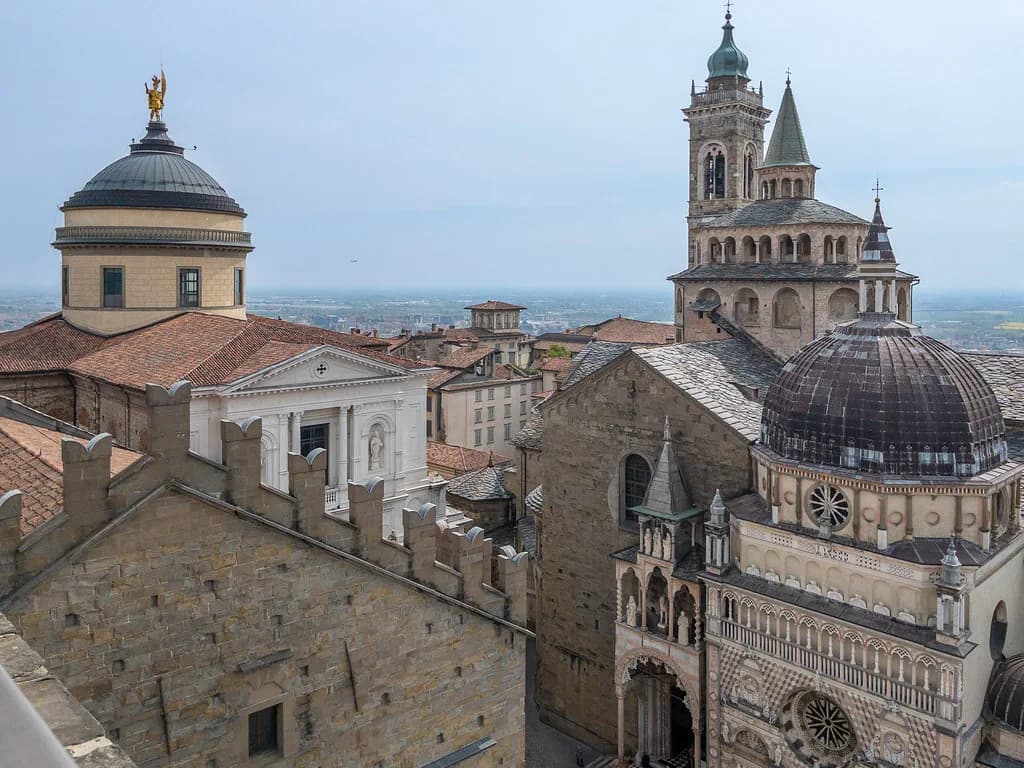
Start on the square rather than at the tower door. From Piazza Vecchia you can see the Palazzo della Ragione's loggia, the Basilica di Santa Maria Maggiore, the cathedral and, a short walk away, the Colleoni Chapel, so you can decide what deserves your time before committing to any interior. For wider planning, see Hidden Gems in Bergamo.
The square is also where the tower's evening tradition is best experienced at ground level, since the bell's sound carries across the open space. If you plan your day around the square, you keep the option of climbing during daylight and returning later for the atmosphere without crossing the city twice.
Medieval Origins: A Suardi Tower-House Turned Civic Symbol
The tower was built between the 11th and 12th centuries as a tower-house belonging to the Suardi family, one of the powerful dynasties of the period. In an era when Bergamo was known as a city of a hundred towers, height signalled status, and noble families competed to build upward.
During the 14th century the structure housed the city prisons, and in the communal era it passed to the municipality, shifting from a private symbol of family power to an emblem of public authority. The bells were installed around this period, which is when the name Campanone took hold. That layered history is worth keeping in mind as you look at the stonework on the way up.
The 1550 Raising and the Height Visitors See Today
The tower originally stood about 37 metres tall. In 1550 the municipality approved a significant raising to accommodate a larger bell chamber, and the structure reached the 52.76 metres it measures today, making it the tallest tower in Bergamo.
Later centuries brought minor structural changes, and the tower now has an elevator alongside the stairs. Knowing that the current profile is a 16th-century decision rather than the original medieval outline changes how you read the facade from the square.
Inside the Bell Chamber: Three Bells and the Largest in Lombardy
Three bells hang in the tower. The largest, cast on 23 March 1656 by Bartolomeo Pisenti, is still the biggest in Lombardy, with a diameter of 2.07 metres and an estimated weight of about 5,580 kilograms. The two earlier casting attempts failed, and the successful pour took place in what is now Piazza Duomo, where a circle in the pavement is said to mark the spot.
The middle bell dates from 1949 and was made by Angelo Ottolina, who obtained the mould before the original 1653 bell was requisitioned and destroyed during the Second World War. The smallest bell is also the oldest, cast in 1474 by Gasparino da Vicenza and weighing about 480 kilograms. All three now run on electrified systems that allow both swinging and electric striking.
Climbing to the Top: The 230-Step Route and the Elevator
Reaching the top on foot means climbing 230 steps, a gradual ascent that lets you look at the internal masonry and the old prison fabric as you go. The alternative is a modern elevator that reaches the first terrace; it was installed in 1960 and enclosed in transparent glass during a 2007 restyling, so it now doubles as a viewing lift.
The trade-off is straightforward. The stairs give you the full sense of the building's scale and a proper look at the bell mechanism, while the lift saves your legs and suits anyone who would rather not tackle a long climb. Neither is inherently better, and the right choice depends on your energy, the weather and how much time you have in Città Alta that day.
What You Actually See From the Terrace
From the summit the view runs 360 degrees: the tiled roofs and walls of Città Alta below, the modern grid of Bergamo Bassa to the south, the Po Valley stretching away and the Orobie Pre-Alps rising to the north. Bring a few minutes to simply scan the horizon rather than photographing immediately, because the double city is the real reward here.
Allow roughly one to two hours if you want to climb, study the bell chamber and linger on the terrace. That is a suggested time budget, not an official operator figure, so adjust it to how busy the tower and the square are when you arrive.
The Hundred Evening Tolls: Tradition and Timing
The tower's best-known ritual is the hundred tolls. Historically the great bell struck one hundred times in the evening, at the hour now shown as 10 PM, announcing the imminent closing of the gates into Bergamo Alta and the start of the night curfew. The gates have not closed for centuries, but the city has kept the custom as a reminder of that past.
Do not assume this happens on every night of your trip. The organisation, frequency and exact timing are the kind of detail that can change, so check with the tourist information service or the tower's own channels before you build an evening around it. If it does ring, standing in Piazza Vecchia rather than on the terrace is arguably the better experience.
The bell also sounds on civic and religious occasions, including city council meetings and the August concert of the city's bell towers ahead of the feast of Saint Alexander, the patron saint celebrated the following day. Those dates are part of the tower's tradition rather than a fixed annual programme you can rely on without checking.
Structuring a Visit: Pairing the Tower With the Square
A sensible half-day pairs the climb with the square at its base. See the Palazzo della Ragione's loggia, step into the Basilica di Santa Maria Maggiore or the cathedral if they are open to visitors, and walk on to the Colleoni Chapel, but confirm separately whether each interior is free or ticketed rather than assuming the tower admission covers them.
From Piazza Vecchia, Via Colleoni, known locally as the Corsarola, leads through historic shops and palaces toward the Cittadella and the museums housed there. The Venetian Walls, a UNESCO World Heritage Site since 2017, loop around the whole upper town and are a natural way to extend the walk if you still have energy after the steps. For wider planning, see Bergamo Attractions: Visitor Guides to 12 Sights.
Practical Planning and What to Verify Before You Go
This guide deliberately does not state a ticket price, current opening hours, a Monday closure or online booking availability for the tower, because those details change and are not confirmed here. Use the city's official tourism site and the comune's event listings to check admissions and any temporary closures before setting out, and confirm accessibility arrangements directly if the lift matters to your visit.
For the approach to Città Alta, check current transport options and any restrictions on driving into the upper town rather than relying on memory or older guides. Confirm where the elevator reaches, how long the last entry window is and whether any part of the tower is closed for works on the day you plan to climb.
Plan Your Visit
The Campanone rewards visitors who treat it as both a monument and a viewpoint. Climb for the panorama over the two Bergamos, take time over the bell chamber, and reserve the evening for the square, where the tolls, if they ring, carry best.
Before you go, verify tickets, opening times, lift access and any bell-ringing events through official tourist or city sources. That way the fixed history in this guide does the work of orientation, and current logistics come from the people who run the place.
Frequently Asked Questions
How many steps are there to the top of the Campanone in Bergamo?
The climb to the top involves 230 steps. Visitors who prefer not to take the stairs can use the elevator, which reaches the first terrace and was enclosed in glass during a 2007 restyling.
Is there an elevator up the Campanone?
Yes, an elevator was installed in 1960 and later given a transparent glass enclosure in 2007, so it doubles as a viewing lift to the first terrace. Confirm the current access and any restrictions on the day of your visit, since operating rules can change.
How tall is the Campanone and why was it raised?
The tower is 52.76 metres tall today, making it the tallest in Bergamo. It originally stood about 37 metres, and in 1550 the municipality approved a substantial raising to accommodate a larger bell chamber.
What are the hundred tolls of the Campanone and when do they happen?
Traditionally the great bell struck one hundred times in the evening, at the hour now shown as 10 PM, announcing the closing of the gates into Bergamo Alta and the start of the curfew. The custom is remembered as history, so check with official local sources whether and when it is rung during your visit.
What can you see from the top of the Civic Tower in Bergamo Alta?
From the summit you get a 360-degree view over the tiled roofs and walls of Città Alta, the modern streets of Bergamo Bassa, the Po Valley to the south and the Orobie Pre-Alps to the north. Daytime is best for reading the double city, while the square below is the place for evening atmosphere.
What else is worth seeing around Piazza Vecchia?
Near the tower you can see the Palazzo della Ragione, the Basilica di Santa Maria Maggiore, the cathedral and a short walk away the Colleoni Chapel, with Via Colleoni and the Cittadella further along. Check each interior separately, as not every monument shares the same entrance or ticketing arrangement.
Do I need to book Campanone tickets in advance?
That information is not confirmed here, and booking arrangements can change between seasons. Check the official tourist and city websites before travelling rather than relying on older guides or third-party listings.
Sources
Continue exploring
More guides you'll find useful