Siena One Day Itinerary: A Realistic Walking Plan
A practical one-day Siena itinerary with a walking order through Piazza del Campo and the Duomo area, what to book ahead, and where to pause for lunch.
On this page
A single day in Siena is enough for one compact loop of the historic centre, but not for every museum, tower and church interior at once. The city rewards slow walking more than box-ticking, so this plan keeps the route short and the choices few. Budget roughly eight hours on foot; that is a suggestion, not an official figure.
The decision that shapes everything else is which paid interior earns your slot. The cathedral, the civic museum in Palazzo Pubblico and the pilgrim-hospital complex of Santa Maria della Scala sit with different operators and separate visiting arrangements, so check each one directly before you commit.
Piazza del Campo, an overview of Siena's sights and the city's own Palio tradition are on the Comune di Siena site, which also points to dedicated pages for the Museo Civico, Santa Maria della Scala and tourism. Start there for orientation, then confirm the specifics with each venue.
Set Expectations: Separate Tickets, Separate Operators
Siena's headline sights do not work like a single pass. The Duomo, the Museo Civico inside Palazzo Pubblico, the Torre del Mangia climb and Santa Maria della Scala are distinct visits with their own organisers, and one booking does not open the doors of the others. Treat each as a separate decision rather than assuming a combined ticket.
Opening days, seasonal timetables and whether timed entry is needed can change through the year, and the sources here do not confirm current details. The safe method is to check the operator's own page shortly before travelling, then book only what you will genuinely have time to see. Aggregator listings are a useful cross-check but not the authority on hours or availability.
The Walking Order: Start High, Finish at the Campo
Begin at Piazza del Duomo, the highest point on this route, and let the day run gently downhill. You reach the striped cathedral facade and its marble-clad companions first, when legs are fresh, and you avoid climbing back uphill after lunch. The cathedral is described as mixing Romanesque lower levels with a later Gothic upper section and a Renaissance interior with frescoes, sculpture and a celebrated library, so even the exterior rewards a slow lap.
From the cathedral square, work down to Santa Maria della Scala, the complex that once sheltered pilgrims and later served as a hospital. It is a natural stop between the Duomo area and the Campo, and it holds temporary exhibitions that change what you see. Whether you go inside or just note the facade depends on the one-interior rule below.
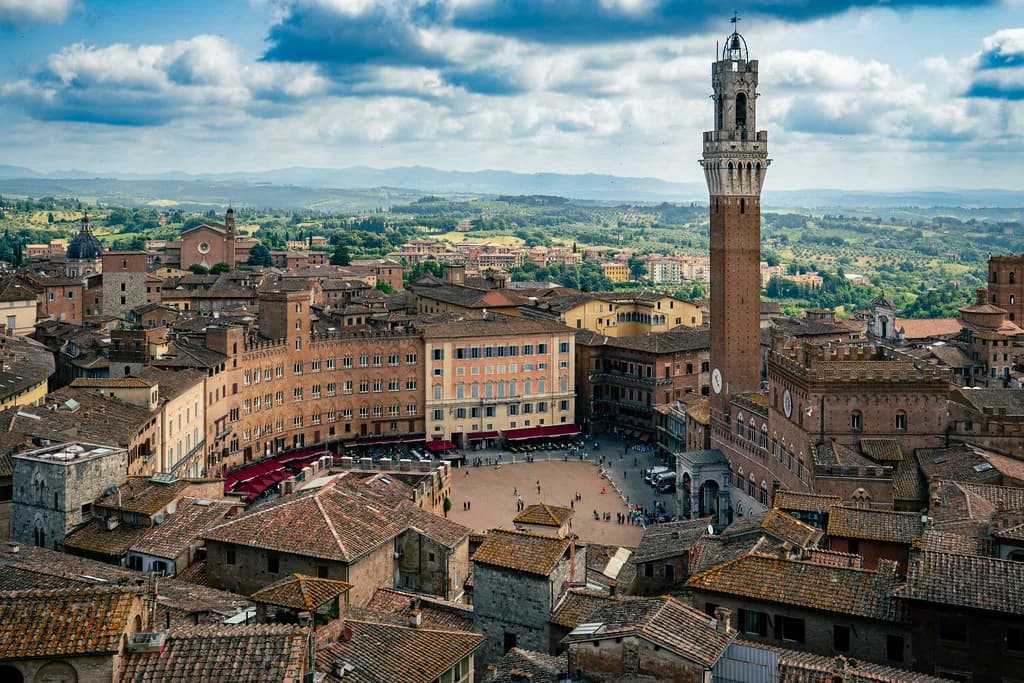
Finish the descent into Piazza del Campo, the shell-shaped square that slopes toward Palazzo Pubblico and the slender Torre del Mangia. Some travellers consider it among Italy's finest medieval squares, and its fan shape is unmistakable once you are standing on the bricks. Late morning is a good moment: the square is public ground, but the buildings around it are not.
Piazza del Campo in Daylight: What Is Free and What Is Not
The Campo itself is open public ground, so wandering onto it costs nothing. The Palazzo Pubblico and its civic museum, the Torre del Mangia and the cathedral interior are the paid layer, each with its own entry arrangement. Keep that distinction clear in your head and you will not be surprised at a ticket desk.
Sitting down is a separate budget decision from standing. Café tables ringing the square come with a premium for the view, which is a fair trade for one slow coffee and a poor one for a full meal. Stand, walk the curve, look up at the tower and save your table money for later.
For a deeper look at corners the day-trippers miss, including quieter churches and viewpoints, use the hidden gems in Siena guide as an evening or early-morning add-on rather than cramming it into the middle of this loop.
Choosing Your One Paid Interior
Pick a single interior and give it proper time. The cathedral suits travellers who want mosaic floors, sculpture and layered architecture; the civic museum suits those drawn to medieval frescoes and civic history; the tower suits anyone willing to climb for the panorama. Each choice means giving something up, so decide from your interests rather than from a ranking.
If you choose the cathedral, go early, because the interior is reported to get crowded in peak season and the advice is to visit in the morning or near dusk. That guidance comes from a traveller's account rather than from the operator, so confirm current hours and any timed-entry system on the cathedral's own page before you rely on it.
If the tower is your pick, wear shoes you can climb stairs in and accept that weather can close the experience. Neither the civic museum nor the tower details are fixed by the sources here, so check availability with the operator that runs Palazzo Pubblico before building your afternoon around it.
Lunch Near the Campo: The Trade-Off
Lunch on the Campo buys the view and the people-watching, and you pay for both. A table a short walk away, on one of the lanes radiating from the square, usually stretches the same budget further. The honest advice is to decide which you value more before you sit down, because menus on the square are priced for the setting.
Sienese food is hearty and best taken as a proper sit-down plate rather than a rushed snack. Traditional sweets such as panforte, a dense cake of honey, nuts and dried fruit, and ricciarelli, almond biscuits, are the natural finish, and a pasticceria counter is cheaper than a dessert course at a view table. Travellers who tried panforte at a family-run pasticceria in the city singled it out as a highlight.
Names and addresses of individual restaurants change hands and standards, and the sources here do not establish which places are currently open. Walk the lanes, read the posted menus and pick a busy room with a short menu; that check takes five minutes and beats any stale list.
Afternoon: A Slow Loop Through the Contrade Streets
After lunch, resist the urge to sprint to a second museum. Instead, loop through the lanes that carry the names and symbols of the contrade, Siena's historic neighbourhood divisions. The walking itself is the attraction: narrow streets, sudden views and small squares that reward an unhurried half hour.
Use this stretch to revisit whatever you passed too quickly in the morning, whether that is the cathedral facade in different light or the steps below Santa Maria della Scala. A self-guided route keeps you moving without a guide's schedule; the Siena Self-Guided Walk Through the Old Town pairs well with this loop.
If the weather turns, the plan survives with one substitution: pick the interior you skipped and use the wet hours inside it. A rainy day in Siena is a reasonable moment to swap outdoor wandering for frescoes, provided you have checked that the venue is open.
If You Have Energy Left: A Second Ticketed Visit
One day rarely fits two major interiors comfortably, but a late-afternoon second visit is possible if you started early and kept lunch short. Santa Maria della Scala is the logical candidate given its position on the route, and its exhibitions give the visit a different texture from a cathedral or a fresco cycle.
Treat this as optional and verify it on the day. The complex's current opening pattern, any separate exhibition charges and whether last entry falls before you arrive are details the organiser publishes, not things to assume from a guidebook. If the timing does not work, a second slow pass through the Campo costs nothing.
Ending the Day: Aperitivo and Palio Timing
Close the loop with an evening pass through the Campo as the light softens, then an aperitivo on a side street rather than on the square itself. Locals and visitors fill the streets and squares in the evening, which makes this the liveliest free hour of the day. Keep dinner flexible and book nothing that forces you back uphill.
If your dates fall near the Palio, plan around it rather than assuming access. The Comune di Siena states that the traditional races are run in the Campo on 2 July and 16 August each year, and such events can be altered or cancelled, so confirm arrangements with official channels before travelling. Expect crowds, restricted movement and higher demand for beds on those days.
For anyone staying longer, the Siena two days itinerary adds the second interior and a countryside half-day, while the Siena three days itinerary makes room for slower neighbourhood wandering and day trips.
Mistakes to Avoid on a One-Day Visit
The first mistake is backtracking: climbing back to the Duomo after lunch wastes the best hour of the afternoon. The second is over-booking interiors, which turns a walk through a medieval city into a schedule. The third is assuming one ticket covers the cathedral, the civic museum and Santa Maria della Scala, which the separate operators make unlikely.
The fourth is treating the station as central. The historic centre is compact on foot, but the station sits outside the old walls, and the sources here do not establish walking times or which local transport reaches the Campo. Check the current situation with the local transport operator or your accommodation before you arrive.
The fifth is planning a car into the centre. The old town is largely pedestrian, and the practical pattern is to park outside the walls and walk in. Confirm parking options and any restricted zones with the city or your accommodation, since rules and availability shift.
Plan Your Visit
A good Siena day is one loop, one paid interior and one proper lunch, with the Campo as the hinge. Check each operator's own page for current opening arrangements before you travel, and keep the rest of the plan loose enough to absorb a closed door or an unexpected detour.
If the day works, extend it: the two days itinerary and three days itinerary both build naturally on this route. And if you want the city without the crowds, the Basilica of San Domenico and the quieter lanes beyond the Campo repay an early start.
Frequently Asked Questions
Is one day in Siena enough?
One day covers a solid walking loop of the Duomo area, Santa Maria della Scala from outside or inside, and Piazza del Campo, plus one paid interior. It is not enough for every museum, tower and church, so treat the day as a taster and check each operator's page for what is open when you go.
What should I book in advance for a day in Siena?
Book only the interior you are certain to use, and book it through the operator that runs that site rather than an aggregator. The cathedral, the civic museum and Santa Maria della Scala are separate visits with separate organisers, so confirm current hours, entry arrangements and any timed slots directly with each one shortly before your trip.
What can you see for free in Siena in one day?
Piazza del Campo and the streets and lanes of the historic centre are public ground, and the cathedral exterior can be admired without a ticket. The interiors, the tower climb and ticketed exhibitions are the paid layer, so plan your budget around one or two of those rather than assuming everything is free.
Can you visit Siena and San Gimignano in one day?
It is possible but tight, and it usually means cutting Siena to a couple of hours. The sources here do not establish transport times or connections between the two towns, so check current schedules with the local transport operator before committing. If Siena is the priority, give it the full day and save San Gimignano for another trip.
How do you order the sights in Siena without backtracking?
Start at Piazza del Duomo, work down past Santa Maria della Scala and finish in Piazza del Campo. The route runs generally downhill through the old town, so you avoid climbing back up after lunch. Keep the afternoon for a slow loop through the contrade streets rather than a return to the cathedral.
Where should you eat lunch near Piazza del Campo?
Tables on the square charge for the view, so choose them only if the setting is the point of the meal. A short walk into the surrounding lanes usually gives better value and a calmer room. Read the posted menus, pick a busy place with a short menu, and finish with panforte or ricciarelli from a pastry counter.
Does one ticket cover the Duomo, Museo Civico and Santa Maria della Scala?
Do not assume so. These are separate sites with different operators and their own visiting arrangements, and the sources here do not confirm any combined pass. Check each operator's own page for what a ticket includes, what it excludes and whether any combined option exists during your dates.
What should I check if my dates fall near the Palio?
The Comune di Siena states that the traditional races are run in the Campo on 2 July and 16 August, and such events can change or be cancelled. Confirm arrangements with official city channels before you travel, expect heavy crowds and restricted movement, and book accommodation early because demand peaks around those days.
Sources
Continue exploring
More guides you'll find useful