Siena Contrade and the Palio: A Visitor's Guide to Race Days
Understand Siena's 17 contrade and the Palio: the two race days, the draw, historic records and respectful viewing etiquette in Piazza del Campo.
On this page
The Palio di Siena is not a folklore show staged for visitors. It is a horse race in Piazza del Campo that the city has run for centuries, and the passion around it belongs to Siena's seventeen contrade, the neighbourhood associations its citizens are born into. This guide explains what the race is, when it happens, and how to watch it without getting in anyone's way.
One practical caution frames everything below: the Palio is a local event first and a visitor experience second. You can stand in the square and feel the tension, but the day is organised around residents who have prepared for it all year. Treat the race dates as fixed traditions and check any detail that matters through official city channels rather than assuming a schedule.
What the Palio Actually Is
The Palio is a horse race contested in Piazza del Campo, Siena's shell-shaped central square, and it is bound up with the identity of the contrade rather than with tourism. Sienese belong to a contrada before they think of themselves as citizens of the city, and each contrada has allies and historic rivals whose histories are remembered for generations. That is why race day feels less like a spectator event and more like a family argument conducted at full volume.
A useful mental model for a visitor is a sports final that happens only once or twice a year, in which everyone in town supports a team. The result shapes the mood of a contrada for months afterwards. If you take that seriously, the practical rules of the day become obvious: do not block sightlines, do not wander onto the track, and do not treat the ceremonies as a photo opportunity that takes priority over the people around you.
The Seventeen Contrade
Siena is divided into contrade, each with its own emblem, colours, church and social life. Membership is inherited rather than chosen, and the contrada organises baptisms, festivals and dinners throughout the year, not just the race. Knowing this helps explain why the streets empty into particular squares on particular evenings and why banners and lamps appear in specific colours.
For a visitor, the contrade are a way of reading the city's geography. Walking the medieval streets, you will notice fountains, chapels and oratories carrying the emblems of a wolf, a snail, a caterpillar or a dragon. If you plan a walk that crosses several contrade, the city's layered identity becomes legible in a way it never is from Piazza del Campo alone. Our Siena neighbourhoods guide explains how the three terzi frame the centre, and a self-guided walk through the old town is a good way to cross them slowly.
Two Race Days a Year: July 2 and August 16
The traditional Palio dates are 2 July, the Palio di Provenzano, and 16 August, the Palio dell'Assunta. Both are run in Piazza del Campo, and the week before each one is filled with trial races, processions and contrada dinners. The city's official site states plainly that the traditional races take place in the Campo on those two dates each year.
Do not expect a published start time to be reliable in the way a concert is. The race follows religious and civic ceremonies whose timing is part of the tradition, and the trial races in the days before build the atmosphere without settling anything. If you are planning a trip around a race, verify any year-specific programme through official city channels rather than a booking site.
How the Field Is Set: Only Part of the Contrade Race
A common misconception is that all seventeen contrade run in every Palio. In practice ten of the seventeen take part in each race, with the lineup drawn by lottery, so the field changes from one Palio to the next. That single fact explains much of the tension in the weeks beforehand: some contrade wait years for a turn.
Because the draw changes, no two Palio weeks look quite the same. A contrada that is racing will be visibly busy, with open-air dinners and activity along its streets, while a contrada that is not drawn may be much quieter. If you want to understand which parts of town are animated on a given evening, check which contrade are running rather than assuming every district is celebrating.
A Historic Record From 1633
For readers who want statistics rather than atmosphere, the independent archive at ilpalio.org presents itself as an extensive non-profit reference on the Palio, with records running from 1633 to the present alongside chronicles, palio-by-palio results and data on jockeys and horses. It states that it is authorised by the Consorzio per la Tutela del Palio di Siena and carries no advertising. Treat that coverage start as the site's own stated scope rather than as a universal claim about when the race began.
The archive is most useful after you have seen a race, or before you go if you want context. You can look up which contrada won in a given year, how often a particular contrada has taken the Drappellone, and how the trial races and lineups have played out historically. Use it to check winners and records directly rather than relying on secondhand claims from social media.
Watching in Piazza del Campo
The square fills long before the race, and the crowd is part of the experience. People stand packed along the perimeter and inside the middle, and the most intense moment is the mossa, when the horses must align themselves at the starting rope. Everything is suspended until that happens, which is why the atmosphere can flip from noise to silence in seconds.
Practically, this means arriving early, choosing a spot where you can stand for hours without needing to move, and accepting that your view may be partly obscured. Do not plan on walking through the square during the race, and be prepared for the fact that the crowd presses in. If you have any mobility concern or are travelling with small children, consider watching from the edges of the square rather than the centre. For wider planning, see Siena with kids.
Etiquette That Avoids Real Friction
The etiquette of the Palio is not ceremony for its own sake; it prevents real arguments. Do not block other people's view, and expect to be told to take a child off your shoulders if you hoist one up. Stay silent during the mossa, and keep out of the way of parades and horses, especially during the trial races when horses leave the square. These points come from a long-standing visitor guide to the Palio, which stresses that the event is not staged for tourism.
Scuffles between rival contrade can break out during Palio week. They are usually brief and generally not something to fear from a distance, but the correct response is to step back and not film or intervene. If you witness tension, move away quietly and let the people involved handle it. Your role is that of a guest in a citywide event, and behaving accordingly is what makes the day enjoyable for everyone.
Contrada Colours and the Neckerchief
Every souvenir shop in Siena sells contrada colours, and the neckerchief worn around the neck or shoulders is the most popular item. Buying one is fine, but ask first which contrade are friendly with the one you are choosing and which are historic rivals. Walking into a rival district wearing its enemy's colours on race night can cause offence that is genuinely meant.
On the evening after the race, the city's lighting becomes a map of the result, according to the same visitor guide: the winning contrada and its allies keep their street lamps on and celebrate late into the night, while the losing contrade turn theirs off. If you are exploring after dark, that visual cue helps you avoid streets where your presence and colours may be unwelcome.
Trial Races and the Days Before
In the days before the Palio, the square hosts trial races, and the crowd is still thick even though they are not the main event. The horses must be allowed to leave the square before spectators move, and visitors who crowd the exits create genuine risk for the horses and handlers.
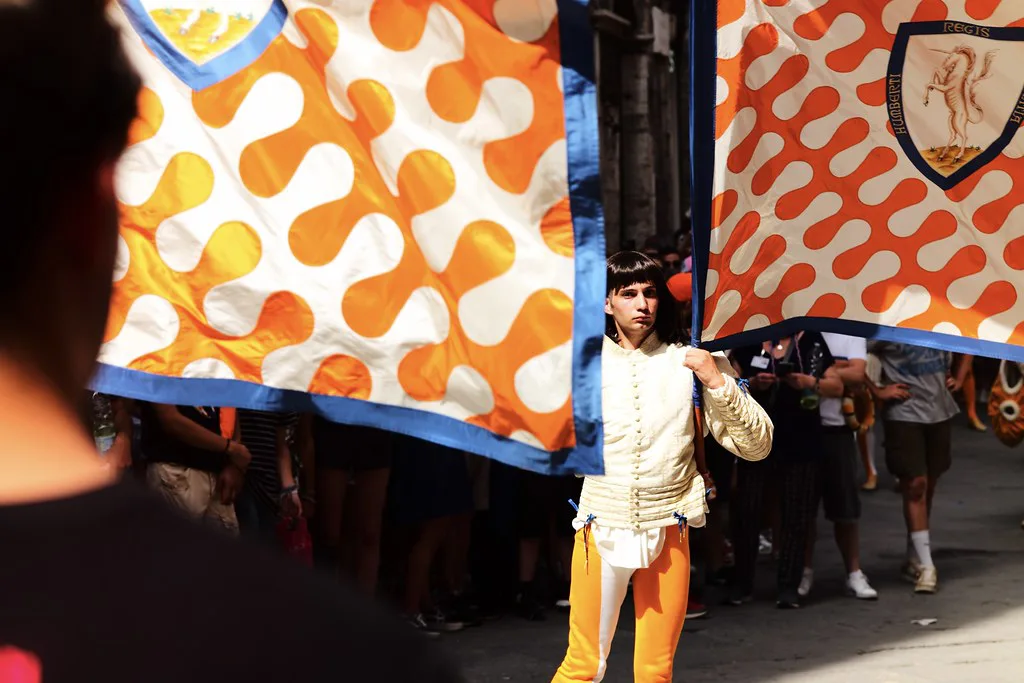
The atmosphere during Palio week is unlike any other time in Siena. Drummers and flag-bearers of the contrade appear in the streets, and the city has a heightened, nervous energy. If you want a calmer version of the city, plan your visit for a different period; our guide to the best time to visit Siena covers the trade-offs between crowd levels and atmosphere.
Eating With a Contrada
In the week leading up to the race, each contrada that is racing holds open-air dinners in the streets of its district, and the visitor guide notes that these have been open to outsiders as paying guests. These are genuinely one of the best ways to see the Palio from the inside: long tables, shared food and residents talking about their neighbourhood. The exact arrangements vary by contrada and year, so check locally rather than expecting a fixed booking process.
The dinner held to celebrate a victory is reserved for contrada members and takes place months later. Do not ask to join that one. For the pre-race dinners, the practical move is to enquire at the contrada's local office in person during the day and ask what is possible. Prices, seating and availability change, so confirm on the ground rather than relying on an older article.
What This Guide Leaves Out
This guide deliberately does not cover ticketing, grandstand seating, transport to Siena, or security and accessibility arrangements for race day, because those details change and a blog post is a poor place to check them. The city and the Palio's own organisations publish information as each edition approaches. Confirm any logistical point that affects your plan directly with the organisers or the Comune di Siena before you travel.
If you are in Siena outside Palio week, the city still rewards slow exploration. Beyond the Campo, quieter corners and churches such as the Basilica of San Domenico offer a different pace. A rainy day in Siena is a good moment to slow down indoors and read about the contrade rather than trying to march through a checklist. Our hidden gems guide points to some of the less crowded places to do that.
Plan Your Visit Around the Palio
The Palio rewards visitors who approach it as a civic event rather than a show. Learn which contrade are racing, respect the silence of the mossa, keep out of the horses' path and ask before wearing colours that carry meaning. Siena is a dense, walkable city, and the contrade make its streets legible if you pay attention.
If you want to build a fuller trip, browse the hidden gems in Siena guide and plan a Siena self-guided walk through the old town for the quieter days. For dates, programmes and any arrangements that carry a cost, check the Comune di Siena and the Palio's own publications rather than relying on old articles. That way, the race you see will be the one you prepared for.
Frequently Asked Questions
When is the Palio di Siena run?
The two traditional dates are 2 July for the Palio di Provenzano and 16 August for the Palio dell'Assunta, both in Piazza del Campo. The week before each race includes trial races, processions and contrada dinners. For any year-specific programme, check the Comune di Siena's own publications rather than assuming dates from a guidebook.
Do all seventeen contrade race in every Palio?
No. Only ten contrade take part in each Palio, with the lineup drawn by lottery, so the field changes from one race to the next. The draw is one reason the atmosphere in a given week depends heavily on which districts are running. It also means a contrada can wait years for its turn.
Can visitors watch the Palio without belonging to a contrada?
Yes. Members of the public stand in Piazza del Campo along with residents, and there is no contrada membership required to be in the square. The catch is that the space is packed for hours and your view will depend on where you stand. Arrive early and accept that you may see only part of the track.
How should visitors behave during the Palio?
Treat the day as a guest: avoid blocking other people's view, stay silent during the mossa, and keep clear of parades and horses, especially when the horses leave the square after the trial races. If a scuffle breaks out between rival contrade, step back rather than filming or getting involved.
Should I buy a contrada neckerchief?
You can, but ask which contrade are allied with and which are rivals of the one you choose, and avoid wearing colours of a losing contrada in its rival's district on race night. After the race, lit streets signal the winning contrada and its allies, while losing contrade turn their lamps off.
Can visitors attend contrada dinners before the Palio?
Yes, visitors have attended the open-air dinners that racing contrade hold in the week before the Palio. The practical step is to ask at the contrada's local office during the day about what is available that evening. Costs and arrangements vary, so confirm details in person rather than relying on older published figures.
Sources
Continue exploring
More guides you'll find useful