San Gimignano Self-Guided Walk: Towers, Squares and Quieter Corners
A step-by-step plan for walking San Gimignano on your own, from the two medieval squares and Torre Grossa to the Rocca, Santa Fina Chapel and quieter stops.
On this page
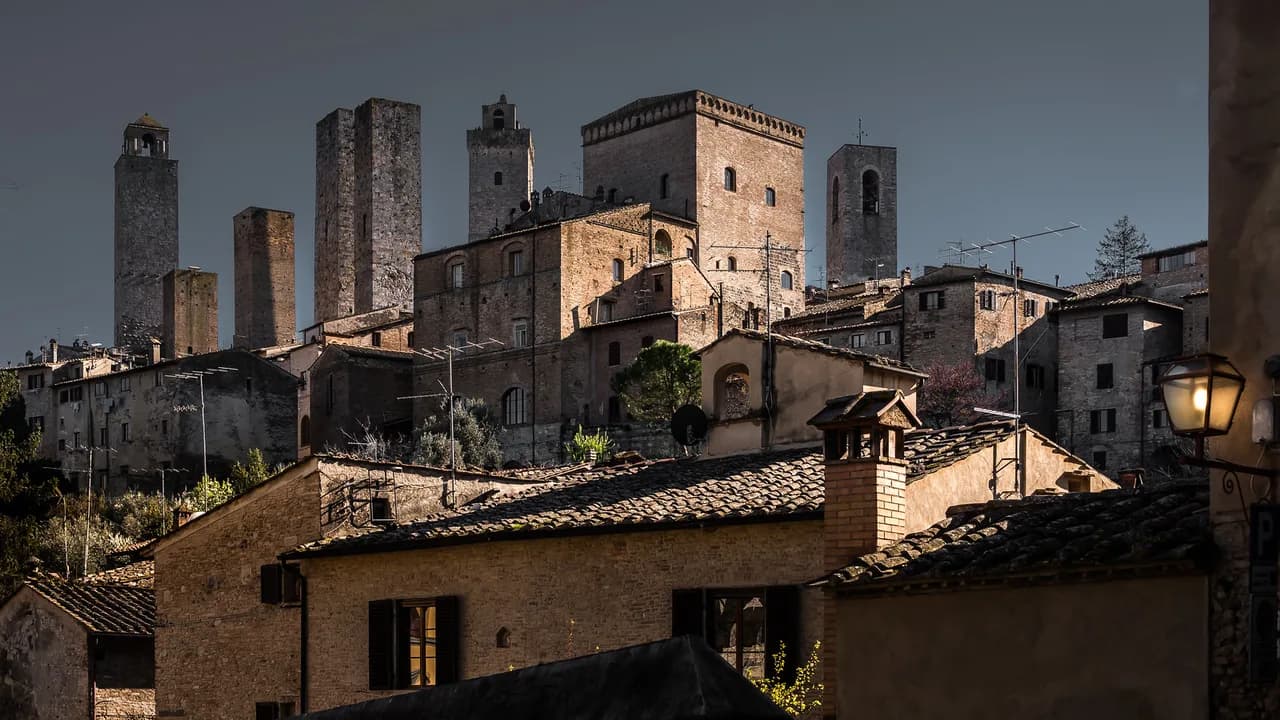
San Gimignano is compact enough to cross on foot, and its skyline is the reason most people come. The Wingman guide reports that about 72 tower houses once stood in the town and roughly 14 remain, which is why the centre still reads as medieval from a distance. Treat that figure as a commonly repeated description rather than official municipal data. Related guide: San Gimignano food guide.
What follows is a loop you assemble yourself, not an official numbered route with mapped distances or step counts. No source provides a fixed walking itinerary, exact walking times or crowd forecasts, so the sequencing below is editorial advice built around documented stops. Check current opening hours and ticket arrangements with each site before you go, because these change by season and by site.
The walk works best in three layers: open squares you pass through freely, paid interiors you enter deliberately, and outdoor edges such as the fortress where you stop for air. That structure lets you drop a layer when time or energy runs short without losing the shape of the day.
What to Expect From a Self-Guided Route
The historic centre is compact and the lanes between the main squares are short, so distance is rarely the problem. Towers, church interiors and museum rooms add vertical metres on top of street-level wandering, which matters when you decide between a half day and a full day. Stone lanes can be slippery when wet, so shoes with grip help.
Because the town is small, navigation is more about sequence than cartography. Fix the two central squares in your head first, then decide which interiors to queue for. If you only memorise one junction, make it the space between Piazza della Cisterna and Piazza del Duomo; most of the notable stops sit within a short stroll of that point.
Starting Out: From the Gates to Piazza della Cisterna
Most arrivals enter from the lower end of town and climb toward the centre, which naturally brings you to Piazza della Cisterna first. The square takes its name from the octagonal stone well at its centre; the Wingman guide dates that well to 1287 and picks it out as a detail many visitors walk past. Circling it once, reading the surrounding facades and moving on makes a sensible short stop.
The square is a hub rather than a hideaway, so treat the well as a reason to pause and look down rather than a quiet find. If you want to understand how the streets around it connect to the gates and the pilgrim route, the neighbourhoods overview is a useful companion before you walk. For wider planning, see San Gimignano Neighbourhoods and Quarters.
Piazza del Duomo and the Collegiata
From Piazza della Cisterna you are moments from Piazza del Duomo, where the Collegiata, the Palazzo Comunale and the tower cluster together. The collegiate church of Santa Maria Assunta is known for its fresco cycles, including works by Ghirlandaio and Benozzo Gozzoli depicting Old Testament scenes, as the Wingman guide describes. The square and the exterior cost nothing; the frescoed interior is a separate, ticketed experience.
Decide before you arrive whether you intend to look at the facade or go in, and check the current arrangement at the entrance. Do not assume one ticket carries you through every religious and civic space nearby. Each site sets its own entry terms, and no source consulted confirms shared tickets or current prices.
If the church interior is a priority, it is worth reading up on what you will see before queuing, so the visit does not dissolve into a crowded shuffle.
Torre Grossa and the Museo Civico
The Museo Civico, housed in the Palazzo Comunale, holds frescoes and artworks from the town's golden age, and the same building gives access to the Torre Grossa. According to the Wingman guide, the tower is the tallest in San Gimignano at about 54 metres and offers panoramic views of the town and the surrounding countryside. The climb is the payoff for the ascent, but it is a view, not a shortcut around the rest of the walk.
Choose one or both depending on your appetite for stairs and art. The museum rewards time and slows the loop down; the tower is a quicker, more physical detour. If you have already climbed the walls at the Rocca, you may find one high viewpoint sufficient and can spend the saved energy elsewhere.
The Quieter Half: Rocca di Montestaffoli
The Rocca di Montestaffoli is the open-space counterweight to the crowded squares. The Wingman guide describes it as a quiet fortress with walls to climb, views over the Tuscan countryside and space for a picnic. Its grounds are an outdoor stop, so they fit naturally into the free layer of the walk. Whether the walls are open on the day you visit should be checked on site.
Schedule it after the busy core rather than before, so the walk ends on rising ground and a wide horizon instead of in a queue. From the fortress you can look back over the rooftops and see how the tower skyline sits in the surrounding hills. For a fuller picture of the town's outdoor vantage points, the viewpoints guide collects the options in one place.
Santa Fina Chapel: A Focused Stop Inside the Collegiata
Inside the Collegiata, the Santa Fina Chapel holds frescoes by Ghirlandaio and the tomb of the town's local saint. The Wingman guide calls it a peaceful spot for art and history, tucked within the larger church. It is a small, focused stop rather than a gallery, so allow a few attentive minutes if you have already paid to enter. Nothing here is a secret; it simply sits away from the main aisle traffic.
Because the chapel is inside a ticketed church, its cost is the church's cost, not a separate fee. Confirm the current arrangement when you arrive, and do not carry over assumptions from other churches in Tuscany about what a single ticket covers.
Contemporary Counterpoint: Galleria Continua
Galleria Continua, housed in a former cinema, shows international contemporary art and is the one modern note in an otherwise medieval loop, per the Wingman listing. Dropping it into the middle of the walk resets your attention: after frescoes and towers, a white-walled gallery changes the pace. Check the current exhibition and opening days before making it a fixed stop.
If contemporary art is not your priority, treat the gallery as a marker on the route rather than a destination. Walking past it still shows you a different face of the town and keeps the loop moving.
Optional Add-Ons Depending on Time and Energy
The San Gimignano 1300 museum presents a detailed miniature model of the town as it stood in 1300, with exhibits on medieval life and architecture, according to the Wingman guide. It suits families, rainy spells and anyone who wants the whole town's shape explained in one room before walking it.
The Complesso museale di Santa Chiara is an active municipal cultural venue; the Comune's own notices list exhibitions and catalog presentations there, including the L'ALTRA GALLERIA catalogue event announced on the town's site. A separate Comune notice describes guided visits tied to an adjacent regeneration project as reserved for residents with mandatory booking, so do not assume tourist access to that particular visit. Check the Comune's notices for current public openings and events.
Timing the Walk
Sequence the open squares first, the interiors in the middle of the day and the fortress last. That order puts the busiest spaces behind you early and leaves the option of abandoning the end of the walk if the town fills up. It is a practical rhythm, not a promise of specific quiet hours, since no source supplies crowd data.
If you are choosing a season or a day of the week, look at broader guidance on timing rather than guessing on the day. Weather, local events and coach schedules all shift the feel of the streets, and the town's own site posts notices about weather alerts and closures that can matter in shoulder season.
Practical Self-Guided Tips
The Wingman guide warns about unofficial parking attendants demanding fees for supposedly safe spots, along with vendors who offer free bracelets or roses and then ask for payment. Use designated car parks, pay official rates and decline gifts you did not ask for. It also advises booking any guided tour through recognised operators and looking for badges or uniforms if you decide you want a guide.
The Comune publishes live information on parking availability, tariffs and permits, which is the sensible place to check before you drive in. It also maintains a dedicated page for the historic centre's restricted traffic zone with access maps and rules for permits. Read both before setting off, since private traffic in the centre is controlled.
For wayfinding, the lanes are short and signposted, so an offline map on your phone helps more than a bespoke app. Download one before arriving and keep an eye on the diagonal sightlines that connect the squares.
Where to Pause for Food
The Wingman guide points to specific dishes rather than specific deals: pappardelle with wild boar at Osteria delle Catene, sliced beef at Cum Quibus, ribollita at Le Vecchie Mura and truffle pasta at Ristorante Perucà. Treat these as orientation, not a ranking, and confirm menus and prices on the day.
Its broader warning is to avoid restaurants in prime locations that charge heavily for mediocre food and to look for places where local diners eat. In practice that usually means stepping a street or two off the main piazzas. A simple lunch also keeps the afternoon climbing manageable.
Suggested Durations for the Walk
For a short version, allow roughly two hours by our suggestion: the two squares, the Collegiata exterior and the fortress walls. For a half day, add one interior such as the Museo Civico or the tower climb. For a full day, layer in the Santa Fina Chapel, the 1300 model museum and Galleria Continua, with a proper lunch break. These are suggested durations, not official timings.
Pick stops by energy rather than clock: climbing towers and walking fortress walls are tiring, while galleries and chapels are restful. Alternating the two keeps the day comfortable. If you are visiting from a nearby base and want a tighter plan, a one-day itinerary can sit inside this walk rather than replace it.
Plan Your Visit
San Gimignano rewards a self-made loop: open squares first, one or two paid interiors in the middle, and the Rocca last for space and air. Confirm current opening hours, ticket arrangements and traffic rules with each site and the Comune before you go, rather than relying on any fixed map.
That way the walk stays flexible when crowds, weather or closing days intervene, and the town's quieter edges remain part of the plan rather than an afterthought.
Frequently Asked Questions
How long does a self-guided walk in San Gimignano take?
There is no official route or published duration. As a suggestion, a short pass through the two squares and the fortress takes about two hours, a half day adds one interior such as the Museo Civico or the tower, and a full day allows the Santa Fina Chapel, the 1300 model museum and Galleria Continua with a lunch stop. Treat these as planning aids, not official figures.
Do I need a map or app for a San Gimignano walking route?
The historic centre is compact and the lanes between the main squares are short, so an offline map on your phone is usually enough to link the squares, the Collegiata, the Rocca and the gallery. No official mapped itinerary is published, so download a map before arriving and use street signs for orientation.
Is San Gimignano walkable in a few hours?
Yes, the core sights sit within a short walk of each other, though slopes, stairs and tower climbs add effort. If you have only a few hours, the two squares, the Collegiata exterior and the Rocca di Montestaffoli make a sensible core, with paid interiors left for a longer visit.
What should I not miss on a self-guided walk in San Gimignano?
The tower skyline, Piazza della Cisterna and Piazza del Duomo are the essentials. The Rocca di Montestaffoli adds open space and countryside views, the Santa Fina Chapel inside the Collegiata offers Ghirlandaio's frescoes, and Galleria Continua provides a contemporary counterpoint.
Can I visit the towers and churches without a guided tour?
Several sights can be explored independently, but interiors such as the Collegiata and the Museo Civico have their own entry arrangements, and the tower climb is a separate decision. Check hours and tickets at each entrance or on the site's own page before you set out.
Where can I find quieter spots in San Gimignano?
The fortress grounds and the Santa Fina Chapel are described as quiet or peaceful corners in the source material, and the octagonal well in Piazza della Cisterna is easy to overlook. These are not secret places, just calmer stops away from the busiest flow through the main squares.
Sources
Continue exploring
More guides you'll find useful