Hidden Gems in Ferrara: Quieter Corners Worth Seeking Out
Look past the castle and cathedral to Ferrara's quieter corners: arched medieval lanes, a monumental cemetery, courtyard theatres and green edges of the old town.
On this page
Ferrara sits in Emilia-Romagna between Bologna and Venice, and its old centre is protected as a UNESCO World Heritage site. That listing covers the historic urban core together with the surrounding landscape, which means the whole street grid matters, not just one showpiece building. A traveller writing about the city describes it as lived in rather than staged, and that is a useful way to frame a short visit.
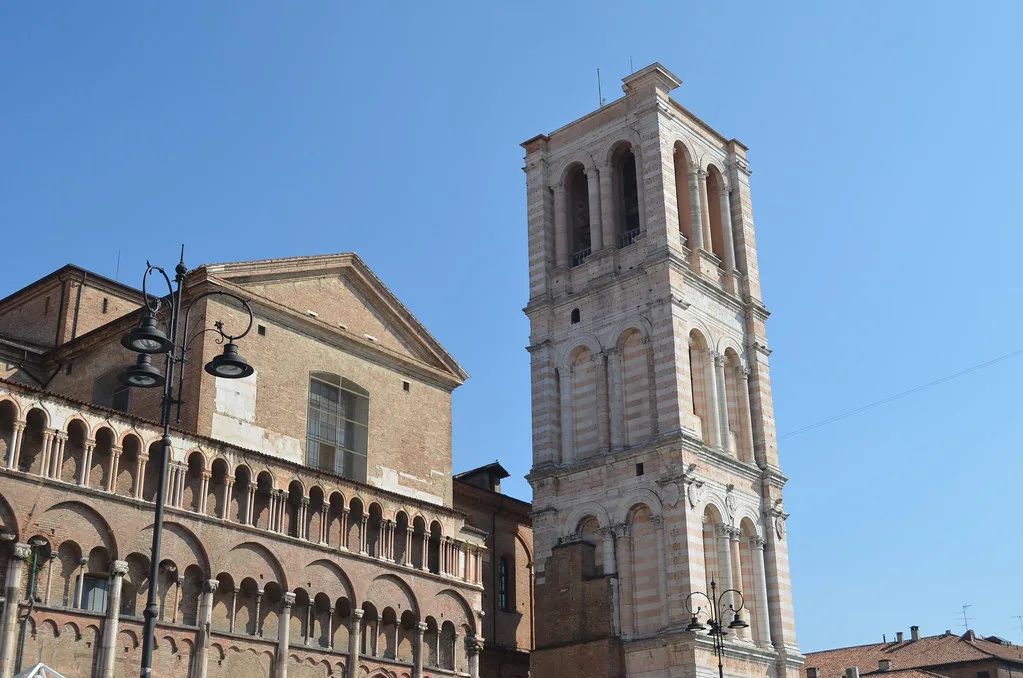
Start with the famous anchors: the moated Estense Castle and the Cathedral of San Giorgio, both free to admire from the outside according to traveller accounts, though interior visits are separate. Then move outwards. The rewards here come from looking at fabric rather than queueing for entries: bricked archways, Renaissance planning lines and a park between palaces.
Why Ferrara Rewards Slow Looking
Ferrara is flat and walkable, and one writer measured the distance from the railway station to the castle at roughly twenty minutes on foot. That compactness is the practical reason a quieter itinerary works: you spend less time transferring and more time stopping. It is also a city where the official tourism consortium publishes separate pages for individual monuments, so you can research one sight at a time instead of trusting a general list.
The city's UNESCO status covers the urban centre and adjoining agricultural land within the old Po delta, which explains how the water, walls and streets connect. Visitors who only tick off the castle and cathedral miss the relationship between the medieval core and the later Renaissance expansion. A suggested allowance is at least a full day to walk both, or two full days if you want to eat properly and wander without a schedule; that is an editorial suggestion, not an official recommendation.
One caveat before you plan: a lot of online advice about Ferrara's smaller sights comes from personal travel blogs rather than operators. Treat descriptions of scale and quietness as impressions, and verify anything that changes, such as opening days or admission, directly with the site before travelling.
Start With the Free Exterior Circuit
The cheapest way into Ferrara is simply to circle its monuments from outside. The Estense Castle's moat and courtyards could be walked for free according to one traveller report from 2024, while interiors are ticketed separately; the same writer also found the cathedral free to enter at the time of their visit. These are personal accounts, not published policy, so check the castle and cathedral websites before relying on either.
Free exterior wandering also covers a lot of ground: the city walls run for nine kilometres around the old centre and can be walked or cycled, and the official tourism site presents them as an introduction to the city's history. That is a good first orientation if you arrive early. It also gives you a mental map of where the gates and passages sit.
Decide your split before you set out. If you are time-poor, treat the streets, squares, walls and courtyards as your itinerary and pick at most one ticketed interior that genuinely interests you. If you have two days, reverse the logic and book a morning inside the castle or a gallery, then give the rest of the day to walking.
Via delle Volte and Via delle Vecchie: Reading the Medieval Fabric
Via delle Volte is the street most often cited as atmospheric, and for a specific reason: it is threaded with arches and suspended passages that once linked warehouses to small artisan workshops. The official tourism consortium describes this economic history directly on its Via delle Volte page. Walking it is free, and the reward is texture rather than a single monument.
A second traveller describes the street as narrow, quiet and full of fragments you almost miss, with parts restored and river pebbles underfoot that make the surface uneven. That is a practical note for footwear rather than a rule. Via delle Vecchie and Via Boccacanale are mentioned in the same walking circuit, near a covered market that was closed during that visit.
The medieval side streets near the cathedral, including the old Jewish ghetto area, are also described as especially quiet in the early morning. If you want photographs without people in them, go early and accept that some businesses will still be shut. Otherwise, walk the lanes at dusk when the light hits the arches. For individual monument pages, the Ferrara Attractions hub collects the visitor guides that accompany this city-level overview.
The Certosa of Ferrara: A Cemetery That Works as a Sculpture Garden
The Certosa di Ferrara, with the church of San Cristoforo, was founded in 1452 as a Carthusian monastery and later became a municipal monumental cemetery. One account dates the monastic community's end to 1813, which is the moment the site changed character. Knowing that history changes how you walk it: this is a working burial ground with family tombs, weeping figures and inscriptions, not an attraction with an entrance queue.
Another traveller visited at sunrise and highlights the arcades, the great cloister and the quiet, with seating and an on-site map. Treat the sunrise detail as their choice rather than a recommendation for everyone. The useful point is that the site rewards unhurried walking, so allow more time than you would give a single church.
Because this is a cemetery, behaviour matters: keep your voice down, avoid blocking family graves and skip the photo poses. Check locally whether the grounds are open on the day you plan to visit, since cemetery access can differ from museum access. One account places it roughly a fifteen-minute walk from the castle, which makes it an easy add-on to a Renaissance-side loop.
Rotonda Foschini: The Oval Theatre Courtyard
Rotonda Foschini is the oval courtyard inside Ferrara's Municipal Theatre, and the theatre itself was built between 1773 and 1797 and inaugurated in 1798, according to the city's tourism consortium. The courtyard was traditionally used for visitors arriving by horse and carriage. It is a small stop, but a memorable one, and it fits naturally into a walk between the cathedral square and the castle.
One traveller found the courtyard free to visit and photogenic, with a view through an archway to the church of San Carlo. Another describes the curved walls and symmetry as feeling like a hidden stage, best appreciated by standing still and looking up. Both are visitor impressions rather than official access terms, so check the theatre's own page or ask at the box office if you plan around it.
If you want to combine it with something ticketed, the theatre runs a season of music, ballet, comedy and prose, so a performance is a legitimate way to see the building properly. Look at the programme before your trip rather than assuming a courtyard visit includes the auditorium.
Addizione Erculea and the Diamond-Facade Palaces
The Addizione Erculea was a planned expansion of Ferrara begun in 1492, adding broad straight streets, churches and gardens to the medieval core; one writer calls it one of the most important pieces of fifteenth-century town planning. Walking it is the point: the grid itself is the exhibit. Look for the shift in street width and building line as you cross from the old centre into the newer district.
Palazzo dei Diamanti is the visual anchor, built from 1493 with a facade of diamond-shaped stone blocks, and it now houses the Civic Art Gallery and temporary exhibitions. A second account puts the count at roughly 8,500 carved blocks, a detail worth knowing before you arrive so the facade reads as deliberate design rather than decoration. Admission and exhibition programming change, so check the palace's own site rather than a guidebook.
Nearby, the same walk passes Palazzo Turchi di Bagno and Palazzo Prosperi-Sacrati, with the Quadrivio degli Angeli as the intended focal point of the new district. None of these need a ticket to admire from the street. If you only have an hour, trace the main axis rather than zigzagging, so the planning logic stays legible.
Parco Massari and the Small Botanical Garden
Parco Massari sits between Palazzo dei Diamanti and the Certosa, and one traveller describes it as a place to sit by a fountain under large cedars, plane trees and chestnuts, with a free public toilet on site. In summer that shade is the practical reason to route your walk through it. It also breaks up a palace-heavy morning without requiring a ticket.
The Orto Botanico di Ferrara is tucked between the Diamond Palace and the park, and the same writer counted around 700 plant species across outdoor beds and greenhouses, including a pond and carnivorous specimens. That scale description is a visitor's impression, and the admission and opening details published online have varied, so confirm current arrangements with the garden before making it your main stop.
The realistic trade-off is time. Both green spaces are small enough to cross quickly but pleasant enough to hold you longer than planned, so put them late in the day rather than at the start. If you are visiting outside the growing season, expect less from the garden and more from the park's trees.
Free Grounds Versus Paid Interiors
The single most useful rule in Ferrara is to separate the shell from the contents. The castle's moat, the cathedral square, the theatre courtyard, the streets and the park can be experienced on foot without buying anything, while the castle museum, the cathedral's restoration-affected interior at times, and the palace galleries are separate propositions. This is how the city's tourism pages are organised too: individual monuments get their own entries.
Do not assume one ticket covers a whole complex. The castle and the Lion Tower have been sold separately at times according to one account, and galleries inside Palazzo dei Diamanti are distinct from the facade. Ask at each ticket desk or check the official site for the specific combination you want.
If your budget is tight, the free circuit alone can fill a day. If your interest is Renaissance art, invert it and pay for the gallery while treating the streets as the walk between.
A Suggested One-Day Quieter Itinerary
Begin early on the walls or in the medieval lanes before the shops open, then work towards Piazza Trento e Trieste for the cathedral exterior and the Torre dell'Orologio. Continue to the Rotonda Foschini courtyard, then cross to Piazza del Municipio through the archway entrance. This order keeps you in the compact core while the streets are calm.
After lunch, head north into the Addizione Erculea for Palazzo dei Diamanti and the surrounding palaces, then take Parco Massari and the botanical garden as a slower middle section. Finish at the Certosa before it closes for the evening, and walk back through Via delle Volte as the light fades. This route is a suggestion, not an official itinerary, and it assumes you are comfortable on foot for most of the day.
For a half-day version, choose the medieval lanes, Rotonda Foschini and one palace facade, and skip the cemetery. That keeps the loop tight around the core without pretending you have seen everything.
Check the Details Before You Go
Ferrara's small sights change quietly: a church interior closes for restoration, a garden adjusts its hours, a courtyard is needed for a performance. None of that is predictable from a travel blog. Before travelling, use the city's tourism consortium pages to identify the official contact for each monument, then confirm the day and time directly.
For transport, the city sits on the main railway line between Venice and Bologna, which one traveller notes makes it easy to reach by train from either direction. Timetables and fares change, so check the operator's site for your dates rather than relying on any published journey estimate. Once in the centre, walking covers almost everything in this guide.
Finally, keep expectations honest. These are not secret places, and Ferrara's quieter corners are quiet because the city attracts fewer visitors than its neighbours, not because they are hidden. The pleasure is in slowing down enough to notice the arches, the brickwork and the planning lines.
Beyond the Centre: Po Delta, Comacchio and Este Residences
If you have a spare day, the province opens up. The Po Delta Park is one of Italy's largest wetland areas, and the tourism consortium lists boat trips and birdwatching among its draws. Comacchio preserves a lagoon-side historic centre within the delta, and the Este family's rural residences, known as Delizie Estensi, are scattered across the territory, with several now ruined.
These are full-day additions rather than quick detours, and transport options vary by season. Check the consortium's activity pages for what is running before you commit a day. If your route continues south, the hidden gems in Bologna guide covers a nearby city with a very different street feel, and the hidden gems in Ravenna guide pairs well with a delta excursion.
Plan Your Slower Visit
Ferrara rewards the traveller who treats the city as a set of layers: medieval lanes, a Renaissance expansion, a cemetery that doubles as a sculpture garden and a theatre courtyard hidden inside a block. None of it needs to be rushed. Pick two or three of these corners, confirm access in advance and leave room for an unplanned turn.
If you are building a longer Emilia-Romagna route, treat Ferrara as a two-night stop rather than a day trip, and compare it with other quieter-city guides before booking. The comparison is useful because each city's free circuit works differently; the hidden gems in Venice guide, for instance, assumes a far denser visitor flow. For related planning, see Best Time to Visit Ferrara Without Crowds: Seasons and Weekdays. For related planning, see Ferrara Markets Guide: A Slow Market Morning in the Old Town.
Frequently Asked Questions
What are the quietest corners of Ferrara to wander?
Travellers most often point to Via delle Volte and the medieval lanes near the cathedral as calm places to walk, especially early in the morning. The Certosa cemetery, the Rotonda Foschini courtyard and Parco Massari are quieter alternatives to the castle and cathedral square. Quietness varies by season and time of day, so treat these as starting points rather than guarantees.
What can you see in Ferrara for free?
The exteriors of the Estense Castle, the cathedral and the palaces of the Addizione Erculea can be admired from streets and squares without a ticket, and the city walls are presented as a walking and cycling route. The theatre courtyard and the main parks have been described as free to enter by travellers. Interior access and any charges should be confirmed with each site before you visit.
Is Ferrara worth visiting for a day?
A suggested day covers the compact core on foot, including the castle exterior, the cathedral square, the medieval lanes and one Renaissance palace. Two days allow a slower pace, the Certosa and the parks without rushing. If you want to add the Po Delta or Comacchio, plan a separate day and check transport in advance.
How do you get to Ferrara from Bologna or Venice?
Ferrara lies on the main railway line between Bologna and Venice, which makes train travel the straightforward option from either city. The station is a short walk from the historic centre. Check current timetables and fares with the train operator for your dates, since services and prices change.
What is Ferrara famous for?
Ferrara is known for its UNESCO-listed historic centre, the moated Estense Castle and its Renaissance town planning, including the Addizione Erculea and Palazzo dei Diamanti. It is also associated with the Este family and their rural residences across the province. Within the city, much of the appeal is in the streets themselves rather than single ticketed sights.
Sources
Continue exploring
More guides you'll find useful