Bolzano Self-Guided Walk: Piazza Walther to Castel Roncolo
Plan a self-guided half-day walk through Bolzano, from Piazza Walther and the arcades to the Duomo, Domenicani and the Talvera promenade toward Castel Roncolo.
On this page
Bolzano's historic centre is compact enough to cross on foot, and the city's own tourism board frames it as a place best discovered by wandering under the arcades, visiting museums and castles, or following the cycle paths. This route strings the obvious set pieces together in a deliberate order: the main square, the covered shopping lanes, the cathedral, a quieter medieval church, then the riverbank green space that leads the eye toward Castel Roncolo.
Treat the sequence below as an editorial suggestion rather than an official, signposted trail. No single body publishes this exact loop, so the value lies in the logic of the order and in knowing where free public space ends and a ticket or an opening time begins. Build it into half a day, keep the pace loose, and let the river decide how much further you go.
Before You Start: Setting Up a Half-Day on Foot
Everything here sits within the old centre, so comfortable shoes matter more than any transport planning. The one formal option, if you would rather not self-guide, is the tourist board's programme of guided city walks, run with the local guide association. Those tours are bilingual in Italian and German, capped at 25 participants unless stated otherwise, and should be booked ahead to secure a place.
A self-guided walk needs no booking and no app, but a rough order saves wasted steps. Start high in the old town, work through the church cluster, then drift to the river; that way you never double back through the busiest lanes. Expect to decide as you go, because the arcades and the market are exactly where a half-day quietly stretches.
Stop 1 – Piazza Walther: A Natural Starting Point
Piazza Walther is the obvious opening move: a large square ringed by cafés with terraces, with the cathedral at one corner. In the middle stands the monument to the medieval poet Walther von der Vogelweide, carved in local marble in 1889 and set on a fountain that acts as its pedestal, which makes it easy to find as a meeting point.
Use the square to orient yourself rather than to linger at length. Order a coffee on the terrace, look over the route ahead, and note that the bells and the cathedral front are the cue to move on. If you are travelling with children, this is also the easiest place to reset before the narrower lanes.
Stop 2 – Via dei Portici and the Arcades
Heading north from the square, Via dei Portici runs as a long covered shopping street where boutiques sit alongside genuinely distinctive small shops. Bakeries are the ones worth slowing for, with sweet and savoury bakes displayed as carefully as jewellery in a window.
This is where the walk's main trade-off appears: browsing and progress pull against each other. Decide before you enter whether this is a shopping stretch or a corridor, and if you are on a half-day, treat the arcades as a passage with one deliberate pause rather than a full browse. The covered walkway does at least keep you dry and shaded while you make up your mind.
Stop 3 – Piazza delle Erbe and the Market Stalls
At the far end of the arcades, Piazza delle Erbe opens into the produce market, where stalls are laid out with fruit and other goods in neat, colourful rows. Even if you buy nothing, it is the liveliest point of the walk and a good place to see how the city still functions as a market town rather than only as a museum piece.
Pause here if you want a snack, since the market sits at the natural midpoint of the old-town section. If time is short, the market is also the easiest stop to compress: a walk-through of a few minutes is enough to catch its character.
Stop 4 – The Duomo: Exterior Details and a Decision
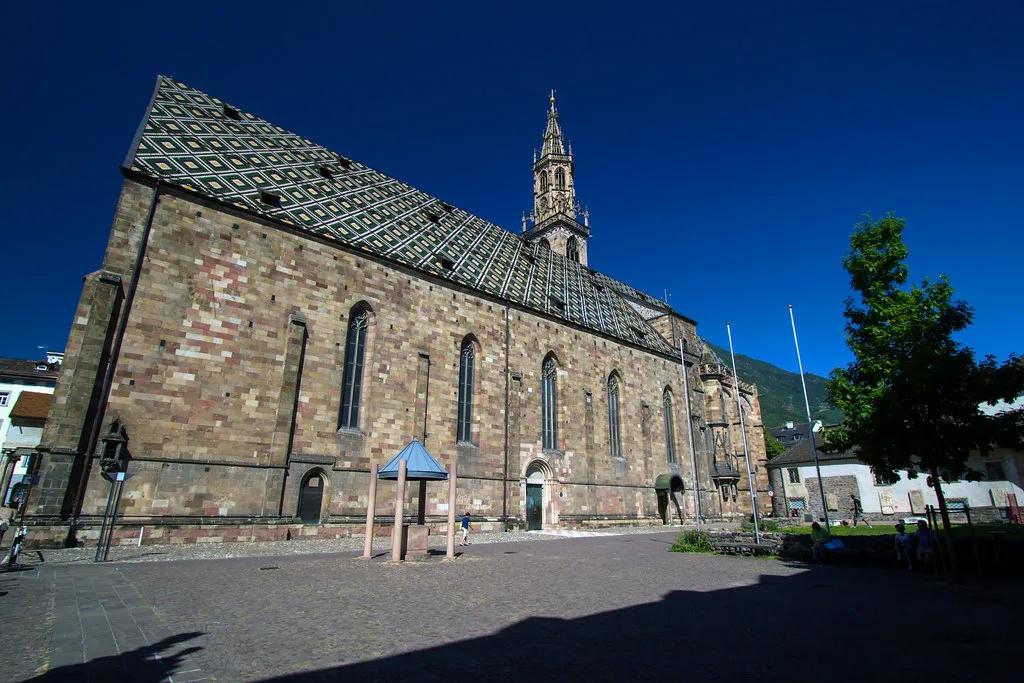
Bolzano's cathedral, dedicated to the Assumption of Mary, doubles as the co-cathedral of the Bozen-Brixen diocese, and its 65-metre bell tower is the city's landmark. The tower took its present form in the early sixteenth century, when an openwork spire was placed on the older Romanesque structure, and the building mixes reddish local sandstone with a lighter stone from the surrounding area.
Two exterior details repay a slow lap: the decorated northern side door known as the Bride's Door, and also as the Wine Door, and the monument to Peter Mayr in the churchyard to the south. The tower survived the Second World War bombing that damaged much of the interior decoration, which is why the exterior reads more completely than the inside.
Decide in advance whether you are adding the interior and the cathedral treasury. Opening rules, service times and any tower access are not something to assume, so check at the door or with the tourist board on the day. The treasury, housed in the old provost's office on the parish square, is a separate sacred-art collection founded in 2007 and holds one of the larger Baroque church inventories in the Tyrol region, so it counts as its own ticketed decision.
Stop 5 – Chiesa dei Domenicani: A Quiet Pause
A short walk away, the Chiesa dei Domenicani is a medieval church that offers something the cathedral square cannot: quiet. It works best as a pause rather than a sight, a place to sit for a few minutes before the river section. Interior or cloister access is not guaranteed and should not be assumed, so treat the church as a free exterior stop unless you find a door open and clear guidance inside.
Optional Diversion: Ötzi at the Museum of Archaeology
The South Tyrol Museum of Archaeology, on Via Museo, has displayed Ötzi the Iceman and his artefacts since 1998, and it is the one stop on this route that will genuinely reshape your half-day. The permanent exhibition and any special show are substantial, so commit to it as a timed visit rather than a quick look in.
Check the museum's own opening hours and fees page before you go, and book if you want to avoid queueing. For families, the museum publishes dedicated services and activities for children, which changes how long the visit takes. If you only have half a day, saving the museum for a separate visit usually produces a better walk.
Stop 6 – The Talvera Promenade and Its Two Banks
From the old town, the Talvera river opens into the city's green lung: tree-lined paths, lawns, playgrounds and a long cycle route, with sports fields and a skate park also in the meadows. The Lungotalvera promenade runs for roughly 3.8 kilometres from the Talvera bridge to the Sant'Antonio bridge, where the St. Oswald path takes over toward the Santa Maddalena vineyards.
The useful detail for a self-guided walker is that there are two promenades, eastern and western, divided by the Talvera bridge and the Petrarca park. Following one bank out and the other back gives you a loop of your own choosing, and the footbridges along the way let you cut the river section short without retracing the whole old town.
Families should note that the playgrounds, sports facilities and cycle path make this the most forgiving part of the day for children who have had enough of churches. The trade-off is that the river path is shared with bikes, so keep to one side and brief younger walkers before you set off. For more overlooked corners beyond the obvious route, our guide to the hidden gems in Bolzano picks up where this walk ends.
Finish – Castel Roncolo as the Visual Endpoint
Where the valley narrows at the entrance to the Sarentino valley, Castel Roncolo rises on one side of the river with the ruin of Castel Rafenstein opposite. The castle is a marker rather than a promised visit: admission prices and interior opening times are not something to guess, so check with the castle or the tourist board before planning a tour inside.
For most half-day walkers, the castle's role is to give the river section a destination and a skyline. If you want to go in, build the visit into the plan and treat the walk back as a separate leg; if not, turn around at a bridge that suits your remaining energy.
Café Stops and Keeping the Half-Day on Track
Plan your breaks by cluster rather than by venue: the terraces on Piazza Walther for the start, the market for a mid-morning snack, and the riverbank lawns for a rest. Specific cafés around the square are described as popular with visitors, which means service can slow at peak times, so a coffee stop is not the moment to be in a hurry.
To protect the half-day, cap the old-town section at the Duomo and the Domenicani church, then give the remainder to the river. If the museum is in, cut one of the smaller stops instead. One slow coffee is usually worth more than a rushed extra sight.
Practical Notes: Language, Signage and What to Skip
Bolzano is bilingual, and signs, menus and place names appear in both Italian and German; the city's public material repeats the point that guided tours are run in both languages. That makes self-guiding straightforward even without Italian, since street names and major sights are marked twice.
If time runs short, skip the arcade browsing and the cathedral interior first, keeping the square, the market and a short river stretch. City information services can confirm current access details for churches and museums, and a stop at the tourist office early in the day saves guesswork later.
Cyclists can follow the riverside cycle route rather than the walking paths, though the shared surfaces and footbridges mean bikes and pedestrians mix constantly. Walkers who want a quieter variant should pick the bank away from the main road and cross back on a footbridge.
If You Have Longer: Add-Ons Beyond the Loop
With a full day, the obvious additions are the cable cars that lift you out of the city in minutes to quieter viewpoints, and the Messner Mountain Museum at Castel Firmiano on the outskirts, which regular buses reach. The city's own tourism material presents the lifts as a way to reach panoramic terrain quickly, which makes them a natural pairing with a shorter old-town walk.
For a second day, the St. Oswald Promenade continues from the end of the Lungotalvera toward the Santa Maddalena wine slopes. For ticketed stops beyond Ötzi, including the cathedral treasury and the older civic collections, our Bolzano Attractions hub lists individual visitor guides so you can check each one's access before committing.
Plan Your Visit
The walk works because Bolzano hands you the pieces in sequence: a square to start, covered lanes to pass through, a cathedral and a quieter church, and a river that keeps opening the view. The only real planning decisions are whether you add the archaeology museum and whether you intend to tour Castel Roncolo, because either one turns a half-day into something longer.
Check opening times and ticket details directly with each museum or castle before you go, wear shoes for cobbles, and leave room for one long coffee. The rest is simply a matter of walking the order that suits your pace. For related planning, see Bolzano Local Food Guide: What to Eat in South Tyrol.
Frequently Asked Questions
Do you need a guide to walk around Bolzano?
No. The historic centre is compact and easy to navigate on foot, and the squares, arcades and river promenade are public space. If you would prefer commentary, the local tourist board runs bilingual guided city tours with licensed guides and caps group size, but those are an alternative to self-guiding, not a requirement.
How long does a self-guided walk in Bolzano take?
Plan for roughly half a day at an easy pace, keeping in mind that this is an editorial estimate rather than an official route duration. Add substantial time if you visit the archaeology museum or tour Castel Roncolo, and subtract if you skip the cathedral interior and the arcade browsing.
Is there a free walking tour of Bolzano?
The squares, the arcade street, the cathedral exterior, the Domenicani church exterior and the Talvera promenade cost nothing to walk through. Guided offerings from the tourist board are a separate, bookable service rather than a free tour, so check directly with the tourist office if you want a guided option and its current conditions.
What should you not miss on a first walk through Bolzano?
The Walther monument on its fountain, the covered arcades, the market in Piazza delle Erbe and the cathedral's bell tower and Bride's Door make the strongest half-day sequence. The river promenade then gives you the view toward Castel Roncolo, which is the natural visual finish.
Can you walk from Bolzano's old town to Castel Roncolo?
Yes, on foot along the Talvera promenade, which runs from the Talvera bridge to the Sant'Antonio bridge and points toward the castle. How far you go is your choice, and admission or interior access at the castle should be checked directly rather than assumed.
Is Bolzano walkable for a half-day with kids?
Yes. The Talvera meadows include playgrounds, sports fields, a minigolf course and a skate park, which give children room to run after the church and museum stops. Shorten the old-town stretch and use the footbridges to keep the loop manageable.
How much does the archaeology museum cost?
Prices are published and updated by the museum itself, so check its opening hours and fees page before you go rather than relying on older figures. The museum also sells advance entry to avoid queueing, and family services are listed separately.
Sources
- Bolzano – Sito Ufficiale dell’Azienda di Soggiorno e Turismo
- Self-guided Sightseeing Tour #1 in Bolzano - Bozen, Italy | Visit Sights
- A walk in Bolzano - Italia Slow Tour
- Guided tours in Bolzano - Tourist Board Bolzano
- Home | Museo Archeologico dell’Alto Adige
- Bozner Dom, a masterpiece of Gothic architecture
- Comune di Bolzano
- Lungotalvera Promenade - Bolzano and surroundings - Wine Road
Continue exploring
More guides you'll find useful