Città Alta Bergamo Guide: Squares, Churches and Walls
Plan a visit to Bergamo's Città Alta with a practical guide to Piazza Vecchia, Piazza Duomo, the Campanone tower, the Colleoni Chapel and the Venetian Walls.
On this page
Bergamo is really two cities stacked on top of each other. Città Bassa spreads across the plain with the station, the shopping streets and most everyday life, while Città Alta sits on its hill behind a ring of sixteenth-century Venetian walls that joined the UNESCO World Heritage List in 2017. Understanding that split is the first practical decision of any visit, because it determines how you arrive and where you sleep. Related guide: What to Eat in Bergamo: A Local Food Guide to Città Alta & Bassa.
The good news is that the historic core is compact. Piazza Vecchia, Piazza Duomo, the Campanone tower and the Colleoni Chapel are all within a couple of minutes of one another, so a first visit is mostly a matter of choosing where to slow down. The wider rewards, from the walls to San Vigilio and the Astino Valley, belong to anyone with a few extra hours.
Getting up the hill: funicular, bus or on foot
Two funiculars do the hard climbing. The lower one links Città Bassa with the upper town near Piazza Mercato delle Scarpe, and a second, shorter line runs from Colle Aperto up to San Vigilio. Both appear on the local public transport network, so the easiest approach is to buy a ticket that covers buses and funiculars together and check the current fare and validity on the operator's site rather than relying on a figure from an older blog post.
Walking up is a genuine option and arguably the better one on a clear morning. Several routes climb from the lower town, including the stepped lanes toward Porta Sant'Alessandro and the pedestrian approach to Porta San Giacomo, and each delivers you through a monumental gate rather than a car park. The trade-off is honest: the gradients are steep, the paving is uneven, and in summer the climb is hot work.
Arriving early pays off twice. You climb in cooler air, and you reach Piazza Vecchia before the cafés fill and the day-trip coaches land. If you would rather save your legs for the walls, take the funicular up and walk down at the end of the day, when the light over Città Bassa is at its best.
Piazza Vecchia: the civic heart
Piazza Vecchia has been the centre of upper-town life for centuries, and it is still the natural place to start. The Contarini Fountain, a gift from Venice completed in the 1780s, marks the middle of the square, with the medieval Palazzo della Ragione and its arched loggia on one side and the neoclassical Palazzo Nuovo, home to the Angelo Mai library, on the other.
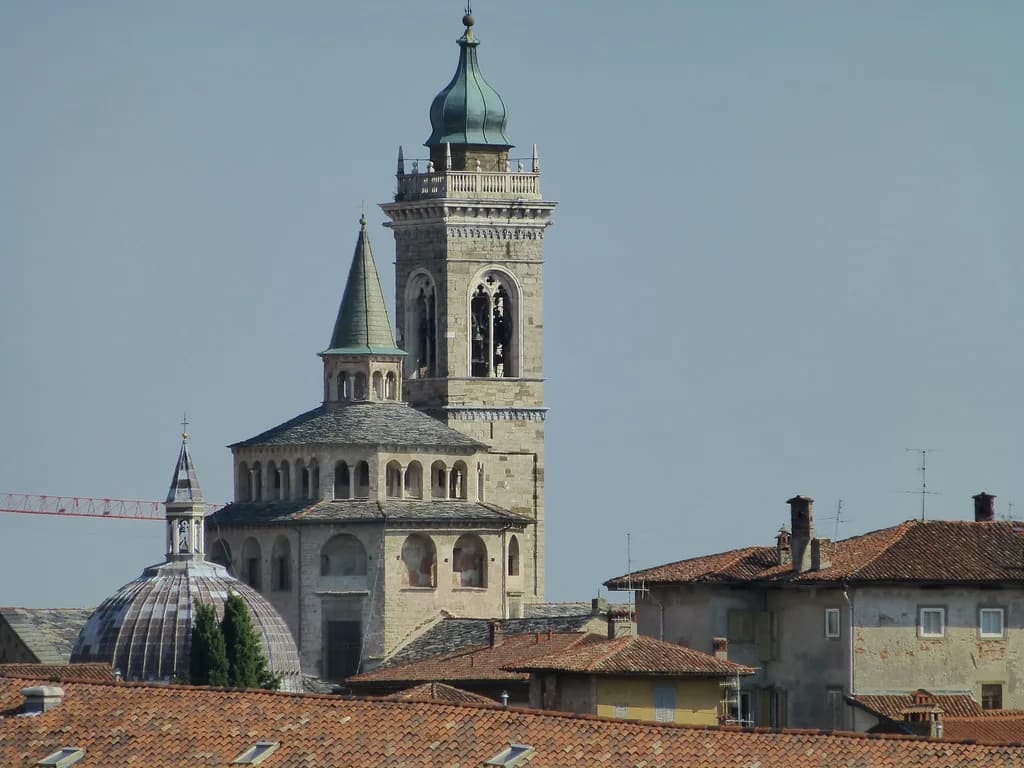
The Campanone, the civic tower, closes the square to the north and is the landmark you will navigate by all day. Its bell still rings a hundred times each evening at ten, a tradition that once signalled the closing of the city gates. Treat the performance as a piece of living history rather than a current curfew, and plan your evening so you are somewhere in the upper town when it starts.
Two useful free stops sit right here. The reading room of the Angelo Mai library and the frescoed upper hall of the Palazzo della Ragione can both be visited without a ticket, which makes them a sensible refuge when a shower passes over. Opening arrangements change, so confirm on the day before building a plan around them.
Climbing the Campanone for the view
The tower stands roughly 52 metres high, and the climb is about 230 steps, with a lift available for anyone who would rather not take them. From the top you get a full circle: the rooftops and bell towers of Città Alta, the plain stretching south toward Milan, and the first ridges of the Bergamasque Alps to the north. It is the single best way to understand the shape of the city before you walk it.
This is a ticketed climb, and published prices vary between visitor accounts, so check the current rate at the ticket office or on the official tourism site rather than budgeting from an old post. Allow something in the region of half an hour including the lift queue and the photographs. If your time in the upper town is short, the tower and the basilica are the two interiors worth prioritising.
Piazza Duomo: basilica, lions and Donizetti
Step through the archway from Piazza Vecchia and the scale changes abruptly. Piazza Duomo packs the Basilica of Santa Maria Maggiore, the cathedral, the baptistery and the Colleoni Chapel into a space barely wider than the buildings themselves. The basilica began in 1137 as a vow against the plague and was embellished for centuries afterwards, which is why its severe Romanesque exterior hides a Baroque explosion inside.
Look at the entrances before you go in. The church has no central facade or main door; instead four side entrances are guarded by red and white marble lions, the Porta dei Leoni Rossi facing Piazza Duomo and the Porta dei Leoni Bianchi facing Piazza Rosate. Between the northern doors you can also find medieval measures carved into the wall, the cavezzo and the braccio, which merchants and weavers used as local standards.
Inside, the draw is the layered decoration: Flemish tapestries along the aisles, wooden choir inlays designed by Lorenzo Lotto, and the funeral monument to Gaetano Donizetti, the composer who remains Bergamo's most famous musical export. The basilica charges non-residents of Bergamo and its province an entrance fee, with a reduced rate for younger and older visitors and free entry for a list of categories including local residents and young children, so budget honestly rather than assuming a church visit is free.
Hours are split around services, and they differ between weekdays, Saturdays and Sundays. The official page currently lists weekday openings in a morning and an afternoon block, a continuous Saturday stretch and a Sunday arrangement that leaves the middle of the day free for worship, but you should verify before travelling since religious schedules can shift.
Accessibility is more complicated than the cobbles suggest. The south-west secondary portal is described as the only accessible entrance, reached by a downhill pedestrian route from Piazza Mercato del Fieno, where there is one designated accessible parking space. Inside, the floor is mostly level apart from three steps before the presbytery and choir, and there are no accessible toilets on site, so plan accordingly.
The Colleoni Chapel: what to look for
Bartolomeo Colleoni, a condottiero from one of the area's leading families, commissioned this mausoleum, and it is usually judged the finest Renaissance building in the city. The facade is the thing most people photograph: polychrome marble in white, pink and black, packed with relief sculpture and columns, all compressed into a space beside the basilica.
Inside, look for the gilded equestrian statue of Colleoni above his tomb and the quieter sarcophagus of his daughter Medea. Entry is free, and a visit takes twenty to thirty minutes; photography is not allowed, so leave the camera down and simply look. Do not assume this ticket covers the basilica next door, because the two are run separately.
The cathedral and the smaller churches
Bergamo Cathedral, dedicated to Saint Alexander, was rebuilt and remodelled over centuries, which explains the mismatch between its nineteenth-century neoclassical facade and the gilded, heavily decorated Baroque interior behind it. Inside, look for Giambattista Tiepolo's altarpiece of the martyrdom of the patron saint and the crypt that holds his relics. Entry is free and the visit is short, fifteen or twenty minutes, which makes it an easy addition to the Piazza Duomo circuit.
If you have time for one more, the small church of San Michele al Pozzo Bianco is worth the detour for its fresco cycle, and the Tempietto di Santa Croce hides in plain sight among the larger buildings, though its interior is not always open. Neither belongs to a combined ticket, so treat each stop on its own terms and check doors as you pass rather than planning a fixed sequence.
Free versus paid: building an honest budget
It helps to separate what genuinely costs nothing from what quietly does not. The Colleoni Chapel, the cathedral, the walk along the walls, the Remembrance Park and the gardens around the Rocca are all free to enter, as is simply wandering the streets. The basilica interior is paid for non-residents, the Campanone climb is ticketed, and museums such as the Rocca's collection or the Accademia Carrara are separate purchases again.
The basilica's pricing is the one worth reading carefully before you go. Non-residents of Bergamo and its province pay the full rate, visitors aged 14 to 25 and those over 70 pay a reduced rate, and several categories including local residents, children up to 13, disabled visitors with a companion, schools, clergy and military enter free. Entry during religious services is also free, so a Sunday morning visit can combine worship and sightseeing.
Bergamo also sells combined museum passes and guided tours, and those are worth pricing only once you know which sights you actually want. For a first visit of a day or less, the basilica plus the tower plus the free sites is plenty; adding a museum pass usually means committing to a second day in the city.
Walking the Venetian Walls
The walls run for roughly six kilometres around the upper town, built by the Republic of Venice between 1561 and 1588 and never tested in a siege. Four monumental gates survive, of which Porta San Giacomo is the photogenic one, its white Zandobbio marble facade bright against the darker ramparts and crowned with the winged lion of Saint Mark. It is pedestrian-only and reached by a steep stone bridge over the former moat.
The full circuit takes about an hour and a half to two hours at an unhurried pace, though the stretch between Porta Sant'Agostino and Porta San Giacomo gives the best variety of views in far less time. Some sections slope moderately, the paving is uneven, and there is little shade at midday, so start in the morning or finish at sunset. Bring water; the fountains are not continuous.
The best order for most visitors is to enter the upper town through Porta San Giacomo on foot, work through the squares, then leave along the walls on the far side. That way the panorama arrives as a reward rather than a warm-up, and you end the day walking downhill instead of up.
Beyond the walls: Rocca, San Vigilio and Astino
The Rocca di Bergamo, a fourteenth-century fortress on the Sant'Eufemia hill a few minutes from Piazza Vecchia, now houses the Museum of the Risorgimento and Contemporary Age. Even without the museum, the Remembrance Park and the bastions give wide free views back over both halves of the city, and half an hour is enough to circle them.
San Vigilio is the high point of the city in every sense. The second funicular from Colle Aperto reaches the hill in minutes, where the castle ruins and their public gardens open onto the upper town, the plain and, on clear days, the Alpine arc. Walkers can reach it from Colle Aperto via a steep path in about twenty to twenty-five minutes; the reward is the same view with more effort and fewer people around you.
The Astino Valley sits just outside the walls and keeps its rural character, with a restored Benedictine monastery founded in the twelfth century, a botanical garden and trails within the Parco dei Colli. It is fifteen to twenty minutes from the upper town on foot and makes a good slow afternoon when the squares feel crowded. The Sentiero dei Vasi, an easy path through woods and hamlets, adds another hour if you have it.
Food stops between sights
Bergamo's own dishes are the ones to build a walk around. Casoncelli are filled pasta served with butter and sage, polenta taragna mixes cornmeal with buckwheat and cheese, and polenta e osei is a sweet almond-paste cake rather than the savoury dish the name suggests. For dessert, stracciatella gelato was invented in the city in 1961 at La Marianna near Colle Aperto, which remains the obvious place to try the original.
Piazza Vecchia's cafés are the most convenient stop and the most expensive; the side lanes off Via Colleoni and Via Gombito tend to give better value for a sit-down lunch. Il Fornaio, a takeaway pizza al taglio counter, comes up repeatedly in visitor accounts, and the warning that comes with it is honest: you take a number, you wait, and you pay by weight, so a burrata-topped slice costs more than you might guess.
Half day or full day: how to pace it
With three or four hours, stay inside the walls. Start at Piazza Vecchia, climb the Campanone for orientation, then give the basilica and the Colleoni Chapel proper time and finish with a short stretch of the walls toward Porta San Giacomo. That covers the richest core of the upper town on foot without ever needing a bus.
A full day adds the Rocca gardens, the San Vigilio funicular and a slow walk along the walls, with a pause for lunch. With a second day, keep Città Alta for the evening bell ritual and give the daytime to the Astino Valley, the Accademia Carrara, or a train to Lake Iseo or Milan. Bergamo works well as a base, which is why the airport traffic and the hotel stock are so well developed.
Where you sleep changes the character of the trip. Staying up in Città Alta means empty cobbles and lamplight after the day-trippers leave, but limited car access, stairs with luggage and fewer places open late. Città Bassa gives you the station, the airport bus, more restaurants and cheaper rooms, at the cost of a daily funicular ride or climb.
Accessibility in a medieval town
Città Alta is beautiful precisely because it was not designed for wheels. Cobblestones, steep lanes, stepped alleys and narrow pavements make it genuinely hard going for wheelchairs, pushchairs and anyone unsteady on their feet, and the funicular cabins themselves are not all equally accessible; the official basilica page notes that one of the two cabins at the upper station is fitted with a stairlift.
If you have reduced mobility, plan around the funicular, pick two or three targets rather than a circuit, and check each site's access notes before you commit. The basilica's south-west entrance and the Piazza Mercato del Fieno parking are the practical details worth noting; elsewhere, ask at the infopoints in Città Alta and the lower town.
Practical checks before you go
Much of what visitors want to know changes seasonally: museum opening hours, whether a given church interior is open, which festivals are running in the squares, and whether roadworks or events are disrupting buses. The city council publishes an events calendar and service notices, and the transport operator posts route diversions, so both are worth a look in the week before you travel.
If you are driving, remember that the upper town is covered by a limited traffic zone with restricted hours, and enforcement is by camera at fixed entry points. Leave the car in the lower town and take the funicular or a bus up; it is cheaper than a fine and considerably less stressful than navigating the lanes.
Finally, Bergamo has appeared on screen, including locations used in parts of Call Me by Your Name, which is one reason the city's profile has risen. Treat that as a pleasant extra rather than a reason to chase specific doorways; the squares and the walls are the reason to come, and they do not need a film credit.
Plan Your Visit
Città Alta rewards a simple plan: arrive early or stay late, climb the tower for orientation, give the basilica and the chapel proper time, and let the walls carry you back down. Everything else, from San Vigilio to the Astino Valley, is a bonus rather than a requirement for a good first visit.
Check the live details before you travel, since opening hours, ticket categories and traffic restrictions all shift through the year. Once those are confirmed, the upper town asks very little of you beyond comfortable shoes, some patience with cobbles, and enough time to sit in Piazza Vecchia without checking the clock.
Frequently Asked Questions
Is Bergamo Alta worth visiting?
Yes, particularly if you like medieval streets, layered churches and hilltop views. Città Alta holds the main sights in a compact area and is easy to reach from the lower town by funicular, bus or on foot, so it works both as a half-day stop and as the centrepiece of a longer stay.
What are the main attractions in Città Alta?
Piazza Vecchia with its Contarini Fountain and the Campanone tower, the Basilica of Santa Maria Maggiore, the Colleoni Chapel and Bergamo Cathedral around Piazza Duomo, and the Venetian Walls that ring the whole upper town. The Rocca gardens and the San Vigilio funicular are easy additions beyond the walls.
How long does it take to walk the Venetian Walls?
Sources describe the full circuit as roughly six kilometres and about an hour and a half to two hours at a relaxed pace. A shorter section between Porta Sant'Agostino and Porta San Giacomo gives the best range of views in well under an hour and suits a half-day visit.
Do you need tickets for the churches in Città Alta?
It depends which church. The Basilica of Santa Maria Maggiore charges non-residents of Bergamo and its province, with reduced rates and a list of free categories, while Bergamo Cathedral and the Colleoni Chapel are free to enter. The Campanone tower is a separate ticketed climb, and none of these share a single ticket.
Is Città Alta accessible for visitors with reduced mobility?
It is challenging rather than impossible. Cobblestones, slopes and stepped alleys are widespread, so plan on the funicular and a short list of targets. The basilica's south-west portal is its only accessible entrance, and one of the two upper funicular cabins has a stairlift, but accessible toilets are limited, so check details before travelling.
What was filmed in Bergamo?
Parts of Call Me by Your Name were shot in the city, which has added to its profile among film-loving visitors. It is a nice footnote rather than a reason to visit; the squares, the churches and the walls stand on their own.
Do you need a car to visit Città Alta?
No, and it is usually easier without one. The upper town has a restricted traffic zone with camera enforcement at fixed entry points, and parking in the centre is limited. Buses and two funiculars connect the parts of the city, and the station and airport are well linked.
How do you get to Città Alta from the lower town?
The simplest route is the funicular from the lower town up to the upper town near Piazza Mercato delle Scarpe, with a second funicular from Colle Aperto continuing to San Vigilio. Buses also reach the upper town, and several stepped footpaths climb from the gates in the walls if you prefer to walk.
Sources
- Home | Visit Bergamo
- [2026 Bergamo Attraction] La Citta Alta Travel Guide & Travel Experiences | Updated Oct | Trip Moments
- Bergamo Alta. Discovering the enchanting upper Lombard city
- Homepage | Comune di Bergamo
- Basilica of Santa Maria Maggiore | Visit Bergamo
- What to See in Bergamo Alta: all the places you shouldn’t miss
- ATB Bergamo
- What to do | Visit Bergamo
- Bergamo Travel Guide: Best Things to Do & See – Northabroad
Continue exploring
More guides you'll find useful