One Day in Arezzo: A Realistic Walking Itinerary
Plan one day in Arezzo with a realistic walking order: Piero della Francesca's frescoes, Piazza Grande, the Duomo and the upper town, plus food stops.
On this page
Arezzo sits in eastern Tuscany between Florence and Perugia, and its historic centre is compact enough that a single day can cover real ground without rushing between taxis. The city is often described as overshadowed by its bigger neighbours, which is precisely the argument for giving it your full attention for one day rather than an afternoon squeezed between trains. This itinerary suggests a walking order; it is not a fixed timetable, and nothing here implies pre-booked access.
The shape of the day is deliberate. Morning goes to the Basilica di San Francesco and the Legend of the True Cross cycle, then Piazza Grande and Santa Maria della Pieve while the light is still soft. Afternoon climbs to the Duomo at the city's highest point and continues to the Fortezza area for orientation, leaving the evening free for food.
Why Arezzo Suits a One-Day Visit
Arezzo rewards travellers who want art without queue fatigue. To Tuscany's guide calls it a hidden jewel frequently overshadowed by other Tuscan destinations, with the practical advantage of fewer tourists, so the same hours that would buy one museum slot in Florence can buy a fresco cycle, a medieval square and a cathedral here. That comparison matters when you are deciding where to spend a limited day.
The centre is also walkable in a way that keeps a one-day plan realistic. The main sights cluster around the sloping Piazza Grande and the streets rising toward the Duomo, and the railway station sits close enough that the antique fair area is reachable on foot from the platforms. Fewer transfers mean more time inside the places you came for.
One honest trade-off: Arezzo is not a checklist city where more stops automatically means a better day. If you try to add the archaeological museum, Casa Vasari and a long lunch on top of the core route, you will spend the afternoon watching the clock. Decide before you arrive whether this is an art day or an upper-town day, and let the other go.
Morning: San Francesco and the Legend of the True Cross
Start at the Basilica di San Francesco, where Piero della Francesca's frescoes depicting the Legend of the True Cross survived an earthquake, lightning and Napoleonic troops, according to To Tuscany. The cycle is the single strongest reason to give Arezzo a day rather than a detour, and seeing it first means your attention is freshest. Do not schedule anything demanding immediately before it.
Timing and access deserve verification rather than guesswork. The frescoes sit inside a working church, and visitor arrangements for the cycle can differ from general church access, so check current visiting conditions with the basilica or the city's official tourism channels before you build the morning around it. The Fondazione Arezzo Intour is the body that governs and promotes the Arezzo destination and publishes city-level visitor information.
Allow generous time inside and resist the urge to photograph every panel. The narrative runs across multiple scenes, and reading it in sequence takes longer than a quick glance suggests. If you arrive and find access restricted, treat that as information rather than failure, and use the saved time on the Pieve and the upper town instead.
Piazza Grande and Santa Maria della Pieve
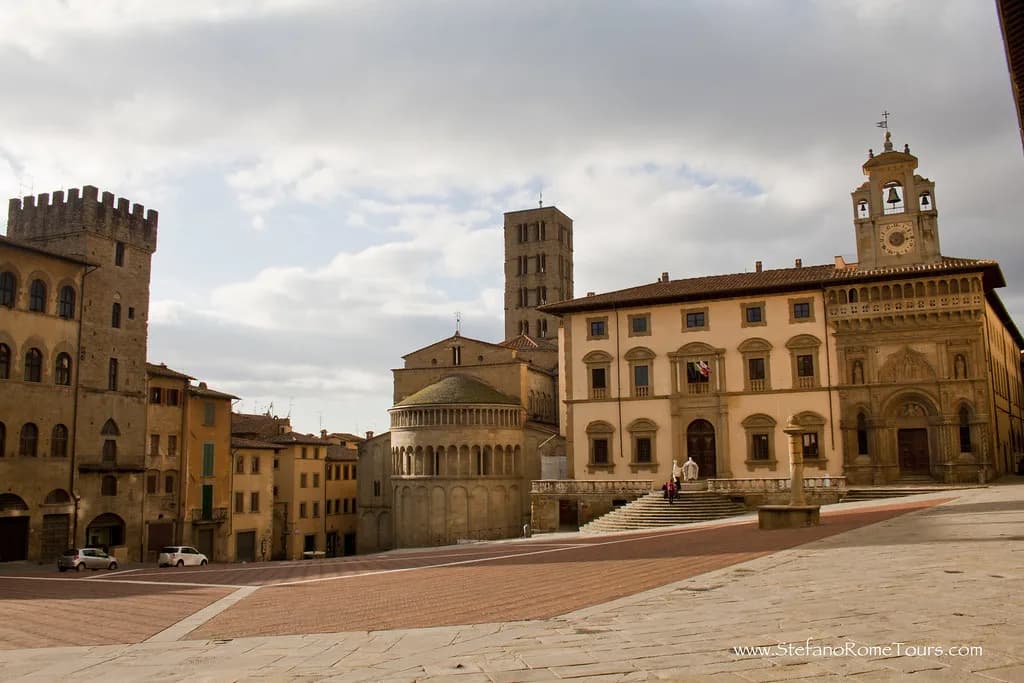
From San Francesco, walk to Piazza Grande, the lopsided main square that has anchored the city since medieval times. Its slope is the detail that stays with people: cafes line an uneven edge, and the square reads as a stage rather than a flat plaza. Sit for ten minutes before doing anything else.
On the southern side stands Santa Maria della Pieve, described as Arezzo's oldest church, with Romanesque carving, a Lorenzetti masterpiece inside and a facade nicknamed the tower of a hundred holes for its many mullioned windows. Step in briefly; the exterior deserves as much attention as the interior, and the apse facing the square is easy to miss if you walk straight past. Check locally whether the interior is open when you visit, since church access is not a museum transaction.
This is the natural point for coffee, and it is also where a market weekend can reshape your morning. If your visit lands on the first weekend of the month, Piazza Grande and the surrounding streets fill with the antique fair, which changes how you move through the centre.
Lunch: Eating Like Arezzo
Arezzo's cooking leans on olive oil, beans, pecorino, honey and cured meats, with Chianina beef from the neighbouring Val di Chiana and Colli Aretini wine as local anchors. End with cantuccini and Vin Santo if you want the classic finish. Understanding those building blocks makes menu reading faster and helps you avoid a generic tourist plate.
Choose a trattoria by its lunch logic rather than by a list: a short menu, a busy room and dishes that name their area are better signals than photographs of food. To Tuscany lists several central options, including places on and near Piazza Grande, but treat any such list as a starting point and confirm current opening days yourself, because restaurant schedules shift with the season.
Keep lunch modest if the Duomo and the upper town are still ahead. A heavy midday meal is the most common reason a one-day Arezzo plan collapses by three in the afternoon. Save the longer dinner for the evening, when the streets quiet down and you are not watching the clock.
Afternoon: The Duomo at the City's Highest Point
The Duomo, formally the Cattedrale dei Santi Donato e Pietro, stands at the highest point in town near the medieval Palazzo Comunale. Inside are stained-glass windows, the Gothic tomb of Guido Tarlati and Piero della Francesca's Mary Magdalene fresco. Approach it on foot through the older streets rather than by circling for parking, since the climb is part of the experience.
Separate what is free from what is ticketed before you go. Church exteriors and public squares cost nothing, but interiors and any associated museum spaces may have their own arrangements, and there is no basis for assuming the Duomo, San Francesco and the Fortezza share one ticket. Check each site's own information rather than relying on a combined assumption.
If the frescoes in San Francesco were closed or crowded in the morning, the Duomo's Piero della Francesca panel is a small consolation that keeps the artist in your day. It is a single work rather than a cycle, so adjust expectations accordingly, and give it the few quiet minutes it needs.
The Fortezza Area and Upper-Town Views
Above the Duomo, the Fortezza area gives you the city's geography in one look: the rooftops, the slope of the centre and the hills beyond. Treat this as orientation rather than a sight to tick off. The city does not publish confirmed visiting details, access rules or ticket scope for the fortress in the sources consulted here, so check the official tourism portal and the fortress's own notices before planning around going inside. For wider planning, see Hidden Gems in Arezzo.
This is where you feel the day's main trade-off. Fresco viewing consumes the morning, and the upper town consumes the afternoon; trying to do both at speed leaves you with neither. If you must cut something, cut the climb and give the art more room, or reverse the order and accept lighter time in the basilica.
Evening light over the upper town is the reward for the walk, and it pairs naturally with a slow dinner back down in the centre. Keep the descent unhurried and let the streets funnel you toward Piazza Grande again.
Optional Add-Ons If the Day Runs Long
Two additions fit a stretched day without breaking it. The Museo Archeologico Gaio Cilnio Mecenate, in the southern part of the city, overlooks the remains of a Roman amphitheatre that once held around ten thousand spectators, and it holds Etruscan and Roman material including the Aretine tableware that made the city's name. Casa Vasari, the home of Giorgio Vasari, decorated with frescoes of the artists he admired, is the other strong option.
Pick one, not both. Neither is a five-minute stop, and each pulls you away from the compact core that makes a one-day Arezzo plan work. If your interest is craft and gold, Arezzo's goldsmithing tradition is a separate thread worth its own time.
If you are already sensing that one day is thin, that instinct is probably right. A second day lets you add the museum, Vasari's house and a slower market morning without sacrificing the frescoes. For wider planning, see Two Days in Arezzo.
Timing the Day Around the Antique Market
Arezzo's antiques market, founded in 1968 with the involvement of dealer and collector Ivan Bruschi, is described as the largest and oldest of its kind in Italy. It spreads through Piazza San Francesco, Piazza Grande and the Logge Vasari and is held on the first Sunday of each month and the Saturday before. Those two days change the pace of the entire centre.
If your day falls on market weekend, expect slower movement between the basilica and the square and build in slack. If it does not, you get a calmer centre and easier photography of the sloping square. Neither version is better; they simply demand different planning.
Do not assume a market weekend also means a particular event schedule. The Giostra del Saracino, Arezzo's jousting tournament, is held twice a year according to To Tuscany, but this plan deliberately avoids publishing dates; check the organiser's own announcements if the tournament matters to your trip.
Getting There and Getting Around
Arezzo sits on the Bologna–Rome railway line, with Intercity and Frecciarossa connections from Florence, Rome and elsewhere in Italy, and the station is close enough to the antique fair area that you can walk there in a little over ten minutes. That makes the city viable as a day trip rather than an overnight, though this plan gives no train times or journey durations because those change by season and operator.
By car, the city has several car parks around the centre, and road distances put Florence at 74 kilometres, Perugia at 92 and Cortona at 29. Parking availability varies, so check current car-park information rather than assuming space near Piazza Grande. Once parked, everything in this itinerary is on foot.
Fondazione Arezzo Intour runs the destination's official tourism portal covering places, itineraries, events and tickets, and its offices are in Via degli Albergotti in the centre. For anything volatile such as hours, ticket scope or event dates, that portal and the individual sites are the places to confirm.
Common Mistakes on a One-Day Visit
The first mistake is over-packing. Arezzo's compactness tempts you to add a fourth church and a museum, and the result is a day spent walking past things rather than looking at them. The second is assuming every interior is free; exteriors and squares are open public space, but interiors may follow their own rules, and no combined ticket should be presumed.
The third is skipping the upper town entirely. The climb to the Duomo and the Fortezza area is what gives the city its shape in your memory, and cutting it leaves Arezzo looking like a single square. The fourth is treating a blog recommendation as confirmed opening information; verify before you rely on it.
A fifth, subtler mistake is arriving without knowing what the city is known for. Arezzo's identity rests on Piero della Francesca, Vasari and its craft traditions, and a day built around those is more coherent than one built around a generic list of churches.
Practical Checklist Before You Go
Before travelling, confirm three things on official sources: whether the San Francesco fresco cycle is open to visitors on your date and under what conditions, the current opening days for the Duomo and any site you intend to enter, and whether your dates coincide with the antique market weekend. None of these can be safely assumed from a travel article.
Also settle your eating plan loosely rather than rigidly. Note two or three trattorias that appeal, then confirm their current opening days, since restaurant hours are among the most changeable details in any Italian city. Keep a backup near the station in case your day runs long.
Finally, decide in advance what you will drop. Naming the thing you are willing to skip is the difference between a calm day and a hurried one, and Arezzo is a city that rewards the calm version.
Plan Your Visit
One day in Arezzo is enough for the frescoes, the sloping square and the climb to the Duomo, provided you accept that the upper town and the museum cannot both have equal time. Sequence the morning around San Francesco while your attention is sharp, use Piazza Grande as the pivot, and let the afternoon follow the hill.
Verify the volatile details before you go, since access to the fresco cycle, church interiors and market weekends all shape the day more than any itinerary can. Everything else, including the walking order and the lunch stop, you can decide on the morning itself.
Frequently Asked Questions
Is one day in Arezzo enough?
For the historic centre, yes. A single day comfortably covers the Basilica di San Francesco and its fresco cycle, Piazza Grande and Santa Maria della Pieve, the Duomo and the upper town. It does not comfortably cover the archaeological museum and Casa Vasari as well, so decide which of those to leave for another visit.
What should I see first in Arezzo?
Start at the Basilica di San Francesco for Piero della Francesca's Legend of the True Cross, then walk to Piazza Grande. Putting the frescoes first protects your attention for the most demanding art of the day and leaves the squares and the climb for when your energy dips.
How do I time a visit around the Arezzo antique market?
The antiques market is held on the first Sunday of each month and the Saturday before, spreading through Piazza Grande, Piazza San Francesco and the Logge Vasari. On those days the centre is busier and movement is slower, so allow more time between stops or choose a different weekend for a quieter visit.
Can you visit Arezzo as a day trip from Florence?
Yes. Arezzo sits on the Bologna–Rome railway line with Intercity and Frecciarossa connections, and the station is a short walk from the centre. Check current timetables with the rail operator rather than relying on any published journey estimate, since schedules change by season.
What food is Arezzo known for?
Local cooking features olive oil, beans, pecorino, honey and cured meats, with Chianina beef from the Val di Chiana and Colli Aretini wine. Cantuccini with Vin Santo is the classic finish. Confirm restaurant opening days directly, as hours vary through the year.
Do the churches and the Fortezza share a ticket?
There is no basis for assuming a combined ticket. Church exteriors and public squares are open public space, while interiors and any associated museum spaces may have their own arrangements. Check each site individually before you plan your day around entering it.
Sources
Continue exploring
More guides you'll find useful