
MUSMA Matera Visitor Guide: Sculpture Museum in the Sassi
Plan a visit to MUSMA in Matera's Sasso Caveoso: what the sculpture collection covers, how the cave galleries are laid out, and what to verify before you go.
On this page
MUSMA, the Museo della Scultura Contemporanea, sits inside Palazzo Pomarici, a sixteenth-century building in the Sasso Caveoso quarter of Matera. It is a sculpture museum first and a cave experience second, and knowing which is which helps you decide how much of a day to give it.
The museum's own visitor information states that it opens daily from 10:00 to 20:00, with last entry an hour before closing. Treat that as the organiser's published rule rather than a guarantee, and check the official site again close to your date, since opening arrangements can change with the season or for exhibition installation.
The collection runs from the late nineteenth century to the present and includes ceramics, medals, jewellery, drawings, prints and artists' books alongside sculpture itself. If your interests lean toward painting or archaeology, Matera has richer options elsewhere; if you want to see how modern sculpture behaves in carved stone rooms, this is the reason to come.
What MUSMA Is and Where It Sits
The museum is housed in Palazzo Pomarici in the Sasso Caveoso, the southern half of Matera's Sassi districts. The building has a conventional upper floor, the piano nobile, and beneath it a set of spaces cut directly into the rock. That combination is what makes the museum unusual: you are walking through a palace and through a quarry at the same time.
Travel writing on the museum describes it as a place where the ancient materiality of the Sassi meets twentieth-century and contemporary sculptural research. That framing is useful for planning: MUSMA is not a folk museum about cave dwelling, and it is not a gallery of local craft. It is a serious sculpture collection installed in historic and subterranean rooms.
The museum is managed by the cultural enterprise Synchronos, which is worth knowing if you need to contact someone about a group visit or a specific question. The published address for the museum's own office is Recinto Cavone 5 in Matera, separate from the Sasso Caveoso entrance where visitors arrive.
The museum's official description calls it the only museum in a cave in the world and the most important Italian museum entirely dedicated to sculpture. Both are promotional claims by the operator rather than independently verified facts, so read them as positioning rather than as something to plan around.
Before You Go: What to Confirm
The clearest published hours are the museum's own: open Monday to Sunday, 10:00 to 20:00, with the last admission one hour before closing. Third-party listings circulate different times, so use the official page as your reference point and re-check it on the day you plan to visit rather than relying on a saved screenshot or an old listing.
The museum has not published ticket prices in the material available here, so do not budget from memory or from a resale site. Check the tickets section of the official site before you travel, and ask at the desk about what the ticket covers if you also plan to visit temporary exhibitions, since those are mounted in both the built rooms and the underground spaces.
Booking arrangements and any online purchase options are likewise not documented in the source material. If you are visiting on a public holiday or during a busy period in the Sassi, contact the museum through the details on its site in advance rather than assuming walk-in entry will be straightforward.
No information on lifts, step-free routes, or the number of stairs is available here, and the setting itself suggests changes of level between the piano nobile and the hypogean rooms. Visitors with mobility concerns should ask the museum directly before buying anything, describing their specific needs rather than relying on a general accessibility claim.
The Collection: Late 1800s to Today
The permanent collection traces Italian and international sculpture from the end of the 1800s to the present day. It is broader in media than the word sculpture might suggest: alongside three-dimensional work you will find ceramics, medals, jewellery, drawings, graphic works and artists' books. That range makes it a reasonable stop even for travellers who think they are not interested in sculpture.
The museum does not publish a highlights list in the material used for this guide, and naming individual pieces would be guesswork. Instead of arriving with a checklist, plan to move through the rooms in sequence and let the chronology do the work; the display is arranged so that the story of modern sculpture unfolds as you walk.
Because the collection spans more than a century, the experience rewards a little patience. If you only have twenty minutes, you will see fragments of the story rather than the arc of it. A second pass through one or two rooms you liked is usually more satisfying than trying to cover every case.
The Piano Nobile: Sculpture in the Built Rooms
The upper level occupies the palace's built rooms, where works are laid out in chronological order from late nineteenth-century masters forward. These rooms give you the conventional museum experience: controlled light, wall texts, and the chance to compare pieces side by side. If you want a clear narrative of how sculpture developed, start here.
The piano nobile is also where temporary exhibitions are mounted, alongside the underground areas, so part of the upper floor may be given over to a changing display when you visit. Ask at the entrance what is currently installed if you want to see the permanent collection without distraction.
Palazzo Pomarici itself is a sixteenth-century building, and the architecture is part of the visit rather than neutral background. Look at how the proportions of the historic rooms affect the way larger pieces sit and how smaller objects are grouped; that relationship between old rooms and new work is the museum's central idea.
Underground: Seven Rock-Cut Spaces and Three Courtyards
Beneath the palace, seven cave spaces carved into the rock form the lower level of the route. These are gallery spaces rather than raw caverns, adapted for sculpture and lit for viewing, and they form the part of MUSMA that most distinguishes it from an ordinary city museum.
Three courtyards open off the lower level, giving the underground route pockets of daylight and open air. They are the transition points of the visit, where your eyes adjust and where photographs tend to come out best, so save a little time for them rather than hurrying toward the exit.
The museum describes seven hypogean rooms used for exhibitions, and independent descriptions confirm the carved environment as the museum's defining feature. Whether that makes MUSMA unique worldwide is the operator's claim, but the contrast between carved rooms and a formal palace floor is something you can judge for yourself within a single visit.
Temperature is a practical consideration underground: cave spaces in Matera stay cool even in summer, and the difference between the two levels can be noticeable. Carry a light layer if you feel the cold, and wear shoes with grip, since carved surfaces and historic floors are not always even.
Temporary Exhibitions and the Changing Programme
MUSMA stages temporary exhibitions in both the piano nobile and the seven underground rooms, so a return visit rarely looks the same as the first. The programme is not reproduced here because it changes, and because exhibition dates are exactly the kind of detail worth confirming rather than assuming.
Check the events and exhibitions pages on the museum's site in the weeks before you travel, and again once you are in Matera. If a show is being installed or taken down, some rooms may be partly closed, and knowing that in advance avoids disappointment on the day.
The museum also runs educational activities, listed separately from exhibitions on its site. These are mostly aimed at school and family groups, but the listings are a decent signal of what is happening in the building during your dates.
How Long to Allow
A focused visit of about an hour to ninety minutes covers both levels and the courtyards at a steady pace; that duration is a suggestion for planning, not an official figure. Add half an hour if a temporary exhibition is running or if you read labels closely. Sculpture specialists often want two hours.
The route involves two distinct environments, and many visitors find the underground section more absorbing than expected. If you are short on time, choose one level and do it properly rather than rushing both; the piano nobile gives you the chronology, the caves give you the atmosphere.
Grouping the museum with the rest of the Sasso Caveoso works well because the museum sits within the district rather than on its edge. Build in slack for the walk there, since the lanes of the Sassi are steep and the route from Piazza Vittorio Veneto involves a descent and a climb back.
Who MUSMA Suits
If sculpture is the reason you came to Matera, or you want a substantial indoor collection rather than another viewpoint, MUSMA is easy to justify. The chronological upper floor rewards curiosity about how carving and casting changed across a century, and the underground rooms give that story a setting you will not find in a purpose-built gallery.
Travellers with only a few hours in the Sassi, or those primarily interested in cave dwellings and churches, may find the museum competes poorly with the streets outside. Casa Grotta di Vico Solitario and the rock churches tell the story of daily cave life that MUSMA deliberately does not.
It is also a sensible option when the weather turns, since the underground level is sheltered and the collection is indoors. A wet afternoon spent between the palace rooms and the caves is a better use of time than waiting out a storm in a café.
Families with younger children should weigh the museum's quiet, label-heavy presentation against more tactile alternatives. There are educational programmes, but the galleries themselves are not designed as a hands-on space, so a shorter visit with a clear exit plan works best.
Fitting MUSMA Into a Matera Day
A workable sequence starts at the Cattedrale di Matera on the high ground, descends through the Sassi to the Sasso Caveoso, and finishes at MUSMA before climbing back up. Doing the museum in the middle of the day also puts you indoors during the strongest sun, which matters in summer.
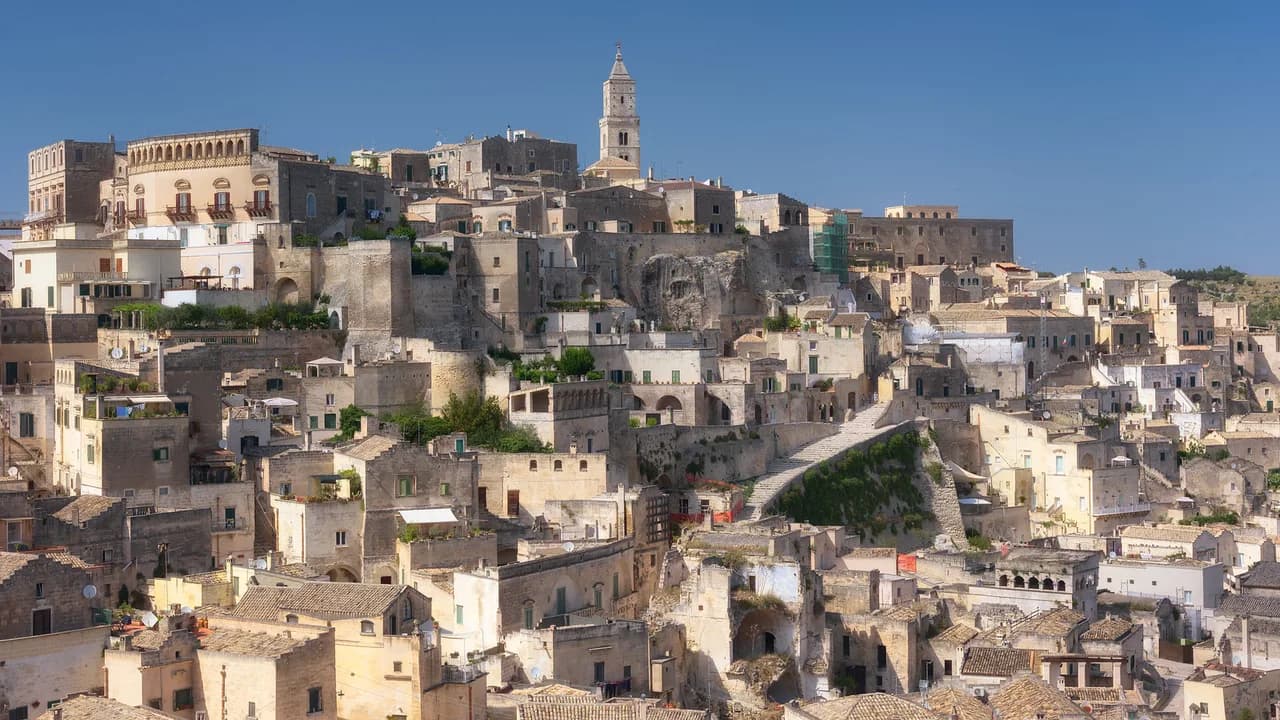
The Sassi are divided into two districts with distinct characters, and MUSMA sits in the quieter of the two. Walking through both on the same day gives you the contrast: the busier lanes around the main viewpoints, then the narrower streets and carved frontages below Palazzo Pomarici.
If you want to extend beyond the obvious stops, the lanes and viewpoints away from the main routes are worth an hour of wandering before or after the museum. Plan the museum for a fixed slot and leave the rest of the day loose, since the pleasure of the Sassi is in turning corners without a schedule.
For a wider shortlist of what to see in the city, the Matera Attractions hub groups the main sights by type and helps you decide what to cut. Two days is enough for the cathedral, one cave dwelling, MUSMA and a long walk; one day means choosing two of those.
Plan Your Visit
MUSMA rewards a little preparation more than most museums, because its two levels ask different things of you. Check the official site for current opening arrangements, last entry and ticket details before you travel, and treat the published daily schedule as something to verify rather than a fixed promise.
Go for the sculpture, stay for the carved rooms, and leave time for the courtyards. If you plan around an hour and a half, book nothing immediately afterwards, and confirm the day before, you will get the most out of a museum that is genuinely unlike the rest of Matera's cave attractions. For related planning, see Casa Cava, Matera: Visitor Guide to the Underground Cultural Centre.
Frequently Asked Questions
Where is MUSMA located in Matera?
MUSMA is inside Palazzo Pomarici in the Sasso Caveoso, the southern of Matera's two Sassi districts, at Via S. Giacomo. The museum's administrative address is Recinto Cavone 5, but visitors should navigate to the Sasso Caveoso entrance within the old town rather than to the office address.
What kind of artworks does MUSMA display?
The collection covers Italian and international sculpture from the late nineteenth century to the present, and includes ceramics, medals, jewellery, drawings, prints and artists' books as well as three-dimensional work. The upper floor presents pieces chronologically, while the underground rooms show sculpture in carved spaces and courtyards.
What are the cave spaces inside MUSMA like?
The lower level consists of seven spaces cut into the rock, adapted as galleries and lit for viewing, plus three courtyards that bring daylight into the underground route. They are cooler than the upper floor and their floors and surfaces are uneven in places, so grip soles are a sensible choice.
How long does a visit to MUSMA take?
Most visitors can see both levels and the courtyards in roughly an hour to ninety minutes; that is a planning suggestion rather than an official figure. Allow extra time if a temporary exhibition is running or if you read the labels closely, and longer still if sculpture is your main interest.
Are MUSMA's opening hours fixed?
The museum publishes daily opening from 10:00 to 20:00 with last entry one hour before closing, but schedules can change for exhibitions, holidays or seasonal reasons. Check the official site shortly before your visit and again on the day rather than relying on a third-party listing.
Is MUSMA worth visiting if I'm not a sculpture enthusiast?
The setting makes it worthwhile for many visitors even without a specialist interest: the contrast between the palace rooms and the rock-cut galleries is the draw, and the collection's range of media keeps it varied. If you have very little time in the Sassi, prioritise the streets and a cave dwelling instead.
Does MUSMA host temporary exhibitions?
Yes. Temporary exhibitions are mounted in both the piano nobile and the seven underground rooms, so part of the museum can change between visits. Check the exhibitions and events listings on the museum's site before travelling to see what will be installed during your dates.
What should I confirm before visiting MUSMA?
Confirm the day's opening hours and last entry, current ticket prices and what the ticket covers, and whether any rooms are closed for installation. Accessibility information, including steps and changes of level, is not documented here, so ask the museum directly if you have specific mobility needs.
Sources
Continue exploring
More guides you'll find useful





