
Matera Cathedral Visitor Guide: The Duomo Between the Two Sassi
Plan a visit to Matera Cathedral, the Romanesque Duomo on the ridge between the two Sassi, and pair it with viewpoints, cave churches and Sassi walks.
On this page
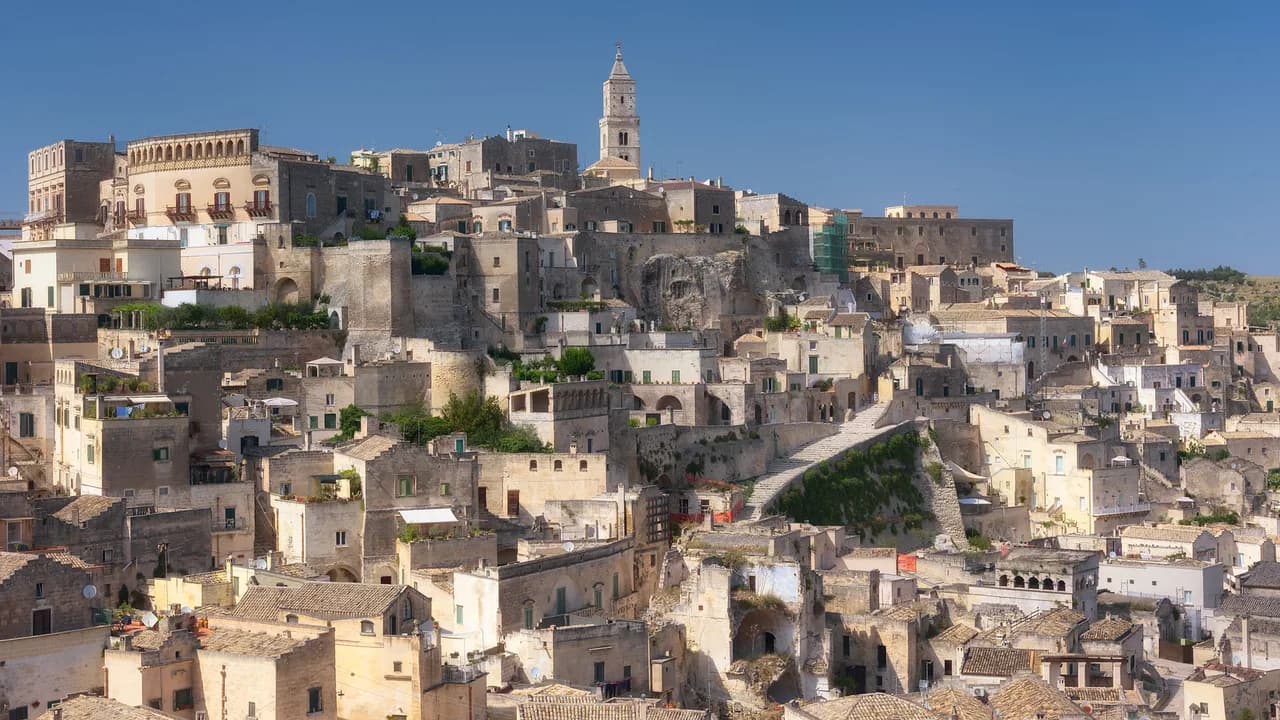
Matera Cathedral, properly the Cattedrale di Maria Santissima della Bruna e Sant'Eustachio and known locally as Il Duomo, occupies the highest point of the old city on the ridge between the two Sassi districts, and its bell tower dominates the skyline from most viewpoints. That position matters more than any single artwork inside: walk up to it and you cross from Sasso Barisano to Sasso Caveoso, with the ravine and the cave churches falling away on either side. Source descriptions of the ascent are consistent about the effort involved, so treat the cathedral as the hinge of a walking day rather than a standalone monument, and the rest of your route organizes itself.
What the Cattedrale di Matera Is and Where It Sits
Matera is the city of caves in Basilicata, a southern region that borders Puglia, and its ancient quarters are carved from soft limestone above a ravine. A regularly updated travel account describes the cathedral as twelfth- or thirteenth-century in origin, built on the ridge at the highest point of the old city, between the two Sassi, with a bell tower visible across the city. Because the building sits on the crest rather than in one district, it works as a natural halfway marker: you climb from one Sassi, pass the Duomo, and descend into the other. The city has been a UNESCO World Heritage Site since 1993, which is worth knowing when you wonder why the lanes are so busy in high season. Visitor details: 17 Fun Things to Do in Matera, Italy, Mysterious Stone City.
Why Start Here: The Duomo and the Shape of the Old City
Matera's historic core divides into Sasso Barisano, which one comprehensive account describes as holding taller and grander facades, and Sasso Caveoso, where the dwellings are simpler and more visibly cut into the rock. The cathedral sits between them, so any sensible route uses it as a turning point rather than a detour. Our suggestion is to pick one Sassi for the morning, climb to the Duomo around midday, and descend into the other district for the afternoon, which keeps the steepest climbing in short bursts. If you are still deciding how to split your days, two nights with one district per day is a commonly suggested structure; one day is possible but rushed because the streets are hilly and the distances take longer than a map suggests.
Context changes what you see here, so consider watching the Casa Noha film before you climb to the cathedral. Travel writers report that Casa Noha shows a multimedia film across the rooms of an original sixteenth-century cave house, and that seating per screening is small enough to sell out in high season. One 2026 account describes a 40-minute film, open daily except Wednesday, with entry reported at seven euros in 2026; another describes a film of roughly 30 minutes with an audioguide for non-Italian speakers. Because the accounts differ, confirm the current details on arrival rather than budgeting from a blog.
The Romanesque Facade and Rose Window: What to Look At Before You Go Inside
Stand in the small piazza in front of the cathedral and read the facade before you enter. Its Romanesque exterior is deliberately plain, and the element that carries the composition is the carved rose window, which photographs well in low morning or late afternoon light. Look also at how the bell tower rises above the ridge and how the building turns its shoulder to each Sassi in turn; the asymmetry explains why no single viewpoint shows the whole facade. Because the terrace area in front doubles as a lookout over the cave districts, allow a few unhurried minutes there before you go in.
The contrast between the restrained outside and the decorated inside is the reason to step through the door. One long-running travel account describes the Duomo's interior decoration as added centuries later and much more ornate, with gold and ceiling frescoes that feel far removed from the plain stone exterior. That mismatch is typical of churches in southern Italy rebuilt and embellished over centuries, and it rewards a slower look at the ceilings and side chapels rather than a quick photo at the entrance. Keep your expectations architectural and atmospheric; this is not a museum with explanatory panels. Further visitor details appear in 16 Unmissable Things to Do in Matera, Italy.
Viewpoints Around the Cathedral
The viewpoint directly in front of the cathedral is the most convenient, but the best-known panorama in the city is a short walk away at the Belvedere di Piazza Giovanni Pascoli, which looks down into the Sassi with the Duomo's bell tower in the frame. One travel account calls it the most beautiful viewpoint in Matera and recommends seeing it twice, once in daylight and once after dark when the cave districts are lit. The Belvedere Luigi Guerricchio, known as dei Tre Archi, sits next to Piazza Vittorio Veneto and gives a closer view with the Duomo visible, though it does not open onto the ravine.
If you want the cathedral in a wider landscape, cross the ravine. One detailed account of the walk reports that the out-and-back route to the Belvedere Murgia Timone runs about 3.5 kilometres with roughly 211 metres of climbing and takes a little over an hour at an easy pace, and that the trail is rocky and steep enough to require proper shoes. From the far side you see the whole city, and the difference between the two Sassi reads clearly. Skip the hike in the heat of midday and carry water; the alternative is a short drive to the viewpoint if you have a car.
Practical Visiting Notes: Entry, Hours and Booking
What you can rely on is the building itself: the exterior, the piazza and the ridge-top position are accessible to anyone walking the old town, and the facade and rose window cost nothing to see. For the interior, published information is thinner than for Matera's ticketed cave sites. The Comune di Matera's website is the right place to start for city notices and tourist information, but it does not publish a cathedral Mass or opening timetable, so do not plan a day around a schedule you read on a blog.
One widely read travel guide, updated in 2026, reports that entrance to the Duomo costs one euro, and the same page describes the interior as ornate compared with the plain Romanesque outside. Treat that figure as third-party reporting rather than an official tariff: it may have changed, and it may not reflect whatever arrangement applies on the day you visit. Check at the door or ask at the tourist information point before counting on it. Because no source here confirms daily opening hours, plan the cathedral as a flexible stop and keep a fallback nearby in case the doors are shut when you arrive.
Two things are genuinely unclear in the public material. First, whether entry is formally free or charged is not settled by any official page, so carry a little cash and ask. Second, there is no confirmation that the cathedral is included in any combined cave-church ticket, so if you buy a multi-site pass for the rock churches, do not assume the Duomo is part of it. No source documents step-free access, toilets or security rules at the cathedral either; if any of those matter to your visit, contact the parish or the city's tourist office directly before you travel.
Pairing the Duomo with Sasso Caveoso
Descend from the cathedral into Sasso Caveoso and the character of the city changes: lower dwellings cut straight into the rock, alleys that dead-end at the ravine, and the rock church of Santa Maria di Idris perched on a spur above the edge. Travel accounts describe Idris as the most dramatic of the cave churches and note frescoed chapels inside, with photography restricted. Rather than guessing at admission, check the current price at the entrance or through the ticket office that covers the rock churches.
The church of San Pietro Caveoso sits just below Idris in a small square at the bottom of the district, with caves rising on all sides; one account describes it as one of the most photogenic spots in the city even if the interior is modest. A short walk away, the Casa Grotta di Vico Solitario recreates a furnished cave dwelling where a family and its animals lived in a single room, which is the most direct way to understand what the cathedral looked like from the inside of ordinary life. That cave house is popular with tour groups, so visit early or late if you want quiet.
Pairing the Duomo with Sasso Barisano
On the other side of the ridge, Sasso Barisano is generally quieter and its buildings are taller, with facades added onto the original caves. San Pietro Barisano is the largest of Matera's rock churches and dates back to the twelfth century, with frescoes and a crypt whose carved seats were used in burial practice; it sits on this side and pairs neatly with a descent from the cathedral. Travel accounts note that the cave churches follow set daily hours, generally opening in the morning and closing in the early evening, but confirm the current timetable locally because seasonal changes are common.
If the crowded cave houses near Sasso Caveoso put you off, consider the smaller alternative reported on this side: Casa Grotta C'era Una Volta, described as quieter but just as interesting, with a modest entry charge that is worth verifying at the door. Either way, the lanes here reward wandering without a plan; some of the best corners of the district are unmarked stairways between houses. Leave room in your route for a slow loop back toward Piazza Vittorio Veneto, where Palombaro Lungo, the vast cistern under the square, offers a cool underground stop in the middle of the day.
Timing Your Visit: Morning Light, Sunset and the Lit-Up Sassi
Split the cathedral from the viewpoints rather than trying to do both at once. Morning light is kindest to the facade and the rose window, and the lanes are emptiest before the tour groups arrive. Save the panoramic viewpoints for late afternoon and again after dark, when the cave districts are illuminated and the city reads as a single carved object; travel accounts rate the evening view highly. If your trip falls in summer, plan indoor stops such as the cathedral or Palombaro Lungo for the hottest hours and keep walking for early and late in the day.
A Half-Day Loop That Puts the Duomo in the Middle
Start at Piazza Vittorio Veneto, cross to the Belvedere dei Tre Archi for the orientation view, and walk into Sasso Barisano through the lanes above San Pietro Barisano. Keep the morning for that district, then climb to the cathedral for the facade, the piazza and, if the doors are open, the interior. Descend into Sasso Caveoso for the rock churches and a cave house, finishing at the Belvedere di Piazza Giovanni Pascoli for sunset. The whole loop is comfortably a half day of walking if you stop often, and the sequence means you are climbing once rather than repeatedly.
Mistakes to Avoid
The most common error is treating the Duomo as a photo stop and skipping the context that makes it interesting. Watch the Casa Noha film or read about the Sassi's twentieth-century evacuation first, and the cathedral stops looking like a generic Italian church on a hill. The second mistake is underestimating the stairs: hotels inside the Sassi are often reached on foot with luggage, parking is limited and the historic centre has restricted traffic zones, so pack light and confirm arrival arrangements with your accommodation in advance.
A third mistake is planning too tightly. Two nights is the sensible minimum for the Sassi, one district per day, with the cathedral as the link between them; a single day leaves you rushing the climbs and missing the evening light. Build in slack for closed doors, queues at the popular cave houses and the simple fact that a hilly stone city takes longer to cross than the map implies.
Accessibility and Comfort
No source consulted documents step-free access, lifts, toilets or assistance arrangements at the cathedral, so anyone with mobility needs should contact the parish or the city's tourist office before relying on a visit. Detailed accounts agree that the Sassi are built of staircases, uneven stone paving and steep alleys, and comfortable shoes with grip are essential rather than optional. In summer, carry water and sun protection, and treat the shadiest stretch of lane as part of the itinerary rather than an afterthought.
Where to Go Next in Matera
Once you have walked the ridge and both Sassi, the city's other sights fall into two groups. Underground Matera means Palombaro Lungo beneath Piazza Vittorio Veneto and the rock complex of Madonna delle Virtù; above ground, the cave-church circuit and the Murgia park across the ravine reward a second day. The Chiesa di San Pietro Caveoso visitor guide covers the lower district in more depth if you want to plan that half of the walk properly.
Before you set out, confirm the details that this guide deliberately leaves open: cathedral opening times, whether any entry charge applies on your date, and cave-church and cave-house prices. The Comune di Matera site and the tourist information point are the most reliable starting places, and asking at the door takes a moment. Everything else on the ridge is there to be walked, and the evening view over the lit-up Sassi costs nothing.
Frequently Asked Questions
Is Matera Cathedral free to enter?
Published information is inconsistent. One widely read 2026 travel guide reports a nominal charge for the interior, but no official source confirms a tariff or free entry, so ask at the door or at the city tourist information point. The exterior, the facade and the piazza cost nothing and are the main reason many visitors climb to the ridge.
How long does it take to visit the Cattedrale di Matera?
Allow 20 to 30 minutes for the facade, the piazza and the interior at an unhurried pace, and rather longer if you linger at the viewpoint in front. Most visitors treat the cathedral as one stop on a half-day walk between Sasso Barisano and Sasso Caveoso rather than a standalone visit.
Where exactly is the Duomo in Matera?
It sits on the ridge at the highest point of the old city, between the two Sassi districts of Barisano and Caveoso, with its bell tower visible from most viewpoints. Approaching from Piazza Vittorio Veneto means climbing through the lanes; approaching from Sasso Caveoso means climbing from the ravine side.
What is the best viewpoint of the cathedral?
The Belvedere di Piazza Giovanni Pascoli is the most celebrated panorama and frames the Duomo's bell tower above the Sassi. The small terrace in front of the cathedral gives a closer view, and the Belvedere Murgia Timone across the ravine shows the whole city with the cathedral on its crest, reached by a steep hike or a short drive.
Can you visit the Duomo and the Sassi in one day?
It is possible but tight. A practical one-day plan covers one Sassi in the morning, the cathedral at midday and the other Sassi in the afternoon, with a viewpoint at sunset. Two nights gives a calmer visit, lets you see the Sassi lit up after dark, and leaves time for a cave house or the underground cistern.
What should I see near Matera Cathedral?
Within a short walk you have the cave churches of Santa Maria di Idris and San Pietro Barisano, the church of San Pietro Caveoso, at least two cave houses and the viewpoints above the ravine. Palombaro Lungo under Piazza Vittorio Veneto is a cool underground stop, and Casa Noha provides the historical context that makes the whole old city legible.
Sources
Continue exploring
More guides you'll find useful





