Cattedrale di Santa Maria, Cagliari: A Visitor Guide
Plan a short visit to Cagliari's cathedral in Castello: what to see inside, the crypt, the rebuilt facade, and where to confirm hours and entry.
On this page
Cagliari's cathedral is the natural anchor of the Castello district. Its address is Piazza Palazzo, in the upper town, where the city's civic and religious buildings have clustered for centuries. This guide covers what you see outside and inside, the Crypt of the Martyrs, and a short route for a focused stop of about 30 to 45 minutes, which is our suggestion rather than an official tour duration.
One practical point up front: opening hours and free entry are reported by third-party listings but are not confirmed by the operator in the material reviewed here. Treat a uniform daily schedule as reported, not guaranteed, and check the parish or archdiocese pages before you go. The heritage record confirms the address and the documented history, which is the reliable core of any visit.
Finding the Cathedral in Castello
The cathedral stands on Piazza Palazzo in the Castello district, the hilltop quarter that has been the political heart of the city. SardegnaCultura gives the address as Piazza Palazzo, postal code 09124 Cagliari, and links to the cathedral website for current information.
Arriving on foot from the lower city, you climb into a dense grid of lanes where the cathedral appears without much ceremony, wedged between civic buildings. The area holds other monuments and viewpoints, so the cathedral works best as one stop on a slow walk rather than a destination in isolation. If you want to extend the day with quieter corners, our guide to hidden gems in Cagliari suggests alternatives to the obvious circuit.
For orientation, the Comune di Cagliari site gathers tourism information on reaching the city, staying and moving around, which is useful when you plan the rest of a day in the Castello area.
The History in a Few Minutes
The church is documented from 1255, when it served the fortified castle established after the Pisan nobleman Lamberto Visconti received the hill from the Cagliari judge Benedetta in 1217. The building was a three-nave room with columns and a semicircular apse, roofed in wood.
After the Pisans took control of the Cagliari court in 1258, the church gained Saint Cecilia as patron and was raised to cathedral rank. Expansion followed at the end of the thirteenth and start of the fourteenth century, adding a large transept and a rectangular apse. The Aragonese, having defeated the Pisans in 1326, completed the transept, and traces of their work survive in a chapel with an umbrella vault.
The building you see today is a palimpsest: a medieval core, a major Baroque reconstruction in the seventeenth century, and a twentieth-century facade. Knowing this sequence prevents the common mistake of reading the whole church as one period.
What You See Outside: Medieval Survivals and a 1925 Facade
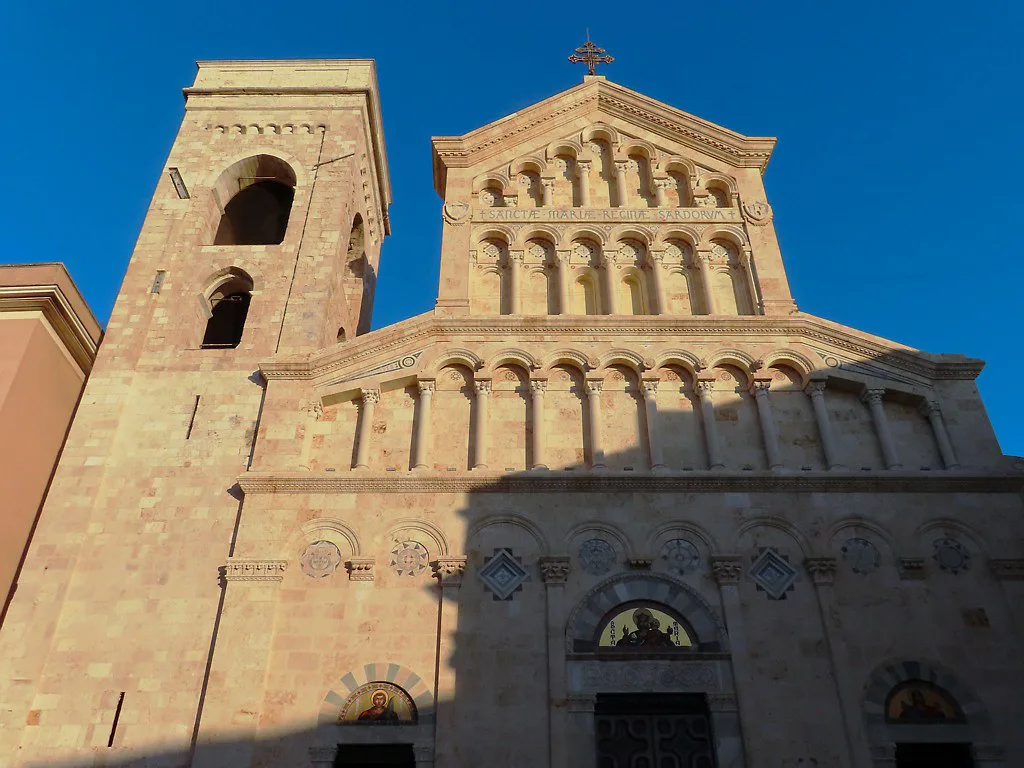
The square bell tower, the counterfacade, the transept perimeter walls and one apse chapel survive from the Pisan phase. These are the genuine medieval elements to look for, and the bell tower is the easiest to identify from the piazza.
The facade is not original. A Baroque front built between 1702 and 1704 and modified in the 1770s was dismantled in 1902 in the hope, which proved vain, of finding a medieval facade beneath it. A new front in a Lucca Romanesque style was rebuilt in 1925 to a design by the architect Giarrizzo.
That reconstruction is why the exterior can look more Romanesque than the interior's Baroque character suggests. Treat the facade as a piece of restoration history in its own right, and give the medieval portal fragments and surviving walls more of your attention.
Inside: The Baroque Rebuild
In 1669 the church was restored and expanded in Baroque style under Domenico Spotorno, with the architect Solaro involved briefly. The work widened the central aisle, replaced the seven dividers with sturdy pillars supporting a higher barrel roof, and added a tall dome on a drum at the crossing.
Look up at the dome and then down the nave to read how the Baroque scheme reorganised the medieval shell. Third-party visitor reviews also single out the marble pulpit and the play of light through the windows, which are worth pausing for even on a short stop.
A chapel with a semi-octagonal plan and umbelliform vault remains from the Aragonese intervention, so the interior is not uniformly Baroque. If you are unsure which chapel is which, ask at the entrance or carry a short printed note from the heritage page.
The Crypt of the Martyrs
Between 1615 and 1617 the presbytery was raised to create the so-called Crypt of the Martyrs, where relics of the alleged Sardinian martyrs found near the Basilica of San Saturnino were placed. Two staircases flanking the presbytery lead down to it.
The sanctuary has three rooms: a larger central space with a low barrel vault and two smaller side rooms, partly cross-vaulted and partly barrel-vaulted. That layout rewards a slow look rather than a quick pass through.
A third-party listing mentions royal tombs in the crypt, but the heritage record reviewed here does not support that claim. Stick to what the heritage source documents when you describe the space to others.
A Suggested 30-45 Minute Route
This route is our suggestion, not an official itinerary. Start on Piazza Palazzo with the facade, noting the 1925 reconstruction and the surviving medieval bell tower. Spend five to ten minutes outside before entering.
Inside, walk the nave once to take in the dome and pillars, then pause at the marble pulpit and any chapel that catches your eye. If the crypt is open, allow ten to fifteen minutes for the stairs and the three rooms; if it is closed, use the time on the transept and side chapels instead.
Finish with a quiet moment near the apse before leaving. If you have longer, our Cagliari Attractions hub lists other sights in the same district that fit naturally into the same walk.
Practicalities: Entry, Hours and Confirmation
Third-party listings report free admission and uniform daily hours of 9AM to 8PM, but these are aggregator figures rather than operator confirmations. Before relying on them, check the parish or archdiocese site and the cathedral website linked from the heritage record. Further visitor details appear in Cattedrale di Santa Maria Assunta e Santa Cecilia, Cagliari, Italy - Reviews, Ratings, Tips and Why You Should.
No ticket prices, booking arrangements or guided tour details are confirmed in the sources reviewed here, so plan around a self-guided visit and ask on arrival if you want more. Liturgical schedules and closures can vary, so confirm locally rather than assuming a listing is current.
If you are building a full day, the city's tourism pages are a reasonable starting point for orientation and for checking what else is open in Cagliari.
Visiting Respectfully
This is an active place of worship before it is a sight. Dress modestly, keep your voice low, and avoid wandering into areas set aside for prayer or services. Attire rules are not formally enforced in the sources reviewed here, so treat this as ordinary courtesy rather than a published policy.
Photography and access to the crypt may be restricted at times; if in doubt, ask a member of staff. A short, quiet visit respects both the congregation and the building's history.
Pairing the Visit with Castello
The cathedral sits within a compact historic quarter, so combine it with a walk along the old walls and a stop at a viewpoint. The architecture and archaeology of the district reward an unhurried pace, and the cathedral is one chapter rather than the whole story.
For a different kind of quiet, the Tuvixeddu necropolis is an ancient burial ground that offers a contrast to the Baroque interior and can be slotted into a longer day. Our hidden gems guide covers Tuvixeddu and other less obvious stops around the city.
Before You Go
Cagliari's cathedral is a layered building: a Pisan core, an Aragonese chapel, a Baroque interior and a 1925 facade. Going in with that sequence in mind turns a quick look into a readable visit. Confirm hours and entry with the parish before you set out, and allow about 30 to 45 minutes if you want to see the crypt as well as the nave.
If you have more time, use the Cagliari Attractions hub to plan the rest of your walk through Castello and beyond. For related planning, see Poetto Beach Cagliari Guide: Free Sand, Lidos and the Devil's Saddle.
Frequently Asked Questions
Is entry to Cagliari cathedral free?
Third-party listings report free admission, but the operator does not confirm this in the material reviewed here. Check the parish or archdiocese website before your visit rather than assuming entry is free on the day.
How long does it take to visit the cathedral?
Plan about 30 to 45 minutes for the nave, the dome and the crypt if it is open. That is our suggested timing, not an official duration, and a longer stay is worthwhile if you want to read the building's phases carefully.
What is in the crypt under the cathedral?
The Crypt of the Martyrs was created between 1615 and 1617 when the presbytery was raised. It holds relics of the alleged Sardinian martyrs found near the Basilica of San Saturnino and is divided into a larger central room and two smaller side rooms.
Is the cathedral facade original?
No. The Baroque facade was dismantled in 1902 and a new Romanesque-style front was rebuilt in 1925 to a design by the architect Giarrizzo. The medieval bell tower and parts of the transept walls do survive from the Pisan phase.
When was the cathedral first documented?
The church is documented from 1255, serving the fortified castle on the hill above Cagliari. It became the cathedral after the Pisans took control of the Cagliari court in 1258.
Do I need to book to visit?
No booking arrangements are confirmed in the sources reviewed here, so assume a self-guided visit and ask on arrival if you want more information. Confirm current arrangements with the parish before you travel.
Sources
Continue exploring
More guides you'll find useful