Palermo's Politeama and Liberty Quarter: A Walking Guide
Walk Palermo's Politeama quarter, from Teatro Politeama Garibaldi and Via Ruggero Settimo to Teatro Massimo and the Capo district, with sourced visiting notes.
On this page
The Politeama district takes its name from the theatre that dominates Piazza Ruggero Settimo, and it works well as the starting point for a half-day of walking in central Palermo. The area is generally described as the more refined, aristocratic side of the historic centre, with shopping and cultural streets running through it. This guide sequences the documented sights in a sensible order and is honest about the parts of the Liberty story that are not covered here.
Expect three clusters rather than one continuous street: Piazza Ruggero Settimo with the Politeama Garibaldi, Teatro Massimo slightly inland, and the Capo district with the Church of the Immaculate Conception near Porta Carini. Each is a short stretch of the same central walk rather than a separate excursion. Treat the route as a framework and adjust it to your pace, the weather and how long you want to spend in each square.
Read the Liberty and Art Nouveau label carefully. Central Palermo has a rich mix of architectural styles, but specific Liberty villas, their architects, addresses and visiting arrangements are not documented in this guide, and you should not assume a building is open or visitable because of its facade. Use the walk to look at what is in plain sight, then check current visiting details directly with each venue before you build a day around it.
Why base a central Palermo walk on the Politeama district
The Politeama district sits at the heart of the city and is described as an elegant, aristocratic quarter named after its theatre. That makes it a convenient anchor for a walk that touches shopping streets, theatres and a historic market district without long transfers between them. If you are still deciding where to sleep, the Palermo neighbourhoods guide: where to stay explains how the central quarters compare for different kinds of trips.
The practical advantage is that the district links three distinct stops: Piazza Ruggero Settimo, Teatro Massimo and the Capo district. You can walk the whole sequence or treat any one cluster as a standalone outing. Because the sources do not give walking times or transit lines, plan by landmarks and check routes on a map before setting out rather than relying on fixed minutes.
Start at Teatro Politeama Garibaldi on Piazza Ruggero Settimo
The Politeama Garibaldi Theater is the natural first stop, standing on Piazza Ruggero Settimo, which is also called Piazza Politeama. Its elegant, classic lines frame the square and make it one of the most recognisable buildings in central Palermo. The theatre was inaugurated in 1874, a date that places it firmly in the city's post-unification building boom.
Look at the facade from the square before deciding whether to go further. The sources describe the theatre as a must for architecture, art and theatre lovers, but they do not publish opening hours, ticket prices or booking rules, so check the theatre's own information before planning a visit inside. Treat the exterior and the square as the reliable part of the stop.
Piazza Ruggero Settimo itself is the hinge of the walk, with the theatre on one side and shopping streets leading away from it. Use the square to orient yourself, then pick your next direction based on how much time you have. For a fuller menu of central sights beyond this route, the Palermo Attractions hub collects guides to individual sites across the city.
Via Ruggero Settimo and the surrounding shopping streets
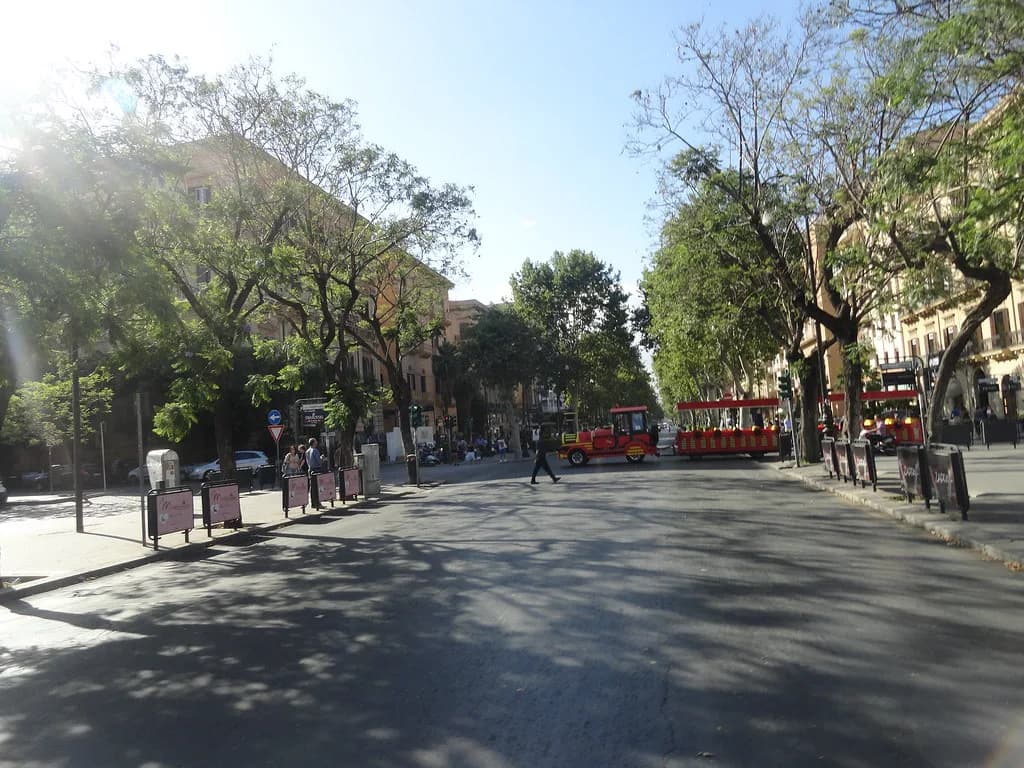
Via Ruggero Settimo is described as one of Palermo's main and most important streets, effectively the city's drawing room, lined with the most exclusive boutiques. Nearby you will find the key places of commerce and business, along with restaurants and lounge bars. This is a busy commercial spine, not a quiet lane, so pace the walk around the shopping rather than expecting calm.
The street rewards a slow pass rather than a checklist. Window-shop, note the entrances of the larger palazzi and use the street as a connector between the Politeama and Massimo clusters. If the crowds wear thin, duck into a side street for a breather and rejoin the main axis further along.
For a change of texture later in the day, the Albergheria neighbourhood guide covers a very different quarter of the historic centre, with its own market character and street life. It is a useful counterpoint if the polished shopping streets leave you wanting a rougher, older Palermo.
Teatro Massimo: the nearby opera house and what it adds
Teatro Massimo Vittorio Emanuele is the second anchor of the walk and is described as a hymn to elegance, with halls, galleries, staterooms and monumental stairways forming an architectural complex of majestic proportions. It is the largest opera house in Italy and the third largest in Europe, a scale that is worth registering even from outside. The contrast with the Politeama's classic lines is part of the pleasure of walking between them.
Because the sources do not give ticket prices, opening hours or booking requirements for either theatre, plan the interiors separately and confirm details with each venue. The walk itself can be done entirely on the exterior and the surrounding streets, which is the safest way to structure a short visit. If you want to see a performance, that is a separate booking decision to make well ahead of your trip.
Pair the theatre stop with a broader look at the city's cultural layers. The hidden gems in Palermo guide points to less obvious corners, including the Oratorio del SS Rosario in Santa Cita, which rewards travellers who want more than the headline monuments.
Pushing on to the Capo district and the Church of the Immaculate Conception
From the theatre cluster, the walk pushes on to the Capo district and the Church of the Immaculate Conception, a consecrated Baroque building near Porta Carini. The church is noted for its marbles and for four precious frontals with polychrome marble inlay, described as hidden pearls in the heart of Palermo. The surrounding Capo district is known for its colours and its local market, which gives this stretch a different flavour from the shopping streets.
Approach the church as an architectural stop first. The sources do not publish opening hours or entry conditions, so check locally before assuming the interior is open to visitors. The market streets around Porta Carini are the other reason to come this far, and they are best experienced on foot at an unhurried pace.
This is also where the walk becomes a lesson in Palermo's layered history: a Baroque church, a working market and a shopping quarter all within one central area. If you want to extend the day, the Palermo self-guided historic centre walk offers a longer route through the older core.
Reading Palermo's Liberty facades respectfully
The Liberty label is often used loosely for late nineteenth- and early twentieth-century decorative architecture in Italy, and Palermo has plenty of it. What the sources document for this route is the Politeama Garibaldi's 1874 inauguration and Teatro Massimo's scale, not a list of named Liberty villas, their architects or their addresses. Be sceptical of any walking route that promises specific villa interiors without current confirmation.
Look for the details you can actually see from the street: balconies, decorative ironwork, carved stone and the way buildings meet the piazza. Photograph from public ground rather than entering private courtyards or doorways. If a building looks interesting and you want to know more, ask at a tourist information point or check the official tourism site for Sicily, which lists attractions and events across the island.
Treat the architecture as a backdrop to the walk rather than a checklist to tick off. That way an unverified facade never becomes a wasted detour, and you stay open to whatever the streets actually offer. The same principle applies to the city's churches and theatres: exterior first, interior only when confirmed.
Practical walking logic: choosing a base and sequencing sights
Sequence the walk from Piazza Ruggero Settimo to Teatro Massimo and then on to the Capo district, or reverse it if your accommodation sits closer to the market end. Both directions work because the clusters are central and linked by the same streets. Choose a base within the Politeama area if you want to walk the route in short bursts, as the hotel page notes that several sites of historical and artistic interest and the main shopping streets are reachable on foot from the district.
Check the official tourism site for Sicily before you travel for events and temporary exhibitions that might change your route. The Visit Sicily events calendar lists festivals and seasons across the island, which is useful if you want to combine the walk with something happening during your stay. For weather and timing, the Best time to visit Palermo and avoiding crowds advice helps you pick a season that suits walking.
Carry water, wear shoes suited to stone paving and keep the route flexible. Do not rely on fixed walking minutes or transit lines from any guide, because these change and are not documented here. A paper or offline map is a sensible backup in the dense streets of the centre.
Where to eat around the route: how to choose rather than a fixed list
The sources mention refined restaurants and lounge bars near Via Ruggero Settimo, including one named venue, but they do not review menus, prices or quality, so use them as a signal that the street has dining rather than as a recommendation. Choose by looking at the room, the menu posted outside and how busy it is at the hour you want to eat. That is more reliable than any fixed list, which would be out of date quickly.
For a different kind of meal, push towards the Capo market district, where the street food culture of Palermo is part of the attraction. The Visit Sicily pages on Sicily street food give context on what the local street eating tradition involves, which helps you order with confidence. Keep an eye on hygiene and turnover, and eat where the food is moving.
Book nothing in advance unless you have confirmed the details directly with the venue. Prices and opening hours in Palermo's centre change with the season, and a guide cannot substitute for a look at the door. If a place is full, the surrounding streets have plenty of alternatives.
Suggested half-day plan and a shorter alternative
For a half-day, start at Piazza Ruggero Settimo and look at the Politeama Garibaldi exterior, then walk Via Ruggero Settimo towards Teatro Massimo, pause in the theatre square and continue to the Capo district for the Church of the Immaculate Conception and the market streets. That sequence covers the documented sights without rushing. Allow extra time for a meal and for spontaneous stops, and note that this is a suggested shape, not an official itinerary.
For a shorter version, do only the Politeama and Via Ruggero Settimo loop, which gives you the theatre, the main shopping street and a choice of cafes without committing to the walk to Capo. It suits a first afternoon in the city or a day when the weather turns. Both versions can be combined with the wider hidden gems in Palermo for travellers who want more depth.
Plan Your Visit
The Politeama district is a practical, walkable base for central Palermo, with three clusters that fit into a half-day or a shorter loop. Confirm theatre interiors and church opening directly with each venue, and treat the Liberty facades as streetscape rather than guaranteed visits. That approach keeps the day flexible and grounded in what you can actually see.
Before you go, check the official tourism site for Sicily for events and seasonal information, and use the Palermo Attractions hub to plan any deeper visits. Book accommodation based on which end of the walk you want closest, and keep the route loose enough to enjoy the city as it is.
Frequently Asked Questions
What can you see on a walk around Palermo's Politeama district?
The core route takes in Teatro Politeama Garibaldi on Piazza Ruggero Settimo, the shopping streets around Via Ruggero Settimo, Teatro Massimo and, further on, the Capo district with the Church of the Immaculate Conception near Porta Carini. Each stop is in central Palermo and the sequence can be walked in either direction. Check opening details with each venue before planning an interior visit.
When was Teatro Politeama Garibaldi inaugurated?
The theatre was inaugurated in 1874, according to the source describing the Politeama district. That date places it in Palermo's post-unification period of civic building. It stands on Piazza Ruggero Settimo, also called Piazza Politeama.
Is Teatro Massimo near the Politeama district?
Yes. Teatro Massimo is described as nearby within the same central area and is a natural second stop on a walk that begins at Piazza Ruggero Settimo. The sources characterise it as the largest opera house in Italy and the third largest in Europe. Confirm visiting arrangements directly with the theatre.
What is Via Ruggero Settimo known for?
It is one of Palermo's main and most important streets, known for exclusive boutiques and nearby commercial and business addresses. It is a busy shopping spine rather than a quiet lane, so pace the walk accordingly. It also links the Politeama and Massimo parts of the route.
How does the Church of the Immaculate Conception fit into a central Palermo walk?
It sits in the Capo district near Porta Carini and is the furthest point of the suggested route. The church is a consecrated Baroque building noted for its marbles and four frontals with polychrome marble inlay. The surrounding market streets give the stop a different character from the shopping quarter.
How long should you allow for a Politeama and Liberty quarter walk?
A half-day is a sensible suggestion for the full sequence including a meal, while a shorter loop around the Politeama and Via Ruggero Settimo suits an afternoon. These are suggested durations, not official figures. Adjust for your pace, the weather and how long you spend at each stop.
Sources
Continue exploring
More guides you'll find useful