Siena Three-Day Itinerary: Slow Days and Timed Sights
A suggested three days in Siena: a mapped walk to Piazza del Campo, the cathedral complex and viewpoints, plus free squares and a flexible excursion slot.
On this page
Siena rewards a longer stay than a rushed day trip because its historic centre is compact but dense: one visitor guide describes a set of medieval walls running for roughly seven kilometres around the old town, with three main streets converging in a Y-shape on Piazza del Campo. Treat the three days below as a suggested rhythm rather than an official programme, and accept that you will not see everything.
As a rough yardstick, one blogger's self-guided circular walk from Porta Camollia through the medieval quarter runs just over four kilometres. That is a visitor's measurement, not an official route length, but it helps you picture how much ground a single day covers when you keep mostly to the centre.
This plan assumes no car, one anchor sight each morning and a looser afternoon, and it does not claim that any street, square or district is quiet, secret or reserved for residents. Everything concerning ticket scope, opening hours or pass terms should be checked with the site operator before you go, because those details change. Further visitor details appear in Homepage | Comune di Siena.
Orientation: How Siena's Three Hills Shape a Walking Plan
Siena is built over three hills, and its three principal streets meet at the central square, which is why nearly every walk in the centre eventually delivers you to Piazza del Campo. The Campo is shell-shaped and slopes gently toward the Palazzo Pubblico, so it works as a natural midpoint for morning and afternoon legs.
Siena's railway station sits outside the historic walls at the foot of the hill, and reaching the old town on foot involves a climb of about 25 minutes to Porta Camollia; buses and taxis cover the same approach. The main bus station near Giardini La Lizza is closer to the centre, which matters if you are carrying luggage or arriving late.
Inside the walls you can plan almost entirely on foot, since the old town is described as pedestrian-friendly and largely traffic-free. That makes a three-day stay without a car realistic; use the city's own pages to confirm current services rather than relying on any single blog.
Day 1 Morning: Porta Camollia to Croce del Travaglio
Start at Porta Camollia, the northern gateway where pilgrims on the Via Francigena once entered the walled city; the present gate replaced an earlier structure destroyed in the 1555 siege. From there, walk along Via Camollia and continue onto Via Banchi di Sopra, the main pedestrian artery that threads the centre.
A short detour brings you to Piazza Salimbeni, framed by Gothic and Renaissance palazzi and associated with the Banca Monte dei Paschi di Siena, whose predecessor institution began as a pawn shop in 1472 and opened as a bank here in 1624. It is a compact square with a statue of Sallustio Bandini, and reading it as a piece of Siena's financial history adds more than a quick photo stop.
The route continues past the Basilica di San Francesco, a redbrick Gothic landmark that one walking guide describes as free to enter, with morning and late-afternoon visiting blocks. Those hours are an older published detail, so check the parish's current timetable before planning around them.
Finish the loop at Piazza Tolomei, with its medieval palazzo and she-wolf column, then walk on to Piazza Indipendenza and the Croce del Travaglio crossroads where Siena's three main streets intersect. The route passes the Loggia della Mercanzia just before the Campo, giving you a first glimpse of the square's stately enclosure.
Day 1 Afternoon: Piazza del Campo, the Courtyard and the Tower Choice
Piazza del Campo is where day one should slow down. The square took its present form in the early fourteenth century, when its red-brick herringbone paving and fan shape were laid out, and its buildings were raised to a uniform design under the urban rules of the time.
Anyone can step into the Cortile del Podestà, the courtyard inside the left wing of Palazzo Pubblico, at no charge; it is where the Palio horses are led in before each race and where race footage is shown through the year. Look upward for the colonnaded walls framing Torre del Mangia, then decide whether the ticketed interiors are worth your afternoon energy.
The Museo Civico upstairs in Palazzo Pubblico holds Lorenzetti's Allegory and Effects of Good and Bad Government, one of the reasons to prioritise the museum over a climb. Older guides list single and combined ticket prices, but treat those numbers as visit-era snapshots and confirm current admission with the operator before budgeting.
Torre del Mangia is a different kind of trade-off: more than 400 steps to panoramic views, and published museum hours shift with the season and around Palio dates. If you climb, keep the rest of the afternoon light, and verify the tower's current opening times before you go.
Day 2 Morning: The Duomo Complex Decoded
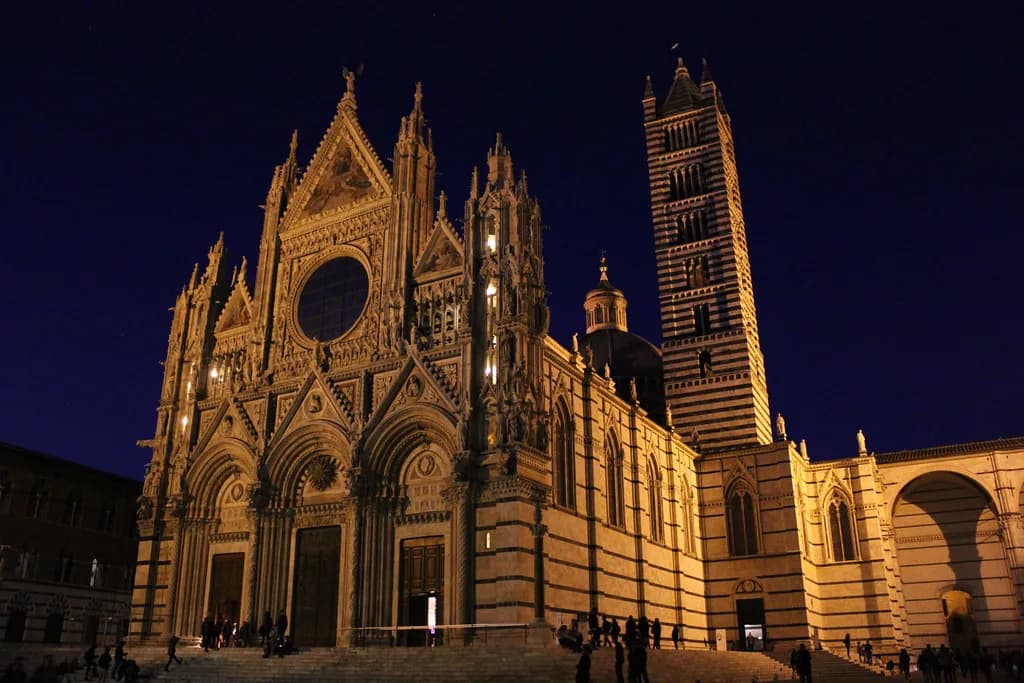
Siena's cathedral dates back to 1264 and is known for its striping of white and dark marble, its patterned floor and works such as a statue of St Paul by Michelangelo. One visitor guide notes that visiting is not free and that summer ticket-office queues can be slow, so arriving early is a practical choice.
The Piccolomini Library, a small room about halfway along the left side of the interior, uses vivid frescoes to tell the life of Pope Pius II and is part of the cathedral visit rather than a separate museum. The crypt, revealed only in 1999 after centuries hidden, sits on the right side near the Museo dell'Opera entrance and holds well-preserved frescoes.
The Baptistery of San Giovanni, in the piazza below the cathedral, is known for its baptismal font carved by Jacopo della Quercia, Ghiberti and Donatello; its upper section was never finished. The cathedral floor is only fully uncovered for part of the year, which affects what you see on a given date.
Remember the dress code: shoulders and knees should be covered at this religious site, for men as well as women, or you risk being turned away at the door. Sunday visiting hours are limited to allow services, so check the cathedral's own published schedule before choosing your morning.
Day 2 Afternoon: Museo dell'Opera, Facciatone and Santa Maria della Scala
The Museo dell'Opera, in the unfinished "new cathedral" beside the Duomo, holds sculptures and art from the cathedral and other Siena churches, including a large rose window in its basement. The main draw is the Panorama dal Facciatone, the wall intended for a cathedral extension halted by the Black Death, now a viewpoint over the roofscape and Piazza del Campo.
Expect a queue: one visitor account reports around 20 minutes of waiting, narrow one-way stairs and a somewhat hurried visit at the top, and advises early or late in the day for both queues and light. Go up first and see the museum afterward, so a long line does not eat your afternoon.
Santa Maria della Scala, the museum housed in the old hospital across from the cathedral, holds the original Fonte Gaia marblework by Jacopo della Quercia, while the fountain in the Campo is a nineteenth-century replica. Treat it as a separate ticketed collection and compare its scale to the cathedral museum before committing, since this stop works better as its own visit than an add-on.
If you are flagging, swap the museum for an unhurried hour in the Campo; the two days itinerary suggests what to cut for a shorter stay.
Decision Box: Does a Combined Cathedral Pass Suit You?
One visitor guide describes a combined pass covering the cathedral, Baptistery, crypt, Piccolomini Library, Museo dell'Opera and the Facciatone viewpoint, sold for use over three consecutive days and available at the ticket office or in advance online. That scope is the key question: the pass only pays off if you intend to enter several of those spaces within its validity window.
Two cautions follow. First, the pass's inclusions and validity are set by the operator, so verify them with the cathedral operator rather than trusting any guide's summary; second, the pass does not collapse every Siena museum into one ticket, and Santa Maria della Scala and the Museo Civico are separate collections.
If you plan a single Duomo-focused morning, a cathedral-only ticket may be simpler; the Porta del Cielo roof route is sold separately according to the same guide, so decide before you queue.
Day 3 Morning: Free Squares, Church Exteriors and Fortress Grounds
Balance the trip with a morning that costs nothing to enter. The Campo, Piazza Salimbeni, Piazza Tolomei and the Cortile del Podestà are public spaces, and one walking guide describes San Francesco's church entry as free, though its interior merited a shorter stop than the cathedral.
A city-level list of sights includes the Basilica of San Domenico, which it credits with a great view, and the Medici Fortress, where walking the old fort grounds is itself the activity. Both fit a slow morning, but do not assume their interiors share the cathedral's ticket arrangements; each is its own site with its own access rules.
For more corners outside the headline sights, from lesser-known churches to other vantage points, keep the hidden gems in Siena guide handy; it suggests places that can be slotted into this free-morning plan rather than replacing it.
Day 3 Afternoon: Contrade Streets, Shopping and the Evening Passeggiata
Siena's seventeen contrade, the city districts with their own traditions and rivalries, give a cultural frame to wandering rather than a checklist of streets. As you pass through the historic quarter, notice the district emblems and fountains; the guide describing the Palio is clear about the competition's intensity, which helps explain why these identities matter so much.
One city guide also recommends gelato as a distinctly Sienese pleasure and local souvenirs for shopping, which makes them sensible low-effort afternoon activities after two full days of museums. Keep the wandering loose and let the pavement lead you, since the centre is compact enough to walk back to the Campo without a plan.
Finish with an evening stroll around Piazza del Campo, when the square becomes an open-air meeting place. For ideas on how to shape that evening, the Siena evening guide holds suggestions for late-day walks and where to sit; it is a planning companion, not a schedule of events.
The Half-Day Excursion Slot: Choose by Season and Transport
The best half-day excursion from Siena depends on your dates, your transport and how much time you want to spend on the road, so this itinerary keeps that slot flexible. Read a current day trips from Siena list, shortlist two options, and decide which works for your season and comfort with trains or buses rather than committing to a destination now.
Choosing by direction helps: towns such as San Gimignano and Monteriggioni to the northwest sit in the same broad Chianti landscape that one guide describes around Siena, while options in the Val d'Orcia lie to the south. Think about how far you are willing to travel and how early you are willing to leave before picking one.
With three nights in Siena, whole-day excursions are unnecessary; an afternoon out breaks the museum rhythm without forcing you to move hotels. The Comune di Siena's visitor pages can point to current information on getting around, while the trip details should come from the destination's own transport operator.
Where to Stay for a Three-Night Siena Itinerary
Staying inside the walls keeps you close to the squares and lets you walk the plan above almost without transport, which matters when a day ends with an evening in the Campo before returning to the hotel. The trade-off is that a stay in the centre is less convenient if you arrive by car, while the station area is at the foot of the hill outside the city walls.
One guide's hotel suggestions sit both inside and just outside the centre, including options near the city walls and near the trains and affordable parking. Weigh daily convenience against arrival logistics and confirm current details with the property directly, as accommodation offers change.
Practical Tips for Siena and Palio Timing
The Comune di Siena states that the Palio is run in the Campo on 2 July and 16 August each year; these traditional dates fall outside a quiet-season stay but can affect local transport, crowding and museum opening patterns, so plan around them if your dates overlap. At the same time, avoid treating the whole year's programme as fixed until official details appear.
For opening hours, check each site's official page: the cathedral is open limited daytime hours on weekdays and restricts Sunday tourist access for services. If rain changes a walking plan, a rainy day in Siena alternative keeps the day useful without pretending the weather will hold.
Given the compact centre, a modest daily plan with one anchor sight and one free space keeps Siena enjoyable; build lunch around the Campo rather than stacking tickets. Then decide the next morning's route based on your energy, weather and confirmed hours.
A Siena Rhythm Worth Keeping
Three days in Siena work best when the headline visits alternate with slow, street-level time: a walk from Porta Camollia to the Campo, a cathedral day split between the complex interiors and the Facciatone viewpoint, and a final morning that costs little to enter. Each element is either a documented feature of the city or a suggestion you can adapt around your confirmed ticket details.
Before booking, verify pass terms, opening hours and any seasonal changes with the operators named in this plan; then let the city's three streets bring you back to the Campo at your own pace.
Frequently Asked Questions
Is three days enough for Siena?
Three days is a comfortable amount for Siena itself. The historic centre is walkable and compact, and one mapped route through the medieval quarter is about four kilometres. That allows time for the cathedral complex and the Facciatone viewpoint, a slower half day on public squares and church exteriors, and an excursion slot in the afternoon, without rushing.
What should you not miss on a first visit?
Prioritise Piazza del Campo and the cathedral complex, including the Piccolomini Library and the crypt. For views, choose between Torre del Mangia and the Facciatone climb; each takes time, so checking opening hours in advance helps. The Cortile del Podestà and the squares between Porta Camollia and the Campo are free to visit and give the city context.
Do you need to book Siena Cathedral tickets in advance?
Advance booking can save time in summer, when ticket-office lines move slowly. The cathedral operator sets what each pass covers, including which interiors and viewpoints, so compare its current terms with your plans. Some presentations, such as the Porta del Cielo roof route, are sold separately.
What is free to see in Siena?
Piazza del Campo, the Cortile del Podestà, Piazza Salimbeni and Piazza Tolomei are public spaces you can enter at no charge. Church exteriors and squares cost nothing, though interiors and museums may be ticketed. The Basilica di San Francesco's church entry is described as free, but confirm current access with the parish before relying on it.
How do you avoid the busiest times at the Facciatone viewpoint?
Go early or late in the day, when queues ease and the light suits photography. Stairs up the Facciatone are narrow and one-way, and staff move visitors along, so arriving when the line is short makes the visit less rushed.
Should you stay inside Siena's walls or near the station?
Staying inside the walls keeps the main sightseeing on foot, but a central stay is also less convenient to arrive with a car. Stays near the station suit people arriving by train. Compare current services and prices directly with the properties once your dates are set, and choose each on daily convenience rather than habit.
Sources
Continue exploring
More guides you'll find useful