Free Things to Do in Positano: Beaches, Walks and Views
Plan a low-cost Positano day with free public beach sections, cliffside and stairway walks, the Path of the Gods hike, and free church and shop browsing.
On this page
Positano has a reputation as an expensive postcard, but a surprising amount of the town costs nothing at all. The public sections of the beaches, the stairways threaded between the upper streets and the sea, the cliff walk to Fornillo, the Path of the Gods trail and a visit to the parish church can all be done without buying a ticket. What you pay instead is effort: this is a vertical town, and the free version rewards people who are willing to walk.
A good place to start is the eastern free section of Fornillo, reached from Spiaggia Grande along a pedestrian path carved into the rock. The walk takes only a few minutes and passes the Torre Trasita tower, which makes it one of the best-value introductions to the town.
How Free Positano Really Works
In Italy, the seafront is public property, but much of it is managed by private concessions. That is why you see rows of matching sunbeds and umbrellas on most of the coastline, with small free areas known as spiaggia libera alongside them. A hostel guide to free and low-cost experiences in Positano puts it plainly: the public beach zones are beautiful but basic, usually pebbly, and first-come, first-served.
The practical consequence is that free access exists on every main beach, but it is rarely the widest or most comfortable strip. If you want shade, a lounger and showers, you book a beach club and pay for it; if you want to swim and sit on the pebbles, you claim a spot in the public zone early. In high season the free areas fill quickly, so arriving before mid-morning makes a real difference.
Budget travelers should treat this as a design feature rather than a compromise. The free version of Positano is mostly visual and physical: you swim, climb stairs, sit on a wall, look at the dome and the stacked houses, and repeat. Very little of that requires a reservation.
Free Beach Options, From Busy to Quiet
Spiaggia Grande is the main beach beside the ferry landing, and it has a free public section as well as paid areas. It is also the busiest and most theatrical stretch of pebbles in town, with boats arriving and day-trippers flowing through all day. Come early if you want space, and treat the beach as a place to swim and people-watch rather than to settle for hours.
Fornillo is the quieter second beach, tucked into its own bay west of the main one. The largest free stretch sits in front of the shortcut down from the upper town, and a smaller public cove continues beyond the last beach club, where the entry is rockier and water shoes matter. The trade-off for calm water and fewer crowds is a pebble beach with limited shade once the sun is high.
Arienzo, often called the 300-steps beach, is reached by a long staircase down from the coast road and has both private and public areas. Laurito is smaller, rougher and more hidden, with a free section if you do not mind the access. For both, the effort of getting there is the filter that keeps them calmer than the main beach.
Whichever beach you pick, pack a thick towel or a cheap beach mat and shoes that can handle hot stones. Free access in Positano usually means beautiful but uncomfortable, and a little preparation turns a short stop into a proper beach day.
Walking the Vertical Town for Free
The best free activity in Positano is simply moving through it. The descent from the upper streets toward the water is not dead time between attractions; it is the attraction, with a new panorama every few corners. A self-guided walk through the lanes and belvederes is the cheapest way to see the town properly, and it lets you follow your own pace rather than a tour schedule.
Expect stairs, and plenty of them. Positano is a cliffside village where the streets climb and the connections between levels are stepped, so good walking shoes are not optional. Travelers who describe the town as tiring are not exaggerating, and anyone with mobility concerns should choose accommodation close to the main road rather than high on the hillside.
Use the stairways as a route plan rather than a workout. Walk down to the water in the morning when it is cooler, pause in the shade of the church square, and save the climb back up for the evening when the light softens. That rhythm costs nothing and avoids the midday heat that makes the steps feel twice as long.
Via Positanesi d'America and Torre Trasita
The short path linking Spiaggia Grande to Fornillo is called Via Positanesi d'America, and it is more than a shortcut. It is named for the Positano emigrants who left for the United States in the late nineteenth and early twentieth centuries, and the route is a small monument to those journeys. The walk itself is carved into the cliff and takes only a few minutes, with sea views the whole way.
Halfway along stands Torre Trasita, the largest and best-preserved of Positano's coastal watchtowers and now a private residence. It was part of a defensive system built against Saracen pirate raids, alongside Torre Sponda and Torre Clavel. You cannot go inside, but the silhouette above the water is one of the most photographed views on this stretch of coast.
Wear closed shoes rather than flip-flops on this path, because the stone surface can be slippery in places. It stays open in most weather, and it is a sensible way to combine both beaches in one free afternoon without retracing your steps uphill.
Free Viewpoints and Sunset Spots
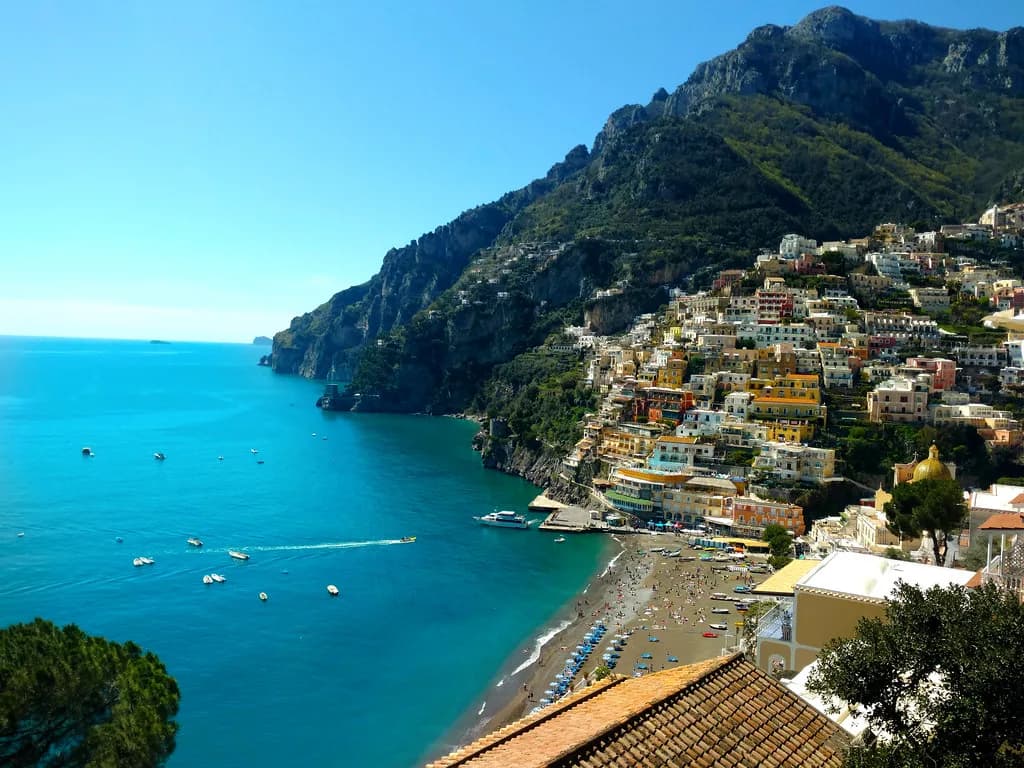
For the classic view, position yourself on the descending walk through the upper town toward Spiaggia Grande. The dome, the stacked pastel houses and the water line up as you drop, and you do not need to buy anything to enjoy it. Higher up, the hills around Nocelle give a bigger and more elevated perspective if you are willing to climb.
A viewpoint called Fotopoint Positano sits on Viale G. Marconi a few minutes west of town, an elevated deck facing back over the town that works well at sunrise and sunset. It is easy to miss, so add it to a map before you set out rather than hoping to stumble across it.
Sunset itself needs no ticket. The beach gives you the town as a foreground, while an upper terrace or a bar with a view gives you the whole bay, and either works if the sky cooperates. A free version of the evening is simply to be somewhere on the walk back up when the light changes, buy nothing, and let the town do the work.
The Path of the Gods on Foot
The Sentiero degli Dei is free to hike, but it is not necessarily free to reach. Most walkers take a bus from Positano to Amalfi and change for Bomerano, then walk the trail toward Nocelle, mostly downhill. Bus tickets are sold in tobacconists and news stands rather than on board, so buy them before you set out.
The main route runs roughly seven kilometres and takes about two hours if you do not stop constantly, which you will. From Nocelle you can take a bus back down or walk the long staircase into Positano, a descent of well over a thousand steps. Good walking shoes, enough water and sun protection are the minimum, because much of the route is exposed.
If you want the free perspective without the full traverse, the upper hillside above Positano and the hamlet of Nocelle give some of the best views in the area. Be honest with yourself about heat, knees and steps before committing to a route, and treat the hike as half a day rather than an hour.
Santa Maria Assunta: A Free Church Stop
The centrepiece of Positano is the church of Santa Maria Assunta, recognisable by its green and yellow majolica dome. It is the town's main landmark and a useful reference point when you are navigating the lanes. Step inside to see the thirteenth-century Byzantine icon of the Black Madonna above the altar, which costs nothing to visit.
A hostel guide to free experiences lists church visiting windows of 9:30 to 12:00 and 16:00 to 20:00, and notes that churches are generally visitable outside Mass. Treat those times as a reported third-party listing rather than an official timetable, and check locally or at the door before building a day around them.
Beneath the church lies a Roman villa buried by the eruption of Vesuvius in 79 AD, with frescoes and mosaics and a depth of around eleven metres. It is a separate ticketed visit rather than part of the church, entered from behind the bell tower with timed slots. Check current prices and availability on site or through the ticket kiosk outside the church.
Free Window-Shopping and Craft Browsing
Positano's shopping is one-dimensional in a good way: sandals, limoncello, ceramics and linen clothing, much of it made by local hands. Looking closely costs nothing, and the ceramic streets are part of the town's identity rather than just retail corridors.
Via dei Mulini, near the main beach, is the street to walk if you want to browse independent stores in sequence. Leather sandals can be made to measure while you wait, and many shops will measure your foot and have a pair ready within an hour or by the next day. Browsing is free; the purchase is the optional part.
Viale Pasitea is another good browsing street, with shops flanked by local artists and vendors. Set yourself a rule before you go in, such as looking only or buying one small item, and the browsing stays an activity rather than an expense.
Where the Paid Upgrades Begin
Beach clubs, boat shuttles, the ticketed Roman villa and the nightclubs are all separate costs, and none of them is required for a good day. If you do want a lounger, expect prices to vary by club, season and row, and ask the operator directly what the day rate includes before committing. Further visitor details appear in Fornillo Beach: Positano's Quieter Alternative | Hostel Brikette | Brikette Guides.
At Fornillo, the lounger clubs run in sequence along the shoreline, with the free zones bookending them. The historic Hotel Pupetto and Da Ferdinando both offer a more casual alternative to the main beach, and their bars are useful even if you stay in the public area. Ask at the bar before using facilities in the free zone.
The municipal website is the place to check for any town-run services or local notices before you rely on them. Details change, and a quick look at the official pages beats acting on an outdated blog post.
Practical Tips for a Free Day
Arrive early for the free beach sections, especially in July and August, because there is no reservation system. Aim to be on the pebbles before mid-morning, and bring water shoes, a mat, sunscreen and a refillable bottle. Bring a light shirt for the walk back up in the afternoon sun.
Buy bus tickets before you board, because drivers generally do not sell them. Tobacconists, news stands and some bars are the usual sellers, and inspectors do check. If you are heading back toward Amalfi or Sorrento in the afternoon, board at an earlier stop than the main one to improve your chances of a seat.
Leave the passport and large amounts of cash at your accommodation, and carry a little cash as backup because card machines can be unreliable. If you rent a lounger, confirm whether showers and parasols are included rather than assumed.
Suggested Free Half-Day and Full-Day Routes
For a free half-day, walk down through the lanes to Spiaggia Grande, look at the dome of Santa Maria Assunta, then follow Via Positanesi d'America to Fornillo and swim in the free section. Finish with a slow climb back up for sunset rather than paying for a view.
For a full free day, start early on the Path of the Gods from Bomerano, descend to Nocelle, and walk the staircase down into Positano. Spend the late afternoon on a public beach and the evening at a viewpoint. If you have no appetite for that much effort, swap the hike for the stairways of the upper town and a longer beach stop.
If you want to weave in more overlooked corners, the hidden gems in Positano guide covers the quieter angles on the same free route. Keep the paid experiences optional rather than central, and the day stays both cheap and genuinely memorable.
Plan Your Free Positano Visit
Positano's free pleasures are not a lesser version of the town; they are the part most people remember. Public beach sections, the Fornillo cliff path, stairway descents, the Path of the Gods and a church visit add up to a full itinerary with almost no spend, provided you accept the effort and the pebbles.
Decide in advance which paid extras you actually want, whether that is a lounger, a boat shuttle or the Roman villa beneath the church, and check current prices and hours at the source rather than trusting an old listing. Then build the rest of the day around walking, swimming and looking, which is what the town does best.
Frequently Asked Questions
Is anything in Positano actually free?
Yes. Public beach sections, scenic stairway walks, the Via Positanesi d'America cliff path, viewpoint stops, church visits and browsing the ceramic and sandal shops can all be done without paying. The trade-off is usually comfort or effort: pebble beaches, steps and no reserved seating.
Are the beaches in Positano free?
Each main beach has a free public area alongside the paid beach clubs. Spiaggia Grande, Fornillo, Arienzo and Laurito all have public sections, and they are first-come, first-served. In high season the free stretches fill early, so arrive before mid-morning.
Can you hike the Path of the Gods for free?
The trail itself is free to walk. Transport to the trailhead, usually a bus via Amalfi to Bomerano, costs money, and you should buy tickets in advance because they are not sold on board. Bring proper shoes, water and sun protection, since much of the route is exposed.
Do you have to pay to visit Santa Maria Assunta?
No, the church is a free stop. A third-party guide lists visiting windows of 9:30 to 12:00 and 16:00 to 20:00 and notes churches are generally visitable outside Mass, but check locally before relying on those times. The Roman villa beneath the church is a separate ticketed visit.
What is the best free viewpoint in Positano?
The descent through the upper town toward Spiaggia Grande delivers the classic view of the dome and stacked houses. For a bigger perspective, the hills around Nocelle reward the climb, and Fotopoint Positano on Viale G. Marconi is a known elevated deck facing back over town.
How do you walk from Spiaggia Grande to Fornillo Beach?
Follow Via Positanesi d'America, the pedestrian path carved into the rock that connects the two beaches. It takes only a few minutes and passes the Torre Trasita tower. Wear closed shoes rather than flip-flops, because the stone surface can be slippery in places.
Is Fornillo Beach free?
Yes, Fornillo has a large free section in front of the shortcut down from the upper town, plus a smaller public cove beyond the last beach club. The rest of the shoreline is managed by beach clubs. Arrive early in summer and bring water shoes for the rocky entry.
Sources
- 25 Things to Do in Positano Like a Local: Where to Eat, Play, and Stay — Travlinmad Slow Travel Blog
- Exactly What To Do In Positano (For First Time Visitors)
- Best 12 Things to Do in Positano, Italy + Travel Guide - SHORT GIRL ON TOUR
- Free and Low-Cost Things to Do in Positano | Hostel Brikette | Brikette Guides
- A Journey through the Amalfi Coast: Positano — eCKsplorer
- Chiesa di Santa Maria Assunta e Cripta Medievale Reviews | Tripexpert
- Fornillo Beach, Positano: 2026 Guide | How to Get There & Prices
- Fornillo Beach: Positano's Quieter Alternative | Hostel Brikette | Brikette Guides
Continue exploring
More guides you'll find useful