Santa Maria Assunta Positano: Visitor Guide to the Church
Plan a visit to Positano's parish church above Spiaggia Grande: the majolica dome, the Black Madonna icon, the separate bell tower and what to verify first.
On this page
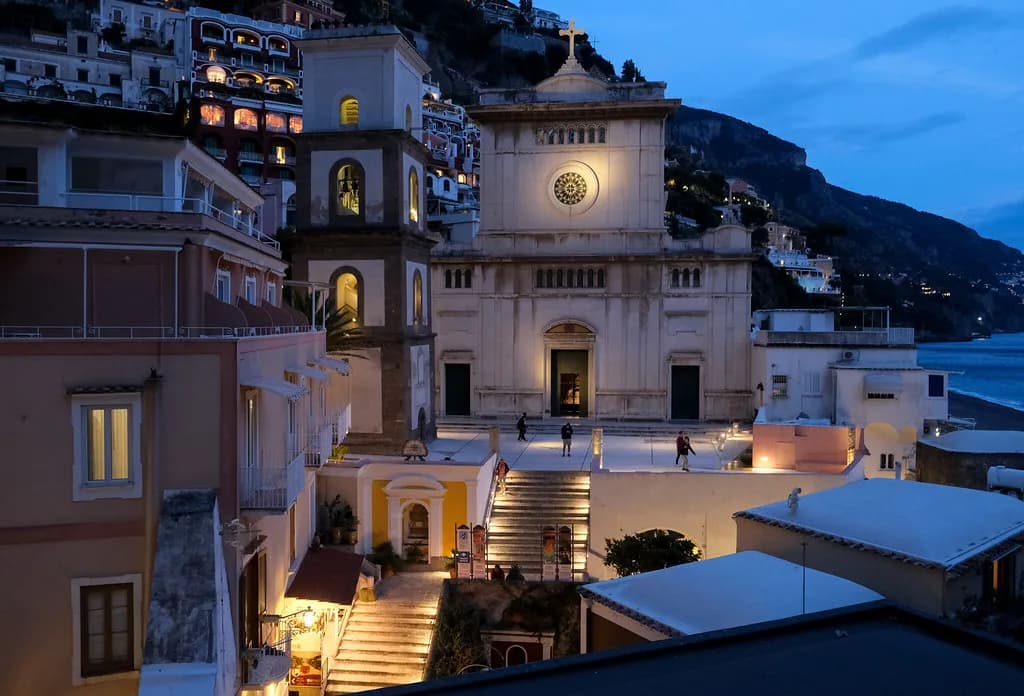
Positano's skyline is a slope of pastel houses, and the one landmark that appears in almost every photograph of it is the tiled dome of Santa Maria Assunta, the town's parish church. It stands just above Spiaggia Grande, so most visitors pass it without planning to. This guide separates what is well documented about the church from the practical questions, such as entry cost, hours and dress, that you have to settle on the spot.
Treat the church as a short, worthwhile stop rather than a half-day attraction. A suggested visit of fifteen to thirty minutes is our own editorial estimate, not an official timing, and it is enough to look at the dome from the piazza, step inside to see the icon above the main altar and use the elevated space outside for a view back over town. A longer visit makes more sense when you combine it with the beach below and the lanes around it.
Where the Church Sits and How to Reach It
The church occupies the raised ground directly behind Spiaggia Grande, Positano's main beach, which is where ferries and boat tours dismount passengers arriving by sea. From the pedestrian centre, the walk down to the beach and up to the church door is a matter of minutes on foot, though the final approach involves steps. Guests staying at Palazzo Murat, for example, are described as four minutes' walk from the beach along the town's main pedestrian precinct.
Arriving on foot from the upper town means descending, and every descent has to be repaid later. If you are coming down from a bus stop on the Amalfi road, allow more time than a map suggests and wear shoes that grip stone steps. Travellers who reached Positano by bus describe the walk down into the centre from the Sponda stop as a scenic introduction to the town, with the climb back up being the tiring part.
Because the church is embedded in the pedestrian core, it fits naturally into a walking loop of lanes, stairways and viewpoints rather than needing its own excursion. A self-guided walk through the town can start or finish here, with the church as the fixed point in a route that otherwise wanders.
The Majolica Dome: Positano's Most Photographed Roof
The dome is covered in green-and-yellow majolica tiles and topped by a small cupola, a combination that makes it visible from much of the town above and from the water below. Travel guides consistently single it out as the town's defining image, with one source noting the coloured dome is visible from just about anywhere in Positano. View it from the piazza in front of the church, from the beach, or from a ferry approaching the port.
The tiled dome belongs to a broader local style, since churches elsewhere on this stretch of coast use similar yellow and green tile work. That context is worth knowing if you plan to visit more than one town: the dome is not an oddity but part of an Amalfi Coast vernacular. The other durable image associated with the church is its separate bell tower, which stands apart from the main building.
Inside: The Black Madonna and Child
Above the main altar hangs a 13th-century Byzantine icon of the Black Madonna and Child, the object that gives the church its religious weight. The image is the reason to step inside rather than simply photograph the exterior. Light and crowds vary through the day, so if the icon is your priority, go when you arrive rather than promising yourself a return later.
The icon carries a story worth telling carefully: tradition holds that it was stolen from Constantinople by pirates and smuggled west, which is how many versions of the tale explain its arrival on this coast. Treat that as legend attached to the object rather than documented history. It is also said to have been carried ashore by fishermen, a variant you may hear locally, so listen to the version you are given without assuming it is settled fact.
The building itself has a longer, uneven history. Sources describe a church abandoned at some point in the 15th century because of pirate raids, with a restoration beginning in 1777 that shaped the interior visitors see now. Those dates explain why the church reads as an eighteenth-century interior wrapped around a much older icon.
The Bell Tower and the View Outside
An eighteenth-century bell tower stands separately in the piazza in front of the church, and that separation is part of what makes the square such a good place to linger. The open space outside the church also works as a raised platform, giving sweeping views back over the stacked houses and the sea. It is one of the few flat, open spots in a town built almost entirely of slopes.
If you are in Positano at a weekend, you may find a wedding occupying the church, since it is a popular place for vows in southern Italy. That is a reason to check the doors before planning your stop rather than a reason to skip the square, which stays open and remains the best free viewpoint in the centre.
What You Cannot Confirm Before You Go
No reliable source establishes the church's opening hours, whether entry is free, or whether any part of the interior or an underground space carries a charge. Guidelines for modest dress, such as covered shoulders, are also not confirmed in the material available. Plan around that uncertainty: check the notice on the door or ask at the parish when you arrive, and carry a light layer in case you are asked to cover up.
A crypt is associated with the church in some listings, and a Roman villa was reportedly found during restoration work on the square and crypt, but its current condition and whether it can be visited are not confirmed. Do not build a day around seeing either. Ask locally what is open that week instead of relying on older descriptions.
Ignore any claim that this is Positano's only sight. It is the most prominent one, but the beaches, the coastal paths and the lanes above the centre are genuine reasons to be here. Skipping them to tick off a single church would misrepresent the town.
Pairing the Church With the Beach and the Coast Path
Spiaggia Grande sits immediately below the church, and it is worth knowing how it works before you commit a day to it. The beach has a small free public section, while most of the sand is occupied by beach clubs whose sunbeds and umbrellas are rented, with prices set by each operator and changing by season and row. If you want the free option, arrive early, because it fills quickly in the peak months.
A better pairing for many visitors is the short walk west to Fornillo, reached from Spiaggia Grande along Via Positanesi d'America, a pedestrian path cut into the rock that takes roughly five to seven minutes and passes the Torre Trasita watchtower. Fornillo is quieter, has its own free area at the eastern end and faces west for sunsets. Wear closed shoes, since the path surface can be slippery in places.
Boat trips leave from the port beside the beach, with private excursions offered along the coast to Amalfi, Li Galli and Capri, and some itineraries include a stop at the Emerald Grotto for an extra fee paid on site. Sea conditions decide whether the grotto can be entered at all, so treat it as an optional extra rather than a certainty.
Timing Your Visit Around Crowds and Heat
Positano receives a very heavy flow of day visitors arriving by ferry and cruise excursion, and the area around the port and main beach is busiest in the middle of the day. Early morning is the calmest window for the piazza, the church steps and photographs of the dome without a press of people. Late afternoon brings the beach crowds back for sunset, so the square stays lively into the evening.
Summer heat and the town's staircases are the other constraint. Carry water and plan the uphill legs for cooler parts of the day rather than treating the climb back from the beach as an afterthought. If you are visiting in July or August, expect queues on boats and packed buses, and build slack into any plan that depends on a fixed departure.
Bus tickets on the Amalfi Coast are bought in advance at tobacco shops and newsstands rather than from the driver, so pick one up when you arrive in town if you plan to leave by bus. That small bit of preparation matters more than any fixed itinerary in a place where services fill up fast.
Plan Your Visit
Santa Maria Assunta is easy to see and hard to see well if you rush it. Give the exterior a few minutes from the piazza, step inside for the Black Madonna icon, and confirm hours, any charges and dress expectations at the door rather than assuming them. That approach costs nothing and avoids a wasted climb.
Then let the church anchor a wider half day: the beach below, the path to Fornillo and a wander through the lanes above. If you want more free options in town, or ideas for overlooked corners, our guides to Free things to do and hidden gems in Positano carry the planning further.
Frequently Asked Questions
Is entry to the Chiesa di Santa Maria Assunta free?
Sources consulted do not confirm whether entry is free, and no reliable figure for any charge is published. Ask at the church door or check the parish notice when you arrive rather than planning around an assumed price.
What are the opening hours of the church in Positano?
No reliable opening schedule is published in the sources available, so hours cannot be stated in advance. Check the notice on the door, ask locally, or look for the parish's own information when you are in town.
Do you need to dress modestly to visit the church?
A dress rule such as covered shoulders is not confirmed in the material available. Carry a light layer anyway, since many Italian churches ask visitors to cover up, and follow whatever notice is displayed at the entrance on the day.
What is the Black Madonna of Positano and where did it come from?
A 13th-century Byzantine icon of the Black Madonna and Child hangs above the main altar. Tradition says it was stolen from Constantinople by pirates and brought west, but that is legend attached to the object rather than documented history.
How long does a visit to Santa Maria Assunta take?
Our suggested visit is fifteen to thirty minutes for the dome, the bell tower, the icon and the view from the square outside. This is an editorial estimate, not an official timing. Allow longer if you combine it with the beach and the walk to Fornillo, and note that a wedding may limit access at weekends.
Where exactly is the church in Positano?
It sits just above Spiaggia Grande, the main beach, in the pedestrian heart of town. It is a short walk, with steps, from the beach and the port where ferries arrive.
Is there a crypt or paid interior at the church?
A crypt is mentioned in some listings, and a Roman villa was reportedly found during restoration work, but neither is confirmed as open to visitors. Ask locally what is currently accessible instead of relying on older accounts.
Is the church the only sight in Positano?
No. The church is the town's best-known landmark, but the beaches, the coastal paths and the lanes above the centre are substantial attractions in their own right and belong in the same visit.
Sources
- A practice guide about what to do and see in Positano | Amalfi Coast - Praiano Online
- Stay in the Heart of Positano | Palazzo Murat
- A Journey through the Amalfi Coast: Positano — eCKsplorer
- Chiesa di Santa Maria Assunta e Cripta Medievale Reviews | Tripexpert
- The Best Beaches in Positano Italy (and Beach Clubs) - UPDATED 2026 — ckanani
- Fornillo Beach, Positano: 2026 Guide | How to Get There & Prices
Continue exploring
More guides you'll find useful