Padua Photography Spots: Iconic Vistas and Quiet Corners
Plan a Padua photo walk with composition tips for Prato della Valle, Santa Giustina, Palazzo Bo and the Scrovegni Chapel, plus booking and timing advice.
On this page
Padua packs an unusual amount of photographic variety into a walkable historic centre: a vast civic square, a brick basilica crowned with Byzantine-style domes, frescoed university halls and a small chapel whose interior changed the course of European painting. The catch is that the most rewarding interiors come with conditions attached, whether a guided-tour slot, a timed entry or a midday closure. This guide separates what you can photograph freely from what needs planning, and suggests how to frame each stop. For wider planning, see Padua Historic Center Self-Guided Walk.
One concrete starting point: the Abbey of Santa Giustina beside Prato della Valle is described as free to enter for individual visitors, which makes it the easiest grand interior to add to a photo walk. Everything else in this guide should be treated as a scheduling decision rather than a spontaneous detour. Pair these spots with the wider set of hidden gems in Padua if you want to stretch the route beyond the obvious monuments.
Why Padua Rewards a Slower Photo Walk
Padua is compact enough that you can move between a monumental square, a working Benedictine monastery and a university courtyard without long transfers, which suits photographers who prefer to revisit a spot in different light rather than race between sights. The architecture also varies sharply in texture: unfinished brick, pale Vicenza stone, stucco, and dense fresco cycles that need close, patient framing. Because several interiors are ticketed or guided, the practical skill here is sequencing rather than speed.
Treat the city as two overlapping subjects. Outdoors you have Prato della Valle and the basilica exteriors, which reward wide lenses and early starts. Indoors you have fresco cycles and carved choirs where light is dim, crowds are managed, and your time may be limited by a tour or a slot. Sorting your shot list by that split prevents the common disappointment of arriving at a locked door with a camera bag full of plans.
For a broader inventory of what the city offers before you commit to a route, browse the Padua Attractions hub and shortlist the sites whose access rules you can live with. If you only have an afternoon, the Padua Historic Center Self-Guided Walk: 2-Hour Route keeps the geography tight and leaves room for one interior.
Prato della Valle and Santa Giustina: Framing the Domes
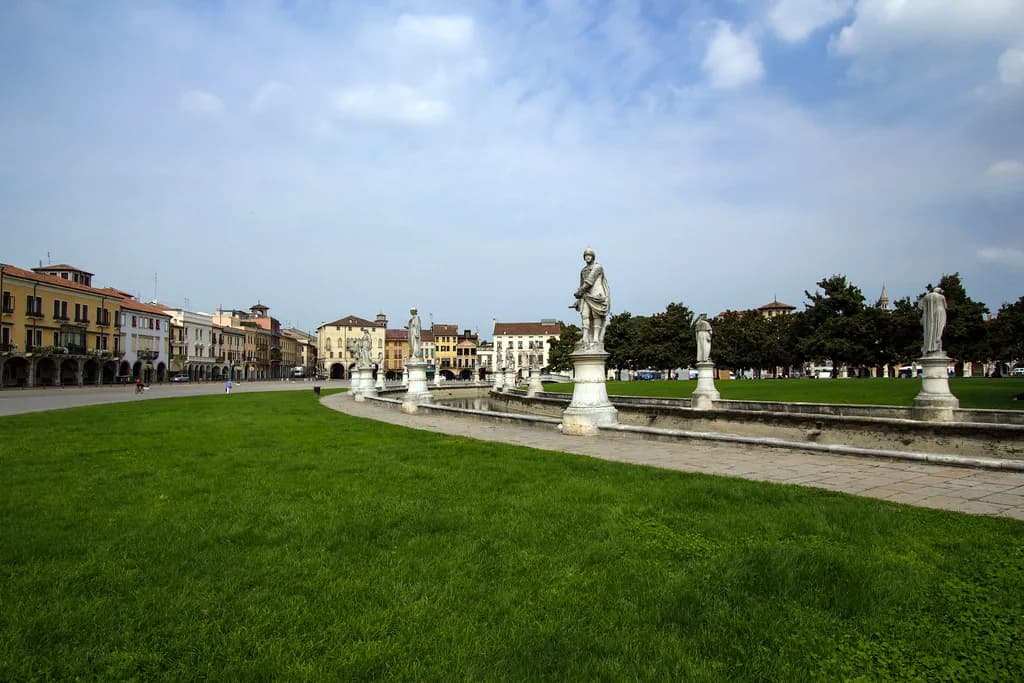
Prato della Valle is one of Europe's largest public squares, a green island ringed by a water channel, statues and four bridges, with the abbey sitting at its edge. That scale is the compositional problem: from ground level a wide lens flattens the statue ring into a thin band. Look for elevated viewpoints or use the canal edge as a leading line toward the domes, and shoot across the water rather than into it so the statues read as silhouettes.
The Abbey of Santa Giustina presents one of Padua's most distinctive facades: an unfinished brick front, eight domes in a Byzantine-influenced arrangement, and a slender bell tower. A travel account describes it as noticeably calmer than the Basilica of Saint Anthony, which is useful if you want a facade shot without a pilgrim crowd in the foreground. Frame the tower against sky from the square rather than standing directly beneath it, and use the brick texture as the dominant tone.
The basilica is also long: the present sixteenth-century building measures 122 metres, with a Latin-cross plan, a central nave and two side aisles, according to the city's tourism board. That length means a single frame rarely captures the interior's scale, so plan a few deliberate shots instead of one sweeping one. The fifteenth-century carved wooden choir in the apse and Veronese's Martyrdom of St. Giustina altarpiece of 1575 are the interior anchors to look for.
Entry to the abbey is free for individual visitors, though the tourism board notes that the fourteenth-century Chapel of St. Luke, the wooden choir and the Antesacristy require an authorised guide. Verify current opening times on the abbey's own site before you build a morning around it, since published hours change seasonally. For more corners like this, the hidden gems in Padua guide covers comparable stops.
Interior Light at Santa Giustina and the Midday Break
Church interiors in Italy typically close around midday and reopen in the afternoon, and Santa Giustina follows that pattern: a visitor account lists morning and late-afternoon windows with a long break in between, while the tourism board simply gives daily morning and afternoon hours. Either way, the closed hours fall in the harshest outdoor light, which is exactly when you would want to be inside a nave. Confirm the day's times locally rather than relying on any printed schedule.
Inside, expect dim ambient light and high contrast between windows and shadowed aisles. That combination punishes hand-held wide shots of the nave but suits detail work on the altarpiece and carved wood if you can stabilise the camera. Check on site whether photography and tripods are permitted, and stay out of active liturgical areas; the abbey remains a working Benedictine monastery rather than a museum.
A workable sequence is to photograph the exterior and Prato della Valle in the morning, use the closure window for a coffee and a look at nearby streets, then return when the doors reopen for interior shots. The evening version of this city, covered in Padua at Night: Evening Activities and Dining, is worth considering if you want lit facades rather than daylight.
Palazzo Bo: Courtyards and the Anatomical Theatre
Palazzo Bo, the historic seat of the University of Padua, is visitable as a guided tour rather than as a free-flowing building, according to the city's tourism board. That single rule reshapes your shot list: the sixteenth-century Cortile Antico with its double colonnade and family crests, the Aula Magna, and the first permanent Anatomical Theatre of 1595 are all interior subjects you photograph within a group's pace. Expect to shoot at whatever angle the route allows rather than composing at leisure.
The university confirms that guided tours of Palazzo Bo cover the Cortile Antico, the Aula Magna and the Anatomical Theater, and it also sells a combined ticket called Padua City of Science that bundles two or three university cultural sites including the Botanical Garden and the Museum of Nature and Humankind. Ticket tiers have been published for Palazzo Bo, but treat any figure you see as source-reported and subject to change, and check the university's own visit page before booking.
For photographers, the practical trade-off is fixed: tour-only access gives you guaranteed entry and context but no control over timing or crowds. Book a slot earlier in the day if you want any chance of softer exterior light before or after, and keep your kit minimal so you are not changing lenses in a crowded historic interior. The university's visiting page is the place to confirm tour availability.
The city's own page on Palazzo Bo and Anatomical Theatre outlines the building's history, including its growth under architect Andrea Moroni in the second half of the sixteenth century. Read it before you go so you know which courtyard details matter, rather than discovering them afterwards in someone else's photographs.
Loggia and Odeo Cornaro: Fresco Detail, Outdoor Cameras
The Loggia and Odeo Cornaro are the surviving fragment of a larger complex built for the patron Alvise Cornaro, with the Loggia designed in 1524 as a fixed theatrical backdrop and the Odeo added for music and intellectual gatherings. Inside, frescoes alternate with stucco work, and the Odeo's octagonal room carries grotesque vault decoration described as the first example of the motif in Padua. This is detail photography rather than vista photography: tight frames of stucco figures, grotesques and the illusionistic Roman-style wall decoration. For wider planning, see Hidden Gems in Padua.
One reported constraint matters more than any composition tip. A visitor account states that photography is permitted only outside the complex, so the interiors are for looking rather than shooting; treat this as reported rather than guaranteed and confirm the rule at the ticket desk before you raise a camera. If it holds, your exterior frames of the arches and Vicenza stone facade become the record of the visit.
The city's tourism board publishes seasonal opening patterns for the complex, with different afternoon closing times across the warmer and cooler halves of the year and closures on non-holiday Mondays plus certain public holidays. It also lists full, reduced and free admission tiers, which should be verified rather than budgeted from a secondary page. Because the visit is short and capacity is small, arriving at the start of an opening window is the more reliable approach.
A blogger's account of visiting notes an entrance on a half-hourly rhythm, a leaflet in Italian and English, and several steps that make the complex awkward for anyone with mobility impairments. Those details are worth knowing before you plan a photo stop with a heavy bag.
Scrovegni Chapel: A Short, Timed Visit
The Scrovegni Chapel is the one Padua stop where spontaneity is the wrong strategy. Entry is regulated and the number of visitors per time slot is limited, so booking ahead is the practical route, especially in high season, according to a ticketing guide. That guide also describes the visit as lasting roughly thirty minutes, a source-reported figure rather than an official one, but a useful planning assumption: you will not have long with Giotto's fresco cycle.
Because the window is short, decide your priorities before entering. The chapel is a single nave measuring about 20.5 by 8.5 metres and some 18.5 metres high, with a barrel-vaulted ceiling, so the Last Judgment on the counter-facade and the narrative panels along the walls compete for the same limited time. Consider looking first without photographing, then returning to the details that matter; check current rules on photography inside before relying on any camera plan.
Prices, pass inclusion and skip-the-line options should be checked with the official ticket service rather than assumed from third-party pages, since those details change and may be presented differently by resellers. The guide notes that the chapel may appear in some Padua tourist passes but that the specific terms must be verified. Build your booking around the confirmed slot, not around a hoped-for walk-up.
A Suggested Half-Day Photo Route
This route is a suggestion, not an official itinerary. Start at Prato della Valle early, when the square is at its emptiest, and work the statue ring and canal edge before the light hardens. Move to the Abbey of Santa Giustina for the facade and domes, then go inside when the doors open, keeping an eye on the midday closure. That gives you one strong exterior set and one interior set within a short walk.
From there, walk into the centre for the Loggia and Odeo Cornaro, timing your arrival to an opening window and accepting that your photographs may be exterior-only. If your day allows a booked slot, place the Scrovegni Chapel at a fixed time and treat everything else as flexible around it, since a missed timed entry cannot be recovered. Finish with an evening pass through the square if you want a second, softer set of facades.
The best time of year for this walk depends on heat and crowds rather than on any fixed rule; if you are weighing seasons, Best Time to Visit Padua: Avoiding Crowds sets out the trade-offs. And if you want to extend beyond the city, Day Trips from Padua: Nearby Excursions covers options that do not require rebuilding your base.
Light, Crowds and Composition Craft
Padua's photographic signature is texture contrast: the unfinished brick of Santa Giustina against pale stone, stucco relief against painted fresco, and the long horizontal of Prato della Valle against vertical bell towers and domes. Build each frame around one dominant texture and let the other recede. Symmetry works best on the domes and the square's radial bridges; corridors and colonnades, such as the Cortile Antico or the Corridor of the Martyrs, reward a low, centred perspective that pulls the eye through.
Crowd management is mostly a matter of ordering your day rather than finding empty rooms. Outdoor squares are quietest at the edges of the day, while the interiors are governed by opening times, tour schedules and timed slots that you cannot negotiate. Accept that some frames will include people, and use them: a silhouetted figure on the bridge at Prato della Valle gives the square the scale it otherwise lacks.
The Basilica of Sant'Antonio is the city's busiest religious site as the burial place of St Anthony, so if you want its Romanesque-Gothic brick exterior without a crowd, treat it as an early or late stop rather than a midday one.
Practical Checklist Before You Carry a Camera
Verify hours directly with each site in the days before you travel, because the seasonal patterns published for the Cornaro complex and the abbey differ and secondary pages drift out of date. Confirm three things per stop: whether the doors are open that day, whether access requires a guide or a timed slot, and what the photography rule is inside. The city's official portal is a reasonable starting point for civic information and links onward.
Dress for church interiors: shoulders and knees covered is the usual expectation in Italian churches, and Santa Giustina is an active monastery rather than a monument. Carry a small bag, keep your kit quiet during services, and be ready to step out if a liturgy begins. If you plan to shoot the fresco interiors at the Cornaro complex, accept in advance that the camera may stay in the bag and that the visit is for looking.
Finally, separate free from paid in your budget and your expectations. Santa Giustina is described as free for individual visitors, while Palazzo Bo is tour-based and the Scrovegni Chapel is timed and ticketed. Do not assume one ticket or one pass covers a whole complex, and check any claim about inclusion with the operator rather than a reseller page.
Plan Your Photo Walk
Padua rewards photographers who plan around access rather than around a list of landmarks. Lock in any timed or guided interior first, then build the free exteriors and squares around those fixed points. That way the midday closure becomes a pause rather than a lost morning.
Take the time to confirm hours, photography rules and booking requirements close to your visit, and keep a second option for each slot in case a door is closed. For the wider context around these stops, start from the Padua Attractions hub and build outward.
Frequently Asked Questions
Is entry to the Abbey of Santa Giustina free?
The city's tourism board lists entry as free, and a visitor account likewise describes it as free for individual travellers with no ticket needed. Certain areas, including the Chapel of St. Luke, the wooden choir and the Antesacristy, require an authorised guide. Confirm current hours and any access conditions with the abbey directly before you go.
Can you take photos inside the Loggia and Odeo Cornaro?
A visitor account reports that photography is permitted only outside the complex, so the frescoed interiors are for viewing rather than shooting. Treat that as reported rather than guaranteed, and ask at the ticket desk before using a camera. The exterior arches and stone facade remain available for photographs.
Do you need to book Scrovegni Chapel tickets in advance?
Advance booking is the practical route because entry is regulated and the number of visitors per time slot is limited, which makes same-day walk-ups unreliable especially in high season. Book through the official ticket service, check what the ticket includes, and confirm the entry point and any photography rules before your slot.
Can you visit Palazzo Bo without a guided tour?
The city's tourism board describes Palazzo Bo as visitable as part of a guided tour, and the university runs those tours through its own booking channel. That means interior photographs of the Cortile Antico, Aula Magna and Anatomical Theatre depend on tour timing rather than on independent wandering. Check the university's visiting page for current tour arrangements and combined ticket options.
What time of day is best for photographing Prato della Valle?
Early morning is generally the most comfortable window for a large open square, since light is softer and foot traffic is lighter, with a second chance towards evening. There is no official best time, so check sunrise and sunset for your visit date and confirm that the abbey's doors will be open when you plan to move inside.
Sources
- Abbazia Benedettina of Santa Giustina
- Tickets for the Scrovegni Chapel: Which One to Choose and How to Book
- Basilica di Sant’Antonio | Padua, Italy | Attractions - Lonely Planet
- Visiting the University | Università di Padova
- Palazzo Bo and Anatomical Theatre
- Loggia and Odeo Cornaro in Padua - My Corner of Italy
- Official event website
Continue exploring
More guides you'll find useful