
Olbia One Day Itinerary: Old Town, Port and Museum
Plan one day in Olbia with a walkable route through the old town, San Simplicio, San Paolo and the port-side archaeology museum, plus realistic timing tips.
On this page
Olbia rewards travellers who treat it as more than a ferry queue. The city packs a Romanesque basilica, a majolica-domed parish church, a pedestrian high street and a harbour museum of ancient shipwrecks into a compact centre that sits minutes from both the airport and the ferry port.
The plan below is a suggestion, not an official route. It runs roughly north to south, from the Basilica di San Simplicio down to Piazza Regina Margherita, then out to the waterfront, so you finish near the port rather than doubling back.
At a Glance: How the Day Fits Together
Count on a walking day. The historic core is compact and largely pedestrian, and the archaeology museum sits on Peddone island, reachable on foot from the waterfront. Save driving for the beach version of the afternoon.
Check opening days before you commit, because one-day trips collapse when a paid site is shut. The regional culture portal SardegnaCultura lists the Civitatense museum complex as open Monday to Saturday from 10:00 to 17:00 but states that current ticket information is unavailable and advises contacting the property on +39 0789 396241 in advance. Treat that window as a lead to confirm, not a guarantee.
Decide before lunch whether your afternoon belongs to the museum or to the sea. Both are rewarding, and trying to fit in both usually means rushing the centre and arriving at the beach when the light is already going.
Morning Stop One: Basilica di San Simplicio
Start at the Basilica di San Simplicio on Piazza San Simplicio, the granite Romanesque church that anchors the northern edge of the centre. It was built over the grave of the Olbia martyr Simplicio and became the cathedral of the ancient Diocese of Civita; excavations beneath it also revealed a temple to Ceres and numerous burials.
Separate the church from the museum. The basilica is an active place of worship, so interiors may be free to enter but can close during services; the Civitatense museum connected to the complex is a paid visit. Read the notices at the door rather than assuming a fixed timetable.
Allow about forty minutes here if you want to read the plaques and walk the perimeter. If the museum is closed on the day you visit, the church exterior and the surrounding lanes still justify the walk north.
Morning Stop Two: Corso Umberto to Piazza Regina Margherita
Head south from the basilica and let the lanes funnel you toward Corso Umberto, the main pedestrian street. Much of the centre was rebuilt after World War II bombing, so the appeal is in the mix of Liberty-style facades, granite townhouses and small squares where people stop for coffee.
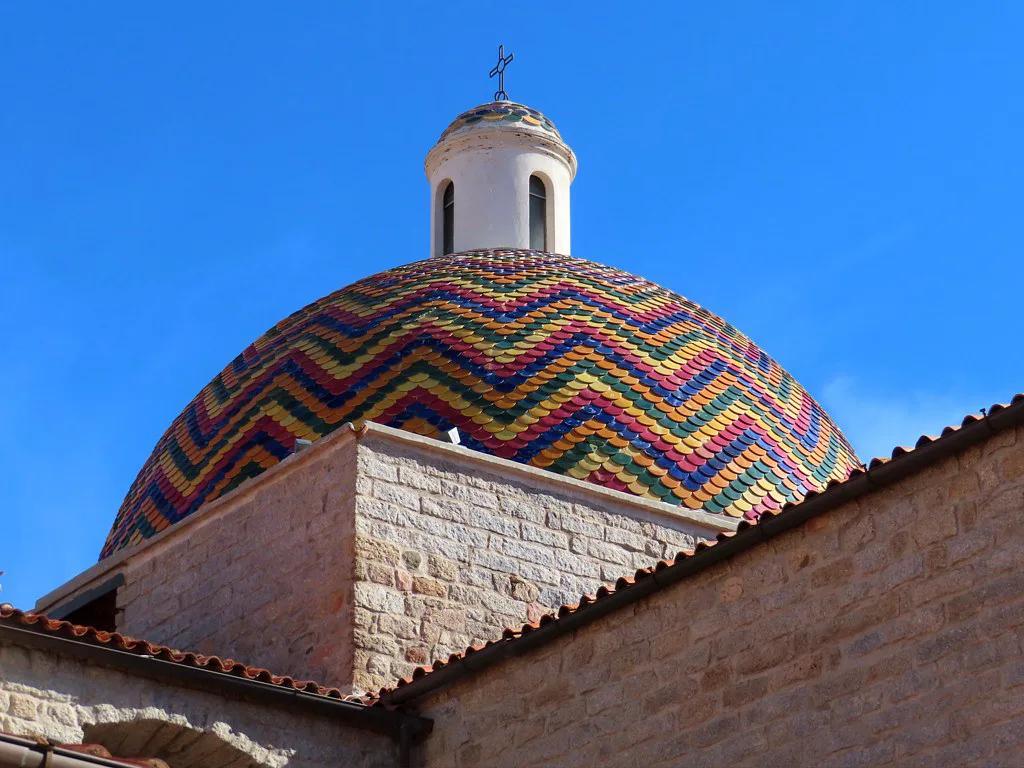
The visual highlight is the Chiesa di San Paolo Apostolo on Piazza Civita, whose dome is clad in polychrome majolica tiles in greens, yellows and blues. The building reflects 18th-century reconstruction over older medieval fabric, and the present dome is a 20th-century addition.
Finish the loop at Piazza Regina Margherita, locally also called Piazza del Popolo, at the southern end of Corso Umberto. This is the social heart of the old town, lined with cafes, bars and restaurants, and a sensible place to pause before deciding on lunch.
Lunch: The One-Block Rule
Menus on and immediately around Corso Umberto and the main squares tend to run higher than a street or two back. Walking one block off the pedestrian spine is the simplest way to trade a little atmosphere for better value and fewer crowds.
Sunday is the day that catches people out. Several shops and some restaurants close or shorten hours, so if your visit falls on a Sunday, pick a place you have seen open earlier in the day rather than saving a specific address for a late lunch.
Sardinian staples worth looking for include suppa cuata, the layered bread and pecorino bake, and bottarga di muggine grated over pasta. Both are widely available in Olbia and give a heavier, more local lunch than a beach-side panino.
Afternoon Option A: Museo Archeologico and the Roman Wrecks
If you choose the museum, walk from Piazza Regina Margherita down to the waterfront and cross to Peddone island. The Museo Archeologico di Olbia occupies a modern building on the islet and traces the city from the Nuragic period through Phoenician, Punic, Roman and medieval phases.
Its centrepiece is the collection of Roman shipwrecks recovered from the harbour, displayed after extensive conservation work and paired with amphorae, coins and pottery that explain how the port functioned in the imperial era. Researchers link one phase of destruction to the Vandal attack of 456 AD.
Allow roughly an hour. Confirm the day's hours and the entry fee at the door or by phone before you build your afternoon around it, since published opening information for Olbia's civic sites changes and the regional portal does not list a current ticket price.
Afternoon Option B: Parco Fausto Noce or Pittulongu
The green alternative is Parco Fausto Noce, roughly 18 hectares of olive trees, Mediterranean scrub, a pond with fountains, playgrounds and outdoor fitness equipment inside the city. Entry is free, and one local guide describes summer hours stretching to 22:00 and winter closing around 21:00, but seasonal schedules vary, so check the Comune's updates before a late visit.
For sand, Pittulongu is the closest beach to the city, a long free stretch with bars and restaurants, free parking and a handful of equipped lidos. It is practical for a short swim, but only if you have a car or are willing to use local transport, and you should verify the current service rather than assuming a schedule.
Whichever you pick, give it a hard finish. Aim to be back in the centre by early evening, because the waterfront is at its best as the light softens and the ferry traffic starts to move.
Port-Side Finish and Evening Passeggiata
Walk the seafront promenade past the ferry terminals, where ships bound for the Italian mainland come and go. It is an unfussy working port rather than a resort marina, and that is exactly what makes it a pleasant contrast to the polished squares inland.
End on Corso Umberto or Piazza Regina Margherita as the passeggiata gathers, roughly between 18:00 and 22:00 according to one walking guide, when families, couples and groups of friends fill the pedestrian streets. Join in with an aperitivo or a glass of Vermentino and let the day close slowly.
Logistics: Walking, Driving and Heat
Everything in this plan except the beach is walkable, and the distances between the basilica, Corso Umberto and the waterfront are short enough that most travellers never need a bus. Comfortable shoes matter more than transport on cobbled, uneven lanes.
If you have a car, park on the perimeter and walk in. One third-party guide refers to a pedestrian zone that starts in the evening and to paid underground parking near Piazza Matteotti, but rates and restricted-traffic hours change, so read the signs on arrival rather than relying on any published figure.
From June to September, temperatures regularly push above 30 degrees. Shift the walking stretch to early morning and late afternoon and keep the middle of the day for the museum or a long lunch, so heat does not flatten the itinerary.
What to Skip on a Single-Day Stay
Costa Smeralda and La Maddalena are attractive extensions, but neither belongs in a one-day Olbia plan. Reaching Porto Cervo takes a drive of around half an hour or more, and La Maddalena requires a ferry from Palau, which alone eats the best part of a half-day.
The same applies to outlying archaeology such as the Sa Testa sacred well, the Giants' Tomb of Su Monte 'e s'Abe and Pedres Castle. They are worthwhile, but they need a car and a separate half-day, better folded into a longer stay than squeezed into an afternoon.
Extend the Trip if You Have Two Days
Olbia works well as a single-day stop, and it works even better if you can give it a second. Use day one for the centre, the basilica and the harbour museum, and keep day two for the outlying archaeology or a proper beach excursion toward Tavolara and the surrounding coast.
Wherever you finish, verify the paid sites before you go. The regional culture portal and the Comune's website are the most reliable places to check for current opening days and ticket arrangements, and a quick phone call to the Civitatense museum settles most doubts. For related planning, see Museo Archeologico di Olbia Guide: Roman Ships & Harbor History.
Frequently Asked Questions
Is one day in Olbia enough?
For the historic centre, yes. A single day comfortably covers the Basilica di San Simplicio, the Corso Umberto walk, the Chiesa di San Paolo and either the archaeology museum or one nearby beach. You would need a second day for outlying sites such as Sa Testa and Pedres Castle, or for a Costa Smeralda excursion.
Can you see Olbia on foot without a car?
The old town and waterfront are compact and largely pedestrian, so the basilica, Corso Umberto, Piazza Regina Margherita, San Paolo and the Peddone museum are all reachable on foot. A beach such as Pittulongu needs transport, and you should check the current local service rather than assuming a timetable.
Is the archaeological museum worth an afternoon?
It is the standout indoor stop in Olbia, chiefly for the conserved Roman shipwrecks found in the harbour and the collection of amphorae, coins and pottery that explains the ancient port. Allow around an hour, and confirm opening days and the entry fee before you plan your afternoon around it.
What is open on a Sunday in Olbia's old town?
Expect variations. Some shops and restaurants close or shorten hours on Sunday, and the Civitatense museum publishes a Monday-to-Saturday window, so it is usually closed on Sundays. Check each site's own notice before you set out, especially if a paid museum is your priority.
Should you stay in Olbia or on the Costa Smeralda?
Olbia is a year-round city with restaurants, bars and ordinary services that stay open outside summer, and it is the more practical base for a short trip. The Costa Smeralda is geared to resort holidays and is far quieter out of season, which suits some travellers but limits flexibility.
Sources
Continue exploring
More guides you'll find useful





