
Olbia Self-Guided Walk: Old Town Route, Timing and Rain Plan
Plan an Olbia self-guided walk linking San Simplicio, the Punic walls, Corso Umberto and San Paolo hill, with a suggested duration and a rainy-day alternative.
On this page
Most travellers treat Olbia as a runway and a rental-car desk, then drive straight toward the beaches of the northeast coast. The historic centre rewards the opposite instinct: park the bags, put on flat shoes and spend a few hours moving between granite churches, Carthaginian ramparts and a pedestrian main street that fills up after dark.
One independent host's guide to the old town proposes a self-guided loop of roughly 2.5 km that takes about three to four hours at a relaxed pace, including pauses for coffee and plaques. Treat that figure as that host's suggestion rather than an official city itinerary: no municipality-published walking route or trail marking is confirmed, so you are stringing together public streets and squares on your own judgment.
The sequence below runs from north to south, starting at the basilica and finishing near the water, and it can be compressed or stretched without any booking. Opening schedules for the churches and the archaeological museum are seasonal and not fixed here, so confirm locally before you build a day around interiors.
Before You Set Off: What This Route Covers and What It Does Not
This is a city-level orientation walk, not a monument circuit with a single ticket. The streets, the Punic wall fragment and the squares are public space and cost nothing to wander; the archaeological museum is a separate, ticketed interior. Budget your time accordingly rather than expecting one admission to cover everything.
The route stays inside the compact centre, so it suits a half-day before a flight, a cruise call or an afternoon arrival. It does not reach the beaches, the airport or the resorts of the Costa Smeralda, all of which require transport. If you want context on how the centre fits into the wider island, the regional tourism board publishes background on Sardinia's towns and culture.
Carry the assumption that nothing is guaranteed to be open at midday. Italian churches commonly close for a long lunch break, and small museums keep limited days. Plan the outdoor stops for the hours when interiors are shut, and reverse the order if you arrive early enough to catch the basilica first.
Route at a Glance: Three Ways to Walk It
Stop order runs Basilica di San Simplicio, Via Artigianato, Via Garibaldi, the Punic walls near Via Tavolara, the museum on Peddone Island, Chiesa di San Paolo, Corso Umberto and finally Piazza Regina Margherita toward the port side. That is the sequence one host guide describes, walking south and east in a loose loop.
The short version takes about ninety minutes: basilica exterior, the craft and townhouse lanes, the Punic walls and a coffee on Corso Umberto. The full version adds the church of San Paolo and the museum and lands in the three-to-four-hour range the host suggests. The half-day version inserts a proper museum visit and a sit-down lunch, which is the version to choose if you have no flight to catch.
Distances between stops are short and the ground is flat apart from the gentle rise toward San Paolo, so the variation between these plans is mostly about how long you linger. None of the three requires a map app beyond a glance, though downloading an offline map of the centre before leaving your accommodation saves roaming charges.
Stop 1: Basilica di San Simplicio, the Anchor of the Walk
Start at the granite Romanesque basilica dedicated to Saint Simplicius, which the host guide dates to the eleventh and twelfth centuries and describes as Sardinia's most important Romanesque church. Walk the perimeter before going in: the massive stone blocks, the plain facade and the small cross at the apex tell you more about the medieval island than any panel inside.
The interior vaulting is the high point of the skyline in this part of town, so step back across the square for the view before entering. Entry is described as free, but opening hours shift with the season and are not reliable enough to plan around. Treat the exterior as the dependable part of this stop and check the door when you arrive.
If your visit coincides with the saint's feast days in May, expect crowds and processions around the basilica; the same host notes the festival draws thousands. Outside those days the square is usually calm, which makes it a good place to fix your bearings before heading into the lanes.
Stop 2: Via Artigianato and Via Garibaldi, Craft Lanes and Townhouses
Head south from the basilica into Via Artigianato, historically the street of blacksmiths, stonemasons and textile workers. Open doorways still reveal small workshops, so walk slowly and look sideways rather than straight ahead. This is working streetscape, not a staged craft village, and you should not expect demonstrations on demand.
Turn east onto Via Garibaldi, the widest lane in the old town and the clearest place to read the city's building layers. Much of what you see is seventeenth- to nineteenth-century townhouse architecture rather than antique masonry, with carved doors and wrought-iron balconies. Knowing that distinction keeps the walk honest: Olbia's centre is a rebuilt place, not an untouched medieval time capsule.
Stop 3: The Punic Walls, a Fragment Worth Understanding
The Mura Puniche near the junction of Via Tavolara and Via Ulisse date to around 330 BC, when Carthage dominated the western Mediterranean. They are among the oldest structures on the island, and an interpretation panel in Italian and English explains their defensive role around the ancient harbour.
Set expectations before you arrive: this is a partly excavated stretch of rampart with an information board, not a walled complex with gates, audio guides or a visitor centre. The reward is the granite blocks themselves and the realisation that this holiday town was a serious commercial and military port long before Rome mattered. Fifteen minutes is enough unless you read every line of the panel.
Access is free and the fragment sits in the open, so it works at almost any hour and makes a sensible stop when churches are closed. Photograph the panel if the text interests you, since there is no booklet to take away.
Stop 4: Museo Archeologico on Peddone Island, the Indoor Pivot
Cross the short causeway to Peddone Island for the archaeological museum, which the host guide describes as small enough to see in about forty-five minutes and curated with English labels throughout. The star exhibits are the hulls and cargo of Roman merchant ships that sank in the harbour, viewed from raised walkways above the preserved timbers.
This is the one ticketed stop on the route, and admission is charged separately from the free churches and streets. The guide gives hours as Tuesday to Saturday with a morning and late-afternoon session, but schedules of this kind change with the season. Confirm the current opening days and the ticket on arrival in Olbia, or ask at your accommodation, rather than trusting a printed plan.
Because the museum is compact and roofed, it is the natural substitute when rain sets in. It also suits travellers who have already seen enough churches and want one concentrated dose of context before returning to the streets.
Stop 5: Chiesa di San Paolo and the Majolica Dome
Climb south to the church of San Paolo Apostolo, built on the foundations of a Roman temple to Hercules according to the host guide. The polychrome majolica dome was completed in 1939 in a Valencian style, and its tiles are the reason to look up rather than straight at the door.
The interior follows a Latin cross plan with three side chapels, and the square granite bell tower is the medieval survivor of the ensemble. The guide gives free entry, but the posted opening window of roughly nine to five is described as variable. Read the notice on the door and accept that a closed interior is not a failed walk; the dome is the point.
This is the highest and quietest-feeling stretch of the loop, so it is a good place to pause, drink water and decide whether to continue to the waterfront or turn back toward the main street.
Stop 6: Corso Umberto and the Evening Passeggiata
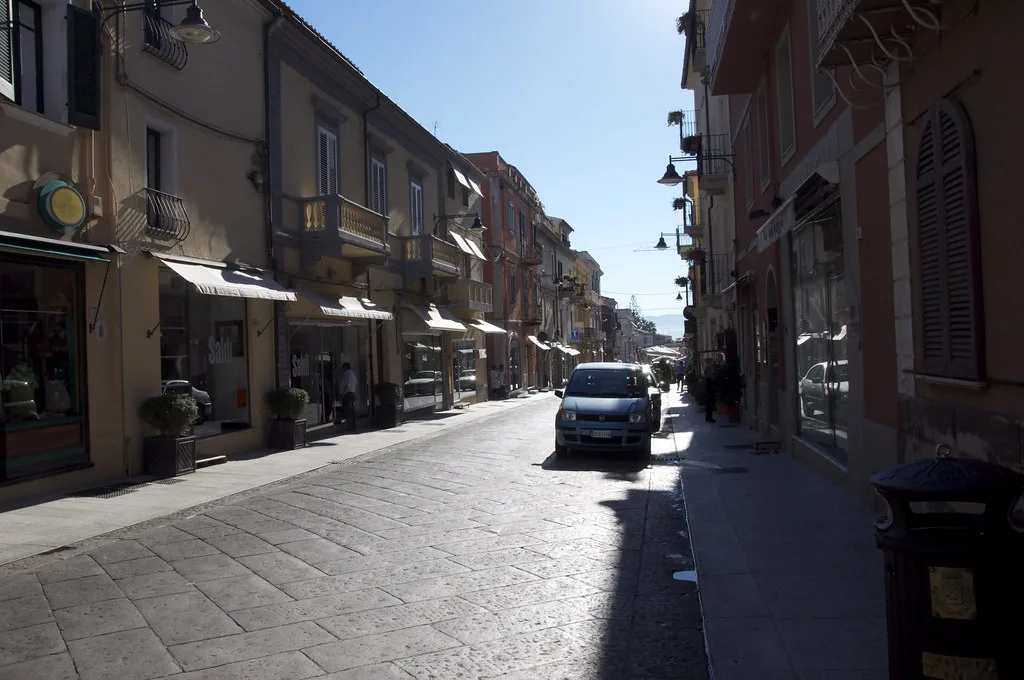
Corso Umberto is Olbia's pedestrian spine and the place where the city's evening ritual happens. The host guide describes families, couples and teenagers promenading from around six until ten in the evening, greeting friends and stopping at cafes and gelaterie. Nothing is staged for visitors; it is simply how the centre is used.
Timing the walk for late afternoon changes the experience entirely. Arrive at the basilica in the morning and you get empty stone and hard light; arrive on the corso at dusk and you get the social version of the same streets. If you only have one window, choose the evening and see the churches from outside.
Shops along the street generally open in two blocks, morning and late afternoon, with some closing entirely on a Monday or Tuesday. Do not schedule your shopping around a fixed assumption; window-shop instead, which costs nothing and shows you more of the city's daily rhythm.
Stop 7: Piazza Regina Margherita and the Port Side
Finish at Piazza Regina Margherita, the sloping main square at the south end of the corso, ringed with cafes and bars and shaded by trees. It is the obvious place to sit down, order a drink and let the walk end without a scramble for the next sight.
On food, one practical rule from the host guide is worth keeping: menus on the square and immediately around it tend to run higher than a block or two away. Walk one street back before committing to a table, and read the posted menu rather than the signs aimed at passers-by. No restaurant is ranked here, and prices should be checked on the menu itself.
From the square it is a short stroll toward the port and the Molo Brin waterfront, where you can watch the ferries and the marina without needing a timetable. This is a wander, not a tour: check directly with the ferry operators if you need sailing information.
Rainy-Weather Alternative: A Compressed Indoor Plan
When it rains, drop the long outdoor loop and build the day around the archaeological museum on Peddone Island plus short dashes between covered points. The basilica, the church of San Paolo and the museum are the three roofed stops; the Punic walls and the corso can wait for a dry hour.
Check museum opening days and the ticket before leaving your accommodation, since a closed door in the rain wastes the whole morning. If the museum is shut, the fallback is a slow cafe stop on Corso Umberto between showers rather than a forced march through wet streets. Arcaded stretches exist in the centre but should not be assumed to run continuously, so carry an umbrella.
Practical Decisions: Shoes, Heat, Water and Breaks
Wear flat shoes with grip. The centre mixes cobblestones, granite paving and slopes, and a two-and-a-half-kilometre walk in sandals is fine until it is not. Carry water, especially from June to September, and plan the outdoor stops for early morning or after five in the afternoon to dodge the worst heat.
Break the walk twice: a coffee mid-morning on the corso and an aperitivo at the end. The host guide notes that a drink with a small plate of olives, cheese and cured meat is a cheaper way to eat before dinner than a full restaurant meal, though you should read the price list on the wall or menu because bar charges vary.
If you have mobility limits, the flat stretch between the corso and the square is the easiest section, while the rise to San Paolo is the one to skip. Detailed accessibility advice for individual churches and the museum is not published in the sources here, so contact the sites directly if step-free access matters.
Mistakes to Avoid on an Olbia Old Town Walk
First mistake: treating the old town as a pre-beach afterthought. The centre is a rebuilt historic core with real depth, and ninety rushed minutes at noon shows you the least attractive version of it. Second mistake: expecting monumental ruins at the Punic walls, which are a preserved fragment rather than a site with facilities.
Third mistake: assuming every church and museum shares one schedule or one ticket. They do not, and the basilica, San Paolo and the archaeological collection should each be checked separately. Fourth mistake: driving between stops. The distances are short enough to walk, and parking in the centre is a distraction rather than a saving.
Finally, avoid building the day around a market unless you have confirmed it. Weekly market days and hours circulate in guides but were not verifiable here, so ask locally or check the city's own notices before making a detour.
Plan Your Visit
An Olbia self-guided walk works best as a flexible few hours rather than a fixed itinerary. Start at San Simplicio, follow the lanes to the Punic walls, use the museum as your indoor anchor, and end on the corso or in Piazza Regina Margherita as the light drops. The roughly 2.5 km, three-to-four-hour figure is a host's suggestion, not an official route, so adjust it to your own pace.
Before you go, confirm the two things that can close a door: museum opening days and church hours. The city website and the museum's own notices are the places to check, and a quick question at your accommodation the night before is often faster than any printed guide.
Frequently Asked Questions
How long does a self-guided walk of Olbia old town take?
One independent host guide suggests about three to four hours at a relaxed pace for a loop of roughly 2.5 km, including pauses. That is a suggestion, not an official figure. A short highlights version covering the basilica exterior, the lanes, the Punic walls and a coffee on Corso Umberto fits into about ninety minutes.
Is the Olbia old town walk free?
The streets, the Punic wall fragment and the squares are public space and cost nothing. Churches are generally free to enter when open, although opening times vary by season. The archaeological museum on Peddone Island is a separately ticketed interior, so check its current admission on arrival.
Can you walk Olbia old town from a cruise ship?
The historic centre is compact and flat over most of the route, which suits a few hours ashore, but the walk from the cruise terminal to the basilica and back has not been measured for this guide. Check the distance with your ship's information desk and keep a buffer before all-aboard time.
Where does the Olbia old town walk start and finish?
The suggested loop starts at the Basilica di San Simplicio in the north of the centre, threads south through Via Artigianato and Via Garibaldi to the Punic walls, continues to the museum and San Paolo, and finishes on Corso Umberto or in Piazza Regina Margherita near the port side.
What should you do in Olbia old town when it rains?
Shift the day around the archaeological museum on Peddone Island, which is roofed and compact, and use short dry spells for the basilica and the church of San Paolo. Confirm the museum's opening days before setting out, since a closed door in wet weather wastes the morning.
Is the Olbia archaeological museum worth visiting?
If you want the story behind the streets, yes. It is small enough to see in well under an hour and displays the hulls and cargo of Roman ships that sank in the harbour, with English labels. It is also the most practical indoor stop when the weather turns.
Do I need a map or guide for the Olbia old town walk?
No formal route is published or waymarked, so an offline map on your phone is enough to link the stops. The centre is small and the sequence is logical from north to south. Ask locally if a street entrance confuses you, and do not rely on signage to explain the sites.
Sources
Continue exploring
More guides you'll find useful





