Lucca Two-Day Itinerary: Towers, Walls and Slow Evenings
A two-day Lucca itinerary balancing the Renaissance walls, tower climbs, churches and local food, with notes on timed entry, ticket scope and slow evenings.
On this page
Lucca rewards a slower pace than its size suggests. The historic core sits inside Renaissance walls that run for over four kilometres, so the obvious temptation is to sprint from tower to church and back again; two days let you walk or cycle a stretch of the walls in the morning, climb only the towers that genuinely appeal, and still leave time for a long lunch and an unhurried evening.
One planning detail shapes everything else. Several of the city's best-known experiences, including the two medieval towers, are separate ticketed sites with their own entry arrangements, and timed slots have become part of how they operate. Check the current state of play before you lock in a schedule rather than assuming a single pass covers every climb.
Why two days suits Lucca better than a half-day sprint
Lucca's centre is compact and flat, and the walls form a shaded ring that connects most of the sights. A half-day visitor typically manages one tower, the cathedral and a quick lap of the amphitheatre piazza. Two days replace the third ticketed site with something slower: a neighbourhood loop, a garden, or an hour on the ramparts with no destination at all.
The walls themselves are the best argument for staying overnight. Built from 1504 to 1648 and later planted with trees under Napoleon's sister, they now carry a wide paved path used for walking, jogging and cycling rather than defence. The full circuit takes a while on foot, so treat it as two shorter sections across your stay instead of one marathon.
Before you go: timed entry and ticket scope
Tower climbs are the main thing to organise in advance. Torre Guinigi and Torre delle Ore both use timed entry slots, and advance booking is recommended in high season and at busy periods. Confirm current prices, opening hours and slot availability through the official ticketing channel before you travel, since these details change by season.
Do not assume one ticket opens every door. The cathedral, its museum and bell tower can be visited individually, and a combined ticket has been described as covering the cathedral complex plus the church of Santi Giovanni e Reparata; verify the current inclusions at the ticket desk or on the official site before paying. Santi Giovanni e Reparata can also be entered on its own for a modest fee.
Step counts help you choose how many climbs to attempt. The cathedral bell tower runs to 217 steps, Torre Guinigi to 230, Torre delle Ore to 207 and the Santi Giovanni e Reparata tower to 119. Two climbs in two days is a sensible ceiling for most people; three in one day is a recipe for sore legs and a shortened afternoon.
Day 1 morning: walls first, then the cathedral complex
Start on the ramparts before the day heats up. Enter at one of the gates, walk a section of the tree-lined avenue, and drop into town near Piazza del Duomo. Cycling is the faster way to cover ground, and bikes can be hired from shops near the walls, but a one-way walk along the southern stretch is enough to understand why the fortifications define the city's shape. For wider planning, see Lucca One-Day Itinerary.
Inside the cathedral, look for the Volto Santo, the celebrated crucifix housed in an octagonal shrine, and Jacopo della Quercia's tender tomb of Ilaria del Carretto, whose effigy includes a small dog at her feet. The facade's carved Labours of the Months and the story of St Martin dividing his cloak are easier to read before the square fills up.
If you want a view without committing to the tower queue, climb the cathedral bell tower now rather than later. The observation deck has been enclosed by mesh, which is fine for phone photographs but awkward for larger cameras. Descending by mid-morning leaves the rest of the day free. For wider planning, see Lucca One-Day Itinerary.
Day 1 midday: San Michele in Foro and a buccellato stop
Head north to Piazza San Michele, where the church of San Michele in Foro rises on the site of the Roman forum. Its tiered marble facade, crowded with carved animals and topped by a gilded Archangel Michael, is one of the finest Pisan-Romanesque compositions in Italy, and it costs nothing to admire from the square.
This is the right moment for a local sweet. Pasticceria Taddeucci, trading since 1881 on Piazza San Michele, is known for buccellato, the ring-shaped anise and raisin bread with Roman-era origins in the city. Buy a slice to share rather than a whole loaf, and save appetite for a later lunch on the amphitheatre ring.
Day 1 afternoon: Torre Guinigi and the amphitheatre
Torre Guinigi is the one climb to prioritise if you only do a single tower. Built in 1384 by a wealthy silk merchant family, it is the city's only surviving tower-house, and holm oaks grow on its summit. The reward at the top is a view over rooftops to the elliptical outline of the Roman amphitheatre below.
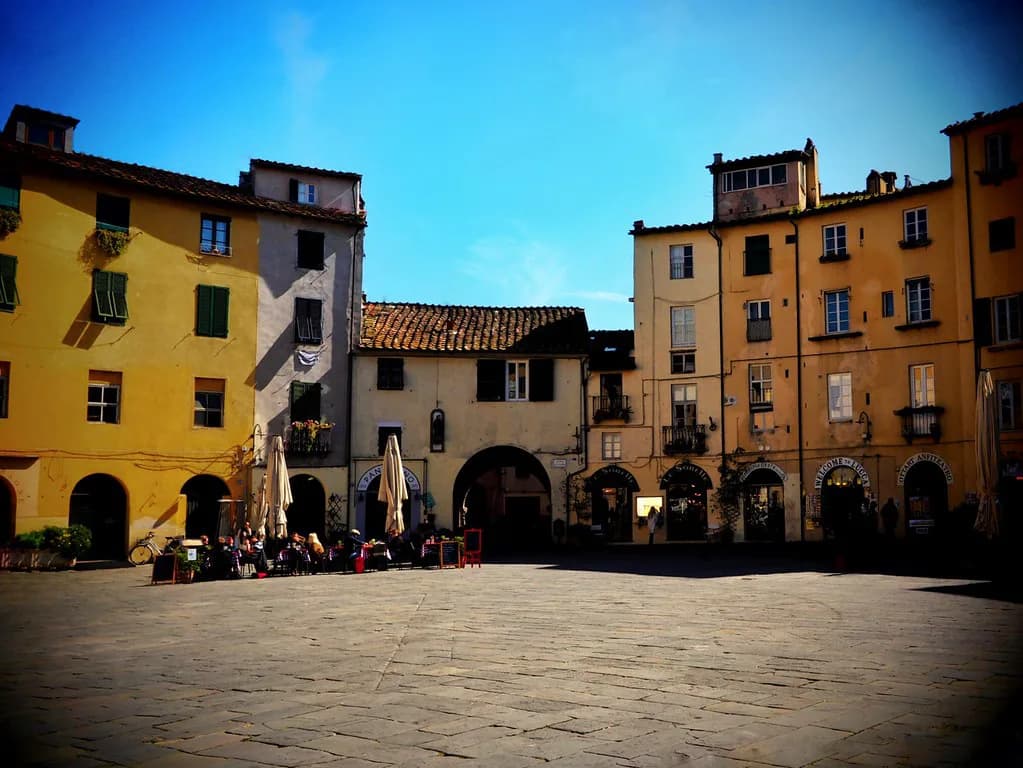
Walk down into Piazza dell'Anfiteatro for a late lunch, when the worst of the midday crowd has thinned. The ring of houses follows the curve of the former amphitheatre, and the square's cafes and restaurants make it an atmospheric place to sit. Reviews on the square vary, so pick a table by menu rather than by position.
If you still have energy, climb Torre delle Ore, the clock tower on Via Fillungo, for a 360-degree view that includes Torre Guinigi itself. Timed entry applies here too, so book a slot rather than turning up and hoping. Otherwise, save it for day two and treat yourself to a slow coffee instead.
Day 1 evening: wine bars, inns and Via Fillungo
Lucca's evenings are civilised rather than raucous. Wine bars and cosy inns tucked inside the walls suit a glass of Colline Lucchesi white or a red from the Montecarlo di Lucca area, both produced in the hills around the city. Cantine Bernardini, in the vaulted cellars of a sixteenth-century palazzo, pairs local wines with seasonal Lucchese dishes if you want dinner in the same place.
Finish with a gentle stroll along Via Fillungo, the pedestrian spine of the centre, which passes the clock tower and loops around part of the amphitheatre. It is shopping by day and a pleasant corridor by night, and it delivers you back towards the walls for a short moonlit circuit before bed.
Day 2 morning: Roman layers and the San Frediano mosaic
Begin at Santi Giovanni e Reparata, the church that served as Lucca's first cathedral. Excavations beneath the floor reveal a Roman bathhouse, a mosaic from a Roman villa and the foundations of earlier churches, layering two thousand years of occupation in a single visit. The 119-step bell tower gives another view if the weather is clear.
Walk west to San Frediano for its gold-and-blue facade mosaic of Christ in Majesty, best seen in morning light. Inside, the massive Romanesque font is carved with Moses leading his people through the Red Sea, complete with camels and medieval armour on the figures. The church is free to enter and takes less time than the cathedral complex. For wider planning, see Hidden Gems in Lucca.
If archaeology appeals more than churches, Domus Romana is a small museum preserving a Roman home discovered in 2010, with a short film and guided rooms. Check its hours and entry price directly before setting out, since it operates independently of the cathedral ticket.
Day 2 midday: Palazzo Pfanner or a garden pause
Palazzo Pfanner offers a change of register: a seventeenth-century residence with baroque gardens, statues of the Four Seasons, a lemon house and an ornamental pool. The palace has appeared in films including Portrait of a Lady, and the interior displays Lucchese silk in the bedrooms and brewing equipment in the cellar from its years as a brewery. Gardens and interiors are ticketed, so confirm current hours and prices on arrival. Related guide: Hidden Gems in Lucca.
On a wet day, swap the garden for a longer lunch or a museum interior. If time is tight, you can glimpse the palace garden and its external staircase from the city walls behind San Frediano, which costs nothing and takes minutes. That shortcut is worth knowing when a sudden shower changes the plan.
Day 2 afternoon: Puccini, a slower loop and the optional aqueduct
Giacomo Puccini was born in Lucca in 1858, and the Casa Museo Puccini occupies the family home on Corte San Lorenzo, where the composer's piano and household rooms are displayed. It is a compact museum that suits a one-hour visit, and it anchors an afternoon loop through the quieter streets west of the centre. Check opening days and ticket prices before you go. For wider planning, see Hidden Gems in Lucca.
With time to spare, walk or cycle out to the Acquedotto Lorenzo Nottolini, a nineteenth-century water channel outside the walls that has become a popular path for walkers and cyclists. It is not Roman despite appearances, and it rewards those with a spare hour rather than those trying to tick off sights. Our Acquedotto Nottolini Lucca excursion guide covers the route in more detail.
Piazza Napoleone is often mentioned in guides but delivers less than the city's other squares, so treat it as a pass-through on the way back rather than a destination. Use the saved time for a second, differently angled section of the walls instead.
Day 2 evening: tordelli, local wine and a last circuit
Order tordelli lucchese on your final evening: fresh pasta stuffed with meat and dressed with a rich ragù, the dish most associated with the city. Buca di Sant'Antonio, trading since 1782, serves refined versions of Lucchese and Garfagnana cooking in a room hung with copper pans. Reserve ahead if you want a table at a civilised hour, and confirm current opening days directly.
For something less formal, look for an osteria or wine bar off the amphitheatre ring, where prices and crowds tend to be gentler. Local specialities range from spelt and bean soup to chestnut-flour ravioli, and the house wine is usually from the surrounding hills. Finish with one last walk on the ramparts, when the plane trees are lit and the city is at its quietest.
How to fit Lucca around a Florence or Pisa base
Lucca works well as an overnight stop rather than a day trip, and that is the main argument for two days. Trains connect it with Florence and Pisa, but treat published journey times as indicative and check the current timetable before you commit to a tight connection. Staying one night inside the walls removes the stress of a last train.
If you only have a single day, a Lucca one-day itinerary concentrates on the walls, one tower and the amphitheatre. The extra day here buys slower mornings, the Puccini house and a proper evening meal. For a longer stay, a Lucca three-day itinerary adds excursions to the villas and gardens outside the walls.
Base yourself in Lucca if the city is the point of the trip, and use Pisa as a half-day add-on rather than the reverse. Parking lies outside the walls at several signed lots, and the station is a short walk from the centre, so a car is optional. Check the Best time to visit Lucca for seasonal notes before booking.
Plan Your Visit
Two days in Lucca come down to a handful of decisions: which towers to climb and when to book them, which combined tickets actually cover what you want to see, and how much of the day to leave unplanned. Build the schedule around two climbs, one church interior and one garden or museum, and let the walls fill the gaps between them.
Recheck opening days, prices and timed-entry availability on the official tourism site and each site's own page in the week before you travel, since seasonal schedules shift and not every attraction shares a ticket. Then pack light shoes for the walls and an appetite for tordelli; the rest of Lucca arranges itself around those two things.
Frequently Asked Questions
Is two days enough for Lucca?
Yes, for most visitors. Two days allow a section of the walls, the cathedral complex, one or two tower climbs, a church with Roman excavations beneath it, and a relaxed evening meal. A single day is workable but compresses the city into a checklist, while a third day is best used for villas and gardens outside the walls.
Should you climb Torre Guinigi or Torre delle Ore?
Torre Guinigi is the more distinctive experience, since oak trees grow on its summit and the view takes in the amphitheatre's oval outline. Torre delle Ore sits on Via Fillungo and gives a 360-degree panorama that includes Torre Guinigi itself. If you climb both, allow for 230 and 207 steps respectively and book timed slots in advance during busy periods.
Do you need to book Lucca's towers in advance?
Advance booking is recommended for Torre Guinigi and Torre delle Ore, especially in high season, because both operate timed entry slots. Availability and prices change by season, so check the official ticketing channel shortly before your visit rather than relying on an older guidebook.
What should you eat in Lucca?
Buccellato, the anise and raisin ring bread, is the city's signature sweet, and Pasticceria Taddeucci on Piazza San Michele is a long-established place to try it. For dinner, order tordelli lucchese, a meat-stuffed pasta with ragù, alongside wines from the Colline Lucchesi or Montecarlo di Lucca hills.
Can you visit Lucca and Pisa in two days?
It is possible, but the combination usually means cutting Lucca short. A better split is one full day in Pisa and an overnight stay in Lucca, or two days in Lucca with a short train hop to Pisa on the way to or from Florence. Check current timetables before relying on any fixed train time.
Is it worth cycling the Lucca walls?
Cycling is the fastest way to cover the full four-kilometre circuit, and bikes can be hired from shops near the walls. Walking a shorter stretch is equally enjoyable and cheaper if you only want the views. Nothing in the historic core is far on foot, so a bike is a convenience rather than a necessity.
Sources
Continue exploring
More guides you'll find useful