Self-Guided Walk in Lecce: A Baroque Loop Through the Old Town
Plan your own Baroque walk through Lecce's old town, linking Piazza Sant'Oronzo, the Duomo and Santa Croce, with flexible pacing and ticketed add-ons.
On this page
Lecce rewards travellers who slow down. The historic centre holds an unusual density of elegant Baroque churches and buildings raised during a golden age that ran roughly from 1550 to 1750, according to the operator Guides of Italia, and much of that ornament sits within easy strolling range of one another.
This guide proposes a shape for a walk of your own making: anchor on three places, Piazza Sant'Oronzo, Piazza del Duomo and the Basilica di Santa Croce, then let the lanes between them set the pace. Nothing here is an official route, and the order is yours to change.
Before you set out, check the city's official pages and the individual church sites for the day you plan to walk, since a self-guided visit depends on being able to step inside when doors are open.
Why Lecce Rewards a Self-Guided Walk
The case for walking without a guide is density. Guides of Italia describes Lecce as a city whose Baroque heritage is concentrated rather than scattered, with decorative flourishes appearing on practically every building in the centre. That means you can look up constantly instead of travelling between sights.
A second argument is flexibility. Guided formats tend to fix a duration and a set of stops; a private tour listed by the same operator runs about two and a half hours and keeps its itinerary open so the guide can adapt the route to the group's interests. Walking alone, you can apply the same logic to yourself, lingering where a facade catches your eye.
Finally, the centre suits slow travel. The area had been largely abandoned by locals before a renaissance over recent decades brought it back to life, again per Guides of Italia, and that recovery is part of what you are walking through, not just the stonework.
How to Shape Your Loop
Treat the walk as three anchors rather than a fixed sequence. Piazza Sant'Oronzo, the Duomo and the Basilica di Santa Croce are the places Guides of Italia names among the city's most iconic, and they make natural pivot points for a loop through the old town.
Do not expect the sources to hand you distances or timings between squares; none of them gives them, and guessing would be misleading. Instead, budget a generous half day and accept that your pace, your pauses and how long you spend at each stop will determine the total.
If you would rather have a tested structure, a one-day plan can sit around the same anchors. Otherwise, treat the loop as a mental map and allow yourself to double back when a side lane looks interesting. For corners beyond the Baroque set pieces, our hidden gems in Lecce guide points toward quieter and less visited places to fold into the same day.
Start at Piazza Sant'Oronzo
Piazza Sant'Oronzo is the obvious beginning because it puts the city's layers in front of you at once. The square honours the city's patron saint, and the Roman amphitheatre sits within view, a reminder that Lecce was a substantial settlement well before its Baroque boom.
Use the square to orient yourself rather than to rush onward. Guides of Italia notes that its own tours finish back here, which says something useful about the piazza as a natural hinge: you can return to it mid-walk or at the end without feeling you have left the interesting part behind.
From the square, head into the tangle of lanes toward the cathedral quarter. There is no need to plan the exact street; the pleasure of this section is the accumulation of facades and balconies rather than any single address.
Into the Duomo Area
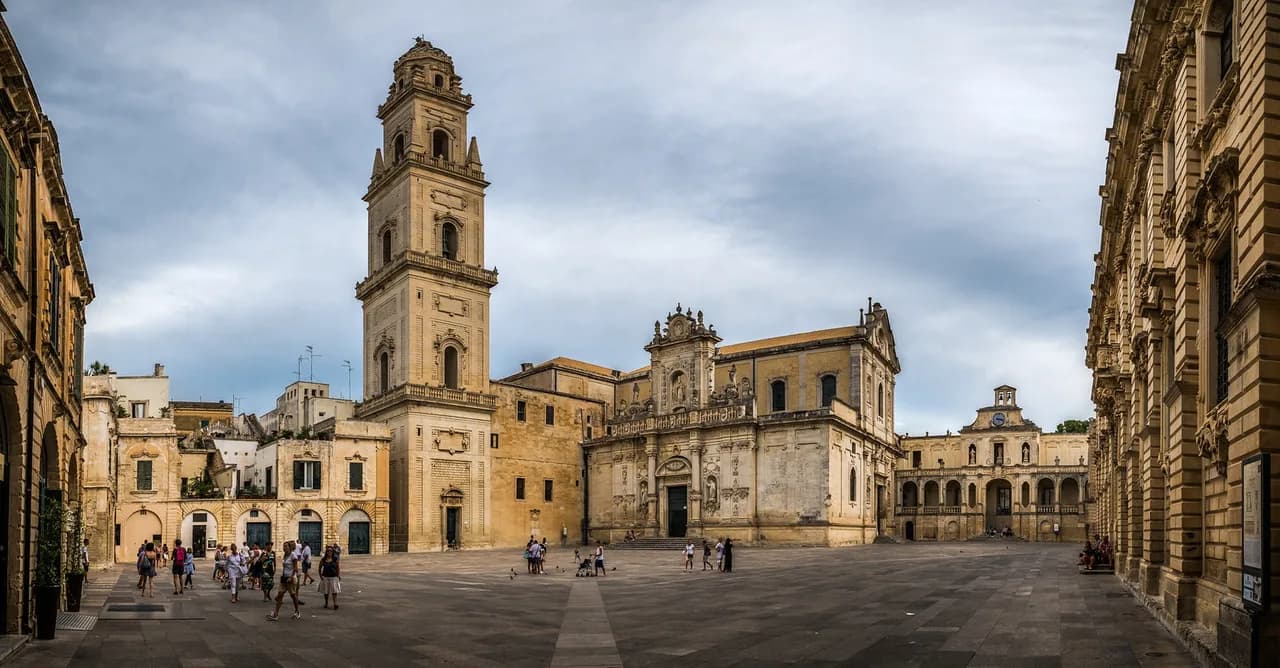
Piazza del Duomo is the walk's most enclosed set piece, a square that rewards a slow circuit rather than a quick photograph. The Duomo facade and the surrounding streets are where you start noticing how deliberately the city's architects staged arrival and surprise.
Look at how the square is entered. Approaching from a narrow lane and emerging into a wide open space is itself an optical trick of urban design, and it is repeated elsewhere in the centre. This kind of close reading is what turns a stroll into a Baroque walk. For wider planning, see Piazza del Duomo Lecce.
If you want a structured introduction to the interiors around the cathedral, the cultural organisation ArtWork runs daily guided tours that include stories about the major Baroque monuments and entry to sites on the LeccEcclesiae itinerary.
Basilica di Santa Croce as the Centrepiece
Many visitors treat the Basilica di Santa Croce as the high point, and its facade justifies the reputation. Guides of Italia calls it the city's most famous Baroque jewel and singles out its extraordinarily ornate front, dense with carved detail that needs time and a bit of distance to read properly. For wider planning, see Visiting the Basilica di Santa Croce in Lecce.
Pause on both sides of the street and look at different times of day if you can. The facade's decoration shifts depending on the light, and walking past it twice, in different directions, is a cheap way to see more.
Beyond the facade, an independent cultural itinerary called Baroque Vision offers a view from inside the facade of Santa Croce, up to the rose window. Per a 2023 ArtWork page, this ran daily between 15.00 and 20.00 with departures every half hour and a last shift at 19.30, for groups of up to ten people, at a ticket price of 12 euros per person. Treat those details as dated to that publication and confirm current arrangements through the official channels before relying on them.
Reading Baroque Tricks as You Walk
One way to make the walk more than a march between monuments is to hunt for the devices that Baroque architects used to catch the eye. Guides of Italia describes fake facades, illusions and impressive decorations designed to draw the attention of passersby, and once you know to look for them they appear repeatedly.
Try asking why, as you go. The operator frames the city's exuberance as a question worth answering in person, given Lecce's position in a remote corner of the peninsula, and reading the decoration as an argument about local pride and external influence makes the walk far more engaging than simply collecting facades.
This is also the reason to keep your head up rather than fixed on a map. Balconies, portals and window surrounds carry the same visual grammar as the big facades, just at a smaller scale.
Where to Pause, and When to Flex
The main practical decision in Lecce is not where to walk but when to stop. Heat and crowds can change the character of the centre, so build in a mid-walk break and move the more exposed parts of the route to the cooler edges of the day.
Sources do not hand you a list of named cafes or shops to aim for, and recommendations change too quickly to treat as fixed. Instead, choose a pause you can revisit on foot, ideally with a view of a square you have already walked through, so the break doubles as orientation.
If food is part of your plan, then a market-based detour can fit naturally into the middle of the walk rather than the end, giving you an excuse to rest before the second half. A companion look at the market and food guide helps you decide what to look for without turning the break into a set itinerary.
Optional Guided and Private Alternatives
A self-guided walk is a choice, not a doctrine, and Lecce has several formats if you would rather hand over the structure. ArtWork's scheduled tours have departures at 11.00 and 16.00, run in Italian and English, and meet at the bookshop in the Palazzo dell'Antico Seminario, with a recommendation to arrive ten minutes before the start. The same 2023 page lists the guided tour at 20 euros per person, purchasable online or at the central ArtWork ticket office in Piazza del Duomo, with reductions for minors and families, and notes that tickets can also be bought at the Basilica di Santa Croce ticket office. Further visitor details appear in Experience the baroque wonders of Lecce with the guided tours of ArtWork - LECCECCLESIÆ.
Private formats suit travellers who want the guide's attention to themselves. The operator listing from Guides of Italia prices a private walking tour at a flat fee of 285 dollars for parties of up to eight, runs about two and a half hours, offers start times across the morning and afternoon, includes the guide Paolo and a pick-up option for an extra fee, and excludes a 6 euro site entrance ticket per person.
These figures come from the sources as published, not from a live check on the day you read this, so confirm prices and availability with the providers before booking.
Practical Planning Before You Go
Confirm the day's arrangements rather than assuming a routine. Church opening hours, tour departure times and ticket availability are volatile, and the official operator pages and the city's own site are the places to verify rather than relying on a secondhand summary.
Wear shoes you can walk in for several hours and carry water if you are visiting in the warmer months. If you are mixing a self-guided walk with a ticketed visit, check the meeting point in advance, since the ArtWork tour, for example, gathers at the bookshop in the Palazzo dell'Antico Seminario rather than at the church itself.
Finally, decide whether you want a single anchor-led stroll or a deeper pass over one part of the centre. Both are legitimate; the second often produces better memories because it lets you look twice at the same facade.
Make the Walk Your Own
Lecce's Baroque centre works best as a walk you shape yourself, anchored on Piazza Sant'Oronzo, Piazza del Duomo and Santa Croce and free to absorb the lanes between them. Keep the walk's structure loose and the observation close.
Use the guided and private formats as additions rather than replacements when you want context or a timed structure, and check current times and prices with the providers before you commit. Then give yourself the thing a schedule cannot supply: an unhurried second look at a facade. For related planning, see Lecce Papier-Mâché Workshops: A Cartapesta Craft Guide.
Frequently Asked Questions
Can you walk Lecce's Baroque sights on your own?
Yes. The main sights sit within the historic centre and can be linked on foot, and a private operator describes its own version as roughly two and a half hours with the route adjusted as it goes. Treat any sequence you read, including this one, as a suggestion rather than an official itinerary, and confirm opening arrangements with the individual sites before relying on them.
What should a self-guided Baroque walk in Lecce include?
Anchor on Piazza Sant'Oronzo with its Roman amphitheatre view, the area around Piazza del Duomo, and the Basilica di Santa Croce. Around those three points, look for the decorative devices that Baroque architects used to catch the eye, such as ornate facades and optical effects, and allow time for a pause rather than trying to cover the whole centre in one push.
Is the Santa Croce terrace and rose window visit separate from a church visit?
It is presented as a distinct cultural itinerary called Baroque Vision with its own entrance arrangement, inside the facade of Santa Croce and up to the rose window, for groups of up to ten people. The details published in 2023 set the timing and price, so check the current schedule and cost directly with the operator before you plan around it.
How long does a guided Baroque tour of Lecce take?
The private tour listing from Guides of Italia gives approximately two and a half hours, and the ArtWork cultural tours run to set departure times rather than a published duration on the page cited here. Because these are operator-specific, confirm the length when you book rather than assuming one format matches another.
Do I need to book in advance for Lecce's Baroque sights?
Scheduled tours and any same-day capacity limits change, so book ahead when a fixed slot matters to you, particularly for a private format with limited party sizes. For the self-guided part of the day, the main check is that the sites you most want to enter are open when you arrive.
Where should I start a self-guided walk in Lecce?
Piazza Sant'Oronzo works well as a starting point because it gives you orientation and a view of the Roman amphitheatre, and the operator notes its tours finish there too, so the square functions as a natural hinge. From there, head into the lanes toward the cathedral quarter and continue to Santa Croce.
Sources
Continue exploring
More guides you'll find useful