
Anfiteatro Romano Lecce: Piazza Sant'Oronzo Guide
Use this guide to see Lecce's Roman amphitheatre in Piazza Sant'Oronzo: what survives, what lies hidden, and how long to allow for the square.
On this page
The Anfiteatro Romano is not a fenced-off ruin you visit in isolation. It occupies the southern part of Piazza Sant'Oronzo, sunk below the level of the square, so most visitors meet it simply by walking across the piazza while the city carries on around them. That setting is the first thing to understand before you arrive: you are looking at a monument embedded in a working urban square, not at a standalone archaeological park.
Where the Amphitheatre Sits and Why That Matters
The amphitheatre lies on the southern side of Piazza Sant'Oronzo, the central square of Lecce in Puglia. Because it sits in the open piazza, it makes an obvious first stop on foot before you head deeper into the historic centre. Approach from the square itself rather than treating the monument as a separate destination you need to travel to.
That central position shapes the experience. There is no approach road, no ticket gate and no visitor centre standing between you and the structure — the exposed curve of stone simply drops away from the pavement, framed by everyday buildings and cafés. Treat it as a landmark you pass and circle rather than an attraction with a formal beginning and end.
Buried for Centuries: The 1901 Discovery
Although the structure dates back to antiquity, it was not brought to light until 1901, when construction work exposed it. The Italy Review notes that the amphitheatre was only discovered that year, which explains why so much of it remains under the modern city rather than consolidated as a free-standing ruin.
Local archaeologists, including Cosimo De Giorgi, were involved in bringing the structure to public attention, and excavation work continued into the 1940s. Even so, only about a third of the original building has been uncovered. The rest is not lost so much as built over, which is why the monument reads as a fragment rather than a complete arena.
How Old Is It? The Dating Debate Explained
You will see the amphitheatre attributed to different periods depending on the source. Some accounts place its construction in the Augustan era, linking it to the prosperity of ancient Lupiae, the Roman precursor to Lecce. Others argue for a later Trajanic or Hadrianic date, and scholarship has not settled the question.
Rather than picking a winner, treat the uncertainty as part of the story. The Italy Review describes the structure as dating to the second century AD, during Hadrian's rule, which sits on the later side of that debate. If dating matters to you, read the information panels on site or check the city's own published material for the current position.
The Scale of the Original Building
Reported figures give a sense of how large the arena once was. The exterior measured roughly 102 by 83 metres, with an arena of about 53 by 34 metres, and the building could hold around 25,000 spectators. These are reported dimensions rather than measurements you can verify on the ground, since most of the structure is still buried.
Those numbers matter because they recalibrate what you are looking at. The curve visible in the piazza is a fraction of a much bigger footprint that extends under the surrounding buildings. Keep that in mind as you walk the edge of the square, and the visible fragment starts to read as the tip of something far larger.
What You Can and Cannot See
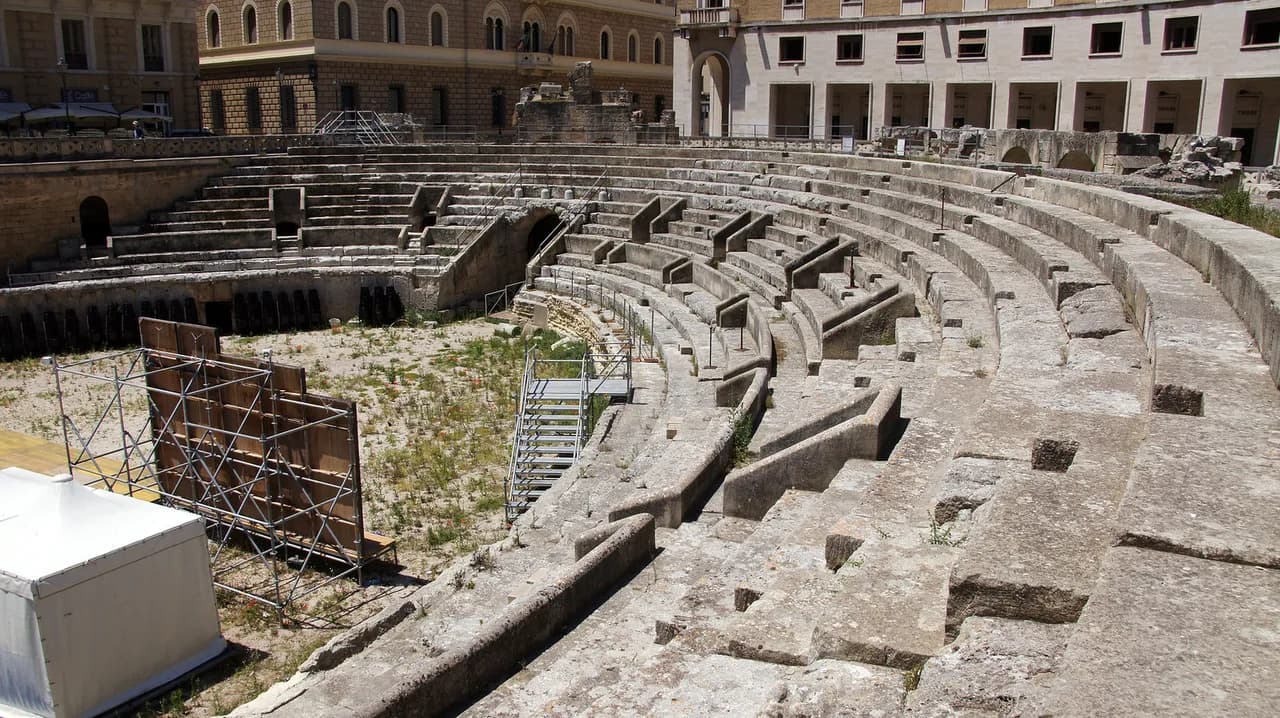
From the public square you can see the exposed section of the amphitheatre, including part of the elliptical arena and the tiered structure that surrounded it. Because the monument sits below pavement level, the best views come from the railing at the edge of the piazza rather than from directly above it. Modern buildings and the church of Santa Maria della Grazia cover other parts of the original structure.
Do not expect a Verona-style arena you can walk through. The Italy Review describes viewing the structure from the public square above, not entering it. Any interior or underground access would be a separate matter to confirm with the city rather than something you can assume on arrival.
A useful distinction is between the freely visible exterior and any guided or ticketed access. The street-level view costs nothing and requires no booking, but it is also limited. If an underground visit is what you are after, check with the Comune di Lecce before you travel rather than relying on older blog posts.
A Suggested Viewing Sequence Around the Square
Start by walking the visible edge of the amphitheatre, following the railing where the stone drops below the piazza. This lets you read the curve of the arena and the surviving masonry at close range before you step back. Take your time here rather than photographing from the first spot you reach.
Then move back across the square for the wider view. From a distance the elliptical footprint becomes clearer, and you can see how the monument sits relative to the surrounding palazzi and the column of Sant'Oronzo. This second position is where the scale of the buried building makes most sense.
Finish by walking the perimeter of the piazza, noting where ancient stone meets later façades. The line between carved rock and built arches is one of the most interesting things to look for. That contrast is the story of the site in miniature.
Pairing It With Lecce's Other Churches and Squares
The amphitheatre works best as one stop on a walking circuit rather than a destination in itself. The Basilica di Santa Croce, the cathedral and the church of Sant'Irene all sit within reasonable walking distance in the historic centre. Use our Basilica di Santa Croce Lecce visitor guide to plan that leg of the route and to understand the Baroque architecture that came later.
If you want to go beyond the obvious sights, the city rewards detours into smaller corners and lesser-known collections. The hidden gems in Lecce guide covers places such as the Museo Faggiano, where excavation beneath a private house revealed layers of the city's past. That makes a natural counterpoint to the amphitheatre's story of a monument buried under the modern street plan.
Practical Planning: How Long to Allow
As a Yondli recommendation rather than an official duration, allow around twenty to thirty minutes for the amphitheatre and the immediate square. That is enough to walk the visible edge, step back for the wider view and read any on-site panels. If you are combining it with nearby churches, budget a half day for the historic centre.
Because the view is from the public square, there is no booking step and no schedule to work around for the basic look. Anything beyond that — an interior visit, a guided tour or a cultural event — needs to be checked separately. The city's official pages are the place to confirm what is currently on offer.
Reading the Monument Like a Slow Traveller
Look for the difference between the parts carved directly into the rock and the parts built up with stone arches. That distinction tells you how the amphitheatre was engineered and how it has survived. It also helps you separate ancient fabric from later intervention.
Then notice how the modern city has grown over and around the ancient one. The church of Santa Maria della Grazia and the surrounding palazzi are not obstacles to the view; they are evidence of how Lecce built on top of its Roman past. Reading the monument this way turns a quick photo stop into a lesson in urban history.
Plan Your Visit
The Anfiteatro Romano is one of Lecce's most distinctive sights precisely because it is incomplete and embedded in the life of the city. Approach it from Piazza Sant'Oronzo, walk the visible edge, then step back to appreciate the scale of what lies beneath. It rewards a few unhurried minutes rather than a rushed circuit.
Use the square as the starting point for a wider walk through the historic centre, and check the city's official channels before travelling if you want to know whether any interior access is currently offered. The monument itself, seen from the piazza, needs no booking and no schedule.
Frequently Asked Questions
Can you visit the Lecce amphitheatre for free?
The amphitheatre can be viewed from the surrounding public square in Piazza Sant'Oronzo, and that street-level view requires no booking. Any interior or underground access would be a separate matter, so check with the Comune di Lecce before you travel.
How much of the Roman amphitheatre in Lecce is actually visible?
Only about a third of the original structure has been uncovered. The visible fragment sits below the level of the piazza, while modern buildings and the church of Santa Maria della Grazia cover much of the rest.
When was the Lecce amphitheatre discovered?
It was brought to light in 1901 during construction work. Local archaeologists, including Cosimo De Giorgi, were involved in the years that followed, and excavation continued into the 1940s.
How old is the Anfiteatro Romano in Lecce?
The dating is debated. Some accounts place it in the Augustan era, while others argue for a later Trajanic or Hadrianic date; the Italy Review describes it as second century AD. Read on-site panels or the city's own material for the current position.
How big was the Lecce amphitheatre and how many spectators did it hold?
Reported figures give an exterior of roughly 102 by 83 metres with an arena of about 53 by 34 metres, and a capacity of around 25,000 spectators. These are published dimensions rather than measurements visible on the ground.
How long should you spend at the amphitheatre in Piazza Sant'Oronzo?
As a Yondli recommendation, allow around twenty to thirty minutes for the monument and the immediate square. That covers walking the visible edge, stepping back for the wider view and reading any panels.
What else is near the amphitheatre in Lecce?
The Basilica di Santa Croce, the cathedral and the church of Sant'Irene are all within walking distance in the historic centre. Smaller corners and lesser-known collections are covered in our hidden gems guide.
Sources
Continue exploring
More guides you'll find useful





