
Colonna di Sant'Oronzo Lecce: Visitor Guide to the Patron Saint Column
Learn how Lecce's Sant'Oronzo column rose in 1666 as a plague ex-voto, why its marble shaft came from Brindisi, and what you can see for free in the piazza.
On this page
The Colonna di Sant'Oronzo stands in Piazza Sant'Oronzo, the busy heart of Lecce, and it is one of the few major sights in the city you can study from every angle without buying a ticket. The column was raised in 1666 as a thank-offering after the plague that had struck Lecce a decade earlier, so it is best read as a civic vow rather than a decorative civic trophy.
The monument is a layering of eras: an ancient marble shaft brought from Brindisi, reworked by the Baroque architect Giuseppe Zimbalo, and topped by a bronze figure of the patron saint Oronzo. Give it ten or fifteen minutes on a first pass, then return in different light, because the pale local stone and the column's marble respond strongly to sun angle.
What the Column Is and Where It Stands
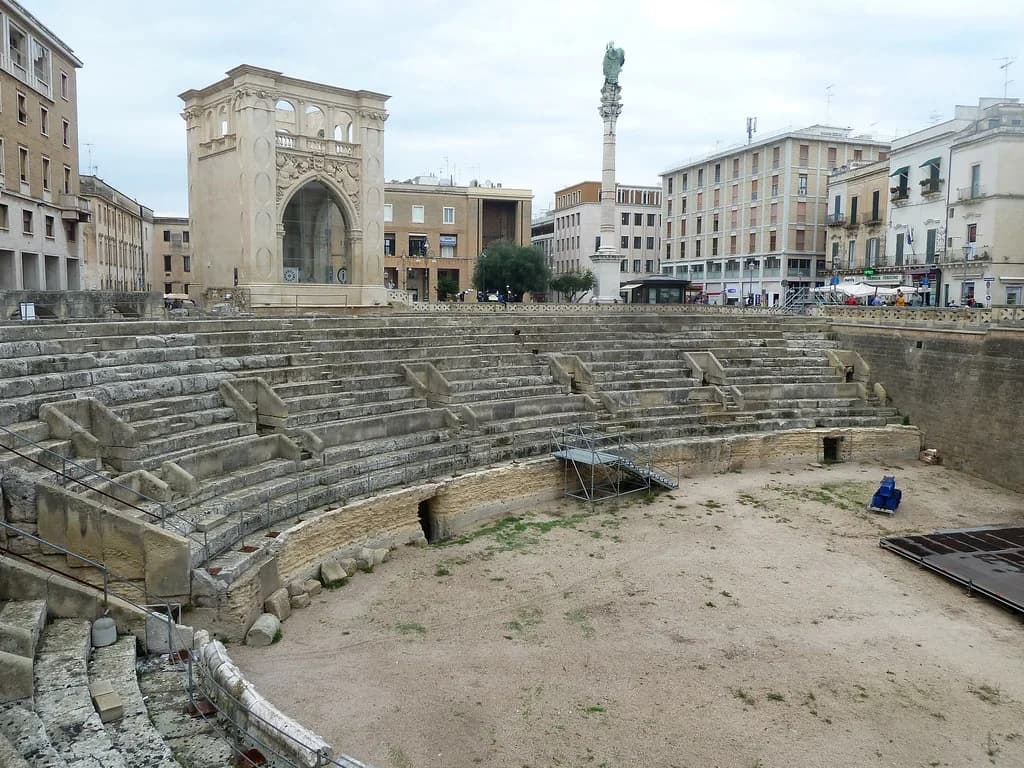
Piazza Sant'Oronzo is Lecce's principal square, ringed by historic buildings and cafés and used constantly as a meeting point by residents and visitors alike. The column rises near the centre, close to the partly excavated Roman amphitheatre whose lower tiers sit below street level in the same piazza.
Because the square is public open space, there is no gate, turnstile or set visiting window for seeing the column itself; you simply walk in. Everything you need to appreciate the monument — the base, the tall shaft, the capital and the bronze saint above — is visible from ground level, and there is no indication anywhere in the sources that the column can be entered or climbed.
The Story Behind the Monument: Plague, Vow and 1666
According to the monument record, the column was erected in 1666 by the will of the citizenry as an ex-voto after the devastating plague epidemic that had hit Lecce ten years before. That timing matters for how you look at it: the column is a collective act of thanks for survival, and the saint at the top is the recipient of a promise rather than a piece of civic decoration.
Oronzo is Lecce's patron saint, and tradition ties him to the city's deliverance from plague. A guide to the city notes that a three-day celebration in his honour has traditionally been held from 25 to 27 August, but treat that as a recurring local tradition rather than a confirmed programme for any given year; check the city's own channels before planning around it.
Recycled Rome: The Shaft from the Appian Way
The column's shaft is not new stone. The Baroque architect Giuseppe Zimbalo reused the African cipollino marble stem of an ancient column that, with a twin, marked the end of the Appian Way at the port of Brindisi, according to the monument record. That makes the monument a piece of deliberate recycling: a Roman waymarker from the coast was hauled to Lecce and given a new job as the pedestal of a Christian vow.
Look for the veining in the marble, which is what gives cipollino its name and its characteristic layered appearance. Knowing the shaft's origin also changes the reading of the piazza: the square sits over Roman remains, including the amphitheatre, so the column's Roman salvage fits a site where antiquity is literally underfoot.
The Bronze Saint on Top: Original and Recast
The bronze effigy of Oronzo that crowns the column is not the first one placed there. The monument record states that the original statue was destroyed soon after it was installed and that the figure was remade in Venice in 1739. That eighteenth-century date is worth holding onto when you read older descriptions that quote a specific original height, because the surviving figure is the Venetian replacement.
From the piazza the saint reads mainly as a silhouette against the sky, so bring binoculars or use a camera zoom if you want to study the modeling. A separate note in the city guide mentions that the patron saint's statue was at one point moved into the nearby city hall, viewable through a screen; that refers to a different display, so do not confuse it with the bronze on the column.
Reading the Column in the Square
Piazza Sant'Oronzo works as a stage for the column because the surrounding buildings leave open sky above it, and the square's cafés and benches let you sit and look up at leisure. The monument is a natural orientation point in a city of winding lanes, so use it as a fixed landmark when you wander back toward the centre.
The second square to pair with it is the cathedral square, a short walk away, where the duomo and its bell tower sit in a more enclosed setting. The contrast is the point: one square is open, busy and framed by the column, the other is tighter and dominated by the cathedral group. Our Piazza del Duomo Lecce visitor guide explains what to look for there.
What Is Free to See and What Is Not
The piazza and the column are free to view as open public space; there is no ticket window for the monument itself. What costs money are the interiors and collections nearby: churches such as the Basilica di Santa Croce and museums in the old town set their own admission, and those charges change, so check with each site rather than relying on older figures.
A useful rule for Lecce is to separate the streetscape from the interiors. The column, the two squares, the façades and the excavated amphitheatre rim give you a full morning of looking for nothing, while a single paid interior can consume the same time and budget. If you want a small, inexpensive indoor stop, our hidden gems in Lecce guide covers options such as Museo Faggiano, which is a private house-turned-museum rather than a civic collection.
Nearby Anchors: The Amphitheatre and the Baroque Core
The partially excavated Roman amphitheatre in the same piazza is the obvious companion sight, since it was only discovered in the early twentieth century and remains half-buried beneath the modern street. Our Anfiteatro Romano Lecce visitor guide covers the visible remains and the way the shops opposite are built over the structure.
Beyond the piazza, Lecce's Baroque core is dense with façades carved from the local stone, and the Basilica di Santa Croce is the showpiece most visitors want to see. Pair the column with a slow loop through the old town rather than treating each monument as an isolated stop; the Lecce Attractions hub lists the sights worth adding to the route.
Practical Planning: Timing and Pacing
The city guide describes the high season as running from April to June and again from September to October, with February quiet and mild, so plan your square time around the crowds you are willing to tolerate. The same account notes that visiting in low season meant no lineups and no reservations at the sights it covered.
Morning and late afternoon give the best light on the column and the surrounding façades, and they are also when the piazza is most photogenic without a crush of people. Our suggestion is to allow fifteen minutes at the column itself and to keep the rest of the day flexible, because the squares are compact and easy to revisit.
A Suggested Short Walk of the Two Squares
Our suggested loop takes roughly 45 to 60 minutes on foot, clearly labeled as our recommendation rather than an official tour. Start at the column, walk the perimeter of Piazza Sant'Oronzo to see the amphitheatre remains, then head through the lanes to the cathedral square and back, pausing at any open church door along the way.
The route is short enough to repeat in a different light or on a different day, and it needs no booking. If you want a self-guided city game to structure the walk, the Escape Tours route passes directly by Piazza Sant'Oronzo and is designed as an interactive challenge rather than a conventional guided tour.
Where the Column Fits in a Longer Lecce Stay
With two or three days in Lecce, the column belongs on the first morning as an orientation landmark, not as a destination in itself. From it you can branch into the Baroque churches, the archaeological collections and the quieter lanes, keeping paid interiors for the afternoons and the squares for the cooler ends of the day.
If your interests lean toward quieter corners, the hidden gems guide points to smaller sites and less obvious stops away from the headline squares. For a different side of the city's religious architecture, the Chiesa di San Niccolò e Cataldo is outside the dense centre and rewards a longer walk or a short ride.
Plan Your Visit to the Column
The Colonna di Sant'Oronzo rewards a few minutes of attention rather than a rushed photograph: a plague vow of 1666, a recycled Roman shaft from Brindisi, and a bronze saint recast in Venice in 1739. Its setting in an open public square makes it one of Lecce's most accessible monuments, and the adjoining cathedral square and amphitheatre remain visible for free.
Check current admission and opening details directly with any church or museum you plan to enter, since the sources do not give reliable current figures. Build the column into a walking day rather than a dedicated trip, and let the piazza's rhythm set the pace.
Frequently Asked Questions
Why was the Colonna di Sant'Oronzo built in Lecce?
The column was erected in 1666 by the will of the citizens as an ex-voto, a thank-offering after the plague epidemic that had struck Lecce a decade earlier. It honours the patron saint Oronzo, who is traditionally associated with the city's deliverance from plague.
Whose marble column was reused for the Sant'Oronzo column?
The shaft is African cipollino marble taken from an ancient column that, together with a twin, marked the end of the Appian Way at the port of Brindisi. The Baroque architect Giuseppe Zimbalo reused that Roman stem for the new monument in Lecce.
Is the bronze statue of Saint Oronzo on the column the original?
No. The first bronze effigy was destroyed shortly after it was installed, and the figure was remade in Venice in 1739. The statue you see today is that later replacement.
What can you see for free in Piazza Sant'Oronzo?
The piazza is open public space, so the column, the surrounding façades and the visible rim of the partly excavated Roman amphitheatre can all be seen without a ticket. Church interiors and museums nearby set their own admission, which you should confirm with each site.
How long does it take to see the column and the surrounding squares?
Our suggested loop of Piazza Sant'Oronzo and the cathedral square takes roughly 45 to 60 minutes on foot. That is a recommendation, not an official time, and the compact distance makes it easy to repeat.
Can you go up or inside the Colonna di Sant'Oronzo?
There is no indication that the column can be entered or climbed. It is a free-standing monument viewed from the piazza, and the bronze saint is best studied from below with binoculars or a camera zoom.
Sources
Continue exploring
More guides you'll find useful





