Lecce Papier-Mâché Workshops: A Cartapesta Craft Guide
Learn how Lecce's papier-mâché tradition began, what a hands-on cartapesta workshop involves, and how to plan a craft-focused visit to the historic centre.
On this page
Lecce's signature craft is not carved from its famous soft stone but built up from paper. Cartapesta, the local papier-mâché tradition, filled the city's churches with processional saints and Madonnas when marble and bronze were out of reach, and it still shapes how the historic centre looks and feels.
Visitors who want more than a shop souvenir can now join a hands-on session. One operator-listed format runs about three hours from an atelier-boutique on Via Umberto I, a few steps from the Basilica di Santa Croce, and combines jewellery-making with a short guided walk to two sites tied to the craft's history.
Why Cartapesta Is Lecce's Signature Craft
Papier-mâché arrived in Lecce between the seventeenth and eighteenth centuries, when a wave of church and monument building created demand for religious art that local craftsmen could afford to make. Working with straw, rags, glue and plaster rather than precious materials, they learned to model figures that had the presence of carved sculpture at a fraction of the cost. That practical compromise became a distinct local art.
The early masters were not full-time sculptors. Barbers were among the first to take up the craft, modelling statues in the back rooms of their shops between haircuts, and the oldest recorded workshop in Lecce belonged to a barber remembered for his crucifixes. Apprenticeship passed techniques from one generation to the next, often through families and moulds inherited along with the tools.
Today the craft has widened beyond sacred subjects into nativity scenes, dolls, masks, furnishings and design objects, while the churches still hold the large processional figures that made its reputation. If you plan your days around craft rather than Baroque facades alone, browse the wider set of hidden gems in Lecce for smaller workshops and courtyards that rarely appear on standard routes.
How a Cartapesta Figure Is Actually Made
Production starts with a skeleton, not with paper. Artisans twist straw into a rough core bound with twine, while hands, feet and head are modelled separately in clay and then attached, which is why a cartapesta master needs sculptural skill as well as patience with glue.
The core is then covered with layers of paper pasted on with a flour-and-water adhesive traditionally called ponnula, with copper sulphate added against woodworm and, in older practice, alum against mould. The piece dries in the air or sun before the finishing stage, when small heated spoons are used in a technique known as fuocheggiatura to correct folds and firm the structure. Gesso, polishing and oil colour follow.
Knowing that sequence changes how you read a demonstration. A short class that jumps straight to gluing paper strips is teaching a simplified craft, while a session that shows the straw armature, the separate clay parts and the finishing tools is showing the real production chain. Ask which stages you will handle yourself before you choose between operators.
What a Hands-On Workshop Involves
The most clearly described visitor format starts at Lady Papavero's atelier-boutique on Via Umberto I, where participants make their own ring or brooch using two different cartapesta techniques. No previous experience is needed, and the session is listed as available in English, French and Italian.
The longer option folds a walk into the drying time. While the piece sets, the group takes a roughly 45-minute guided stroll through the historic centre with stops at two sites linked to the history of cartapesta, then returns to the atelier to personalise the piece with decorative finishes and take it home. Materials, tools and finishes are listed as included.
A second operator lists a shorter artisan-led class of about one hour and 30 minutes aimed at both children and adults, with a historical introduction, a step-by-step demonstration and a handmade work to keep. Its language is listed as English, and the meeting point is shown only as a map pin rather than a street address, so confirm the exact location before you pay.
Comparing the Two Operator-Listed Formats
The three-hour jewellery session and the 90-minute artisan class produce different outcomes, and that is the main decision. The first gives you a wearable ring or brooch made with two named techniques and a heritage walk built around drying time; the second gives you a general handmade object plus a broader demonstration of production phases, which suits families or travellers with a tight schedule.
Durations and prices shown on both listings are operator-supplied and can change by date and season, so treat them as a planning guide rather than a fixed rate. Check the live booking page for the day you want, and read the cancellation terms: both listings state a full refund for cancellations made at least 24 hours before departure.
If you want a workshop that fits around sightseeing, place the shorter class on a busy morning and keep the longer session for a slower day. The drying-time walk already covers part of the centre, so do not schedule a separate guided city tour immediately before or after it without checking the routes for overlap.
What to Check Before You Book
Confirm the language, group size, address and what you take home before paying, because these details differ between listings and are set by the operator rather than by the city. The jewellery workshop names its host and street address; the shorter class does not, so ask for the meeting point in writing.
Accessibility is worth a direct question. The shorter class lists wheelchair-accessible areas and surfaces and welcomes prams and strollers, but that is one operator's description of one venue and does not cover the jewellery atelier, whose listing mentions only that the experience suits all physical fitness levels and that public transport runs nearby.
If you are buying a voucher as a gift, note that the shorter experience is sold as a voucher the recipient redeems later, with the booking made after redemption. That flexibility is useful, but it means you are not reserving a specific date at the moment of purchase, so coordinate with the recipient before choosing it.
Where Cartapesta Lives in the City
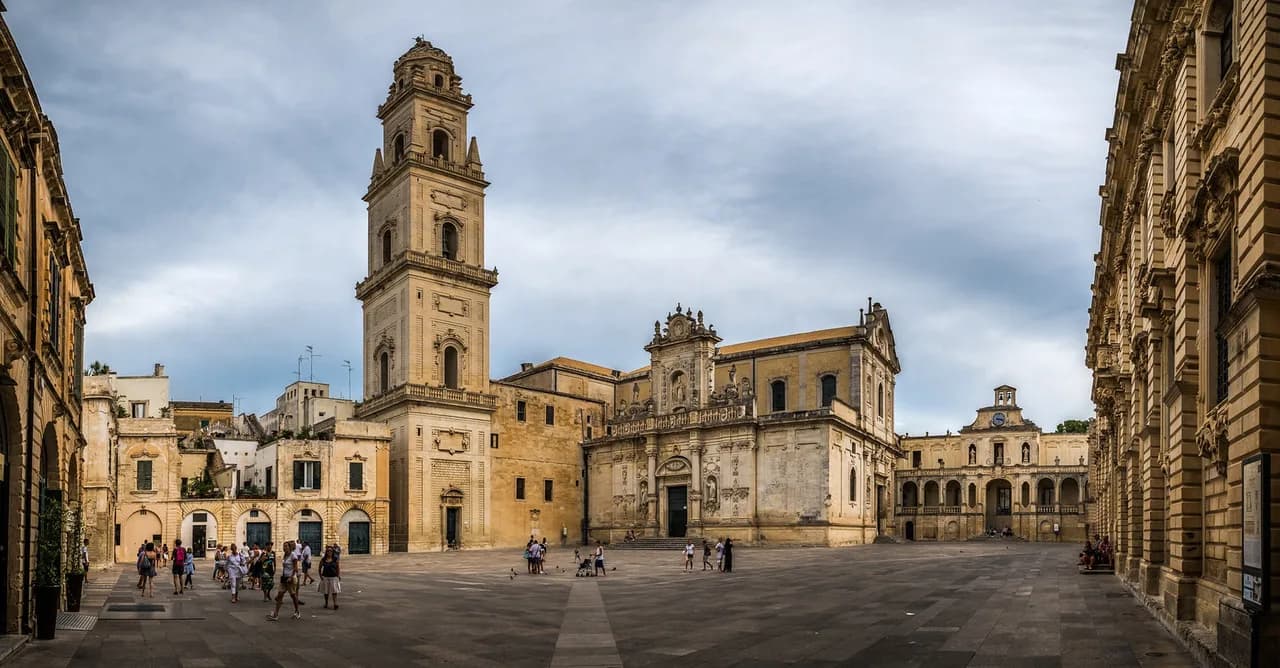
The ateliers cluster in the historic centre, and the Via Umberto I address sits close to the Basilica di Santa Croce, whose carved facade is the area's landmark. Our Santa Croce Quarter Lecce Guide covers the surrounding lanes, cloisters and church interiors so the walk to and from a workshop becomes part of the visit.
For finished works rather than work in progress, look inside the churches. Sacred statues, crucifixes and Nativity scenes in cartapesta fill chapels across the centre, and the association that runs the main church sites publishes its own information on individual buildings. Their page on the Church of San Matteo, for example, sets out the church's history, altars and the polychrome high altar that dominates the interior.
A papier-mâché museum has been established in the historic centre within the Castello di Carlo V complex, near Piazza Sant'Oronzo, according to published accounts of the craft. Opening arrangements can change, so verify current access with the castle or the city's tourist information rather than assuming the collection is on display on your dates. Lecce Attractions collects our guides to the city's main sights if you want to build a craft-themed day around them.
Reading the Churches with Craft Eyes
Once you have handled paper pulp, church interiors look different. Baroque altars in Lecce were dressed with cartapesta figures precisely because the material could be modelled into expressive faces and drapery, then coloured to seem almost alive, and the effect was judged a success when the illusion held at a distance.
Santa Chiara is the stop most often singled out in craft terms, with accounts describing a wooden ceiling section made in papier-mâché. Treat that as one visitor's description rather than a documented inventory, and look up when you enter; the decorated side altars and ceiling are the reason the church rewards a slow visit.
Church access in Lecce is not uniform. Some buildings are free to enter for worship, while others sit within a paid circuit that covers several sites, and Mass times can restrict visitors. Check the notices at the door or the church association's own ticket pages for the day you plan to visit rather than relying on a printed guide.
Beyond Workshops: Processions, Fairs and Collections
Cartapesta is not confined to display cases. Statues are light enough to be carried through the streets, which is why the craft is tied to Holy Week processions in Puglia, when figures of Christ and the saints are borne through the centre. If your trip coincides with the processions, expect crowds and check local parish notices for routes and times rather than guessing.
Accounts of the city also describe a Christmas-season craft fair, the Antica Fiera dei Presepi e dei Pupi or Santa Lucia Fair, held between Piazza Sant'Oronzo and Piazza Duomo, plus an exhibition of artistic Nativity scenes in the former Teatini convent. These are traditions reported in published guides; confirm dates and locations with the city's tourist office before planning a trip around them.
Practical Planning for a Craft-Focused Visit
The historic centre is compact and walkable, but the paving is polished limestone and cobbles that turn slippery after rain, so wear shoes with grip. Churches ask for covered shoulders and knees, and modest dress matters if you plan to combine a workshop morning with visits to Santa Croce, San Matteo or the Duomo.
If you arrive by car, leave it outside the old town. One Lecce accommodation guide explains that the historic centre is a limited traffic zone with cameras checking access overnight and on Sundays and public holidays, and describes paying parking near Porta Rudiae. Rules can change, so read the signs on arrival.
To stitch a workshop into a fuller day, use our self-guided walk Lecce Baroque for a route through the main churches, then book a class for the following morning when your eyes are fresh. Finish with a market stop for pasticciotti and rustici; our A Lecce Market Food Guide covers what to buy near Porta Rudiae.
Plan Your Visit
Lecce's papier-mâché is best understood in sequence: a workshop shows you the raw materials and the stages, the churches show you the finished figures in their intended setting, and a museum collection fills in the history when it is open. Book the session that matches your time and the object you want to bring home, and confirm language, address and accessibility directly with the operator.
Above all, treat listed durations and prices as operator-supplied and date-sensitive. Check the booking page for your dates, read the cancellation terms, and verify church and museum access with the sites themselves before you travel.
Frequently Asked Questions
Do I need experience to join a papier-mâché workshop in Lecce?
No. The jewellery workshop listing states that no previous experience is needed and that it suits beginners, art lovers and travellers curious about local craft. The shorter artisan class is pitched at children and adults alike, with a step-by-step demonstration before you make your own piece. If you are unsure, ask the operator which techniques you will handle yourself.
How long does a Lecce cartapesta workshop take?
Listed durations differ by operator. The walk-and-workshop format is advertised at about three hours, including a roughly 45-minute guided walk through the historic centre while your piece dries. The artisan-led class is listed at about one hour and 30 minutes. These are operator figures, so confirm the current duration when you book.
What will I make and take home from a Lecce papier-mâché class?
In the jewellery format you make a ring or a brooch using two cartapesta techniques, then personalise it with decorative finishes and take it home; materials, tools and finishes are listed as included. The shorter class promises a handmade work to keep but does not specify the object on its listing, so ask before booking if the outcome matters to you.
Is a Lecce papier-mâché workshop suitable for children?
The shorter artisan class is explicitly designed for both children and adults and lists prams and strollers as welcome. The jewellery workshop does not name an age range, so contact the atelier directly if you plan to bring young children. Neither listing promises a dedicated family programme beyond those general statements.
Where can I see finished cartapesta works in Lecce?
Start with the churches. Sacred statues, crucifixes and Nativity scenes made in cartapesta fill chapels across the historic centre, and Santa Chiara is often mentioned for its papier-mâché ceiling section. A papier-mâché museum has been established within the Castello di Carlo V complex, but opening arrangements can change, so verify current access before relying on it.
Should I book a workshop or just visit an artisan studio?
Book a workshop if you want to handle the material and understand the stages; visit studios and churches if you mainly want to see finished work. A workshop also gives you a take-home piece, which a shop visit cannot replace. Many travellers do both: a class in the morning, churches and ateliers in the afternoon.
Sources
- Lecce Papier-Mâché Tradition: Guided Walk & Creative Workshop
- Papier Mâché Class In Lecce - Tinggly
- Papier-mâché in Lecce — Google Arts & Culture
- The Lecce Paper Mache: Art, Tradition, and Charm of Salento - Mariano Immobiliare
- Porta Rudiae
- A Taste of Puglia – Lecce – Dare, Dream, Discover
- Baroque Church Walk in Lecce — Historic Route
- Church of San Matteo - LECCECCLESIÆ
Continue exploring
More guides you'll find useful