
Arezzo Rainy Day Guide: Indoor Sights and Backup Plans
Plan for rain in Arezzo with indoor-leaning ideas like the Basilica di San Francesco, Casa Vasari and city museums, plus practical ways to reshape a wet day.
On this page
Rain in Arezzo rarely means a wasted day, but it does mean choosing differently. The city's best-known draws, from the fresco cycle in the Basilica di San Francesco to the house where Giorgio Vasari worked, are interiors you can build a wet morning around, provided you treat them as suggestions rather than guarantees. Hours and access can shift, so the plan below shows how to sequence stops, not exact timings.
One useful concrete anchor: in February, historical averages for Arezzo put typical days at roughly 1 to 9°C, described as cold and breezy, according to Wanderlog's monthly summary. That is a long-term climate picture for the month, not a forecast for any given trip, and it matters because cold rain makes short outdoor hops between sights feel much longer than they look on a map.
The Fondazione Arezzo Intour is the city's destination management body, set up to coordinate tourism promotion for Arezzo rather than to publish rainy-day advice. Its existence is a useful reminder that a single official city channel exists for events and openings, which is where you should confirm a museum's status before committing a whole afternoon to it.
Why Arezzo Works When It Rains
Arezzo's centre is compact and layered, with frescoed churches, a sloping main square and several small museums within walking distance of each other. That density is what saves a wet day: instead of crossing the whole city, you pick one cluster and stay in it, ducking from one interior to the next during the heaviest showers. The trade-off is that you will see fewer sights than a sunny day allows, and that is the right call.
Treat every named interior as indoor-leaning rather than rain-proof. Churches can have covered but open entrances, museums may have courtyards or queues that form outside, and a small house museum can only absorb so many visitors at once. Build in slack so a closed door or a full lobby does not derail the whole schedule. For a wider list of quieter corners to fold into a dry interval, the guide to hidden gems in Arezzo pairs well with an indoor-first plan.
It also helps to decide in advance what kind of wet day you want. An art-heavy day built around one major fresco cycle feels very different from a museum-hopping day, and a slow day of short walks between interiors suits travellers who would rather not commit to a fixed route. Choosing that shape before you leave your accommodation prevents the classic rainy-day mistake of zigzagging between sights that are not actually near each other.
First Decision: Frescoes or Museums
Start by choosing between a church-and-frescoes block and a museum block, because they pull you toward different parts of the centre and mixing them loosely is how a wet day turns into a commute. The fresco option centres on the Basilica di San Francesco and the Legend of the True Cross cycle by Piero della Francesca, which is the reason many visitors come to Arezzo at all. The museum option spreads across several distinct collections, each its own decision rather than one interchangeable indoor list.
Resist the assumption that all interiors behave the same in rain. A large church can feel crowded and echoey when everyone shelters at once, while a small house museum may have limited room to wait inside. Neither is a reliable refuge for a two-hour downpour, so plan each stop as a self-contained visit and keep a café or covered arcade in mind as the gap-filler between them.
If you only have one wet day, pick one block and let the second be a bonus. The fuller picture of what the city offers, sight by sight, sits in the Arezzo Attractions hub, which is easier to skim than a single long list of names.
Basilica di San Francesco and the True Cross Frescoes
The Basilica di San Francesco houses the cycle of the Legend of the True Cross, and it is the single strongest rain-day anchor in Arezzo because the visit is interior and the draw is concentrated in one place. Wanderlog lists the church as a 13th-century building holding those frescoes, which is enough to justify building a morning around it rather than around the weather. Go early in your day if you can, so a delay elsewhere does not cost you the main event.
The practical caution is that the frescoes are the reason for the queue, so a wet day can concentrate demand rather than disperse it. Check the basilica's published visiting arrangements before you set out, and treat any access restriction you read about online as something to reconfirm locally. If the fresco viewing is not possible on your date, the church itself and the surrounding streets still give the block a purpose, and you can shift the rest of the day to a museum.
Pair this stop with a short walk rather than a long one. The point of anchoring here is to keep the outdoor portion of the day brief and to leave your afternoon flexible.
Casa Vasari: The House-Museum Option
Casa Vasari is the intimate alternative to the big fresco stop, a historic home associated with Giorgio Vasari with frescoed interiors that reward a slower, closer look. It suits travellers who want one focused interior rather than a chain of large galleries, and it fits neatly into a wet afternoon when the morning has already been spent on the basilica. The Casa Vasari Arezzo visitor guide sets out what the house contains and how to approach the visit.
Schedule around showers rather than against them. A house museum visit is usually short enough that you can slot it into a break in the rain and keep the longer indoor block for the wettest stretch of the day. That ordering depends on what each site publishes for the day you are there, so check before you walk across town for it.
Think of Casa Vasari Arezzo as a change of pace, not a substitute for the major fresco cycle. Using both gives the day a rhythm: one headline interior, one smaller domestic one, and a short walk between them. If you are weighing how this fits a broader plan, the One day in Arezzo itinerary helps you see what a full day looks like before you start cutting it down for rain.
Choosing Among the City Museums
Arezzo's museums are separate choices, not a single circuit, and you should not assume one ticket covers several of them. The Museo Archeologico Nazionale Gaio Cilnio Mecenate holds Etruscan and Roman material and appeals to travellers who want objects and context rather than frescoes. The Museo Archeologico Nazionale Gaio Cilnio Mecenate Arezzo visitor guide explains the collection and how to plan around it.
Wanderlog also names the National Museum of Medieval and Modern Art and the Museo dell'Antiquariato Ivan Bruschi among the city's attractions, the latter tied to the antiques world that Arezzo is known for. Each has its own character, so pick by interest: archaeological material, medieval and modern art, or the story of the antique trade. Checking each museum's own published information is the only reliable way to know whether it is open and how long a visit takes.
Do not stack three museums into a wet afternoon and assume it will work. A single collection with time to actually look beats a rushed run through several lobbies, and the smaller venues may have less indoor space to absorb a crowd. Choose one, add a second only if the first leaves you with time and energy.
Piazza Grande and the Historic Centre in Wet Weather
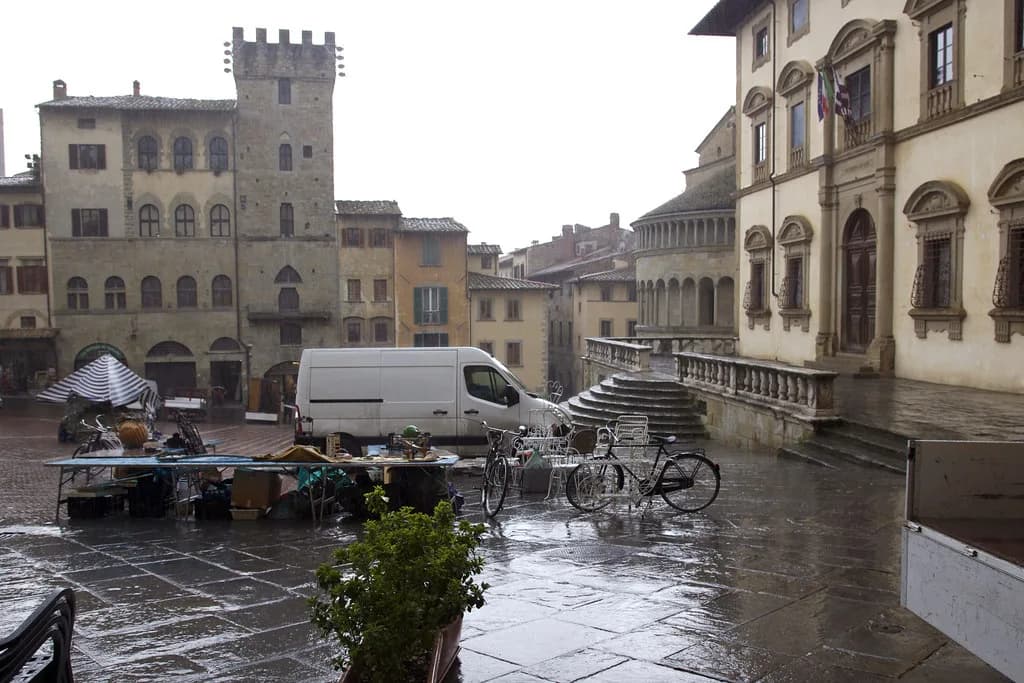
Piazza Grande is the sloping heart of the historic centre, lined with historic buildings, and it is exactly the kind of place that shines on a dry evening and disappoints in steady rain. Wanderlog describes it as a sloping square built on a hillside, which is worth knowing before you commit to a long loop of the centre on wet stone. Use it for short crossings between interiors rather than as a destination in itself.
The historic centre is best treated as a sequence of brief outdoor interludes: a quick look at the square, a sheltered coffee, a walk to the next door. Arezzo's hidden gems guide includes Piazza Grande among the places worth knowing, and it is a sensible way to identify the short stops that fit a wet day.
Cobblestones and slopes deserve respect in the rain, and a full walking plan across the centre is the first thing to drop when the weather turns. Wear shoes with grip, keep your route to one neighbourhood, and accept that the scenic detours can wait for a clearer day.
Secondary Options and Where to Verify Them
When you need alternatives, Wanderlog's attraction list also includes Arezzo Cathedral, the Palazzo della Fraternita dei Laici and the MUMEC communications museum, alongside the Medici Fortress. The cathedral sits high in the centre and has its own fresco and stained-glass interest, while the Palazzo della Fraternita dei Laici is a heritage building on the square. These are options to weigh, not a schedule to follow.
None of these should be assumed open or fully sheltered. Published information for each site is the only reliable source of opening hours, closure days and booking arrangements, so verify with the individual site or the city's tourism channels before you build a day around one. That check takes a minute and is the difference between a smooth wet afternoon and a wasted walk.
For a broader sense of how these stops fit together with the rest of the city, the Arezzo Attractions hub lists the main sights with visitor guides, and the Arezzo antiques fair and markets guide is useful if your dates coincide with market activity and you need to know how the centre changes.
How to Rebuild a Rainy Day's Schedule
The method is simple: regroup around one area, cut the cross-city hops, and alternate indoor blocks with short outside walks. If your original plan had a morning in one quarter and an afternoon across town, collapse it and accept the loss. A wet day rewards depth over coverage, and one well-seen fresco cycle is worth more than four rushed doorways.
Order the day by shelter rather than by opening times you cannot confirm. Put the longest interior stop in the middle, when rain is most likely to be persistent, and keep the smaller stops at the edges where a change of plan costs little. Leave one flexible slot empty so a closure or a queue does not force you to abandon everything after it.
Finally, keep a short list of backup interiors you have not committed to. If the basilica is inaccessible on your date, the archaeological museum or Casa Vasari can absorb the time, and the reverse also works. That redundancy is what makes the plan robust rather than rigid.
Practical Prep for a Cold, Wet Day
Historical February averages for Arezzo put highs near 9°C and lows near 1°C, with the month described as cold and breezy, so layers matter more than a single heavy coat. Wanderlog's figures are long-term climate averages, not a forecast, so check a current forecast close to your visit and adjust. Warm layers you can remove indoors, plus a waterproof outer layer, handle both the cold street and the heated museum.
Set expectations about hours before you go. Printed opening times and closure days for Arezzo's churches and museums can change with the season, so confirm on the day or the day before. Do not commit to a fixed timed itinerary built on assumptions about when doors open.
Small practical items earn their place: grip-friendly shoes for wet stone, a compact umbrella, and a plan for where to pause between stops. If you want a sense of the city's broader tourist information structure, the Fondazione Arezzo Intour site is the official place to start, though it does not publish indoor-visiting guidance.
Plan Around the Rain, Not Against It
A wet day in Arezzo is a day for choosing one interior and doing it properly, then letting the rest of the schedule follow the weather. Start with the frescoes at San Francesco or a single museum, keep the outdoor stretches short, and confirm access before you set out. The city rewards that discipline more than a packed list.
If the sun does return, the same sights read differently from the square and the surrounding streets. Use the hidden gems guide to pick up the corners you skipped, and keep the remaining Arezzo guides handy for a clearer day.
Frequently Asked Questions
What can you do in Arezzo when it rains?
Build the day around one interior that interests you most: the fresco cycle in the Basilica di San Francesco, Casa Vasari, or one of the city museums such as the archaeological collection. Keep outdoor stretches short and use the historic centre for brief crossings between stops. Because printed opening hours and access rules can change, verify with the individual site or the city's tourism channels before you commit.
Is Arezzo worth visiting in rainy weather?
Yes, if you adjust your expectations. The centre is compact, with churches, house museums and collections close enough to combine without long exposed walks. The trade-off is fewer sights and more time indoors, so choose one anchor visit rather than trying to cover everything. Check that your chosen site is open on your date before travelling across the city for it.
What should you wear in Arezzo in February?
Historical averages for the month suggest highs near 9°C and lows near 1°C, with cold and breezy conditions, so layers you can remove indoors plus a waterproof outer layer work best. Shoes with grip matter on wet cobblestones and slopes. Treat those figures as long-term climate averages and check a current forecast close to your trip.
Are Arezzo's churches and museums fully indoor options?
Not necessarily. Entrances, courtyards and queues can leave you exposed, and smaller venues may have limited space to wait inside during heavy rain. Treat each stop as indoor-leaning rather than rain-proof, and keep a café or covered arcade as a fallback between visits. Check each site's own published arrangements before relying on it.
How do you adjust a planned Arezzo itinerary for rain?
Regroup around one neighbourhood, cut cross-city hops, and put the longest interior stop in the middle of the day. Keep one flexible slot empty so a closure or queue does not ruin everything after it, and retain a backup museum in case your first choice is unavailable. Verification matters more than a fixed timetable.
Sources
Continue exploring
More guides you'll find useful





