Arezzo with Kids: A Practical Family Activities Guide
Plan Arezzo with kids: a compact walkable centre, short museum stops, hillside parks and frescoes that need booking ahead, plus realistic breaks and timing.
On this page
Arezzo rewards families who plan around small distances rather than big days. The historic centre is compact and walkable, and the city draws fewer visitors than Florence, which changes how a day with children actually feels. A realistic plan here is two or three stops, a long lunch and time outdoors, not a checklist of churches.
The practical friction is terrain, not scale. Much of the centre climbs a hill, with cobbles and sloping squares, so buggies and tired legs need a route decided in advance. Build in a sit-down break near the middle of the day, and keep one flexible hour for the inevitable slowdown.
Why Arezzo Works for Families
Arezzo sits on a hill above four valleys, and its old centre rewards walking rather than driving between sights. The city is often described as a quieter, less queue-heavy alternative to the headline Tuscan destinations, which matters most when you are travelling with children who tire of waiting. That comparative calm is the honest reason to choose it, not any claim that it is undiscovered.
The trade-off is that the centre is genuinely hilly. Think of the day as a loop: start high near the Duomo, work downhill through the shopping streets, then finish in the flatter parts around the station. Setting that direction early saves you from pushing a buggy up cobbles in the afternoon heat.
For orientation before you commit to a route, an overview of the city's sights helps you decide which two or three justify a stop with children in tow. Pacing matters more than coverage here; a single church plus a square plus gelato is a full morning.
Start at Piazza Grande
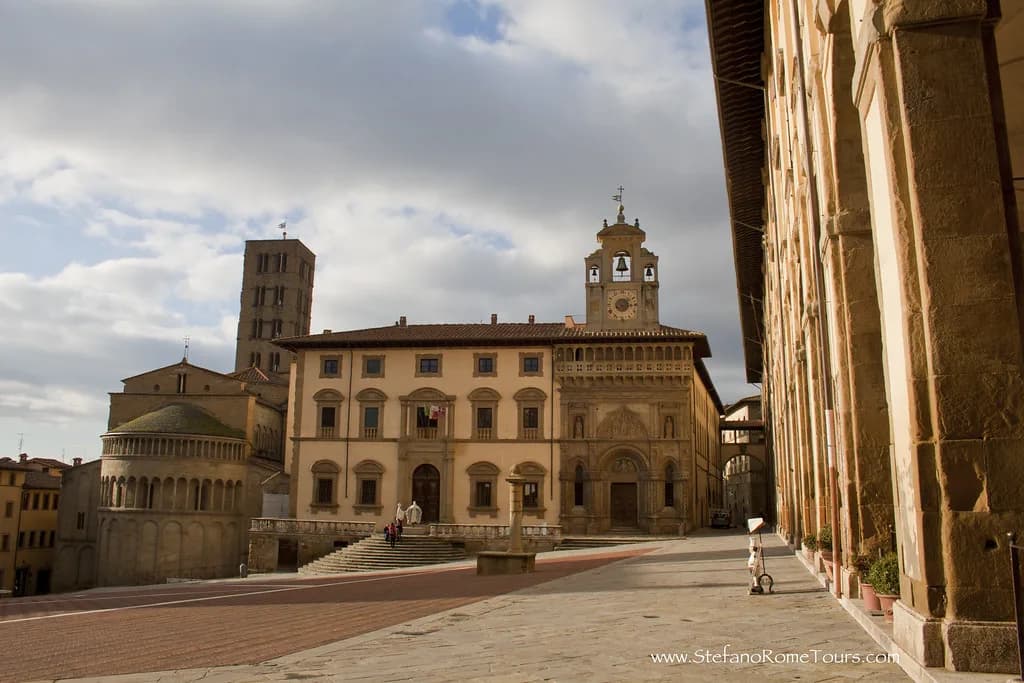
Piazza Grande is the natural first stop: a sloping, brick-paved square ringed by medieval buildings and the Vasari loggia, and it gives children open space in the middle of the historic centre. Cafes line the edges, which makes it easy to alternate movement with a seated pause.
The slope is the feature children notice first, and it is also why the square can be slippery after rain. It is a sensible base for meeting up if your group splits, and a natural place to time a snack. For a deeper look at corners like this, the city's hidden gems are worth browsing before you set a route.
One catch: the square doubles as the setting for major events, and the monthly antiques fair fills it and neighbouring streets with stalls. If you want the square as an open play space rather than a market, check the fair pattern before fixing your day.
Short Museum Stops That Work
The Archaeological Museum, the Museo Archeologico Gaio Cilnio Mecenate, sits beside the remains of Arezzo's Roman amphitheatre, which once held thousands of spectators. The pairing is the point: children get ruins outdoors and a modest collection indoors, so the visit can end when attention does rather than at a prescribed route's end.
Casa Vasari, Giorgio Vasari's house on Via XX Settembre, is small and unusual, with rooms the artist frescoed himself. It is the kind of museum that works with children precisely because it is a house with painted walls rather than a long gallery. Keep the visit short and lead with the idea that a painter decorated his own home. An older traveller account notes the frescoed ceilings and walls as the surprise of the visit.
Hours and any closed days vary by site and season, and ticketing can differ between a building and the collection inside it. Check each museum's own page before you travel rather than relying on a guidebook or an aggregator listing. Do not assume one ticket covers a whole complex.
Piero della Francesca in San Francesco
The Bacci Chapel in the Basilica of San Francesco holds Piero della Francesca's fresco cycle of the Legend of the True Cross, the work most visitors come to Arezzo for. Access to the chapel is managed separately from the church, and older visitor accounts describe admission by reservation at set times rather than free wandering. Treat reservations as the planning constraint and confirm the current system directly before you go.
Framing helps children here. The cycle tells a story involving a tree, a dream, a battle and a queen, and leading with that narrative works better than a lecture on perspective. Keep the viewing window short and let the story carry the visit.
Towers, Fortress and Room to Run
The clock tower at Palazzo della Fraternita dei Laici, designed by Vasari, offers a rooftop view over Piazza Grande and the city beyond. It is a short, focused climb rather than a long museum visit, which suits children who need a goal. Check access conditions on the day, as tower openings can be limited.
The Medici Fortress sits at the top of the hill with a park around it, and the walk up through the gardens gives children space to move after time indoors. The position means wide views and a natural place to let off energy before heading back down.
A free car park at Via Pietri is connected to the upper town by escalators, which is a practical way to avoid the climb with small children. That detail changes the shape of a day: you can arrive high, walk downhill and finish in the lower town.
If you only have a single day, a compact route covering the square, one church and the fortress park is realistic. Our one day in Arezzo itinerary sets out that sequence without overloading it. For wider planning, see One Day in Arezzo.
The Duomo: Free Church, Ticketed Museum
Arezzo's cathedral, dedicated to Saints Peter and Donato, is the largest church in the province and holds works including Piero della Francesca's Mary Magdalene and the Tarlati monument. Entry to the cathedral is separate from the adjoining museum, so plan for two possible stops rather than one combined ticket.
The cathedral operator publishes opening times and prices for the Duomo and its museum, including reduced rates for children and free entry for the youngest, but these are a snapshot that changes with season. Read the current page before travelling and treat any figure you saw earlier as provisional.
With children, the cathedral works best as a short, quiet stop: the scale, the stained glass and the facade are enough. The museum, with its different hours and ticket, is the optional extra if energy allows.
Timing the Antiques Fair and Crowds
Arezzo's antiques fair, the Fiera Antiquaria, takes over the upper town on the first Sunday of each month and the Saturday before it, with stalls running from Piazza Grande toward San Francesco. It is one of the largest in Italy, and it changes the practical experience of the centre: more people, narrower walking lines and far less open space for children.
With a buggy or very small children, that weekend is harder work, not easier. If you want the fair, go early, keep the group tight and plan a fixed meeting point. If you want the square as breathing room, choose another weekend and confirm the market dates on its own calendar.
Season matters as much as day. Late spring and early autumn give warm but manageable weather, while July and August bring real heat in the valleys and the middle of the day becomes difficult with young children.
Walks That Hold Attention
Corso Italia runs through the centre as the main shopping street, linking the lower town with Piazza Grande and the historic core. It is a natural walking spine for families: level stretches, shop windows to break up the walk, and plenty of places to stop.
Themed walks work better than general sightseeing with children. A Vasari trail linking the loggia, the clock tower and Casa Vasari gives a thread, and a Piero trail connecting San Francesco with the Duomo's Mary Magdalene gives another. Both keep the walking purposeful and the stops short.
Resist the temptation to add hill towns on the same day. Arezzo's own slopes are enough for small legs, and the surrounding towns can wait for a separate outing in the wider province guide.
Heat, Hills and Realistic Breaks
July and August in the Val di Chiana regularly push temperatures above 35°C according to family travel guidance, which makes the middle of the day the hardest window with young children. Plan indoor stops or a long lunch between roughly midday and mid-afternoon, and save the walking for morning and evening.
Cobbles and gradients are the other constraint. Many of the historic streets are steep, so a buggy route needs choosing in advance rather than improvising. Keep expectations modest: two sights and a park is a good day.
Eating with Children
Trattoria culture is the easiest route with children in Arezzo. Order simple pasta and share a plate of local salumi, and you avoid a negotiation over a separate children's menu. Bread usually arrives quickly, which buys time at the start of a meal.
For a mid-afternoon pause, a bomboloni stop near the Pieve is the kind of small ritual that resets a tired child. Keep it as a break rather than a destination, and check current opening days before building the day around it.
Timing matters more than venue choice. Italian lunch hours are later than many families expect, so an early snack plus a later lunch avoids the hungry gap. Self-catering accommodation with a kitchen makes this easier.
Beyond the City: Easy Day Trips
The Casentino forests north of Arezzo offer woodland trails that range from gentle walks to longer hikes, plus the sanctuary at La Verna on its rocky outcrop. For families wanting nature rather than churches, this is the strongest nearby option. Driving is the realistic way to reach the trailheads.
Lago di Montedoglio in the Valtiberina acts as a summer swimming and picnicking spot for families in the region. Water levels and facilities change, so check before travelling if swimming is the goal rather than a walk.
Sansepolcro and Cortona are the other obvious outings, each with a compact historic centre. Cortona is steep, so treat it as a half-day rather than a full one with small children. The regional tourism board's portal lists events and openings across the province.
Age by Age: What to Skip
With toddlers, skip the second museum and the tower climb. Focus on Piazza Grande, the fortress park and short church visits, and stay close to your base for naps. The hill towns are the first thing to cut.
Children aged roughly six to twelve get the most from Arezzo: old enough to enjoy the amphitheatre ruins, the Chimera in the archaeological museum and the story behind the frescoes, and young enough to find a medieval tower genuinely exciting.
Teenagers respond to choice. Offer a pick between the Vasari house, the fortress views and the antiques fair, and let them set the photography stops. Give them the map and a meeting time rather than a fixed route.
Where to Base Yourselves
Staying in the old town puts the main sights within walking distance and removes the daily parking question. The trade-off is that you will be carrying bags up slopes and dealing with limited vehicle access, so check arrival arrangements with your host.
A self-catering stay slightly outside the centre gives you a kitchen, space and easier parking, at the cost of a daily walk or bus ride in. For families with young children, that flexibility often outweighs the convenience of an address on the Corso.
Plan Your Family Visit
Arezzo is a good family city when you accept its scale and its slopes. Plan two or three stops a day, reserve the San Francesco frescoes ahead if they matter to you, and check current hours and tickets on each site's own page rather than trusting a listing.
Time the visit for late spring or early autumn if you can, avoid the antiques fair weekend if you want open space, and treat the middle of the day as a break rather than a sightseeing slot. That rhythm is what makes a family trip here work.
Frequently Asked Questions
Is Arezzo good for a family trip with children?
Yes, for families who prefer a compact city to a large one. The historic centre is walkable, the main sights sit close together, and the city is generally less crowded than Florence. The main challenge is the hilly, cobbled terrain, which needs a planned route with small children or a buggy.
How many days do you need in Arezzo with kids?
Two full days covers the centre comfortably: Piazza Grande, one or two short museum visits, the San Francesco frescoes and the fortress park. A single day is enough for the square, one church and a park stop. Add separate days for the surrounding valleys rather than squeezing them in.
Do you need to book the Piero della Francesca frescoes in advance?
Visitor accounts describe timed admission to the Bacci Chapel by reservation, so treat booking as a planning step rather than an optional extra. Confirm the current system on the basilica's official ticketing channel before you travel, as procedures and slots change.
Is the Arezzo Cathedral free for children?
Cathedral entry and the adjoining museum are ticketed separately, and the operator publishes reduced rates and free entry for very young children. Those figures are a snapshot that changes with season, so check the official Duomo page before your visit rather than relying on older guides.
What can families do in Arezzo when it rains?
Use the rain for the indoor stops you would otherwise skip: Casa Vasari's frescoed rooms, the archaeological museum beside the amphitheatre, or the cathedral. Keep each visit short and pair them with a long lunch. Check opening days first, since museum hours vary.
When is the best time of year to visit Arezzo with children?
Late spring and early autumn give the mildest weather for walking. July and August bring real heat in the valleys, making midday hard with young children, so plan indoor or shaded breaks then. The antiques fair weekend also means more crowds in the centre.
Are the hill towns around Arezzo pushchair-friendly?
Generally not. Cortona and similar hill towns have steep, cobbled streets that are difficult with a buggy, so plan routes in advance or use a carrier instead. Treat these towns as half-day outings and keep them separate from your Arezzo days.
Sources
Continue exploring
More guides you'll find useful