Santa Maria della Scala Siena: Visitor Guide to the Old Hospital
Plan a visit to Santa Maria della Scala in Siena: the Pellegrinaio frescoes, the Holy Nail treasure, archaeology, temporary shows, ticket scope and timing.
On this page
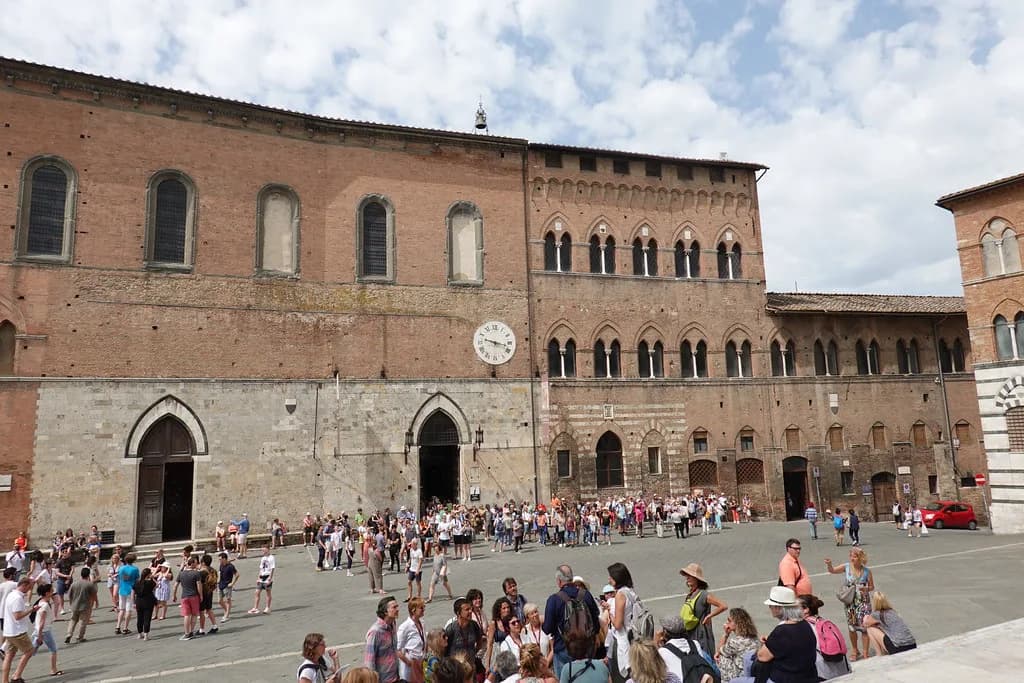
Santa Maria della Scala occupies the slope opposite Siena's cathedral and began life in the late twelfth century as a hospital for pilgrims and the poor rather than as a gallery. Its address is Piazza Duomo 1, and that origin explains why it feels like a warren of halls, chapels and service corridors instead of a single sequence of rooms; the art inside is tied to nursing, almsgiving and civic pride.
Visitors who treat it as a ten-minute photo stop usually see one frescoed hall and leave confused about the rest. Give it at least a couple of hours and the complex separates into distinct visits: the great pilgrim ward, the relic treasury, an old master collection, an archaeology museum reached through internal tunnels, and a children's art museum.
Orientation: How the Complex Is Laid Out
The museum addresses itself as Piazza Duomo 1, Siena, and its main monumental entrance sits on the piazza, so you reach it on foot from the cathedral steps rather than from a separate side street. Inside, the museum numbers its levels and describes Level IV as the first floor counting from the Piazza Duomo entrance, which is where several of the headline sights sit.
That floor brings together the Pellegrinaio, the treasure, the Piccolomini Spannocchi Collection, the Old Sacristy, the Santissima Annunziata church and halls that once served as pilgrims' dormitories. Knowing this saves backtracking: work through the historic core in one sweep, then descend for the archaeology rooms and temporary shows.
The museum complex plus the National Archaeological Museum sit within the same building, but do not assume every room, temporary show or collection shares one ticket. The Battistero di San Giovanni Siena visitor guide covers the baptistery below the cathedral, a natural companion stop for a Duomo day, and it explains its own separate arrangements.
Opening Hours, Free Sundays and Last Admission
The museum has published a general pattern of daily opening from 10:00 to 19:00, announced in a visitor notice on its site, and holiday notices for Easter, 25 April and 1 May confirm the same hours on those days. Read those as the baseline rather than a promise: the notices page also records earlier closings for Palio days, delayed openings, strike days and short closures for events.
One ticket-office notice states that the ticket office closes 45 minutes before closing time, which in practice sets your latest realistic entry. Because that detail appears in a specific notice rather than a general rule, confirm the last admission time for your date before setting out.
On the first Sunday of every month the museum complex opens free to the public, and the museum's own description extends that to the National Archaeological Museum, making it an excellent day for a longer visit. Expect more people in the Pellegrinaio and the treasure room on those mornings, and arrive near opening if the frescoes matter most to you.
Ticket Scope: What You Are Actually Buying
The complex sells tickets for its own itineraries, and the museum explains that visits can be organised around different routes through the historic, architectural and artistic layers of the building. It does not publish a simple statement that every room, temporary exhibition or separate collection shares one ticket, so treat the main museum ticket as covering the permanent complex unless the ticket desk tells you otherwise.
Prices are not published in the material reviewed here, so check the tickets page on the museum site or ask at the desk on arrival rather than budgeting from old figures. If a special exhibition is your reason for coming, confirm at the same time whether it needs a supplement.
Access to the square, the cathedral exterior and the hospital's outer courtyard is separate from the museum interiors, and the Fonte Gaia fountain on the Piazza del Campo is a public monument in its own right, not part of the complex. Plan your ticketed time and your free wandering as two different parts of the day.
The Pellegrinaio: Reading the Fresco Cycle
The Pellegrinaio, the men's pilgrim ward, was added in 1328 when the hospital bought and demolished neighbouring houses to bridge a three-storey drop, extending care space toward piazzetta della Selva. Its ceiling was decorated between 1439 and 1441 by Agostino di Marsiglio across five bays and the connecting arches, with saints, coats of arms and plant motifs above the visitors' heads.
The walls work best read as a sequence of hospital life rather than as isolated masterpieces. In the fourth bay on the left, Domenico di Bartolo's Alms shows the weekly distribution of bread to the poor, with pilgrims, the sick and noble figures including Sigismondo in the same scene; nearby, the third bay carries the alms of the small courtyard and scenes of hospitality.
Look also for the care of the sick in the fifth bay on the left, another Domenico di Bartolo panel detailing hospital doctors, friars and nurses in 1378, and for the marriage of the maidens in the fourth bay, a charitable practice that shows the hospital acting as a social institution. The story of Sorore hangs above the side door leading toward the Sant'Ansano and San Galgano aisles.
Those two aisles were originally one large male dormitory, later altered between the thirteenth and nineteenth centuries, so the frescoed ward, the dormitory and the church together describe a working institution rather than a princely palace.
The Treasure and the Holy Nail
In 1359 the hospital, backed by the Commune of Siena, bought a collection of relics from Byzantium that included the Holy Nail, an object of intense veneration. The reliquary made for it, with relief scenes of the Resurrection and Crucifixion, is one of the most significant liturgical objects in the complex and sits with the treasure on the fourth level.
The treasure room is compact, so it rarely demands long, but it explains why the hospital mattered far beyond Siena. Pair it with the Madonna of the Mantle, painted by Domenico di Bartolo in 1444 for the Chapel of the Relics and later moved to the Old Sacristy, where restoration in 1969 revealed preparatory sketches and hidden side panels.
Piccolomini Spannocchi Collection and the Old Sacristy
The Piccolomini Spannocchi Collection was formally founded in 1774 after the marriage of Caterina Piccolomini di Modanella and Giuseppe Spannocchi, but it draws on three separate nuclei with roots far older than that union. Its history is entangled with seventeenth-century European politics, which gives the paintings a family and diplomatic backstory rather than a purely aesthetic one.
The Old Sacristy belongs to the 1340s renovation, when the hospital's religious and care spaces were enriched with paintings, furnishings and chapels until it ranked among the most important centres of early Sienese Renaissance production. Look for the Vecchietta's Christ the Redeemer in the church of the Santissima Annunziata before or after this room.
If you enjoy palace interiors, the Palazzo Chigi-Saracini Siena visitor guide covers another privately shaped collection in the city and makes a logical follow-on for travellers who like paintings in domestic-scale rooms.
National Archaeological Museum and the Tunnel Route
The National Archaeological Museum grew out of small antiquities collections formed in Siena between the late nineteenth and early twentieth centuries, and it now sits within the Santa Maria della Scala complex. Its route, Siena. Racconto della città dalle origini al Medioevo, runs through the tunnels facing the internal road and uses finds, documents and photographs to trace the city from its earliest remains to the medieval commune.
This is the part most hurried visitors miss, because it is underground and reached after the frescoed halls. If you have an hour left, the tunnel route gives a different Siena from the painted one above, and the free first Sunday described by the museum covers both, making it a good day to combine them.
Children's Art Museum and Hands-On Rooms
The Children's Art Museum was founded in Siena in 1998 and moved into Santa Maria della Scala in 2007, where it also took on the role of educational services for the complex. Its collection of international works on childhood has been housed in the San Leopoldo hall since 2008, and the museum's stated aim is to make the young visitor the protagonist of the visit.
The complex also hosts a tactile route of works made with sculpture students from the Duccio di Buoninsegna art high school, plus black-and-raised images of city monuments created with the Siena section of Uici and Rotary Siena Est. Availability of these materials on any given day is not guaranteed by the published pages, so ask at the desk if you are relying on them.
Temporary Exhibitions and Guided Tours: How to Check
Santa Maria della Scala runs a busy programme in the Magazzini della Corticella and other halls, and its 2026 listings have included Remember Joseph Beuys from 13 September to 15 November 2026, an architecture exhibition curated by Luca Molinari Studio that closed on 27 September, and Metamorfosi del Sacro with works by Teodora Axente ending on 30 August. Check the events section for what is actually on during your dates rather than planning around past listings.
The museum has also advertised a special cycle of visits, A porte chiuse, opening roughly 18,000 square metres of the complex previously closed to the public between 10 September and 29 October 2026, alongside free guided tours for the Giornata del Contemporaneo. Whether that cycle continues beyond its published run is something only the museum can confirm.
Before you travel, open the events and exhibitions section and match titles to your actual dates, then check whether a show is included in your ticket or sold separately. An audio guide for the complex, such as the SmartGuide entry for Santa Maria della Scala, can fill in the narrative if you prefer to move at your own pace.
Old notices on the museum's site show how often things shift, from a closure in late January and early February 2026 for Wine&Siena to flooring work that closed rooms on the fourth level in autumn 2025. Treat any single published schedule as needing a same-week confirmation.
How Long to Allow, and a Short-Visit Cut List
This is a recommendation rather than an official figure: allow about two hours for the Pellegrinaio, the treasure, the Piccolomini Spannocchi Collection and the archaeology tunnels, and half a day if you add a temporary show and the children's museum. The building rewards slow walking because so much of the interest is in ceiling decoration, inscriptions and the fabric of old service spaces.
With 45 minutes only, go straight to Level IV from the Piazza Duomo entrance and see the Pellegrinaio frescoes and the Holy Nail reliquary, then leave. Skip the archaeology route and the old master collection rather than rushing all three, since the tunnels and painting rooms need more time than a quick pass allows. If you are building a walking day, the Siena self-guided walk old town can slot the complex into a route through the old streets, but keep the museum as a fixed block rather than something you dip into between sights.
Practical Cautions Before You Go
The museum posts operational notices that genuinely affect visitors: earlier closing on Palio days, delayed openings, temporary room closures and general strikes during which service may be disrupted or hours changed. Check the notices page in the week of your visit, especially if you are travelling in late June, July or August when the Palio reshapes the city's day.
Notices on the site have also recorded free evening openings and special hours for events such as the European Night of Museums, so a late arrival is only worth planning if a current notice confirms it. The museum's contact address, email and telephone numbers are published on the site if you need to ask directly.
For a wider sense of what else is worth your time in the city, especially quieter churches and corners, explore the hidden gems beyond the main squares, where the Basilica of San Domenico offers a very different scale of visit.
Plan Your Visit
Santa Maria della Scala is best treated as the second half of a Duomo morning: arrive near opening, head to the Pellegrinaio and treasure first, then descend to the archaeology tunnels if your legs and schedule allow. Confirm the day's hours and last admission on the museum site before you set out, and check whether a free first Sunday fits your trip.
If you are still choosing between Siena's sights, the Siena Attractions hub compares the cathedral, baptistery, palaces and museum complexes so you can match them to the hours you actually have.
Frequently Asked Questions
Is entry to Santa Maria della Scala free on the first Sunday of the month?
The museum states that on the first Sunday of every month the complex opens free to the public, and its own description includes the National Archaeological Museum. Other days, exhibitions and any special events may have separate arrangements, so check the current notice for your date.
What are the opening hours and when is the last admission?
The published general pattern is daily opening from 10:00 to 19:00, with holiday notices repeating those hours. One ticket-office notice says the ticket office closes 45 minutes before closing, but Palio days, strikes and events can change the schedule, so confirm on the museum notices page before travelling.
Is the National Archaeological Museum included with the museum complex?
The archaeology museum sits within the Santa Maria della Scala complex and the museum's free first Sunday description extends to it. Whether every special exhibition is included on a normal day is not stated clearly, so ask at the ticket desk if a particular show matters to you.
How long should I allow for a visit?
As a recommendation rather than an official figure, allow about two hours for the Pellegrinaio, the treasure, the Piccolomini Spannocchi Collection and the archaeology tunnels. With only 45 minutes, see the pilgrim ward frescoes and the Holy Nail reliquary and skip the rest.
What should I see first in the Pellegrinaio?
Start with Domenico di Bartolo's Alms in the fourth bay on the left, showing the weekly bread distribution, then the care of the sick in the fifth bay. Read across the bays rather than room by room, and look up at the ceiling decorated by Agostino di Marsiglio between 1439 and 1441.
Are temporary exhibitions and guided tours included in the ticket?
The museum does not publish a blanket statement that temporary shows are covered by the main ticket, so check the event page for each exhibition and ask at the desk. Guided tours such as the 2026 A porte chiuse cycle and the Giornata del Contemporaneo visits had published dates that have now passed.
Can I visit the ruins and tunnels without seeing the artworks?
The archaeology route through the internal tunnels is part of the complex, so in practice you enter through the museum rather than separately. If the tunnels are your priority, say so at the ticket desk so staff can point you to the right starting level.
What should I do if visiting on a Palio day?
The museum has posted early closures for Palio days, including a 10:00 to 16:30 day on one August date, so check the notices page before a June, July or August visit. Plan the museum as a morning block and leave the afternoon free for the city's changing crowd patterns.
Sources
Continue exploring
More guides you'll find useful