Basilica di Sant'Antonino, Sorrento: What to See Inside
Plan a visit to Sorrento's patron saint basilica: medieval origins, Romanesque facade, crypt ex-votos, whale-rib legend and February 14 feast tradition.
On this page
The Basilica di Sant'Antonino is the church most Sorrentines point to when asked about their patron saint, and it sits close enough to Piazza Tasso that it slots naturally into any walk through the old town. The exterior reads as a compact Romanesque building in grey tuff, but the interior reveals centuries of reworking, with Baroque additions layered over medieval bones. Treat it as a working place of worship first and a sight second, and the visit rewards you differently.
This guide covers what the building actually contains, how to read the facade and the three naves, why the crypt matters, and how the local legend of a rescued child connects to the bones displayed near the entrance. It also separates what is reliably described in published visitor accounts from what you should check on arrival, particularly the current hours and whether the crypt is open. For the wider set of sights around town, the Sorrento Attractions hub is a useful next stop.
Where the Basilica Sits in Sorrento
The basilica occupies a corner of the old town just off the main square, on Piazza Sant'Antonino, and the walk from Piazza Tasso takes only a few minutes. Because it is not a large church, it is easy to pass without registering, so look for the grey stone facade and the bell tower set into it. Its position makes it a natural midpoint between the shopping streets and the clifftop gardens.
If you are building a half-day route, pair the basilica with the lanes around Piazza Tasso and the sea views further west. A Sorrento walking tour self-guided through the centro storico can absorb the church without making it the sole purpose of the outing. Many travelers treat Sorrento as a base rather than a destination in itself, and this church is one of the few interior sights that justifies a pause. For wider planning, see A Self-Guided Walking Tour of Sorrento's Historic Center.
A Medieval Church Reworked Over Centuries
Published accounts describe the site's origins in a small oratory built in the 9th century around the saint's tomb, later expanded into a church with a basilica layout of three naves separated by twelve marble columns. Those columns are thought to have been reused from Roman villas in the area, a common medieval practice of recycling older stone. That alone tells you the building is not a single-period design.
The structure was subsequently enlarged and redecorated, with the 17th and 18th centuries introducing Baroque ornament that sits alongside the medieval fabric. One older visitor account describes the church as grand but essentially baroqued, which is a useful reminder that the interior impression depends heavily on which century you look at. Approach it expecting a palimpsest rather than a pristine Romanesque interior.
According to About Sorrento, the basilica is among the oldest on the Sorrentine Peninsula and has long served as a pilgrimage destination, though that superlative comes from a single secondary source rather than an official designation. Take it as a description of local standing, not a verified ranking.
Reading the Exterior
The facade has a marked Romanesque influence, built in grey tuff with a portico leading into the interior, and the bell tower is integrated into the front rather than standing apart. That integrated tower is one of the building's most recognizable features in the townscape. Look for the later decorative layers that soften the severity of the stone.
The square outside holds the second of two statues of the saint in Sorrento, the other standing in Piazza Tasso. Both show him treading on a sea creature that reads like a whale. Before going inside, it is worth a moment to look at the statue and then match it to the bones displayed in the vestibule.
Inside the Three Naves
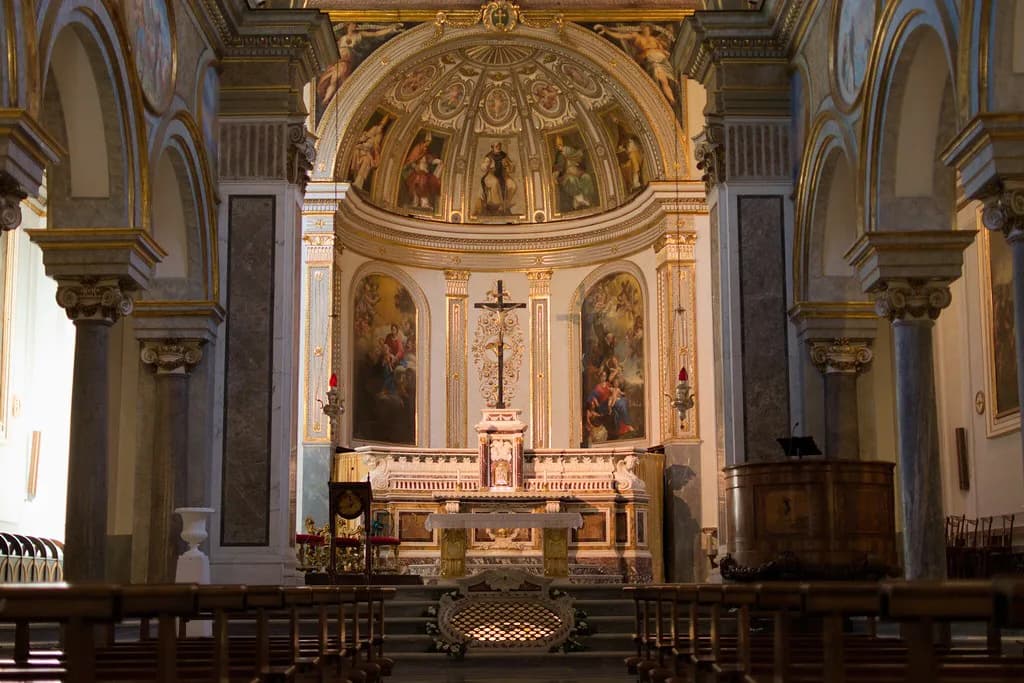
The interior follows a longitudinal plan with three naves, the central ceiling painted with coffered panels by 18th-century artists including Giovan Battista Lama, whose work depicts episodes from the saint's life. Paintings by Giacomo del Po celebrate miracles connected to the protection of Sorrento from plagues and sieges, and further frescoes narrate the saint's miracles. Give the ceiling and the side paintings more time than the pews.
The twelve columns are the quiet highlight: sculpted, varied, and most likely reused from Roman villas, which is why they do not quite match. If you enjoy spotting architectural recycling, this is a small masterclass. The overall effect is darker and more layered than a Baroque church alone would suggest.
The Crypt Beneath the Apse
Under the apse, reached by marble stairs, the crypt known as the succorpo preserves the saint's remains along with votive offerings and evidence of popular devotion. It is supported by columns and also holds paintings by Carlo Amalfi depicting Sorrento's patron saints. Because access involves stairs, check on arrival whether the crypt is open that day rather than assuming it always is.
The votive cases surrounding the tomb are the most affecting part. One older account describes floor-to-ceiling glass cases wallpapered with silver talismans, one devoted entirely to legs, others filled with shaped body parts stamped with anatomical detail. The labels often read per grazie ricevute, which carries a double meaning in Italian because grazie serves for both thanks and grace. Read the cases slowly; they are a record of ordinary people's fears and recoveries.
Behind the altar, cases hold silver babies, some beside blurry photographs of the infants concerned. At the crypt exit, the entry wall is lined with more than 30 prints and paintings of 19th-century ships in storms, with the saint appearing in an aura of light to save sailors. The most recent is a photograph from the 1950s, donated by the captain of a motorboat named after the saint.
The Whale-Rib Legend at the Entrance
Just inside the main doors, mounted high on the wall to the right of the vestibule, are bones said to be the remains of the sea creature from the saint's most famous miracle. The legend varies in detail, but the core is consistent: a child was swallowed, and Antonino called the creature from the depths and forced it to spit the boy out alive. The bones are described in sources as whale ribs of some sort, not as scientifically identified relics.
A separate account places the bones at the main entrance and describes them as evidence of the miracle that locals associate with a child rescued from the jaws of a shark, so even the creature shifts between tellings. That variation is part of the story's life in Sorrento. Treat the bones as a legend attached to the building rather than a settled fact.
The Patron Saint and the February 14 Feast
Sant'Antonino died on February 14, AD 626, and his feast day falls on that date, shared with Saint Valentine. On the day, crowds gather to pay homage to the saint's remains in the crypt, and a procession winds through the main streets with representatives of the town's confraternities, religious dignitaries, and the municipal administration carrying a silver statue of the patron. February 14 is also when many Sorrentines mark the town's identity, and Lonely Planet notes the day brings religious processions, markets, street food, and fireworks.
The silver statue is kept in the sacristy, which one account describes as a small museum of sacred art holding the statue, paintings from different eras, and an 18th-century nativity scene of considerable value. The programme for any given year is not published here; if you plan around the feast, confirm details through the town's official channels rather than relying on older descriptions.
If you want the atmosphere without the crowds, a quiet weekday visit shows the crypt cases and the statue's setting more calmly. The trade-off is that you miss the procession and the square at its most alive. Plan according to whether you want to observe the devotion or simply understand it.
The Two Statues in Town
Sorrento honors its patron with two prominent statues, one in Piazza Tasso and one in Piazza Sant'Antonino, both showing the saint standing over the sea monster. The repetitions are a useful way to read the town: the saint is placed at the main square and at his own church, marking the route between civic and religious centers. Look at the faces of the statues; they are sometimes overlooked by passersby.
Practical Planning: Hours and Access
One older visitor account listed the church as open daily 7am–noon and 5–7pm and gave a telephone contact, but that listing dates from the mid-2010s and should not be treated as current operator hours. The town and regional tourism sites are where to confirm opening times before you go, since churches in Sorrento are working places of worship and can change access without notice.
Entry to the basilica is not confirmed here as a fixed free or ticketed arrangement, so ask when you arrive rather than assuming. The basilica should also be separated from the separate Museo Correale di Terranova collection, which is a different institution and site; its hours and any closure windows do not carry over. If you want a paid museum on the same day, check the Museo Correale di Terranova site directly.
Because the crypt is reached by stairs, anyone with limited mobility should check access arrangements with the church on arrival. Published descriptions do not give accessibility rules for the stairs. A short visit of 20 to 30 minutes suits the nave and crypt when open; allow longer if you want to read the ex-votos carefully.
Etiquette and Timing
Dress modestly with shoulders and knees covered, as Lonely Planet advises for churches in the area, and keep voices low in the crypt. Avoid visiting during Mass if you can, since the church is active. The busiest moments coincide with feast days and tour groups, so mid-morning or late afternoon tends to be calmer.
Where to Go Next
The Villa Comunale, a short walk west, offers the classic clifftop view over the Bay of Naples, and it appears in lists of free things to do in Sorrento. The Chiostro di San Francesco is another quiet corner nearby, a 14th-century cloister that many people pass by. Together with the basilica, these two make an easy, low-cost morning.
For more of Sorrento's less obvious corners, the hidden gems in Sorrento guide collects neglected and quiet places, including the cloister and the city's lesser-known churches. A separate Chiostro di San Francesco Sorrento visitor guide goes into detail on that cloister if you want to see it properly. If you plan to swim, Bagni della Regina Giovanna Sorrento visitor guide covers the rocky cove west of town, though it is a hike from the center.
Plan Your Visit
The basilica works best as a short, deliberate stop during a walk through Sorrento's old town. Come with modest dress, expect a layered interior, and leave time to read the crypt cases; the details are the reason to step in. Check current opening times and crypt access with the church or the town's tourism office before you plan around it.
If you are seeing several sights, the Basilica pairs naturally with the Villa Comunale and the Chiostro di San Francesco. Consult the Sorrento Attractions hub for the other sights and the hidden gems guide for places beyond the main squares. That way, one small church becomes part of a coherent day rather than an isolated detour.
Frequently Asked Questions
Is the Basilica di Sant'Antonino free to enter?
Entry is not confirmed here as a fixed free or ticketed arrangement, and published descriptions do not settle the question. Ask at the church door or check the town's tourism information before you go, rather than assuming either way.
How long should I spend at the Basilica di Sant'Antonino?
Twenty to thirty minutes covers the nave and the crypt when it is open. Allow longer if you want to read the silver ex-votos and the storm paintings lining the crypt walls, which reward a slower look.
Can visitors see the crypt and the saint's remains?
The crypt, known as the succorpo, holds the saint's remains and the votive cases, and it is reached by marble stairs. Access should be checked on arrival, since published sources do not guarantee it is open at all times.
What are the whale ribs at the entrance about?
The bones mounted near the main doors are attached to the local legend that Sant'Antonino rescued a child from a sea creature. Sources describe them as whale ribs of some sort rather than scientifically identified relics, and the story varies in the telling.
When is the feast of Sant'Antonino in Sorrento?
The feast falls on February 14, the date of the saint's death in AD 626. The day brings a procession through the main streets with the silver statue; details of any given year's programme should be checked through official town channels.
Where is the basilica in relation to Piazza Tasso?
It stands on Piazza Sant'Antonino, a short walk from Piazza Tasso in the old town. The approach passes through the lanes of the centro storico, so it fits easily into a walking route.
What should I wear when visiting the basilica?
Cover shoulders and knees, as is expected in Italian churches, and keep voices low in the crypt. Avoid shorts and sleeveless tops if you plan to go inside.
Which nearby sights pair well with a visit?
The Villa Comunale clifftop gardens, the 14th-century Chiostro di San Francesco, and the lanes around Piazza Tasso are all within easy walking distance. The Museo Correale di Terranova is a separate museum and deserves its own time slot.
Sources
Continue exploring
More guides you'll find useful