Mausoleo di Galla Placidia: A Visitor Guide to Ravenna's Starry Vault
Plan a visit to the Mausoleo di Galla Placidia in Ravenna: what to see inside, how it pairs with San Vitale, and where to confirm tickets before you travel.
On this page
The Mausoleo di Galla Placidia is easy to underestimate from the outside: a modest brick structure in central Ravenna, a short walk from the Basilica of San Vitale. Its pull is not scale but concentration, a compact Latin-cross interior whose mosaics cover nearly every surface above eye level. It is one of the oldest buildings in Ravenna, dating to the 5th century AD, and it forms part of the city's UNESCO World Heritage site.
This guide covers what the decoration shows and the order in which to read it, the short history that explains why the building stands apart from the church it once served, and how to pair it with San Vitale without treating the two as interchangeable stops. Prices, opening hours and any booking arrangements change, so plan to confirm them with the operator rather than relying on secondhand summaries.
Quick Orientation: A Small Building in a Big Heritage Group
The mausoleum stands in Ravenna's historic centre, close to the Basilica of San Vitale. The Opera di Religione della Diocesi di Ravenna presents five UNESCO monuments together in the centre: the mausoleum, San Vitale, Sant'Apollinare Nuovo, the Neonian Baptistery, and the Chapel of Sant'Andrea with the Archiepiscopal Museum. If you are building a mosaic-focused day, these are the names to keep on one list.
The building's setting is part of the experience: the operator notes that it stands very close to San Vitale, in the shadow of a centennial plane tree that turns golden in autumn. Arriving on foot through the centre is straightforward and puts you in the right frame of mind, so allow time to approach slowly rather than treating it as a drive-by stop between two other sights.
Why This Is Not a Normal Church Visit
Most church visits ask you to look down a long nave toward an altar. Here the plan is a Latin cross, the space is small, and the decoration is arranged to be read upward from the walls to the dome. The operator describes a deliberately stark architectural shell that contrasts with the richness of the interior, which sharpens the effect of the mosaic work above.
That compactness changes your pacing. You are not walking a circuit; you are standing in a room and lifting your eyes in stages. Visitors who move through quickly tend to remember a general impression of gold and blue rather than specific scenes, so the reading order in the next section is the single most useful thing to carry in with you. As an editorial suggestion rather than an official timing, plan to spend enough time inside to complete one slow circuit of the surfaces before you leave.
What You See Inside, Read Bottom to Top
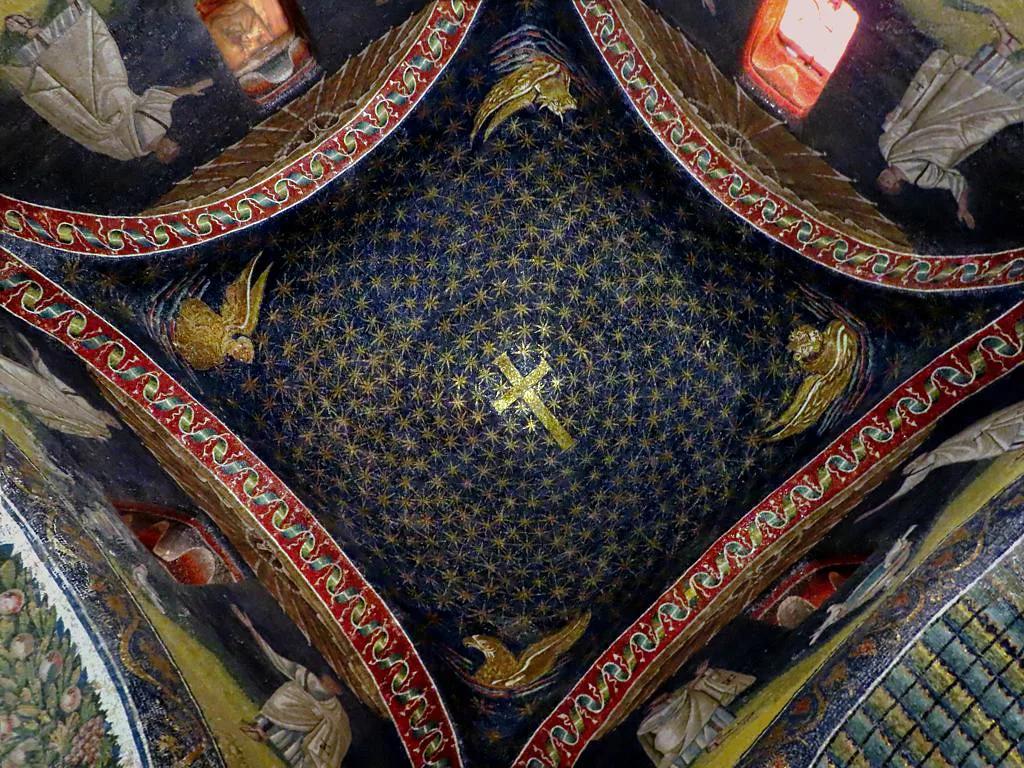
Start low and work upward. In the pendentives of the central dome, the four living creatures of the Evangelists appear: a winged lion for Mark, a winged ox for Luke, a man for Matthew, and an eagle for John. The operator explains that they represent the four Gospel writers carrying the message to the four corners of the world, which is why they sit at the transitional points of the architecture rather than in a single panel.
In the barrel vaults, pairs of apostles raise their hands toward a central cross inscribed as the crux sancta et invicta. That cross sits at the centre of the dome, surrounded by stars, and points eastward, the direction from which Jesus is expected to come to restore the dead to life. This is the image most visitors carry away: a deep blue field scattered with gold stars around a jewelled cross.
The lunettes complete the programme. Above the entrance door, the Good Shepherd sits among his flock; opposite, Saint Lawrence runs toward martyrdom carrying a cross and a cabinet holding the four Gospels. Between the apostles, pairs of doves drink from a vessel, and on the eastern and western lunettes deer drink at a pond and acanthus shoots appear in the background, a reference to Psalm 42. Water, in other words, runs through the whole scheme as a symbol of life.
The Two Lunettes: Good Shepherd and Saint Lawrence
The Good Shepherd lunette over the door is the first scene many visitors notice, partly because it faces them as they enter and partly because the figure is immediately legible even without context. It sets a pastoral tone that the rest of the decoration complicates rather than repeats. Look at it before turning around, because the Saint Lawrence lunette opposite answers it.
Saint Lawrence is shown in motion, carrying the cross and the cabinet of Gospels as he heads toward martyrdom. Together the two lunettes frame the room's message: the cross triumphing over death, announced at the entrance and enacted at the far end. Knowing this makes the starry dome read as a conclusion rather than a decorative ceiling.
A Short History You Can Use
The mausoleum was built in the first half of the 5th century as an oratory at the southern end of a narthex, the entrance portico that belonged to the Church of the Holy Cross. In 1602 the church and the mausoleum were separated, which is why the building now reads as a freestanding monument rather than a chapel attached to a larger complex. That single fact explains much of what puzzles first-time visitors about its position.
It was intended to contain the remains of Galla Placidia, daughter of Theodosius the Great, sister of Honorius, and mother of Valentinian III. Because her son was only six when he came to the throne, she became regent of the Western Roman Empire. She died in Rome in 450 and was buried in the family vault there, so the building's name records an intention rather than a burial.
For visitors, the history is useful mainly as a lens. It tells you why the interior is so densely theological, and why a building this small was built to such a high standard of craftsmanship. The city tourism board also confirms its status as one of Ravenna's oldest buildings and part of the UNESCO site, which is a useful cross-check if you are assembling a shortlist.
Pairing the Mausoleum With San Vitale
The mausoleum and the Basilica of San Vitale are neighbours, and they are deliberately contrasting experiences rather than two versions of the same thing. San Vitale is vast and processional; the mausoleum is intimate and compressed. Seeing them back to back sharpens both, because the scale shift is immediate and physical.
Decide which to see first rather than letting the queue decide for you. The operator frames the two as allies and rivals, each leaving visitors wanting more of the other, so either order works emotionally. What matters is leaving enough attention for the second building instead of treating it as an afterthought once the first has exhausted your looking.
Tickets and Logistics: Confirm Before You Travel
The operator runs a ticket office and publishes a section on opening times and prices, and that is where current admission costs, combined-monument options and any reductions should be checked. This guide deliberately does not quote figures, because ticket structures for multi-monument groups change and a stale number is worse than none. Check before you fix your dates, not on the morning of your visit.
Do not assume that every UNESCO monument in Ravenna shares one ticket or one entry arrangement. They are presented as a group for visitors, but the practical question of what a given ticket covers is exactly the kind of detail the operator's pages answer and general summaries do not. Read the ticket terms on the official site, including which monuments are included in any combined offer.
If you want human confirmation, the operator lists an information and booking office by telephone and email, open Monday to Friday from 9.00 to 16.00, excluding public holidays. Use it for questions about group visits, guided tours or specific needs rather than relying on forum posts. Third-party review pages can be useful for atmosphere but should not be your source for prices or times.
Notices, Ceremonies and Seasonal Openings
The operator maintains a dedicated section for evening openings and has run a summer programme promoted as Mosaico di notte in July and August in the past. Treat any such programme as seasonal and separately confirmed, not as a standing feature of the mausoleum. If an evening visit appeals, check the current listing close to your travel dates.
Seasonal notices on the operator's site also flag temporary conditions. One notice states that from October 2026 baptisms at the Neonian Baptistery will be celebrated only on the last Saturday of each month, with visits suspended during part of that period. Notices like this change with the calendar and are worth reading before you set out, though they concern a different monument in the group.
Practical Mistakes to Avoid
The first mistake is treating the mausoleum as a walk-in stop with no planning. Because it belongs to a managed group of monuments, your visit is shaped by the operator's arrangements, and those are worth checking before you set out. The second is skipping the reading order and leaving with only a vague memory of blue and gold.
The third is misjudging how the sites are ticketed, assuming one purchase covers everything or that separate entries are needed for each. The fourth is rushing the interior; the room rewards a slow second look at the lunettes after the dome. Build in time to stand still, because the detail is small and close.
Finally, resist the urge to rely on outdated blog posts for practical details. Use them for context and use the operator for facts. That division keeps the planning useful and the visit unhurried.
Where It Fits in a Wider Ravenna Itinerary
Ravenna rewards a mosaic-focused day built around the five diocesan monuments, with the mausoleum as the concentrated opener or the quiet closer. From there, add the city's other layers: the streets around San Vitale, the corners beyond the main squares, and the churches that rarely appear on shortlists. Our guide to hidden gems in Ravenna covers several of those stops, including the Basilica of San Francesco and Dante's Tomb, if you want to extend the day beyond the headline sites.
If you are comparing monuments before committing, the Ravenna Attractions hub sets out the main sights side by side so you can decide how many to fit into your time. Read it alongside this guide rather than instead of it: the hub gives you the map, and this page gives you the interior.
Plan Your Visit
The Mausoleo di Galla Placidia rewards preparation more than most small monuments. Know the reading order, understand the 1602 separation from the Holy Cross church, and treat it as a deliberate pair with San Vitale rather than a box to tick. That is enough to turn a brief stop into the most memorable room of your Ravenna day.
Then confirm the volatile details, prices, hours and any seasonal openings, through the operator before you travel. Leave slack in your schedule for a second look, and let the rest of the city fill in around the mosaics.
Frequently Asked Questions
What is most of the decoration in the Mausoleum of Galla Placidia made of?
The interior decoration is mosaic work, set against a deliberately plain architectural shell. The most famous element is the starry dome around a central jewelled cross, with Evangelist symbols in the pendentives, apostle processions on the barrel vaults, and the Good Shepherd and Saint Lawrence lunettes. The contrast with the simple brick exterior is part of the effect.
Can you visit the Mausoleo di Galla Placidia and San Vitale on the same ticket?
They are neighbours within the same UNESCO monument group and are usually discussed together, but you should not assume one purchase covers both. Check the ticket terms on the operator's official site, or ask at the ticket office, to see what any combined offer includes before you buy.
What should you not miss inside the Mausoleo di Galla Placidia?
Look up in stages: the Evangelist symbols in the pendentives, the apostles on the barrel vaults, and the starry dome with its central cross. Then compare the two lunettes, the Good Shepherd over the entrance and Saint Lawrence carrying the cross, and notice the water motifs, doves and deer, that run through the programme.
Are there evening openings at the Mausoleo di Galla Placidia?
The operator keeps a section for evening openings and has run summer programmes in the past, but these should be treated as seasonal rather than permanent. Check the current listings on the official site close to your travel dates rather than assuming an evening slot will be available.
Why does the mausoleum stand apart from a church?
It was built in the first half of the 5th century as an oratory at the end of the narthex of the Church of the Holy Cross. In 1602 the church and the mausoleum were separated, which is why it now reads as a freestanding monument rather than a chapel attached to a larger complex.
Was Galla Placidia buried there?
The building was intended to hold her remains, but Galla Placidia died in Rome in 450 and was buried in the family vault there. The mausoleum's name records the intention, not the burial, which is worth knowing before you read the interior programme.
Sources
Continue exploring
More guides you'll find useful