
Visit the Basilica di San Vitale, Ravenna: Mosaic Guide
Plan a visit to the Basilica di San Vitale in Ravenna: Justinian and Theodora mosaics, how long to allow, and the five-monument UNESCO mosaic circuit.
On this page
The Basilica di San Vitale is the monument many travellers picture when they plan a mosaic day in Ravenna: an octagonal church set back from the shopping streets, its presbytery glowing with gold tesserae and the celebrated portraits of Emperor Justinian and Empress Theodora. It is one of five UNESCO-listed diocesan monuments in the historic centre, so the practical questions are less about whether to go and more about ordering your day, understanding what your ticket actually covers, and giving the mosaics enough time. The operator describes San Vitale as the city's most-visited monument, which shapes how you should schedule it.
Quick answer: why San Vitale anchors a Ravenna mosaic day
San Vitale is a sixth-century Byzantine church whose interior decoration concentrates on the presbytery and choir, reached through a high triumphal arch lined with mosaic medallions of Christ, the apostles and saints Gervasius and Protasius. The two panels most people come for sit at eye level on the lower walls: Justinian with his court on one side, Theodora with her attendants on the other, both carrying offerings toward the altar. A visit is short in distance but dense in detail, so it rewards a slow, deliberate half hour far more than a quick loop past the highlights.
Because the church belongs to a diocesan group of monuments rather than standing alone as a single-ticket attraction, the sensible planning move is to treat it as the anchor of a circuit and build the rest of the day around it. The official tourism portal for the city also lists San Vitale among Ravenna's paleochristian monuments forming part of the UNESCO World Heritage Site, which helps explain why the mosaics are protected and presented as a coordinated ensemble rather than as separate curiosities.
Where San Vitale sits in the historic centre
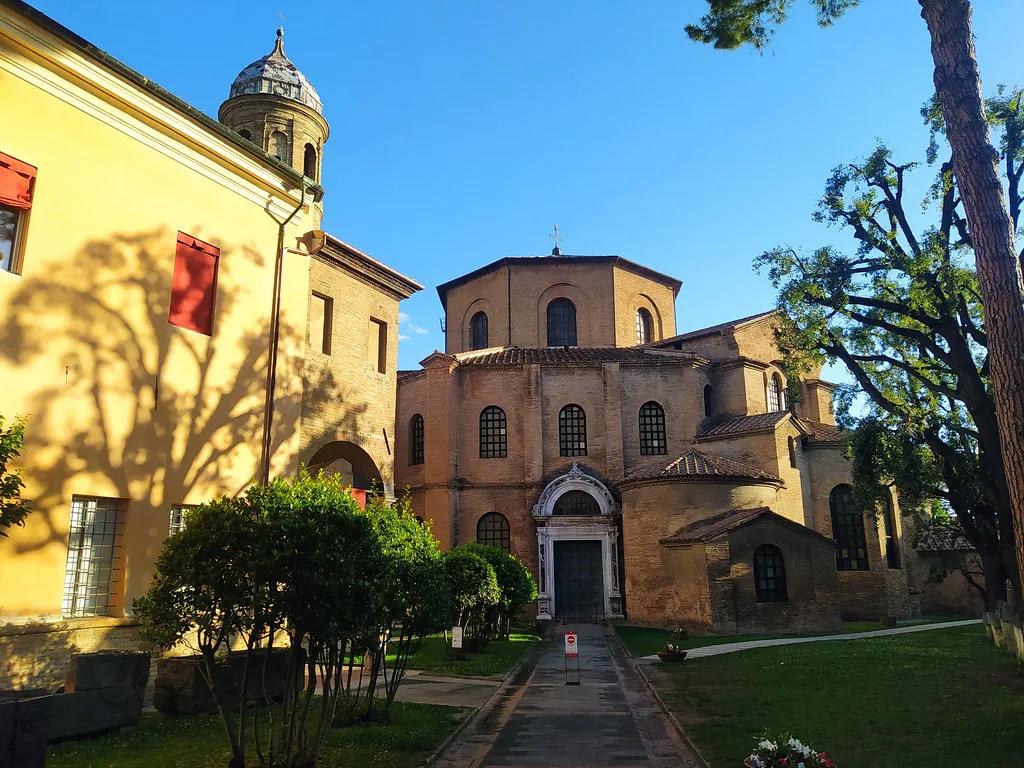
San Vitale stands close to today's Via Cavour in the heart of the historic centre, set slightly back from the street along a driveway so that the church arrives almost as a surprise after the surrounding shops and porticoes. The operator's own orientation advice is simple: walking along Via Cavour, turn into Via Argentario in the direction of San Vitale. That single instruction is more useful than any map app for first-time arrivals, because the approach is easy to overshoot.
The wider advantage of this position is that the diocesan monuments cluster within a walkable spread of the centre, so you can move between them on foot without needing buses or taxis. Keep the city's official site bookmarked for local notices that can affect walking routes or street access on the day of your visit.
The five diocesan monuments and how the mosaic ticket circuit is scoped
The Opera di Religione della Diocesi di Ravenna presents five UNESCO-listed sites together: the Mausoleo di Galla Placidia, the Basilica di San Vitale, the Basilica di Sant'Apollinare Nuovo, the Battistero Neoniano, and the Cappella di Sant'Andrea with the Museo Arcivescovile. The operator maintains dedicated pages for opening times and prices, which is where the current structure of the ticket offer is actually published. Do not build a budget from a guidebook or an old blog post, because the scope and terms of combined tickets can change between seasons.
The practical decision is to check, monument by monument, what your ticket includes rather than assuming one purchase covers all five sites on identical terms. Some mosaics sit inside active churches with their own rhythms of worship, and a baptism or service can interrupt visitor access to a space even when the site is open. Before you commit to a circuit, confirm the scope on the operator's own pages and treat any single-ticket assumption as unverified until you read it there.
What to look for inside: the imperial panels and the apse
The Justinian and Theodora panels show the rulers at the centre of their retinues, holding a golden cup and a paten as offerings, and the operator notes pointedly that neither sovereign ever actually visited Ravenna. The panels work as a pair, so look at Theodora's jewelled robes and the court officials opposite before stepping back to see how both processions converge on the Eucharist at the altar.
Around the altar, Old Testament scenes face each other: Abraham's hospitality to the three angels at the oak of Mamre and the near-sacrifice of Isaac on one side, the offerings of Abel and Melchizedek on the other. These are chosen to echo the bread and wine of the liturgy, so they read differently once you have seen the imperial offerings below. In the apse, a beardless Christ in gold and purple sits on the celestial globe, handing a martyr's crown to Saint Vitalis, with Bishop Ecclesius offering a model of the church he commissioned.
High above, the Agnus Dei caps the cross vault at the point where the host is elevated during Mass, which explains the vertical logic of the whole programme. Give yourself permission to sit or stand still and read upward from altar to vault to apse, rather than working side to side. This is the kind of interior where one deliberate pass beats several hurried ones.
A short history: Ecclesius, 525 and 547
Bishop Ecclesius commissioned the church after returning from Constantinople in 525, with financing from the banker Giuliano Argentario, and it was built over an earlier fifth-century chapel dedicated to Saint Vitalis. It was consecrated in 547 by Bishop Maximian, who had also commissioned the interior decoration. Those dates are useful anchors: they place the mosaics within a few decades of the fall of the western empire and explain the deliberate imperial imagery.
That historical layering helps when you look at the church from the outside, where the plain brick octagon gives little away about the interior. The contrast is the point: an unassuming exterior, an overwhelming presbytery. Knowing who paid for it and who consecrated it turns the mosaics from decoration into a political and theological statement.
Klimt, gold and why art-minded visitors linger
Gustav Klimt visited Ravenna twice in 1903, and the operator links those visits to the beginning of his so-called golden period, arguing that he took the formal language of the gold mosaics while leaving behind their theological content. Whether or not you accept the full claim, standing in front of the gold tesserae makes the connection legible: flat fields of colour, strong outlines, figures pushed toward the viewer.
If you care about that lineage, look first at how the gold is set at slightly different angles so the surface shifts as you move. Then look at the greens, blues and whites of the vegetal and animal details around the margins, which situate the church in Ravenna's own pinewoods and wetlands as much as in Byzantium. It is a useful reminder that the mosaics are local work in a global idiom.
How long to allow
As an editorial suggestion rather than an official figure, allow around 30 to 45 minutes inside San Vitale if you want to read the imperial panels, follow the Old Testament scenes and take in the apse without being pushed along. Add time if you like to sit with a space. The church is compact, but the amount of visual information is high, and the temptation to rush toward the next monument on the circuit is real.
A more realistic frame for the day is to plan two to three hours across two or three diocesan monuments rather than trying to see all five properly in one push. San Vitale and the Mausoleo di Galla Placidia alone, done with attention, fill a comfortable morning. Check the operator's calendar before locking that estimate in, because events and worship can reshape the time you actually get inside.
Timed entry and booking
San Vitale draws the heaviest footfall of the diocesan monuments, and the operator notes that its small interior hosts the highest daily attendance in the city. That combination of fame and physical scale makes it the one site on the circuit where arriving without a plan is most likely to cost you time. Booking a timed slot in advance is the sensible default, especially for short stays or weekend trips.
Reservations are handled through the operator's own booking channels, and the information office can be reached by telephone and email on weekday mornings, excluding public holidays, according to the contact details published on the site. Do not assume a specific slot interval, an online-only system or walk-up availability: the operator publishes the current booking arrangements, and that is the version to trust on the day you book.
The quieter monuments on the circuit reward the opposite approach. Once you have secured San Vitale, leave room to move between the Battistero Neoniano and Sant'Apollinare Nuovo without a rigid timetable, since a church with fewer visitors is exactly where an unplanned twenty minutes pays off.
Pairing San Vitale with the other mosaic monuments
The most natural pairing is the Mausoleo di Galla Placidia, a small cruciform building where cobalt blue tesserae meet a dome of golden stars; the operator presents the two as neighbouring highlights of the same UNESCO group. Its intimacy is the counterweight to San Vitale's scale, so see it either immediately before or after. Note that it is a separate monument with its own capacity, so check how entry is managed rather than assuming you can walk straight in.
The Battistero Neoniano offers a different pleasure: a domed mosaic of the baptism of Christ with the apostles processing around it, described by the operator as almost a joyful dance. Sant'Apollinare Nuovo, a short walk away along Via di Roma, lines its nave with virgins and martyrs in procession. Together they let you read the same visual language across three very different building types.
The Cappella di Sant'Andrea and the Museo Arcivescovile complete the diocesan set with the ivory throne of Bishop Maximian and the small chapel whose gold surface catches the light. If your time is limited, choose by appetite: blue stillness at Galla Placidia, imperial ceremony at San Vitale, processions at Sant'Apollinare Nuovo. Each has a different ticket and entry arrangement to verify with the operator, so treat the circuit as a set of decisions rather than a single purchase.
When you want a break from mosaics altogether, the city repays a slower afternoon, and there are quieter corners worth folding into the same walk, including the Basilica of San Francesco and the streets around it.
Common mistakes to avoid
The first mistake is assuming one ticket admission covers all five monuments on identical terms; check the scope of what you buy before you queue. The second is rushing the presbytery, which is where nearly all the mosaic narrative sits. The third is arriving at San Vitale at the busiest hour without a slot and then cutting the rest of the circuit short to compensate. Plan the sequence, not just the list.
A fourth mistake is skipping the reading in favour of photographs. The Old Testament scenes only make sense as a programme when you notice how they answer the imperial offerings below, and no image captures the way the gold changes as you move. Budget a little stillness.
Where to verify prices, hours and notices before you travel
Ticket prices, opening hours, evening openings and one-off notices for San Vitale and the other diocesan monuments are published by the Opera di Religione della Diocesi di Ravenna on its official site, which also carries a dedicated notices section for changes affecting visitors. Check it in the week before you travel rather than relying on any secondary summary, including this one.
For civic information, including transport changes and city-wide events that could affect a day in the centre, the Comune di Ravenna publishes its own updates. Between the operator's pages and the city's, you have what you need to confirm the practical details, and neither source is a substitute for the other.
If a detail matters to your plans, such as whether a particular chapel is accessible on the day or how a combined ticket is structured this season, contact the operator's information office directly. It is better to ask than to build a schedule on a rule that has quietly changed.
Plan Your Visit
San Vitale rewards a visitor who arrives with a sequence in mind: book a slot for the church itself, see the imperial panels and the apse without hurrying, then let the smaller monuments on the circuit take the rest of the day at their own pace. Verify the current ticket scope, prices and hours with the operator before you go, and leave room for the city between the mosaics.
If your trip has space for more than the headline sights, our guide to the hidden gems in Ravenna picks up where the mosaic circuit leaves off, with quieter streets, smaller churches and slower afternoons in the same compact centre.
Frequently Asked Questions
How long does it take to see the mosaics at San Vitale?
As an editorial suggestion, allow roughly 30 to 45 minutes inside the basilica if you want to study the Justinian and Theodora panels, the scenes around the altar and the apse without being hurried. Photography, crowding and your own pace will all change that. Check the operator's calendar before you go, since worship and events can affect how much time you actually get inside.
What should I not miss inside the Basilica di San Vitale?
Prioritise the paired imperial panels of Justinian and Theodora, which face each other at eye level with their retinues and offerings. Then look at the Old Testament scenes around the altar, the apse mosaic of Christ with Saint Vitalis and Bishop Ecclesius, and the Agnus Dei at the top of the cross vault. Read the decoration upward as a single programme rather than as separate highlights.
What is the Church of San Vitale in Ravenna known for?
It is known for its sixth-century Byzantine mosaics, above all the portraits of Justinian and Theodora, and for the apse theophany showing a beardless Christ in imperial dress. The church was commissioned by Bishop Ecclesius around 525 and consecrated in 547 under Bishop Maximian. It belongs to a group of five UNESCO-listed diocesan monuments in the city centre.
Where can I buy tickets for the Ravenna mosaics?
Buy through the Opera di Religione della Diocesi di Ravenna, which operates the five diocesan monuments and publishes the current ticket and booking arrangements on its official site. Before purchasing, check which monuments and which entry terms a given ticket covers, because the circuit is not simply one uniform admission. The operator's information office can confirm details by telephone or email on weekday mornings.
Do all five Ravenna mosaic monuments share one ticket?
Do not assume so. The operator presents the Mausoleo di Galla Placidia, San Vitale, Sant'Apollinare Nuovo, the Battistero Neoniano and the Cappella di Sant'Andrea with the Museo Arcivescovile as one UNESCO group, but the scope and terms of combined tickets should be verified with the operator before you buy. Treat any claim of a single uniform ticket as unconfirmed until you read the current terms yourself.
Is San Vitale busier than the other mosaic sites?
The operator describes San Vitale as the diocesan monument with the highest daily attendance in the city, so it is the one where booking a timed slot in advance matters most. The smaller monuments, such as the Mausoleo di Galla Placidia and the Battistero Neoniano, have their own capacity limits but generally give you more breathing room. Sequence your day so San Vitale gets your freshest attention.
Sources
Continue exploring
More guides you'll find useful





