
Villa Episcopio Ravello: History and Current Visitor Access
Villa Episcopio in Ravello is an 11th-century former bishops' palace. Learn its layered history, its 1944 royal episode and why you can't visit inside today.
On this page
Villa Episcopio is one of Ravello's oldest pieces of architecture and one of its least visitable. It began in the 11th century as the residence of the town's bishops, and over the following centuries it served as a seminary, a refuge for the poor, a Scottish botanist's restoration project and the site of a wartime royal residence. Today the UNESCO Amalfi Coast heritage page lists the complex as undergoing renovation with no visitor access, so a stop here is about reading the building from the street rather than touring rooms. For wider planning, see Duomo di Ravello Visitor Guide.
That single fact shapes everything else in this guide. You will find the history worth understanding, the location in Ravello's oldest quarter, and honest guidance on what you can and cannot promise yourself at the gate. If your aim is a paid interior, a garden walk or a coastal panorama, the practical answer is to spend that time at Ravello's other villas and treat Episcopio as a landmark you pass and interpret.
Is Villa Episcopio Open to Visitors Right Now?
The UNESCO Amalfi Coast entry for Villa Episcopio states plainly that the complex is in the course of renovation and records no visitor facilities. That is the most specific access information available, and it means you should plan on the building being closed rather than on finding a ticket desk. No reopening date, partial opening or guided schedule is published in the sources consulted.
Because conditions on restoration sites change quietly, the honest move before you build a stop around Episcopio is to check with the Comune di Ravello or the local tourist office in the days before you travel. Treat any claim that gardens, terraces or interiors are open as unverified unless it comes from the town or the property itself. Do not rely on a holiday rental listing or an old travel blog for access, since neither is a statement about public visiting.
Where Villa Episcopio Sits in Ravello
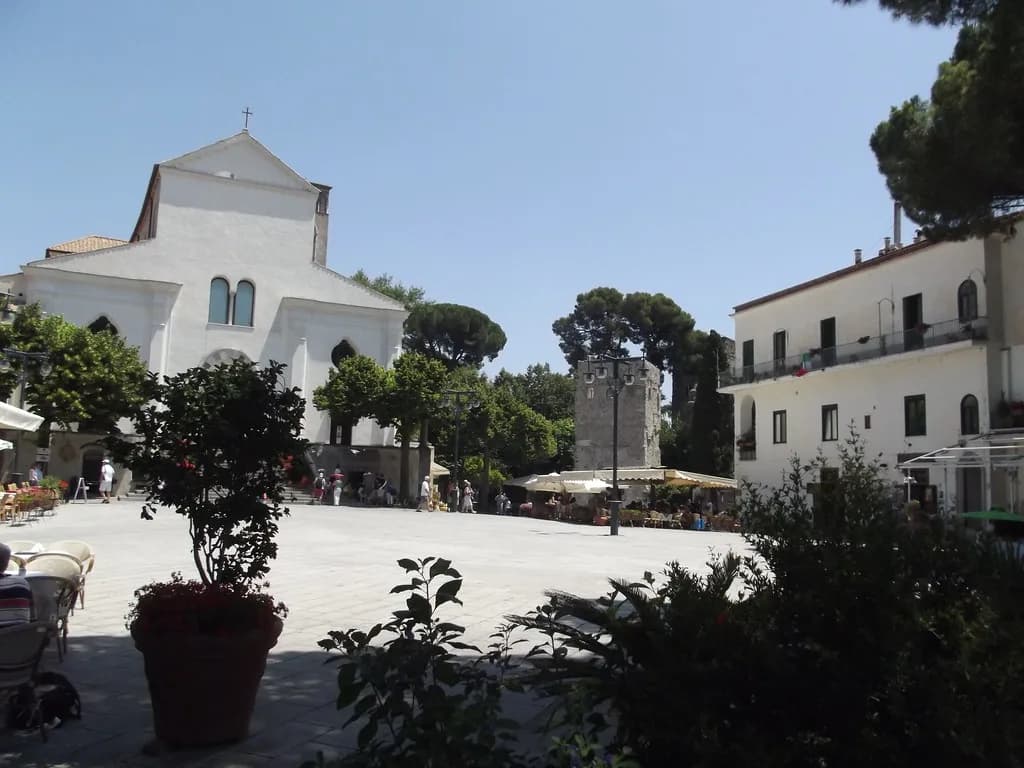
The villa stands on Via Episcopio in the rione Toro, the oldest nucleus of Ravello, according to the UNESCO heritage description. That places it in the lanes above and behind the cathedral core rather than on the main approach to the famous villa gardens. Walkers exploring the historic centre will pass close to it, which is precisely why knowing what you are looking at matters.
For orientation, a holiday rental description of an apartment in the historic centre places Piazza Duomo about 100 metres from the property and notes that the lanes around it fall within a limited traffic zone. That is a useful reminder that Ravello's core is compact and pedestrian, and that arriving by car puts you in the hands of paid parking rather than at the villa's door.
What 'Villa Episcopio' Actually Means
The name misleads. Episcopio is not a pleasure villa built for a noble family's leisure but the ancient residence of the bishops of Ravello, erected during the 11th century. The UNESCO description lays out a multi-storey complex with an atrium and vaulted rooms, following the conventions of the medieval Ravello domus. Expect thick masonry, layered levels and an inward-looking plan rather than a symmetrical facade with a garden axis.
Two churches once stood beside the palace: San Bartolomeo, already ruined by 1606, and Tutti i Santi, which in the 16th century was used as a furnace for casting bells. Neither survives as a visitable monument, so what you see today is the palace fabric without its original sacred neighbours. Knowing this helps you interpret the street pattern around Via Episcopio instead of looking for buildings that are no longer there.
Reading the Building From Outside
A street-level look at Episcopio is an exercise in reading a palazzo that has been rebuilt and re-purposed many times. The UNESCO account describes a complex of several floors with an atrium and vaulted interiors, typical of the medieval Ravello house, which is why the building reads as a tight cluster of volumes rather than a single frontage. Look for the massing and the way the structure steps with the slope, and accept that the rooms behind the walls are not on show.
Do not expect a coastal belvedere. The sources consulted do not establish that the villa's terraces or gardens are publicly reachable, so any sea view from the building should not be promised to yourself in advance. Keep the camera for the lanes and the cathedral square, where the views and the architecture are reliably accessible to anyone walking through town.
Seventeenth and Eighteenth Century Reinvention
By the 17th century the episcopal complex had fallen into disrepair. Bishop Giuseppe Saggese began its restoration and the building took in the diocesan seminary, and the UNESCO account records that its halls hosted the meal traditionally offered to the diocesan clergy on Holy Thursday and on the feast of the Assumption. Later in the same century Bishop Biagio Chiarelli enlarged the complex with new rooms, frescoes and columns.
The palace also housed the episcopal curia and a workshop called the celendra, used for cleaning, calendering and dyeing woollen cloth, a trade documented in Ravello from 1299 until the plague of 1656. By the end of the 18th century the building had become a house of the poor, sheltering men, women and children who received a frugal meal as their only means of support. That sequence, from bishop's seat to seminary to charitable shelter, is the part of Episcopio's story most visitors never hear.
Francis Nevile Reid and the Modern Villa
In the second half of the 19th century the Scottish botanist and art lover Francis Nevile Reid acquired Villa Episcopio and carried out restoration work on it. The Villa Cimbrone family history adds that the Reid family had bought both Villa Episcopio, formerly the bishops' palace, and Palazzo Rufolo in 1851. Reid's intervention is the hinge between the building's ecclesiastical past and its later life as a place that welcomed travellers.
That same account traces how the Vuilleumier family's hospitality business began in 1874, when Pasquale Palumbo was hired by Reid and took charge of what became the Pensione Trattoria Palumbo inside the former Episcopal Palace. The Palumbo venture is described as the first real hotel in Ravello, drawing British travellers on the Grand Tour who came for the beauty and history of the coast. It is a lineage worth knowing, though it tells you nothing about whether the doors are open now.
From Palace to Pensione
The UNESCO page credits Pasquale Palumbo, a Reid employee, and his wife Elisabeth Von Wartburg, who came from Bern, with turning the old Episcopio into Ravello's first pensione. The Villa Cimbrone history adds detail: Palumbo had earlier, in 1870, started commercial wine production under the Cantina Episcopio name, from vines in the Episcopio garden and beside the cathedral. The building, in other words, has a working past as well as a ceremonial one.
Guest lists from that era are the stuff of Ravello's self-image, and the family history mentions figures as varied as André Gide, Truman Capote, Humphrey Bogart and Gina Lollobrigida passing through the Palumbo hotel over the decades. Read such names as hotel history rather than as evidence that Episcopio is a sight you can enter. The distinction matters when you are deciding where to spend a limited afternoon.
1944: The Royal Interlude
From February to June 1944 Villa Episcopio was the temporary residence of King Vittorio Emanuele III and Queen Elena, guests of Duke Riccardo di Sangro, who had acquired the house in 1926. On 22 April of that year the ministers of the first Government of National Unity, formed by the anti-fascist parties, took their oath before the sovereign in the palace's great hall. On 5 June the king handed the lieutenancy of the kingdom to his son Umberto in the same setting.
This is the episode that gives Episcopio its national significance, and it is entirely historical: the rooms where it happened are not open for viewing. Treat the story as context for the building you pass, and if you want a deeper sense of Ravello's public history, the Duomo di Ravello visitor guide covers the cathedral and its museum, which are the places to spend time indoors.
Planning a Ravello Walk Around Episcopio
Build your day around what is reliably visitable and let Episcopio be a brief pause. Ravello's core is small enough to cross on foot, and a route that takes in Piazza Duomo, the lanes of the Toro quarter and one of the big villa gardens gives you a coherent half day without depending on a closed building. A quick look at our Ravello Attractions overview helps you slot the sights in the right order.
For a garden and coastal panorama, the Villa Cimbrone in Ravello is the property to consider: its own history notes a very large garden with a wide variety of trees and flowers open to the public. Its story is separate from Episcopio's, so do not assume the two share ownership, tickets or access rules.
Villa Rufolo is the other obvious alternative, and it belongs to a different chapter of Ravello's story. If you are hunting for the quieter corners between the headline sights, our guide to the hidden gems in Ravello points to lanes and viewpoints that reward slow walking rather than queueing.
For the medieval fabric of the Toro quarter, the Chiesa di San Giovanni del Toro Ravello guide explains a church in the same part of town with a very different visiting profile. Pairing it with a look at Episcopio's exterior gives you a sense of the quarter's layers without overpromising access anywhere.
Common Mistakes to Avoid
The most frequent error is assuming that because Villa Rufolo and Villa Cimbrone welcome visitors, every villa in Ravello does. Episcopio is a former bishops' palace under renovation, and the UNESCO page gives no indication of public entry. Do not plan a day around a garden that may not exist as a public space or a terrace you have seen in a photograph.
A second mistake is treating the building as a museum with tickets, hours and a shop. No such details are published, so there is nothing to budget for and nothing to book. If you want a ticketed interior in Ravello, choose a site that actually sells admission and confirm the current terms directly with that site on the day.
Plan Your Visit
Villa Episcopio rewards curiosity more than scheduling. Its value lies in the 11th-century origins, the seminary and poorhouse years, the Reid restoration and the 1944 oath, all of which you can hold in mind while standing in the lane outside. Confirm the renovation status with the Comune di Ravello before you go, and keep your indoor time for Ravello's visitable churches and villas.
If you are building a longer Amalfi Coast itinerary, treat Ravello as a half-day of lanes and gardens rather than a checklist of villas. Use the attraction guides to choose one paid garden, one church and one slow walk, and leave room for the unplanned viewpoint that turns out to be the best part of the day.
Frequently Asked Questions
Is Villa Episcopio open to visitors?
The UNESCO Amalfi Coast heritage page describes the complex as in the course of renovation and records no visitor facilities. No reopening date or partial opening is published there. Check with the Comune di Ravello or the local tourist office shortly before travelling, and plan on seeing the exterior only.
Can you see the sea from Villa Episcopio?
The sources consulted do not establish that the villa's gardens, terraces or interiors are publicly accessible, so a coastal view from the building should not be assumed. For reliable panoramas, head to Ravello's public squares and to villa gardens that openly admit visitors.
Is Villa Episcopio the same as Villa Rufolo or Villa Cimbrone?
No. Villa Episcopio is the former bishops' palace in the Toro quarter, a medieval complex with a history as a seminary, poorhouse and hotel. Villa Rufolo and Villa Cimbrone are separate properties with their own histories, ownership and visitor arrangements, and neither shares access rules with Episcopio.
Where is Villa Episcopio in Ravello?
It stands on Via Episcopio in the rione Toro, the oldest part of Ravello, close to the cathedral core according to the UNESCO heritage description. The surrounding centre is compact and pedestrian, so it fits naturally into a walk through the historic centre rather than a separate trip.
Do you need tickets for Villa Episcopio?
No ticket information is published because the building is not presented as a visitable attraction. Rather than budgeting for entry, plan to spend your admission money at a Ravello site that openly sells tickets, and confirm current terms with that site directly.
What was Villa Episcopio used for historically?
It was built in the 11th century as the bishops' residence, later housed the diocesan seminary and a woollen-cloth workshop, became a shelter for the poor in the late 18th century, was restored by Francis Nevile Reid in the later 19th century, became Ravello's first pensione, and in 1944 was the temporary royal residence of Vittorio Emanuele III.
Sources
Continue exploring
More guides you'll find useful





