
Villa Cimbrone Ravello: A Visitor Guide to Gardens & Terrace
Plan a visit to Villa Cimbrone in Ravello: the hotel and public gardens, the Terrace of Infinity, garden highlights, and the walk from Piazza Duomo.
On this page
Villa Cimbrone sits at the far end of Ravello, high above the Amalfi Coast, on a rocky spur that gives the estate its name. It is an unusual hybrid: a historic villa that operates as a hotel, wrapped in large gardens that open to day visitors. The draw is not one building but a sequence of paths, statues and sudden sea views ending at the celebrated Terrace of Infinity.
Because part of the estate is a working hotel, the first planning decision is understanding what you can and cannot walk into. The gardens are the public element; the villa interiors and guest areas are not a museum circuit. Once that split is clear, a visit becomes simple: walk out from the centre, pay for the grounds, and give the terrace real time rather than a quick photo stop.
Villa vs Garden: What You Are Actually Visiting
Hotel Villa Cimbrone describes a residence with roots in the twelfth century, preserved by the Vuilleumier family across generations of hotel management. Its history page traces the family's Ravello hospitality back to 1874, when Pasquale Palumbo managed a pension at Villa Episcopio for Francis Nevile Reid. That lineage explains why the property reads as a lived-in house rather than a restored monument.
For visitors, the practical point is that the villa operates as a hotel with guest rooms, a restaurant and event spaces. The gardens are the part open to the public, and that is where you should set expectations. If you arrive imagining a room-by-room tour of the villa, you will be disappointed; if you arrive for a long garden wander and a clifftop edge, you will not.
Ravello itself makes more sense once you see it as a cluster of separate sites rather than one attraction. The Ravello Attractions hub lays out the main sights and how they relate, which helps you decide how much time to give each one. Treating the estate as one stop among several is far more realistic than building a whole day around it.
Villa Rufolo is the obvious comparison and the easiest to confuse with Cimbrone. It is a distinct property in the centre of town, entered from beside the cathedral, with its own gardens and its own admission. Bundling the two villas into a single mental entry is the most common planning error in Ravello.
Walking from Piazza Duomo Through Ravello's Lanes
The approach is part of the visit. From Piazza Duomo, where the cathedral stands, the route to Villa Cimbrone is roughly four-tenths of a mile along pedestrian-only lanes, lined with ceramic shops, vines and the occasional sleeping cat. It climbs gently rather than steeply, but the surface is uneven stone, so shoes matter more than distance.
If you would rather make the town itself the point, a Ravello self-guided walk threads the lanes and viewpoints at your own pace and ends naturally at the villa gate. That format suits travellers who want context along the way instead of a single destination.
Driving changes the calculation. The climb from the coast road to Ravello is narrow and winding, with sections controlled by traffic lights, and parking in town is limited. Many visitors arrive by bus or taxi from Amalfi and walk the centre on foot; that approach removes the parking problem entirely and pairs well with the lane route to the estate.
Budget water and a slow pace, especially in warm months, and carry a layer for the shaded stretches under trees. The route is short enough to do twice if you want to see the shops on the way back. Set aside time for the return leg, which is mostly downhill but still cobbled.
Arrival and Ticket Scope: What Admission Covers
Admission at the gate is for the gardens, not the hotel. That distinction decides what you see: paths, parterres, sculpture and the terrace are inside the ticketed grounds, while the villa building, restaurant and guest spaces are not part of a visitor route. Plan the visit around the grounds and treat any glimpse of the building as scenery rather than an exhibit.
Prices and opening hours change with season and management decisions, and the estate does not publish them through third-party guides. Check the hotel's own site, or contact it on the published details, before you set out, particularly outside the main spring-to-autumn window. Do not rely on travel blogs for current figures.
The gardens are also used for private events, which can affect access on a given day. If your trip hinges on the terrace, ask about event closures when you confirm hours. A short email ahead of a tightly planned day is cheaper than discovering a wedding has taken the belvedere.
Ravello's wider sights have their own arrangements, so do not assume one ticket opens everything. The town's official pages and the individual villa sites are the places to confirm each property's current terms. Build your day around confirmed openings rather than optimistic assumptions.
The Terrace of Infinity: The Estate's Signature Moment
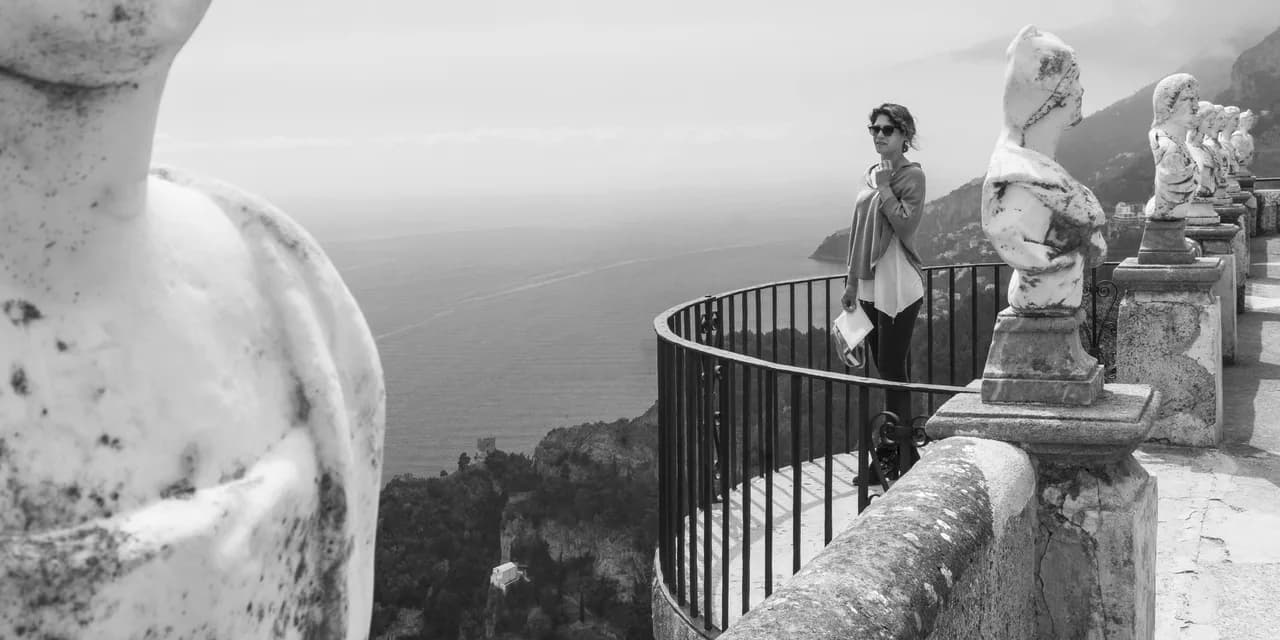
The Belvedere, known as the Terrazza dell'Infinito or Terrace of Infinity, is the reason most people come. A balustrade lined with worn stone busts marks the cliff edge, and beyond it the Mediterranean and coastline open out with nothing in the way. The busts themselves are whimsical rather than solemn, which keeps the scene from feeling like a monument.
Gore Vidal's line about a wonderful place from which to observe the end of the world is often quoted here, and the setting explains why. The drop is real, so keep children close and resist the urge to perch on the balustrade. Standing back a metre still gives you the full horizon.
Treat the terrace as a timed moment rather than a base camp. Take one composed photograph, step aside, and let the next visitors have their turn at the rail. Arriving early or late in the day gives softer light and fewer people, which makes that rotation easier for everyone.
The approach through the grounds builds the effect deliberately. You walk shaded paths, pass sculpture and planting, and only then reach the opening in the trees. Rushing straight to the edge flattens that sequence; the slower route is the point of the design.
Beyond the Terrace: Statues, Plantings and Shaded Paths
The garden is a layered landscape rather than a flower bed. Its framework is associated with English landscape design, and the planting mixes exotic species with Mediterranean staples, so the walk changes character section by section. Shade, stone and sudden colour alternate, which is why the grounds reward unhurried wandering.
Look for the quieter compositions away from the belvedere: sculpture framing a path, a doorway opening onto greenery, a bench placed where the light falls. These details are easy to miss if you keep your camera pointed only at the sea. They are also where the grounds feel least crowded.
The estate's long history shows in its layers. The site is first mentioned in the eleventh century, and the name comes from the rocky outcrop that surrounds the grounds, known as Cimbronium. Lord Grimthorpe's later work gave the property much of its romantic English character, though current management and ownership should be checked with the hotel rather than assumed from old accounts.
Ravello's artistic reputation adds context to the visit. The town attracted writers and musicians for centuries and later drew figures such as Virginia Woolf, Greta Garbo and Gore Vidal, and the gardens carry some of that cultivated atmosphere. Knowing this makes the eccentric statues read as a collection of curiosities rather than random ornament.
Pacing Your Visit and Choosing Your Light
As a suggestion rather than an official figure, allow around an hour to ninety minutes for the gardens if you want the terrace without rushing. Photographers and garden enthusiasts will want longer. The distance is short, but the pleasure is in stopping, so a tight schedule works against you.
Morning gives cleaner light across the water and generally thinner crowds; late afternoon brings warmer colour and a softer mood but more company on the terrace. Spring and early autumn are the sweet spots for mild weather and fewer visitors. High summer is hot and busy, and winter is quieter but cooler.
Build in a pause somewhere shaded before you reach the belvedere. Arriving calm changes how the terrace lands, and it keeps you from treating the walk as a transfer. A bench and ten quiet minutes are a legitimate part of the itinerary.
If you are combining the estate with other Ravello stops, sequence them so the villa is not the exhausted last item. The gardens reward attention, and a visit squeezed between two other sights rarely gets it. Give the terrace a slot of its own.
Etiquette on a Working Estate
Remember that people are staying here. Keep voices low near the building, avoid photographing guests, and do not wander into doorways that are not marked for visitors. The atmosphere that makes the place special depends on that courtesy.
Dress with a little care. Garden paths and chapel-style spaces call for modest, comfortable clothing and quiet behaviour, and shoulders and knees covered are a sensible default in this part of Italy. It is a small effort that keeps the visit smooth.
Respect the planting. Stay on the paths, do not pick flowers or climb on statues, and keep an eye on children near the cliff edge. The busts and balustrade are old, and touching them accelerates wear.
Finally, if the estate has been good to you, the most useful courtesy is patience at the rail and generosity with space for other visitors. A short, well-mannered visit leaves the place intact for the next person.
Combining Villa Cimbrone with Villa Rufolo and the Town
Villa Rufolo sits beside Piazza Duomo and is a separate ticketed site, so treat the two villas as distinct visits. Its gardens and views are different in character, and its cultural history is bound up with the Ravello Festival, which has used the gardens for performances in recent editions. Check the villa's own site for current hours and entry terms.
A sensible Ravello day starts at the cathedral square, takes in Villa Rufolo, wanders the lanes toward Cimbrone, and ends at the terrace before walking back downhill. That order uses the town's compact geography and puts the biggest view at the end.
If you want to go beyond the headline sights, the quieter corners of Ravello reward an extra hour. Some of the most memorable stops are small churches and viewpoints rather than ticketed attractions.
For a change of register, the Chiesa di San Giovanni del Toro in Ravello is a medieval church with an ornate pulpit, and access is limited, so ask locally in advance rather than assuming the door will be open.
Where It Fits in an Amalfi Coast Itinerary
Ravello sits high above the coast, which makes it a natural half-day or full-day trip from Amalfi, Minori or the towns below. Buses run up from the coast, and the ride itself is part of the experience. Confirm current schedules locally, since services vary by season.
Spring and early autumn give the best balance of weather and space, while summer brings heat and company along the lanes. If you visit in high season, start early and leave the terrace for late afternoon, when day-trippers thin out.
Hikers can descend on foot toward Minori or Atrani through terraced slopes, turning the visit into a point-to-point day. The trails are steep and uneven, so treat them as a separate activity rather than an afterthought. Leave the descent for cooler hours.
If time is short, choose one villa and do it properly. Cimbrone suits travellers who want a landscape walk and a cliff edge; Rufolo suits those who want to stay close to the cathedral square. Either way, check current opening details before committing your day.
Quick Planning Notes Before You Set Out
Ravello is a walking town, so footwear matters more than any other item. Stone lanes, garden paths and the walk back down all punish smooth soles. Carry water, wear a hat in summer, and keep a light layer for shade.
Parking is limited and the centre is largely car-free, so arriving by bus or taxi from the coast removes a headache. If you do drive, expect narrow roads and plan to park at the town entrance.
Confirm garden hours and any event closures directly with Hotel Villa Cimbrone before travelling, especially outside the main season. Keep the estate's contact details to hand in case plans change.
For a broader look at what else is worth seeing, the hidden gems in Ravello piece covers the corners that get overlooked when people sprint between the two villas.
A Calm, Well-Paced Visit
Villa Cimbrone rewards a visitor who understands what it is: a historic garden estate on a working hotel property, not a museum of rooms. Walk the lanes from Piazza Duomo, give the terrace its moment, and treat the grounds as the main event. That framing turns a checklist stop into the most memorable hour of a Ravello day.
Confirm current hours and any access restrictions directly with the hotel before you go, since the estate hosts events and its visitor arrangements are not fixed year-round. Then let the place set the pace rather than the other way round.
Frequently Asked Questions
Is Villa Cimbrone a hotel or can anyone visit?
It is both a historic villa operating as a hotel and an estate with large gardens open to visitors. The gardens are the public element; the villa interiors and guest areas are not a touring route. Confirm current garden hours and access on the hotel's official site before you go.
Is the Terrace of Infinity free once you are inside the gardens?
Yes. The Belvedere, or Terrazza dell'Infinito, sits within the garden grounds, so once you are inside the ticketed area there is no separate charge for the terrace. Keep children close near the balustrade and step aside after your photograph.
How far is the walk from Piazza Duomo to Villa Cimbrone?
The pedestrian route is roughly four-tenths of a mile through Ravello's lanes. The climb is gentle but the surface is uneven stone, so allow more time than the distance suggests and wear shoes with grip.
Do you need to book Villa Cimbrone gardens in advance?
Booking requirements can change and are not published in a single reliable place, so check with the hotel before a tightly scheduled visit. The gardens also host private events, which can affect access on a given day.
When is the best time of day to see the Terrace of Infinity?
Early morning offers cleaner light and thinner crowds, while late afternoon brings warmer colour with more company at the rail. Spring and early autumn give the best balance of weather and space. Treat the terrace as a short, shared moment rather than a long stay.
Is Villa Cimbrone worth visiting if you have only one day in Ravello?
Yes, if you want the landscape and the cliff-edge view. With one day, choose between Cimbrone and Villa Rufolo rather than rushing both, and confirm opening details before you commit. The walk out through the lanes is part of the experience.
Should you visit Villa Rufolo and Villa Cimbrone in the same day?
They are separate ticketed sites, so doing both is feasible but requires planning. Start at Piazza Duomo for Villa Rufolo, then walk the lanes to Cimbrone and finish at the terrace. Check each property's current hours separately.
What should you wear and how should you behave inside the gardens?
Wear comfortable shoes for uneven paths and modest clothing, especially in chapel-style areas. Keep voices low near the hotel, avoid photographing guests, stay on the paths, and do not climb on statues or the balustrade.
Sources
Continue exploring
More guides you'll find useful





