San Giovanni del Toro, Ravello: A Practical Visitor Guide
Plan a visit to Ravello's Chiesa di San Giovanni del Toro: its Arab-Sicilian bell tower, mosaic pulpit and eagle lectern, plus why interior access needs arranging.
On this page
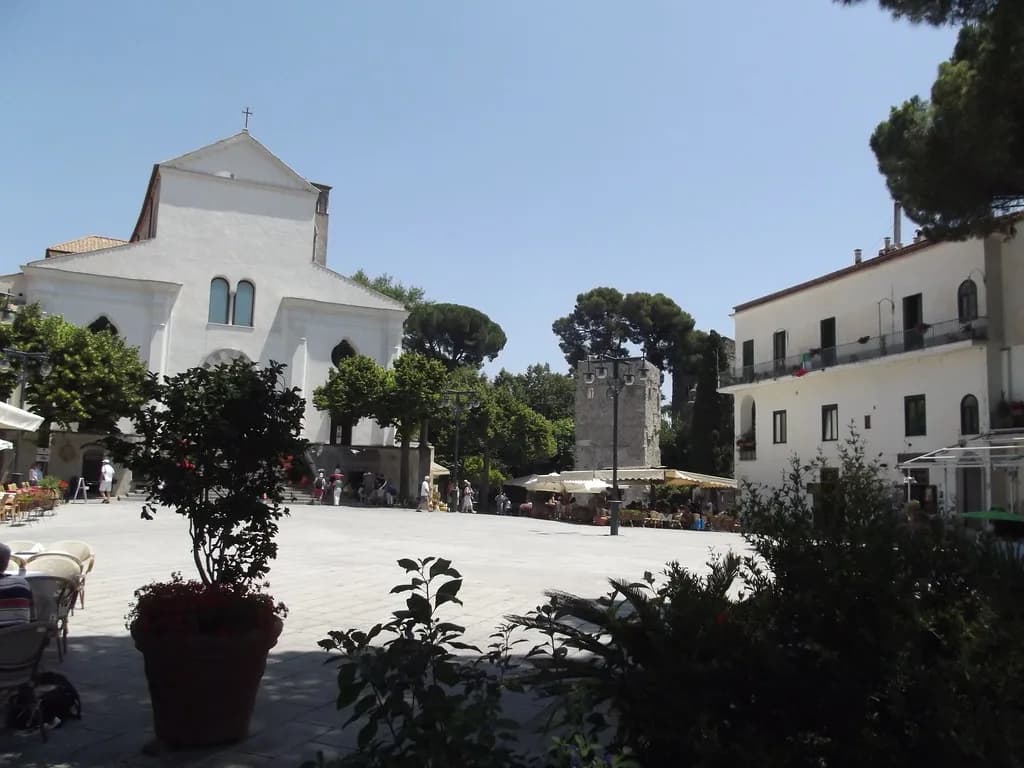
Chiesa di San Giovanni del Toro sits on a small piazzetta of the same name in Ravello, a short climb from the town's central square and away from the villa circuit that absorbs most day-trippers. Its draw is concentrated: a slender bell tower in an Arab-Sicilian idiom, a facade pierced by three portals, and an interior whose carved pulpit carries mosaic scenes drawn from scripture. Because the interior is not reliably open, this is a church to plan around rather than stumble into.
The single most useful thing to know before you go is that access to the interior is limited and should be requested in advance through the office on Via San Giovanni del Toro 50, according to published descriptions of the church. That turns the visit into a small piece of logistics rather than a spontaneous stop. If a request is not possible on your dates, the exterior still justifies the detour: the tower and facade can be read from the piazzetta in a few minutes.
Why this church deserves a place on a Ravello walk
Ravello's headline sights are its two villas and the cathedral, all clustered near Piazza Duomo and the streets leading to Villa Cimbrone. San Giovanni del Toro sits in the same compact hill town but reads as a different kind of building: a Romanesque church rather than a garden estate, with an architectural personality shaped by Mediterranean trade rather than later landscape design. It suits travellers who want one quieter, more contemplative stop between the villas.
Treat the church as a 20- to 30-minute visit if you only see the exterior, and allow longer if you have arranged to go inside, where the pulpit rewards close attention. That is a suggested duration, not an official one. It fits naturally into a morning that also covers the cathedral and one villa garden, and it costs you little in walking because everything in Ravello's centre is close together.
Where it is and how it fits a route from Piazza Duomo
The church stands directly on the Piazzetta San Giovanni del Toro, a small open space that gives you room to step back and look at the whole building at once. The town's main square, Piazza Duomo, is the natural orientation point for any walk in Ravello: it holds the cathedral, sits beside Villa Rufolo, and is where the lanes converge. From there the church is a short uphill wander through the pedestrian alleys.
Ravello itself sits high above the Amalfi Coast, and one traveller's account describes the approach road climbing through narrow, winding stretches — at one point so narrow that a traffic light lets uphill traffic proceed while downhill traffic waits — before you reach the town centre. Once you are in the pedestrian core, distances shrink and the church becomes a natural extension of a self-guided route rather than a separate excursion. A sensible order is cathedral, then the lanes toward San Giovanni del Toro, then back through the centre toward the villas.
What to look for on the facade
Before you try the door, give the exterior a proper look. Published descriptions note a slim bell tower in an Arab-Sicilian style and a facade with three entrance portals, a composition that speaks to the maritime trading culture that once made Ravello prosperous. The three doorways suggest a building designed for a substantial congregation rather than a small chapel.
Photograph the tower from across the piazzetta rather than from directly beneath it, since the narrow space compresses the proportions at close range. The lanes shift in and out of shade through the day, so look at the facade from a couple of angles before moving on. If you are carrying a wide lens, the piazzetta is one of the few places in Ravello where you can frame a whole church front without stepping into a doorway.
Inside: the pulpit, its mosaics and the eagle lectern
The interior is dominated by an ornate pulpit supported on columns and decorated with mosaic panels depicting biblical scenes, along with fragments of Syrian ceramic worked into the decoration. Those details reflect the influence of craftsmen from the eastern Mediterranean and the trading wealth of medieval Ravello. The pulpit, rather than fresco cycles, is the reason to arrange interior access.
Look for the reading desk at the top of the pulpit: it rests on a carved eagle holding an open book that displays the opening line of the Gospel of John. The device is a compact piece of medieval symbolism, tying the preacher's voice to the evangelist's words, and it rewards a moment of quiet looking rather than a quick circuit of the nave. Visitors who have written about the church single out the pulpit as its most memorable element.
The rare mosaic work in Ravello has a wider afterlife: one travel account notes that the pulpit mosaics here are said to have inspired interlocking patterns used by the graphic artist M.C. Escher, who spent time in Ravello in the 1920s. The reading desk detail meanwhile is easy to miss if you scan the space from the entrance, so walk closer once you have permission to be inside and look up at the pulpit's upper level. Keep your voice low and check whether photography is welcome before you start shooting, since small churches often have local customs that are not posted.
Building history: consecration, earthquake and restoration
The church was consecrated in the 11th century and served as an important religious centre for Ravello's community during the town's mercantile heyday. Its name comes from Saint John, whose veneration was deeply rooted in this part of southern Italy through the Middle Ages. That medieval layer is what you are reading in the tower and the pulpit today.
Later history left its marks. Published descriptions report that the building was damaged by an earthquake in 1715 and substantially repaired, with comprehensive restoration completed in the 1990s. Treat those dates as reported history rather than as something you can verify on site, and read any notices at the church for detail you want to rely on.
Arranging interior access before you travel
Access to the interior is limited and should be requested through the office at Via San Giovanni del Toro 50, so build the request into your planning rather than hoping for an open door on arrival. The office address is the only contact detail worth acting on from published descriptions; there is no reliable public timetable for openings to plan around. Ask specifically whether the interior can be visited on your dates and at what time.
The town's municipal site is a reasonable place to check local information before you travel, though it does not publish a church visiting schedule. If your request goes unanswered, plan the day around the exterior and the rest of Ravello rather than rearranging your itinerary. Never assume that a previous visitor's successful entry means the church will be open for you.
How to weigh it against the Duomo and the villas
If your time in Ravello is a single afternoon, the cathedral and one villa garden will absorb most of it, and San Giovanni del Toro becomes a bonus rather than a priority. The cathedral sits at the centre of town with its own celebrated pulpit and is easy to combine with everything else. The villas offer gardens and coastal views on a scale this small church cannot match. For wider planning, see Duomo di Ravello Visitor Guide.
If you have a full day, or you are staying overnight after the day-trippers leave, the church earns its slot precisely because it is a different experience: architecture and carving rather than panorama. It also pairs well with a slow wander through the lanes, which is where much of Ravello's appeal actually sits. Budget your time so that the church is not the thing you squeeze in last.
Pairing it with nearby stops for a half-day route
A workable half-day starts at Piazza Duomo, takes in the cathedral, climbs to San Giovanni del Toro for the exterior, then returns through the centre toward Villa Rufolo's gardens and its terraces. Villa Rufolo stands right beside the cathedral, which makes it the easiest of the two villas to fold into a short visit. If you have arranged interior access, slot it into the middle of the morning when the lanes are less crowded. For wider planning, see Ravello Attractions: Visitor Guides to 6 Sights.
For the second half of the day, the walk out to Villa Cimbrone runs through pedestrian lanes lined with ceramic shops and small shrines, and the gardens at the end open onto the celebrated belvedere. Villa Rufolo's own garden terraces are a shorter commitment, and the two villas together make a full day rather than a half. Choose one if you are short on time, and let the church be the quiet hinge between them.
If the interior is closed when you arrive
If the door is shut, do not linger trying handles. The facade, the three portals and the bell tower are visible from the piazzetta and are worth the ten minutes it takes to look properly. Note the office address on Via San Giovanni del Toro 50 so you can ask in person whether a later slot is possible during your stay.
Then redirect your time. Ravello's small gardens and viewpoints fill an hour comfortably, and the ceramic workshops in the lanes reward browsing even if you buy nothing. The town's wider appeal is in the slow wander rather than any single ticketed sight, which makes a closed church a minor loss rather than a ruined day. For wider planning, see Hidden Gems in Ravello.
Etiquette and planning notes for a small church
This is an active religious building, so dress as you would for any Italian church and keep voices low. Keep phone calls outside the door, and check before using a flash or a tripod, since many small churches restrict both. If a service is under way, wait outside rather than walking through.
Wear shoes that handle polished stone and uneven steps, and carry water in warm months because Ravello's lanes climb. Confirm your plans close to the date rather than months ahead, since small volunteer-run offices cannot always answer early enquiries. Build in slack so a closed door does not derail the rest of your route.
Plan Your Visit
San Giovanni del Toro is a small church with a specific pleasure: an Arab-Sicilian tower outside and a mosaic-covered pulpit with an eagle lectern inside. The catch is access, which is limited and has to be requested in advance through the office on Via San Giovanni del Toro 50. Plan the request, and the rest of Ravello fits easily around it.
If the interior cannot be arranged, the exterior still earns the short climb from Piazza Duomo, and the town's lanes, gardens and villas will fill the day. Check local information close to your travel date, and leave room for a slow wander that Ravello rewards more than a rushed checklist.
Frequently Asked Questions
Can you go inside Chiesa di San Giovanni del Toro, and do you need to arrange it in advance?
Access to the interior is limited, and published descriptions of the church say it should be requested in advance through the office on Via San Giovanni del Toro 50 in Ravello. There is no reliable public timetable for openings, so make the request part of your planning rather than assuming the door will be open when you arrive. Ask whether your specific dates are possible.
What is there to see inside San Giovanni del Toro?
The main draw is the ornate pulpit, supported on columns and decorated with mosaic panels showing biblical scenes alongside fragments of Syrian ceramic. The reading desk at its top rests on a carved eagle holding an open book with the opening line of the Gospel of John. Treat the pulpit, rather than any fresco cycle, as the reason to arrange entry.
What makes the pulpit unusual?
Its combination of carved stone, mosaic scenes and eastern Mediterranean ceramic fragments reflects the trading culture of medieval Ravello. The eagle lectern turns a functional reading desk into a piece of symbolic design, tying the preacher's voice to the evangelist. It is a small detail that is easy to miss from the entrance, so look up once you are inside.
Is San Giovanni del Toro worth visiting compared with Ravello's Duomo?
They offer different things. The cathedral sits at the centre of town with its own celebrated pulpit and is easy to combine with the villas, while San Giovanni del Toro is a quieter Romanesque building a short climb away. If your time is very short, prioritise the cathedral and one villa garden, and treat this church as a bonus for a longer day.
How do you get to San Giovanni del Toro from Piazza Duomo in Ravello?
Walk. The church stands on the Piazzetta San Giovanni del Toro, a short uphill wander through Ravello's pedestrian lanes from the main square. Once you are in the town centre, everything is close together, so no transport is needed between the cathedral, the church and Villa Rufolo.
What should you do if the church is closed when you arrive?
Look at the exterior properly, noting the slim Arab-Sicilian bell tower and the three entrance portals, then visit the office on Via San Giovanni del Toro 50 to ask whether a later slot is possible. If not, redirect your time to Ravello's gardens, viewpoints and ceramic workshops rather than waiting at the door.
Sources
Continue exploring
More guides you'll find useful